Bordeaux mixture
Copper and lime against vine mildew
Contents
- 1Vine trained on a wire
- 2Leaf coated with the blue-green spray
- 3Oil spot on an untreated leaf
- 4White down on the underside of the leaf
- 5Bunch of grapes
Bordeaux mixture is a fungicide of copper sulphate and lime in water, sprayed on vines to protect them from downy mildew. It dries to a blue-green coating that keeps the spores of the disease from entering leaves and grapes. In 1882, in the Médoc, the botanist Alexis Millardet noticed that vines sprinkled with copper sulphate and lime had escaped the disease, and in 1885 he presented the treatment, worked out with the chemist Ulysse Gayon.
What it is
Bordeaux mixture is a fungicide made of copper sulphate, lime and water. Sprayed on the leaves and grapes of vines, it dries to a thin, pale blue-green coating that protects them from downy mildew. Its two ingredients come from long-known trades: copper sulphate is made from copper, and the lime is the slaked lime of lime burning. It is now sold ready-made, and in the European Union it is one of the copper compounds authorised as plant-protection products.
Downy mildew is caused by Plasmopara viticola, a water mould, or oomycete, native to the wild vines of North America. On the upper face of a leaf it makes pale yellow, translucent patches called oil spots; under them, on the lower face, a white down appears in damp weather, made of the branches that carry its spores. Young bunches can be destroyed. Rain splashes the spores from leaf to leaf, and in wet years an unprotected vineyard can be stripped of its leaves and lose much of its crop.
How it works
The mixture works by contact. It leaves a fine bluish deposit that clings to the leaf and is not easily washed off by rain. Moisture on the leaf slowly frees copper ions from that deposit. They damage the membranes, enzymes and genetic material of the mould’s spores, which cannot then germinate and enter the leaf. The blue colour also showed growers where the spray had landed.
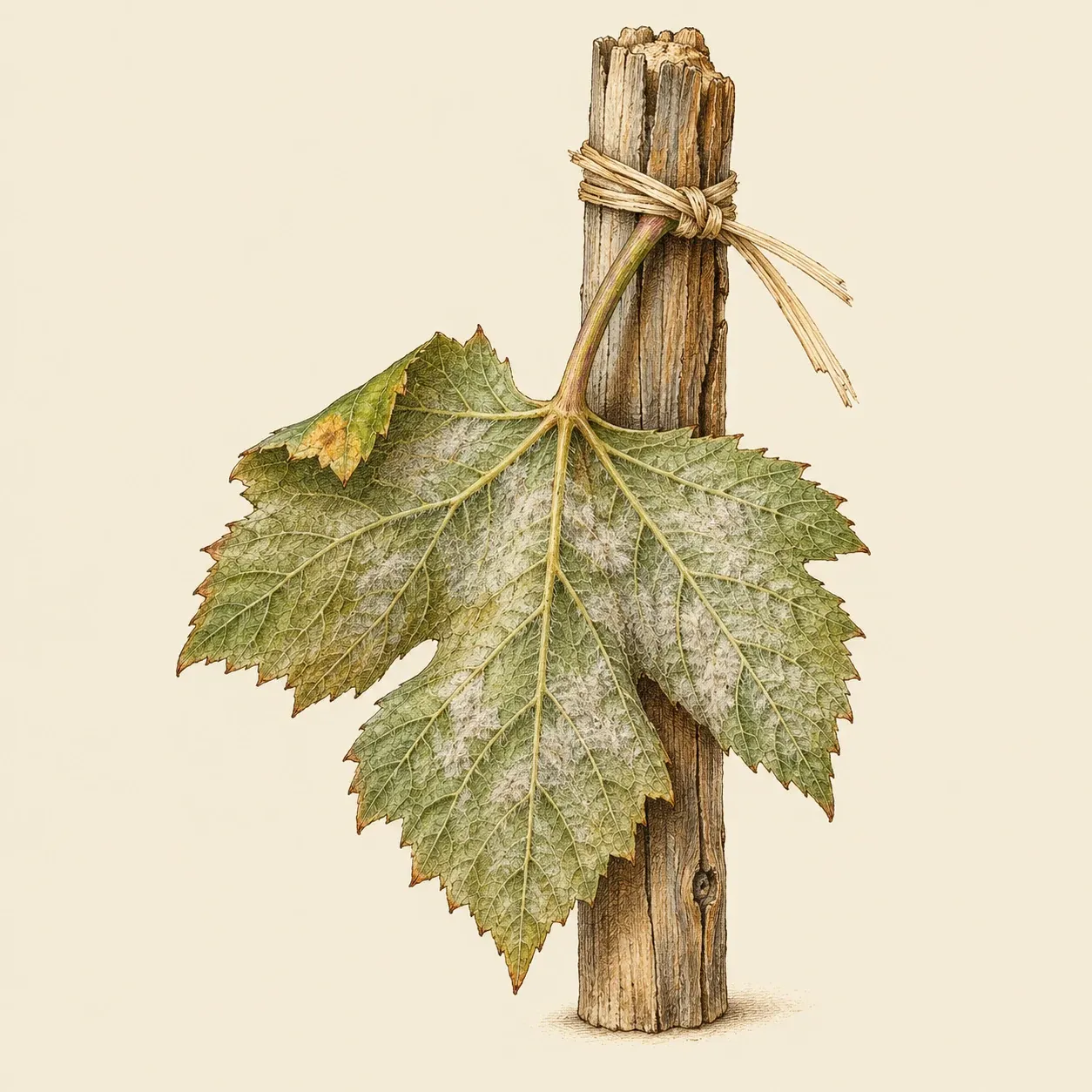 On the underside of the leaf, the white down of downy mildew carries the spores that spread the disease.
It only prevents. Copper does not cure a leaf that is already infected, and it protects only the parts of the vine that its deposit covers, for as long as the deposit lasts. The mould enters through the pores on the lower face of the leaves, and infections come with warm, wet weather.
Copper does not break down. Sprayed year after year, it builds up in the topsoil, where it is toxic to soil micro-organisms, and it can be carried into streams, where it harms aquatic life. A survey of European topsoils found the highest average copper content under vineyards, and a review of vineyard studies describes copper accumulating in vineyard soils. Since 2019 the European Union has renewed copper fungicides only as candidates for substitution, to be replaced when alternatives exist. Copper remains the main protection against downy mildew in organic vineyards, where synthetic fungicides are not allowed.
History and evolution
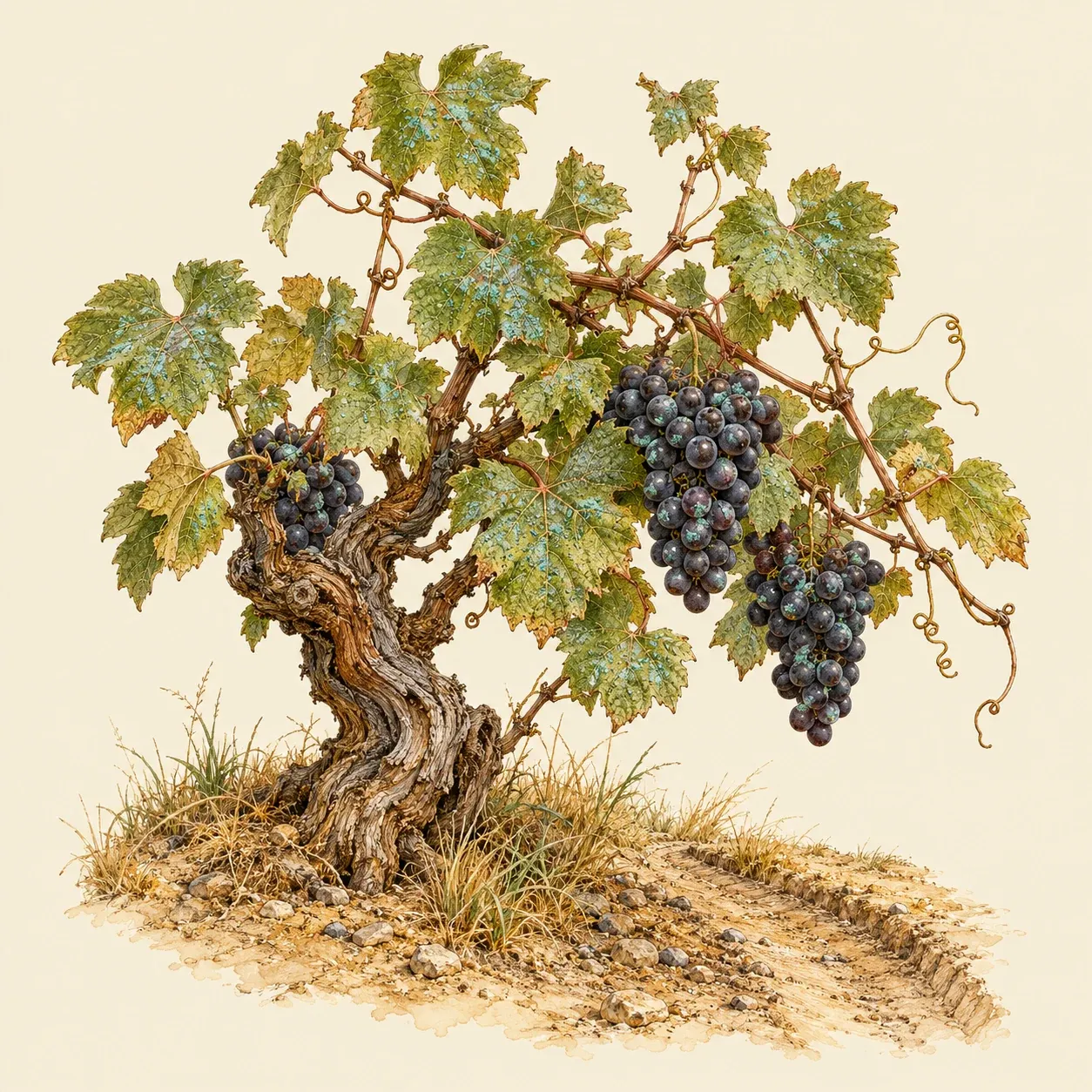 Médoc growers spattered roadside vines with copper and lime to discourage grape thieves.
Copper had already been used against a plant disease. In 1807 Bénédict Prévost, at Montauban in southern France, showed that bunt of wheat was caused by a fungus and that copper sulphate acted against it. The salt then came into use against bunt and smut of cereals.
Downy mildew was first seen in Europe in 1878. It probably arrived with the American vines that growers imported to rebuild vineyards destroyed by phylloxera, and it spread through the vineyards of France. Alexis Millardet, a botanist who had come to Bordeaux in 1876 to study American vines, began to study the disease.
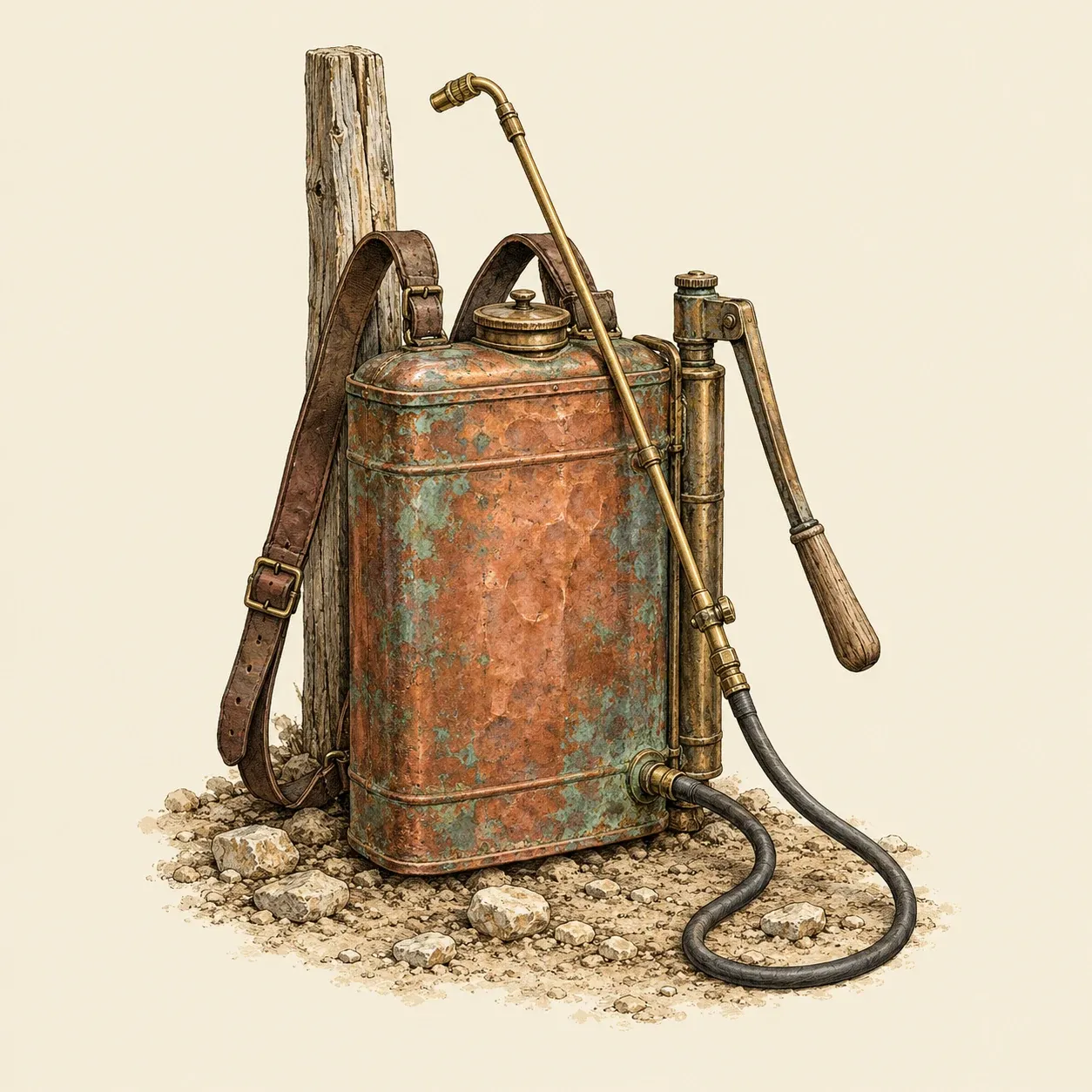 A knapsack sprayer worked by a hand pump, the usual tool of small vineyards.
In 1882, in the Médoc, Millardet noticed that the vines along the roads had kept their leaves while the rest of the vineyards were stripped by mildew. Growers sprinkled those rows with a mixture of copper sulphate and lime, which looked unpleasant and tasted bitter, so that passers-by would not pick the grapes. His first published note on copper against mildew appeared in a German wine journal. With Ulysse Gayon, professor of chemistry at Bordeaux, he then tested the treatment in vineyards and presented it in 1885 to the agricultural society of the Gironde. Growers of the Gironde adopted it widely, and the name bouillie bordelaise, Bordeaux mixture, stayed with it.
Within a few years it was used in other wine regions of Europe and as far away as Australia and the United States, and against other diseases of the same family, such as late blight of potatoes. Growers carried it through the rows in knapsack sprayers worked by a hand pump, and later in machines that blew it out as a mist. From the mid-twentieth century synthetic fungicides took over much of its place, but copper products are still sprayed today.