Ball bearing
Consistent balls for industrial rotation
Contents
- 1Inner ring and shaft
- 2Outer ring and housing
- 3Steel balls between the raceways
- 4Cage maintaining spacing
- 5Raceways and lubrication
Loading the figure…
Balls roll between two grooved rings to support a turning shaft. Industrial bearings need hard surfaces and closely controlled geometry; a wooden model turned by hand shows the motion.
What it is
A ball bearing supports a shaft while allowing it to turn inside a housing. The inner ring fits around the shaft and the outer ring sits in the housing. Balls travel between circular grooves called raceways. A cage keeps the balls apart, limiting contact between neighbours and guiding their movement around the bearing.
The plate shows a modern radial bearing in steel. In a machine, the choice of bearing depends on the forces, speed, mounting and surroundings. Its load rating comes from the maker’s geometry, steel and tests, so a bearing that spins sweetly between the fingers can still be the wrong one for the job.
How it works
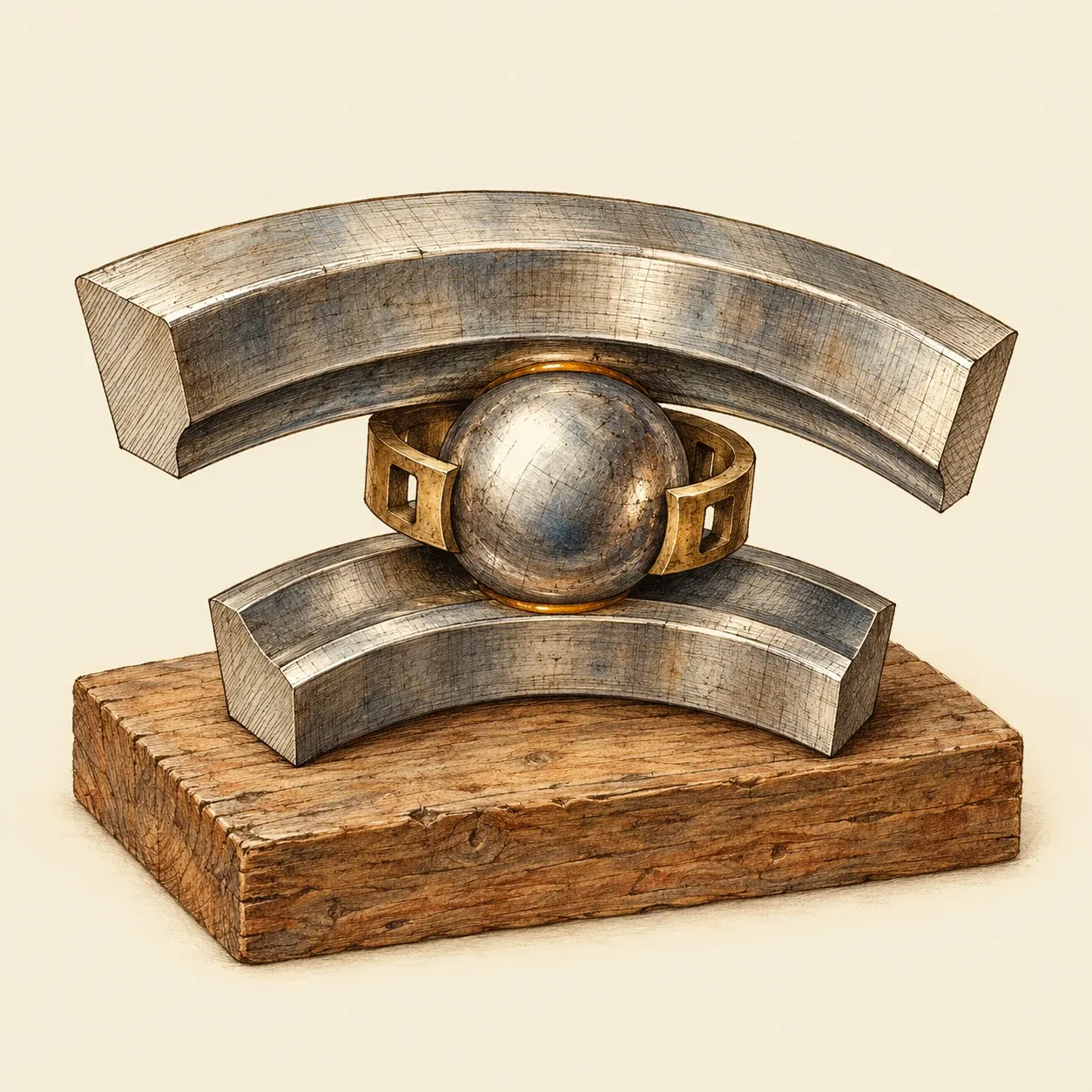 The film is enlarged out of scale; the load travels through the ball and raceway contacts.
As the shaft turns the inner ring, each ball spins and also travels around the axis. Small contact areas transmit force between the rings. The cage keeps the spacing, while the balls and raceways carry the load. The grooves guide the balls along their circular path, and the mounting keeps the rings on a common axis. A dent in a raceway or an oversized ball breaks up that regular movement.
Rolling cuts the friction of a shaft sliding in a plain bearing, but some losses remain. Local sliding, deformation and lubricant resistance all contribute, and contact seals add drag of their own. Oil or grease must suit the operating conditions, and too much of it heats the bearing. Dirt, misalignment and the wrong clearance wear raceways and balls.
How to do it
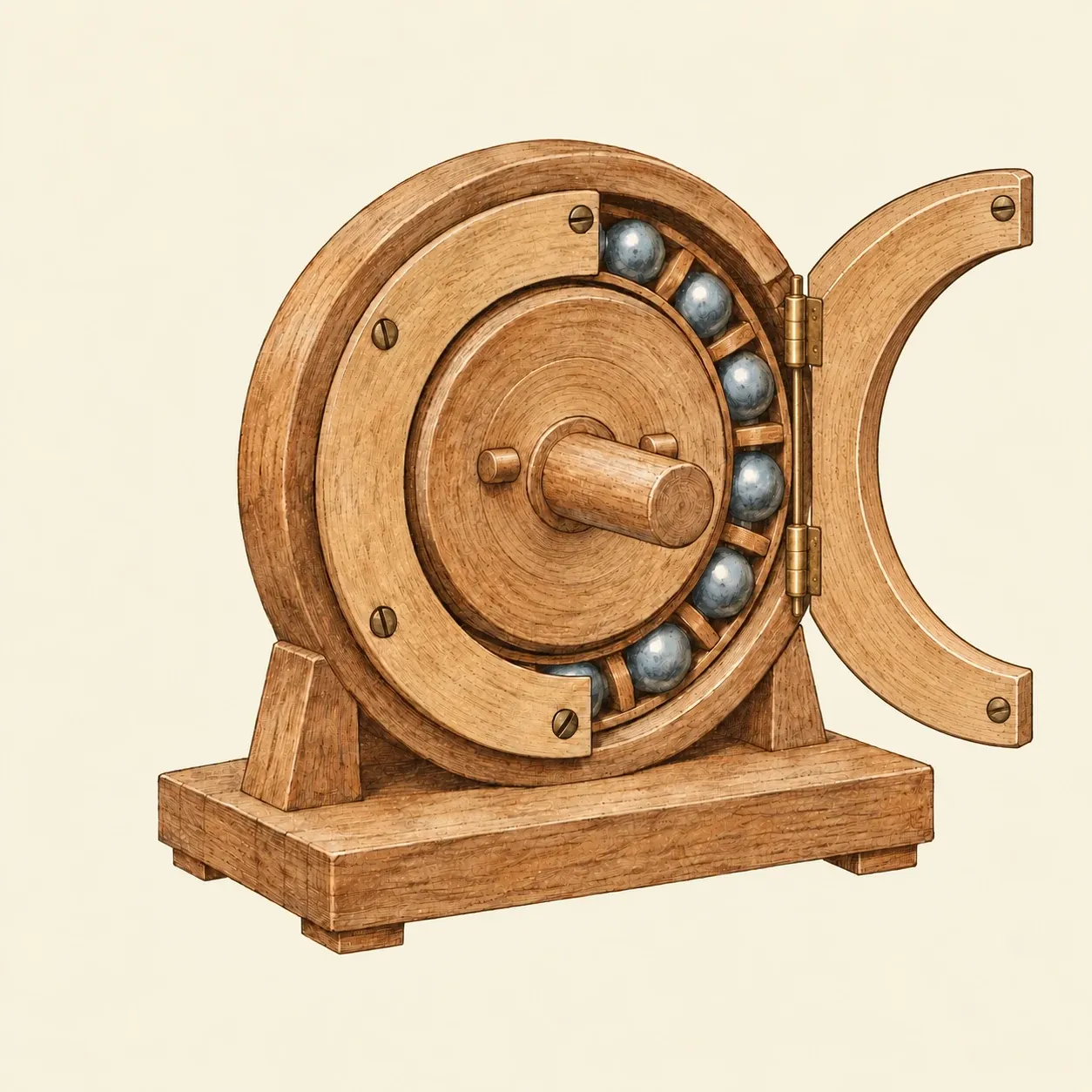 This retained-ball teaching model turns by hand and carries no useful load.
For a demonstration, buy steel balls from one identified batch with a supplier reference and stated diameter. Keep those details and measure the balls before laying out the wooden parts. Turn two concentric hardwood rings with smooth, rounded, opposing tracks. Plan the assembly so that it comes apart for the balls to go in. Close the hinged side plates over the balls while everything is stationary, so the balls cannot escape. A thin wooden cage with openings separates them without squeezing them or rubbing hard against either ring.
Set the shaft and rings on a common axis. Check every fastening and the retention of the balls at rest, then turn slowly by hand. Stop at any tight spot and take the model apart to find the cause. A drop of light oil is optional if it suits the wood.
Never power the model, install it on a vehicle, use it for lifting or support a person with it. Small balls can be swallowed or thrown out of an insecure assembly. When turning the wood, secure the work, wear eye protection and restrain hair and sleeves. Keep gloves and measuring tools away from rotating work. Grinding and heat treatment belong in an appropriately equipped workshop.
Industrial production follows a longer chain. A lathe roughs out the rings and grooves. Ball blanks are formed, heat treated to suit their steel, ground and lapped. Dimensions, roundness, coaxiality and surface finish are checked, and the balls are sorted by size before assembly, lubrication and clearance checks. The hand test shows only that the model turns without jamming or losing balls; it gives no permissible speed, fatigue life or load rating.
History and evolution
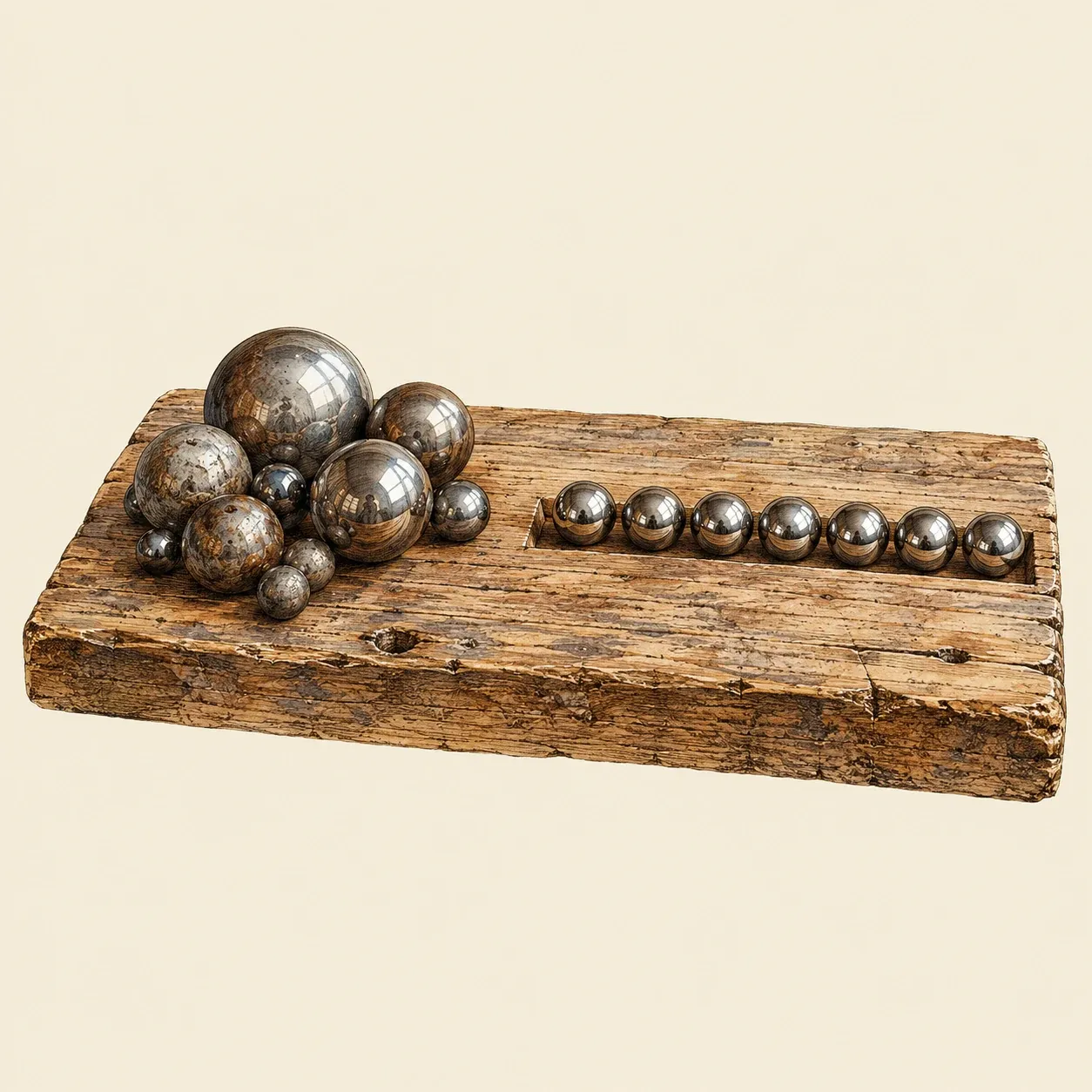 Uneven balls beside the equal, round balls that Fischer’s grinding machine made in quantity.
In 1794 Philip Vaughan patented ball bearings for carriage axles, with cast-iron balls finished by hand. In 1872 Friedrich Fischer opened a workshop in Schweinfurt repairing sewing machines and bicycles, and bought English balls that were costly and uneven in size. In 1883 he built a grinding machine that turned out balls of equal size and roundness in quantity. Sources disagree on what those first balls were made of: Schaeffler describes hardened cast iron, the Gale company history hardened steel. The patent for his improved machine followed in 1890.
Bicycle building raised demand for uniform balls, and cars and industrial machinery then widened the market. Today many balls start as short lengths of wire pressed into blanks before grinding and lapping. Rollers, needles and ceramic balls serve particular uses. Service life still depends on mounting, suitable lubrication and keeping dirt out.