Vacuum tube
Steering electrons through empty space
Contents
- 1Glass bulb emptied of air
- 2Filament
- 3Grid
- 4Plate
- 5Base pins
Loading the figure…
A vacuum tube, or valve, is a sealed glass bulb emptied of air in which a heated filament gives off electrons that travel to a metal plate. With two electrodes it lets current pass one way only; with a wire grid between filament and plate, a small voltage controls a large current. In 1883 Thomas Edison applied for a patent on a lamp with an extra electrode used to indicate the supply voltage, and in 1904 John Ambrose Fleming used such a tube to detect radio waves. Tubes then ran radio, the long-distance telephone and the first electronic computers.
What it is
A vacuum tube is a glass bulb, sealed and emptied of air, holding two or more metal electrodes whose wires pass through the glass to pins in the base. One electrode, the cathode, is heated, usually as a thin filament glowing like that of a light bulb. Another, a metal plate around it, is the anode. In Britain the tube was called a valve, because current passes through it in one direction only.
The two-electrode tube, the diode, turns alternating current into current that flows one way, and picks the sound out of a radio signal. The three-electrode tube, the triode, adds a grid of fine wire between filament and plate and becomes an amplifier: a weak signal applied to the grid comes out as a much stronger copy at the plate. Before the transistor, tubes amplified the voices of the long-distance telephone, made radio broadcasting possible and did the switching in the first electronic computers.
How it works
A metal heated to a glow gives off electrons from its surface, much as a hot liquid gives off vapour. In a lamp with an extra electrode, Thomas Edison found that a current flowed to that electrode only when it was positive compared with the filament; the Edison Papers at Rutgers date the first observation to 13 February 1880, the IEEE to 1883. The current is a stream of electrons crossing the empty space. The vacuum matters twice over: the electrons travel without striking gas molecules, and the hot filament does not burn.
In a diode the electrons, being negative, are drawn to the plate when it is positive and pushed back when it is negative. Current can therefore cross the tube in one direction only. Fleming used this to turn the rapid oscillations reaching a radio aerial into a current that a meter or earphone could register, and diodes later supplied the direct current that radio sets needed from the alternating mains.
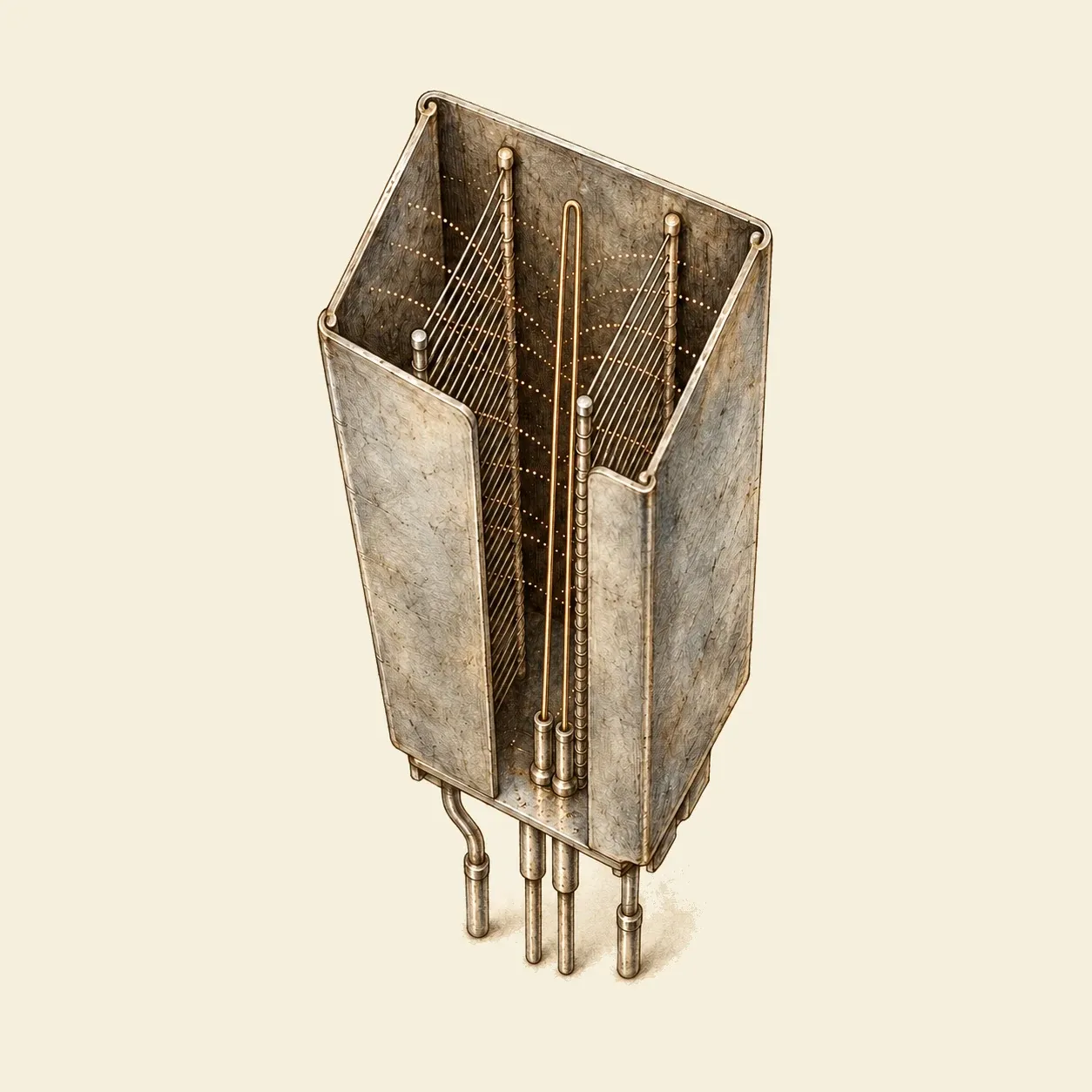 In a triode, electrons from the filament pass between the wires of the grid on their way to the plate.
In a triode the grid sits much closer to the filament than the plate does. A slightly negative grid turns many electrons back, a less negative one lets more through, and because it is so close, a small change of grid voltage makes a large change in the plate current. Fed back from the plate to the grid, part of the output keeps the tube oscillating at a steady frequency, which is how tube transmitters produced their waves. Later tubes added more grids and replaced the bare filament by a coated sleeve heated from inside, but the principle stayed the same.
Tubes need a low voltage to heat the filament and a much higher one for the plate. Tube equipment works at voltages that can kill, its capacitors stay charged after it is unplugged, and its glass gets hot and can implode if it cracks. Old radios and amplifiers should be opened and repaired only by people trained to do so.
History and evolution
On 15 November 1883 Thomas Edison applied for a patent on an electrical indicator. It was an ordinary carbon-filament lamp with a piece of platinum between the legs of the filament, wired to a galvanometer outside the bulb. The current that crossed the vacuum to the platinum rose and fell with the brightness of the lamp, so the galvanometer showed changes in the voltage of the supply, and its needle could also close contacts to work regulators. The patent was granted in October 1884.
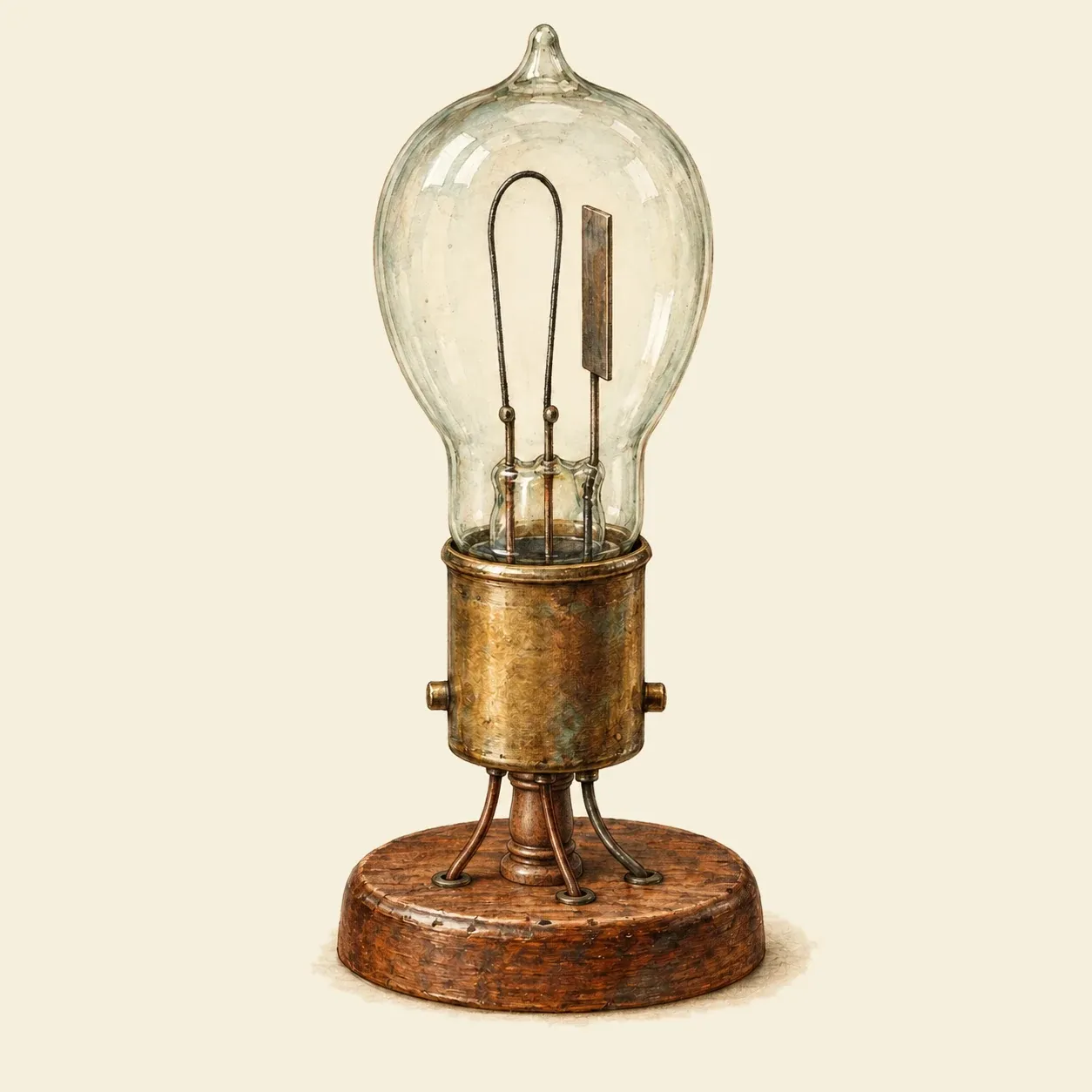 Fleming’s oscillation valve of 1904: a lamp with a metal plate beside its filament.
John Ambrose Fleming, a professor at University College London, had advised the Edison electric light company in London from 1881 to 1891 and had studied the Edison effect. In 1899 he became scientific adviser to Marconi’s wireless company, which needed better detectors. In October 1904 he tried lamps fitted with a metal plate and found that they rectified radio oscillations. He applied for a patent on his “oscillation valve” on 16 November 1904. The Science Museum in London keeps a valve made for him by the Edison and Swan company and used in October 1904, and experimental lamps of 1889 that he took up again that year.
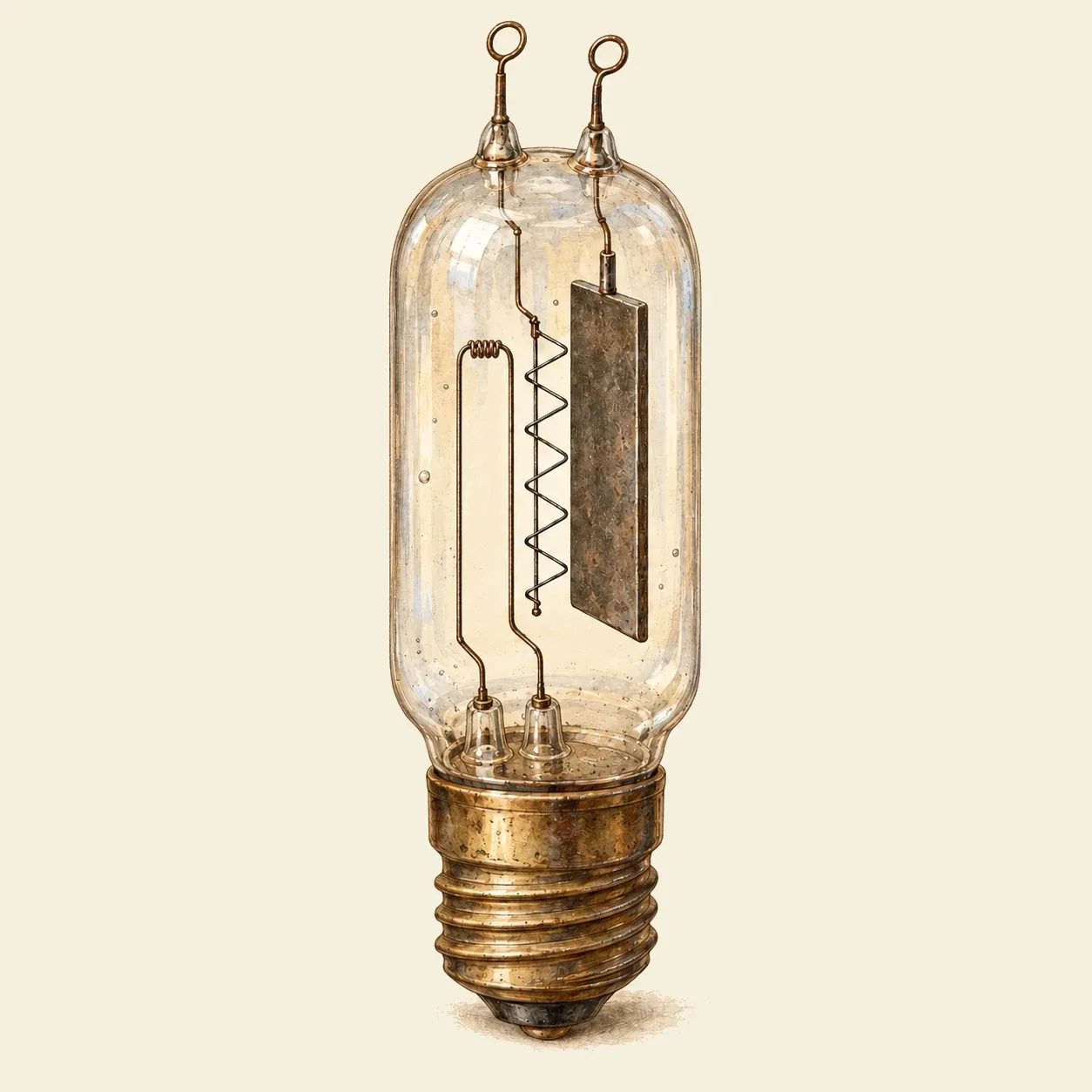 Lee de Forest’s Audion put a wire grid between the filament and the plate.
After reading Fleming’s paper of 1905, Lee de Forest in New York placed a third electrode, a zigzag of wire, between filament and plate in 1906. He called the tube the Audion, and believed that the gas left inside it played a part in its working. At the Western Electric company, Harold Arnold and his team found that the tube worked better the more completely it was emptied. In October 1913 high-vacuum tube amplifiers were put on a long-distance telephone line out of New York, and with tube repeaters along the way the telephone line from New York to San Francisco opened on 25 January 1915.
In the 1920s and 1930s tubes carried radio broadcasting into homes. ENIAC, the electronic computer built at the University of Pennsylvania and unveiled in February 1946, used more than 17,000 tubes, and keeping enough of them working at once was the main problem of its builders. From the 1950s the transistor, smaller, cooler and longer-lived, took over most of their work.