Ultrasonic humidifier
Cool mist torn from water by sound
Contents
- 1Water tank
- 2Shallow basin over the transducer
- 3Piezoelectric ceramic disc
- 4High-frequency oscillator
- 5Fan
- 6Mist outlet
An ultrasonic humidifier adds water to the air without boiling it. A ceramic disc under a shallow pool of water vibrates far above the range of hearing, raises a small fountain at the surface and tears off a fog of fine droplets, which a fan blows into the room. Robert Wood and Alfred Loomis reported fogs raised by intense ultrasound in 1927, and in 1951 Friedrich Tillmann applied in Germany for a patent on a humidifier for rooms that worked this way. Hospital nebulizers used the effect in the 1960s, and compact models for homes and offices followed in the 1970s. Because the mist carries whatever is in the water, the tank must be kept clean.
What it is
An ultrasonic humidifier is a small appliance that puts water into dry indoor air as a cool, visible mist. It does not heat the water. A disc of piezoelectric ceramic, set in the floor of a shallow basin, shakes the water with sound at a pitch far too high to hear, and the surface breaks up into droplets light enough to float.
People use it in winter, when heated air dries the nose, throat, lips and skin. The same principle runs hospital nebulizers that turn a liquid medicine into a fog to be breathed.
How it works
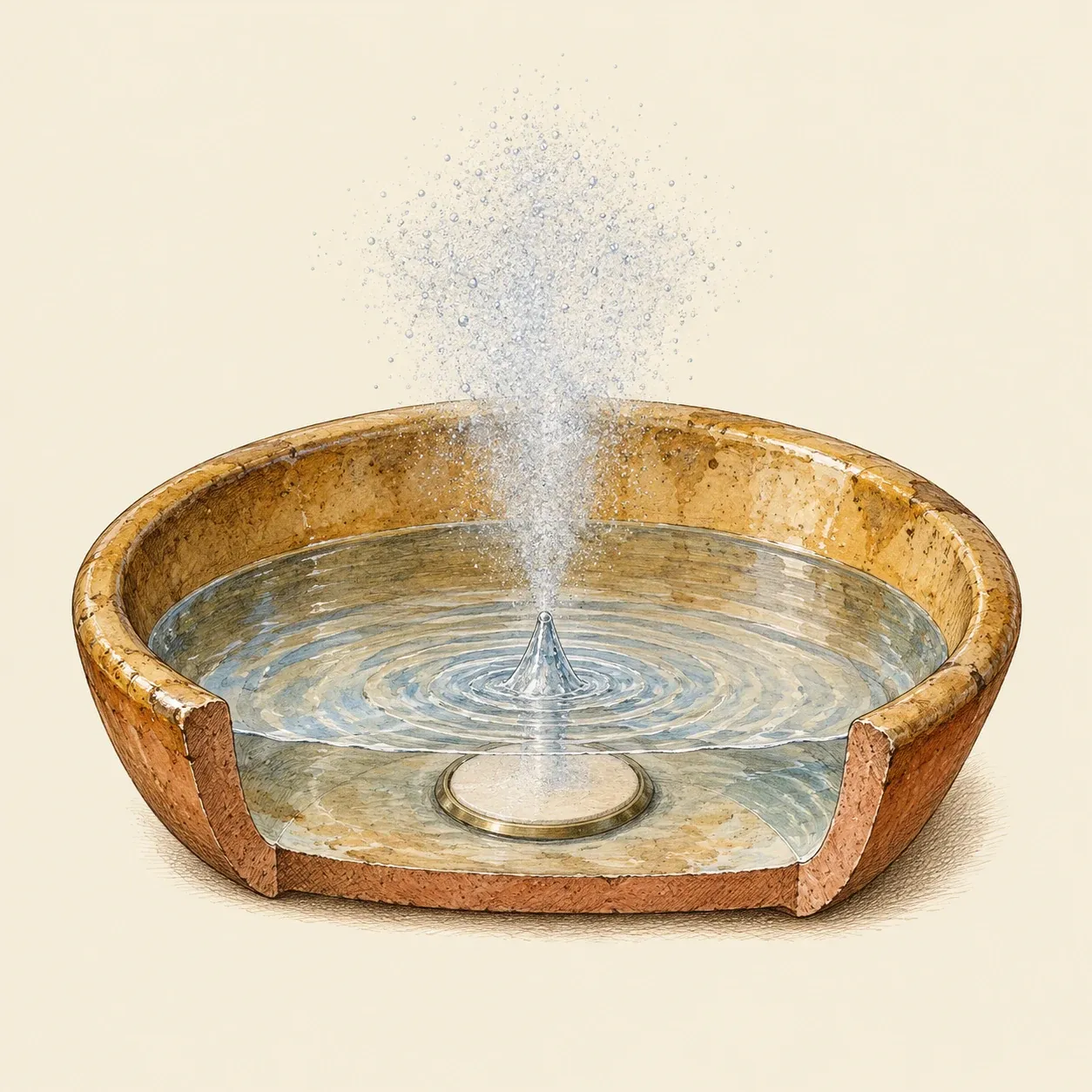 Above the vibrating disc the water rises in a small fountain, and a fog of fine droplets leaves its tip.
An electronic oscillator feeds the ceramic disc an alternating voltage at its own resonant frequency. Piezoelectric ceramic changes thickness when a voltage is applied, so the disc swells and shrinks in step with the current and sends a beam of sound up through the water. Where the beam meets the surface it lifts a small fountain and tears fine droplets off it. Robert Lang found in 1962 that the droplets are thrown off the crests of fine ripples on the surface, so a higher frequency, which makes shorter ripples, gives smaller droplets. A DeVilbiss patent for an inhalation apparatus adds that too much power only throws up a tall, thin jet that makes few droplets of the right size.
A fan pushes air across the basin and carries the fog out through a nozzle. The droplets evaporate into the room, and the mist stays cool because nothing is boiled. A larger tank refills the basin as the water is used. A Mikuni Kogyo humidifier patent describes the usual layout: the vibrator under the floor of the water vessel, and the high-frequency generator and the motor-driven blower in the same cabinet.
Whatever the water holds goes into the mist. Minerals from tap water settle on furniture as a white dust, and bacteria or moulds that grow in standing water can be breathed in. The US Environmental Protection Agency counts ultrasonic and impeller humidifiers among the types that spread the most minerals and microorganisms.
How to do it
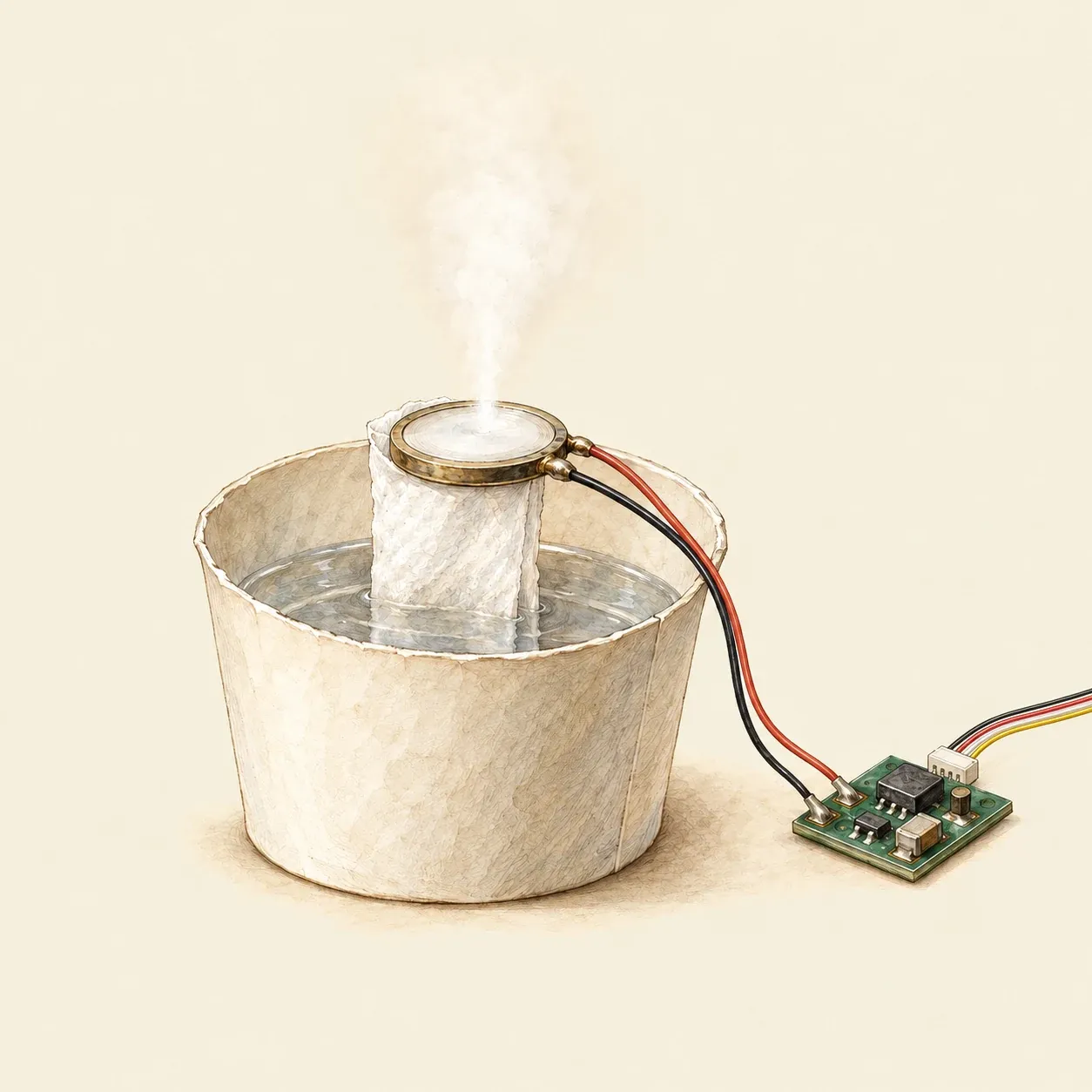 A tissue wick brings water to the atomizer disc, which throws it off as a plume of mist.
A ready-made atomizer module shows the effect safely at low voltage. Seeed Studio’s Grove Water Atomization module, for example, has a small driver board and a thin disc on two wires. The board makes mist only while its control pin is held high, so it needs a microcontroller board, such as an Arduino-compatible board with a Grove base shield, powered from a computer’s USB port or a USB power bank.
Cut a paper cup down to about half its height and fill it with distilled water. Push a folded paper tissue into the water so that it stands up as a wick. Lay the disc on the tissue with its hollowed side downward: the underside should touch the wet tissue and the top must stay above the water. Keep both boards on a dry surface away from the cup, and join the driver board to a digital port of the shield with a Grove cable.
Load a short program that sets that port’s pin high to start the mist and low to stop it; Seeed’s example program starts a burst each time a touch sensor is touched. While the pin is high, a plume of fine mist rises from the disc. Stop when the tissue starts to dry out, then empty and dry the cup.
Safety. The driver board puts a voltage far higher than its supply on the disc’s pins, and a coil on the board gets hot: do not touch either while the board is powered.
History and evolution
In 1927 the physicist Robert Wood and the banker and amateur scientist Alfred Loomis reported the effects of intense high-frequency sound produced in Loomis’s laboratory at Tuxedo Park, New York. A quartz plate lying in a bath of oil, driven by a powerful oscillator, raised a mound of oil above it, and among the effects they described was the formation of emulsions and fogs. In 1951 Friedrich Tillmann applied for a German patent on a humidifier for workplaces, homes and meeting halls: water dripping onto metal plates set vibrating by ultrasonic heads broke into a fine mist, and a fan, with a heater if needed, carried it into the room.
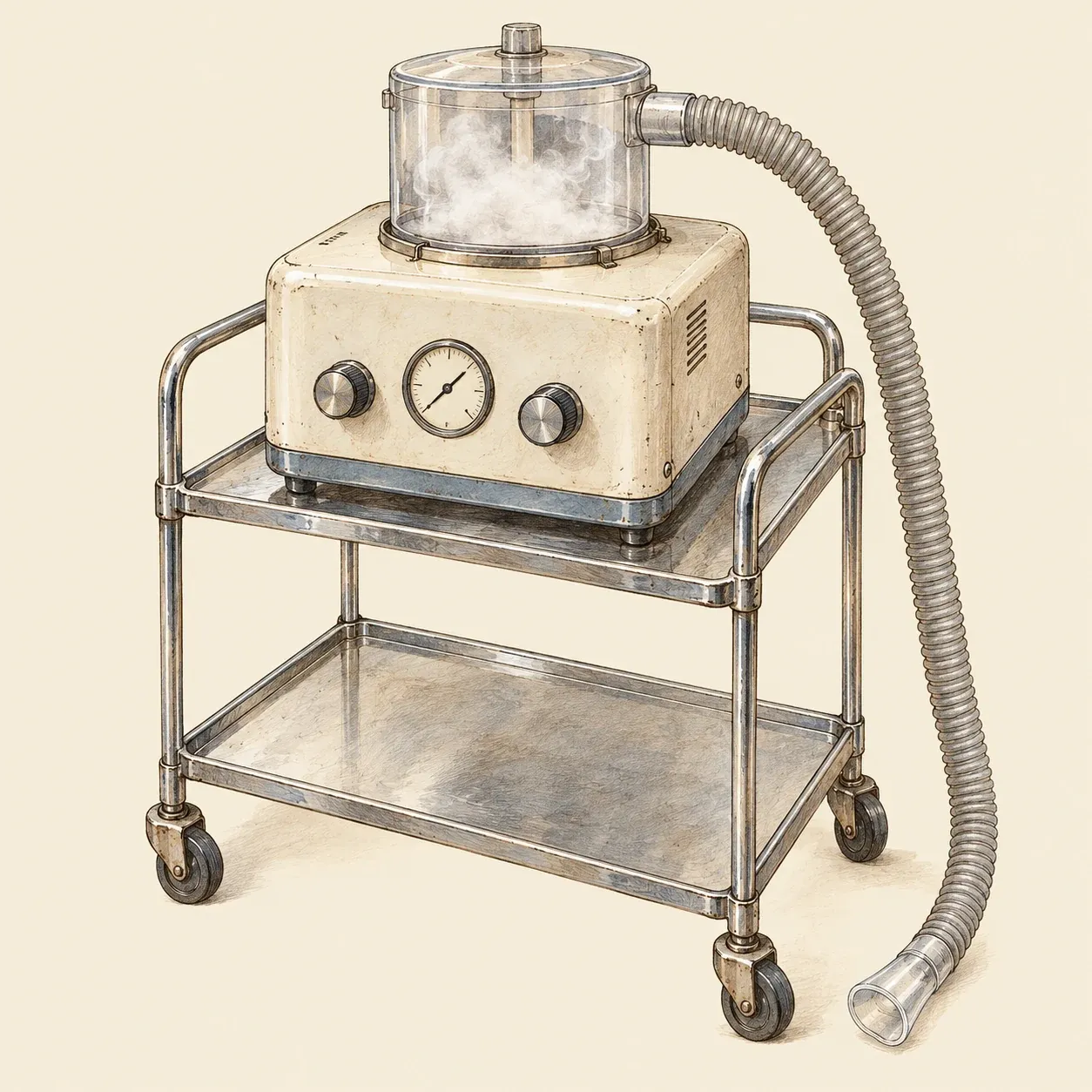 Hospital nebulizers of the 1960s made fog with sound before compact humidifiers reached homes.
In 1962 Robert Lang published his study of ultrasonic atomization of liquids; a 2017 history of therapeutic aerosols counts it as the introduction of the piezoelectric nebulizer and notes that the early crystals were not very reliable.
William D. Gauthier and Robert J. Della Flora of the DeVilbiss Company in Toledo, Ohio, patented an ultrasonic apparatus for inhalation therapy. Its ceramic disc sent sound through a layer of coupling water and a thin plastic window into a cup of liquid, and a motor-driven blower carried the fog to the patient through a tube. The patent also mentions using the aerosol to raise the humidity of an anaesthetic gas.
In the 1970s compact ultrasonic humidifiers were designed for living spaces. Siemens patented one in Germany with a plate set vibrating by a transistorised oscillator and a motor-driven blower, meant to be quieter than the impeller types that disturbed living rooms and bedrooms, and the Japanese firm Mikuni Kogyo one to stand on the floor of a house or an office. Humidifiers are now common in homes. For the ultrasonic kind, the EPA advises distilled or low-mineral water, daily emptying and drying, cleaning every third day, and indoor humidity no higher than 50%.