Lathe and screw thread
The machine that makes machines
Plate
- 1Headstock spindle
- 2Change gears
- 3Lead screw
- 4Slide rest and tool
- 5Workpiece with its thread
- 6Tailstock centre
Anatomy
Loading the figure…
A lathe spins a piece of wood or metal between two centres while a cutting tool shapes it, so that the surfaces it leaves are round about one axis. Fitted with a lead screw and change gears, as in Henry Maudslay's iron lathe of about 1800, it cuts screw threads of a chosen pitch, and those screws became the basis of standard bolts, interchangeable parts and precise measurement.
What it is
A lathe spins a piece of wood or metal about an axis while a cutting tool, held still, takes shavings off it. Chair legs, bowls, axles and bolts are made this way. The tool stays at one distance from the axis all the way round, so the surface it leaves is round.
The work is usually held between two centres. The headstock carries the driven spindle, which drives metal work through a clamp fixed on it, the carrier; the tailstock slides along the bed to suit the length of the piece. The tool rests on a bar and is guided by hand, or is clamped in a slide rest that travels along the bed. The plate shows Henry Maudslay’s iron screw-cutting lathe of about 1800.
How it works
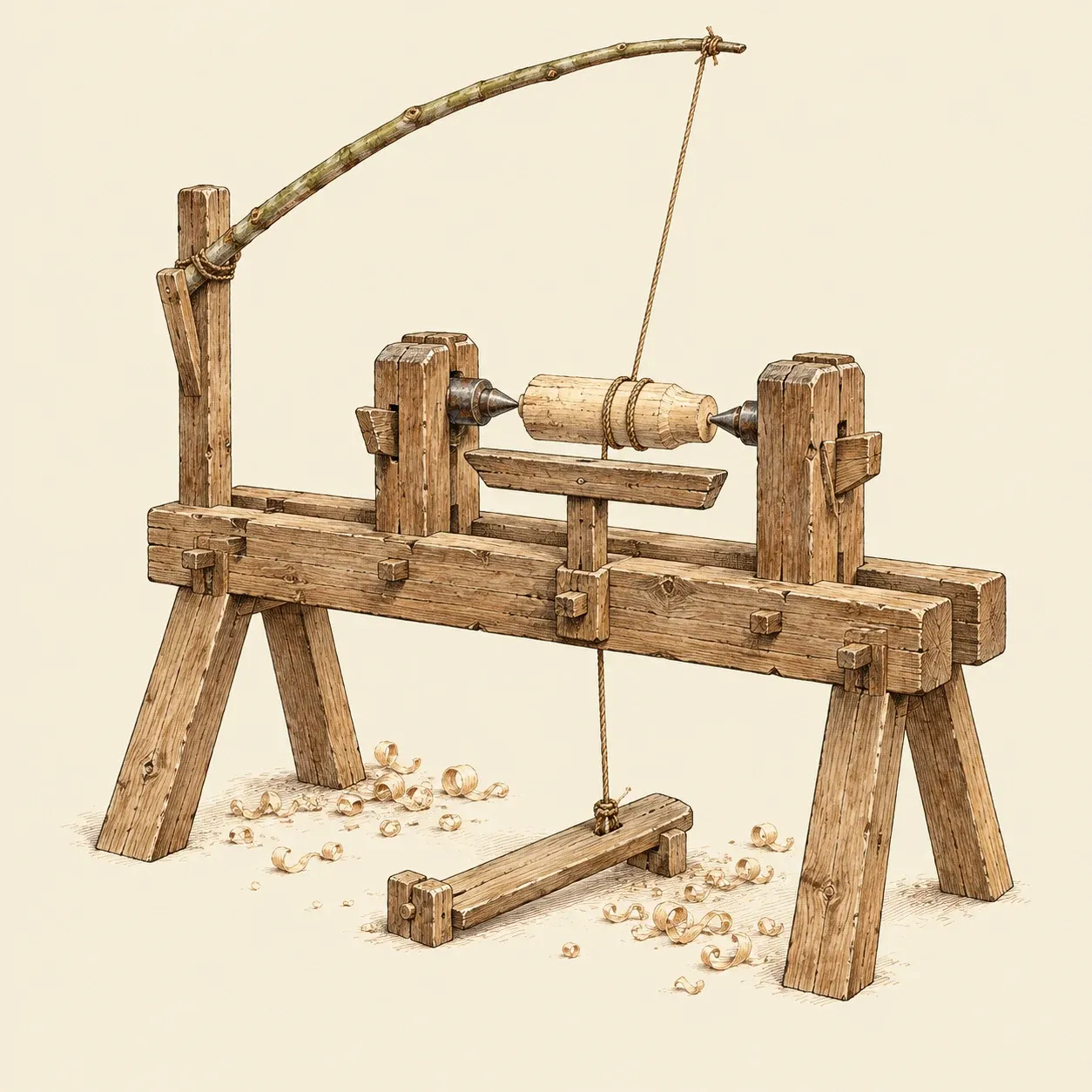 On a pole lathe the cord turns the work one way under the foot and back again under the pull of the pole.
The oldest lathes turned the work back and forth with a cord wound round it, pulled by a bow in the turner’s hand or, on a pole lathe, by a foot treadle against a springy pole. The tool cuts only while the work turns towards the turner. Cranks, flywheels and later belts from a water wheel or an engine gave continuous rotation.
A screw thread is a groove wound round a cylinder at a constant pitch, the spacing between neighbouring turns; on an ordinary single-start screw it is also how far the groove advances in one turn. To cut it, the tool must move along the work by exactly that distance for every turn. A skilled hand can do this with a chaser, but a screw-cutting lathe does it every time without that skill, by means of a second screw. The lead screw runs along the bed and a nut under the slide rest rides on it, so each turn of the lead screw moves the tool by one of its own pitches.
Gears link the spindle to the lead screw. With a lead screw of 8 threads to the inch and equal gears, the tool cuts 8 threads to the inch. A 20-tooth wheel on the spindle driving a 40-tooth wheel on the lead screw halves the movement and cuts 16. Other change gears give other pitches.
The thread is cut in several passes, the tool set a little deeper each time by a hand wheel on the slide rest. Any fault in the lead screw is copied into the new screw, so good lead screws were checked and recut many times.
How to build it
A spring-pole lathe needs timber, a few iron parts and a sapling. It turns green wood, slowly enough for a beginner.
Make the bed. Fix two straight beams about 1.5 m long side by side on four splayed legs, about 5 cm apart. Two upright blocks, the poppets, drop into the gap and lock with wedges underneath.
Fit the centres and the rest. Drive a pointed iron centre through each poppet at elbow height, both on one line. Make one of them a threaded bolt with a filed point, so it can be screwed in to grip the work. For the tool rest, fix a plank along the front, just below the centres, with bolts in slots so it can be moved. With the lathe still, set it about a finger’s width from the work and turn the work by hand to check that it clears.
Rig the pole. Fix the butt of an ash or hazel sapling about 3 m long above and behind the lathe, its tip over the work. Tie a cord to the tip, wind it twice round the work and tie the other end to a board hinged on the floor as a treadle.
Turn a tool handle. Rough a piece of green ash about 4 cm square and 15 cm long round with a hatchet and mount it firmly between the centres, the cord wound so that the near side of the work moves down as you press. Lay the gouge on the rest before it touches the wood, cut on the downstroke and ease off on the upstroke, shape the grip with a skew chisel, and let the handle dry for some weeks before fitting a blade.
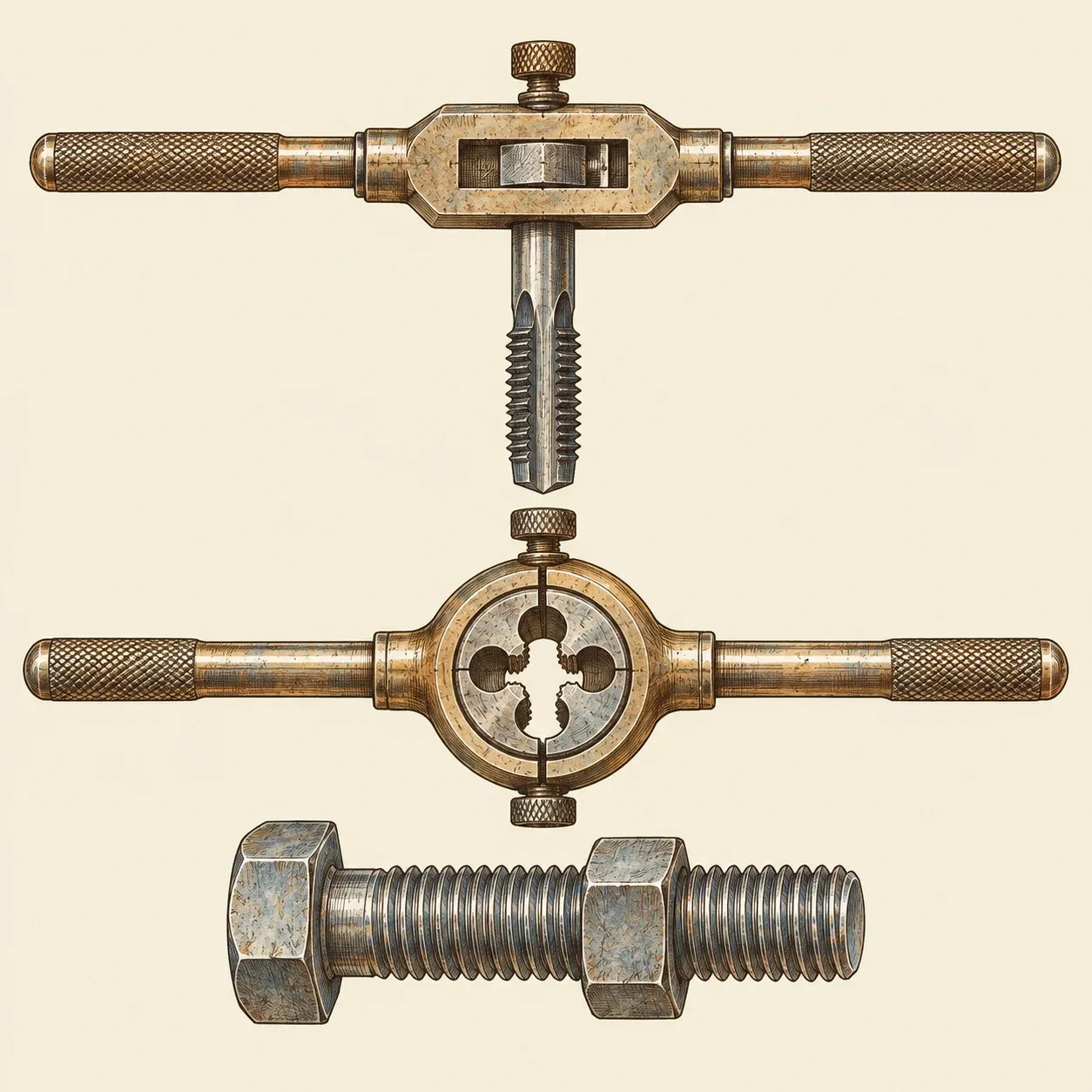 The tap cuts the thread inside a hole; the die cuts it on the outside of a rod.
Cut a thread by hand. Clamp the work in a vice first. For an M8 thread in metal, drill a 6.8 mm hole and turn the tap in square to the surface, half a turn forward and a quarter back with a drop of oil, so the chips break. Cut the matching outside thread on a chamfered rod with the die. Wood and brass can also be threaded with a chaser, a flat steel tool with teeth filed at the pitch wanted, moved along work that turns continuously; keeping its pace even takes practice.
Safety. Spinning work catches anything loose: tie back long hair, roll up sleeves, and take off scarves, rings and gloves. Wear safety glasses against chips, with a face shield over them on larger work; neither makes a loose piece safe. Check before each session that the work sits firmly between the centres and has no cracks. Keep edge tools sharp and covered when not in use. Taps are brittle and a broken one leaves sharp ends. On a powered lathe, stop the machine before measuring or reaching across the work.
History and evolution
The earliest known picture of a lathe, carved in the tomb of Petosiris in Egypt around 300 BCE, shows one man pulling a strap round the work while another holds the tool. In Viking-age York, turners on Coppergate, “the street of the cup-turners”, left part of a lathe, unfinished bowls and an iron turning tool.
In the 1770s the instrument maker Jesse Ramsden built screw-cutting lathes to make the screws of his dividing engines. Henry Maudslay, trained by the lockmaker Joseph Bramah, opened his own London shop in 1797 or 1798, depending on the account. He invented neither the slide rest nor the lead screw, but his lathe combined them with change gears on a rigid iron frame, and its threads could be repeated exactly. He then built the machines Marc Brunel designed for the Navy’s pulley blocks at Portsmouth, finished in 1808–09, where about ten unskilled men did the work of a hundred skilled ones.
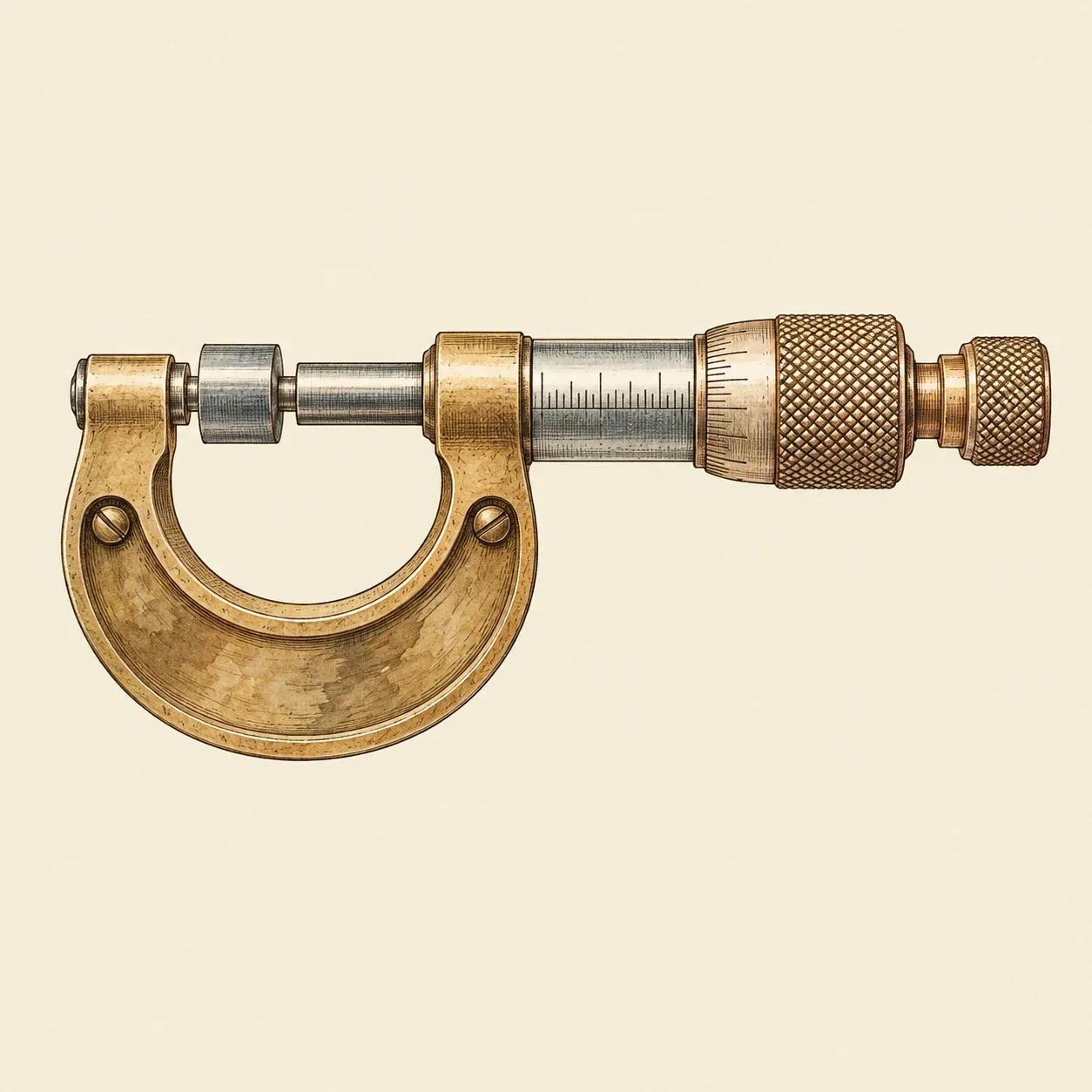 Each turn of the thimble moves the spindle by one pitch of its screw.
A precise screw also measures. Around 1805 Maudslay built a bench micrometer nicknamed “the Lord Chancellor”, the final judge of size in his shop. Jean-Laurent Palmer’s pocket micrometer, patented in Paris in 1848, read to 0.05 mm with a screw of 1 mm pitch and a thimble divided into 20. A common micrometer today has a screw of 0.5 mm pitch and 50 divisions, and reads to a hundredth of a millimetre.
In 1841 Joseph Whitworth, once a workman of Maudslay’s, proposed one thread for all British engineers, the average of bolts gathered from workshops across England: flanks at 55°, rounded crests and roots, and a set number of threads per inch for each diameter, 8 on a 1-inch bolt. Railway companies took it up.