Jeans
Riveted work trousers of indigo twill
Contents
- 1Copper rivet at a pocket corner
- 2Front pocket
- 3Watch pocket
- 4Button fly
- 5Twill weave: blue warp, white weft
- 6Flat-felled seam
Jeans are work trousers of denim, a cotton twill woven with an indigo-blue warp and a white weft, whose pocket corners are held by copper rivets so that hard wear does not tear the seams. The Reno tailor Jacob Davis made his first riveted pants around the turn of 1871, and in 1873 he and the San Francisco merchant Levi Strauss obtained a patent for the rivets.
What it is
Jeans are trousers made of denim, a strong cotton cloth that is blue on the outside and pale on the inside. They began as work clothes for labourers, made to last through rough use, and have since become everyday wear around the world.
What sets the work trouser apart is its reinforcement. The seams are sewn twice, with the raw edges folded inside, and the corners of the pockets, where the seams tear first, are held by small copper rivets. A row of metal buttons closes the front. Levi Strauss & Co.’s first riveted trousers had two front pockets, a small watch pocket on the right and one back pocket; a second back pocket was added in 1901, which gave the five-pocket cut.
How it works
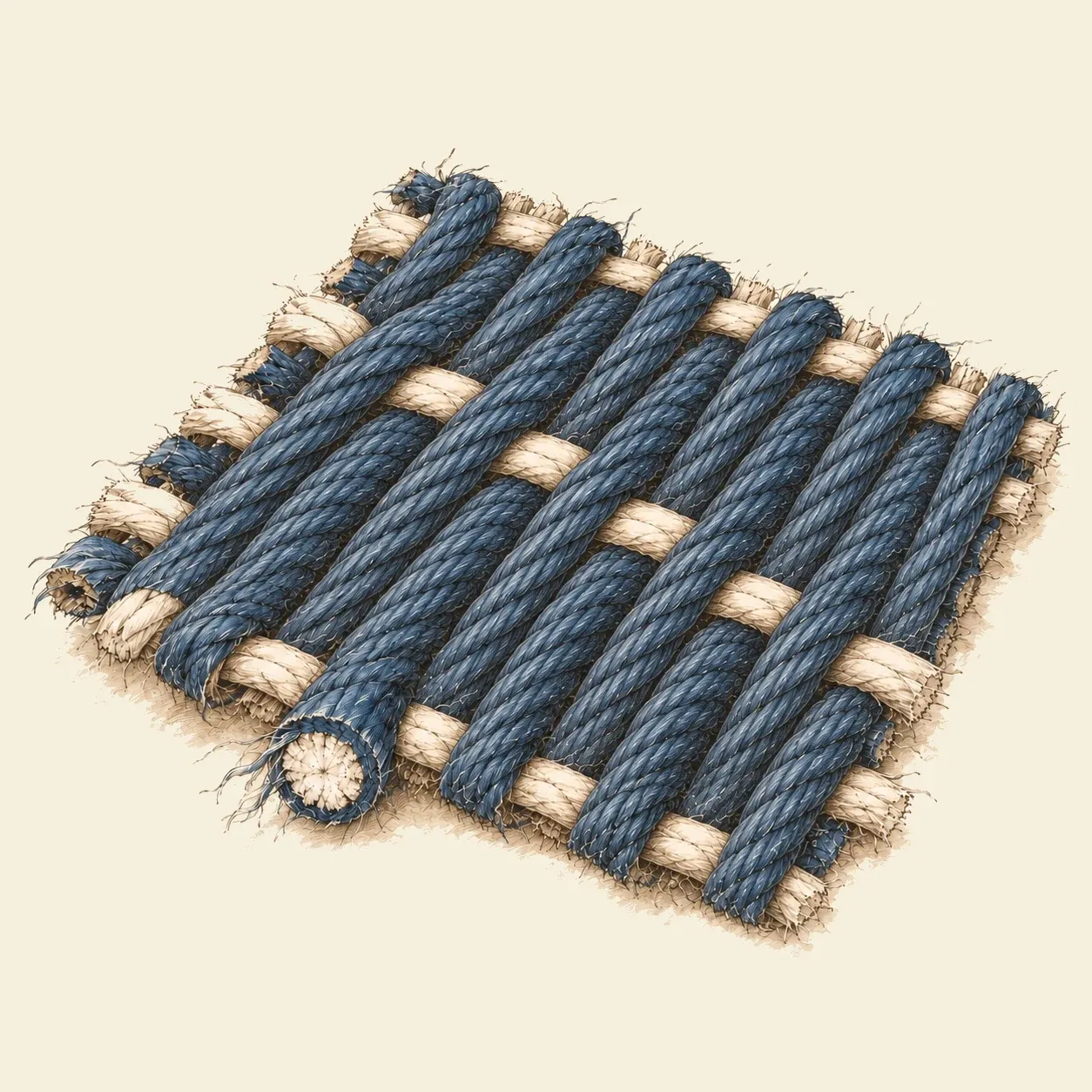 In denim, each blue warp thread passes over three weft threads and under one, so the blue covers the face.
Denim is a twill. In a plain weave each thread passes over one thread and under the next; in denim’s usual twill, each warp thread runs over three weft threads and under one, and each row starts one thread further along, which draws diagonal lines across the cloth. The warp, the lengthwise threads, is dyed with indigo, and the weft is left undyed. Because the warp covers most of the face, the outside of the cloth looks blue and the inside, where the weft shows, looks white.
Indigo sits mostly on the outside of each warp thread: the yarn is dipped in the dye bath and aired several times, and each dip adds a thin layer while the core stays pale. Rubbing wears away the blue skin and shows the white core and the white weft. That is why jeans fade at the knees, the thighs and the seams.
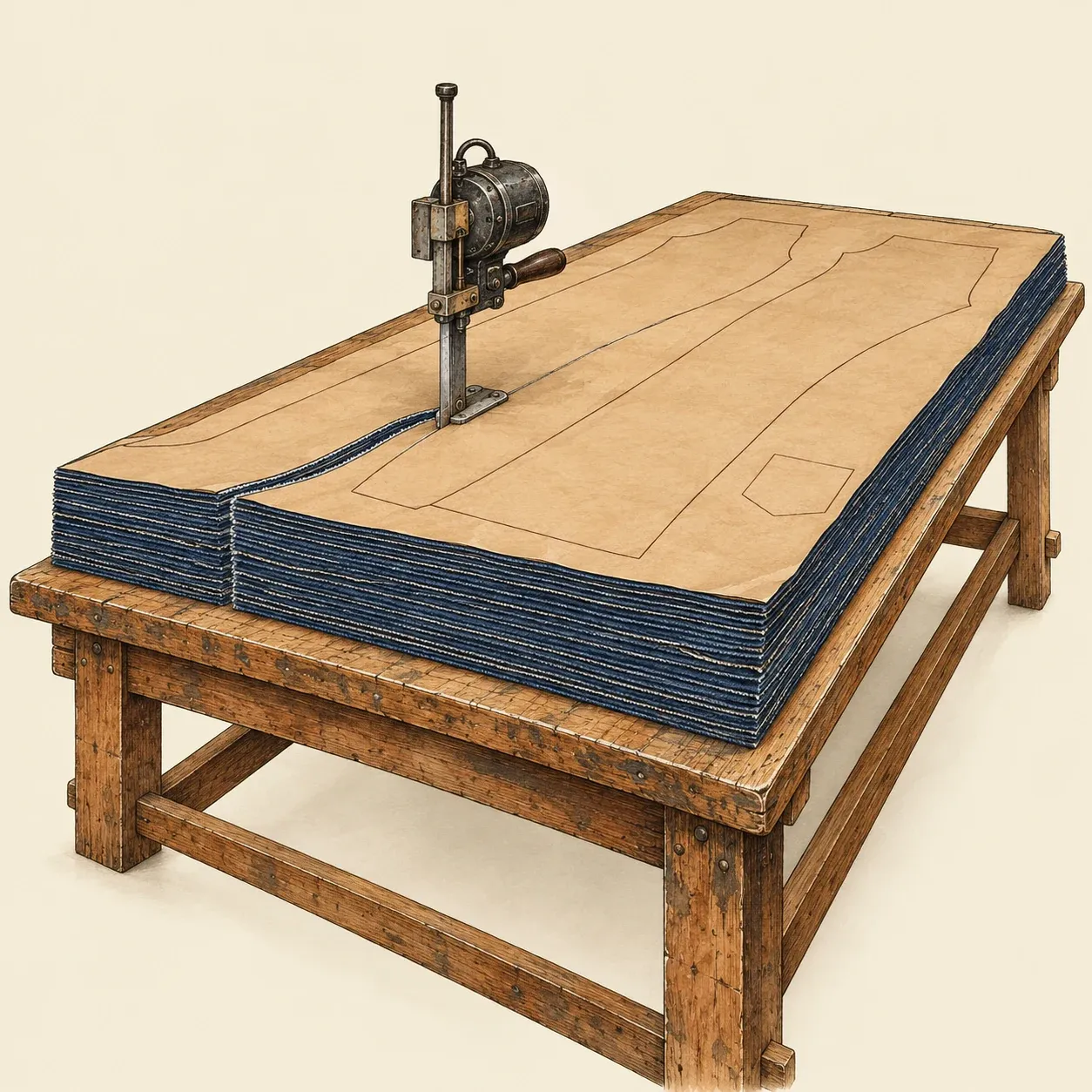 Laid in a stack, many layers of cloth are cut to the same pattern at once.
The garment is made from flat pieces cut to a pattern. In a factory the cloth is laid in a stack of many plies, the pattern is placed on top, and the cutter goes through every layer at once, so each cut gives the same piece for many pairs. The pieces are joined with flat-felled seams, in which the edge of one piece is folded into the edge of the other and both are stitched down with two rows of stitches, so no raw edge is left to fray.
A seam is only as strong as its thread. When a worker pushes his hands into his pockets or loads them with tools, the strain falls on the few stitches at each end of the pocket opening. A rivet passes through both layers of cloth there and is hammered flat on the other side, so the rivet takes the strain instead of the thread.
How to do it
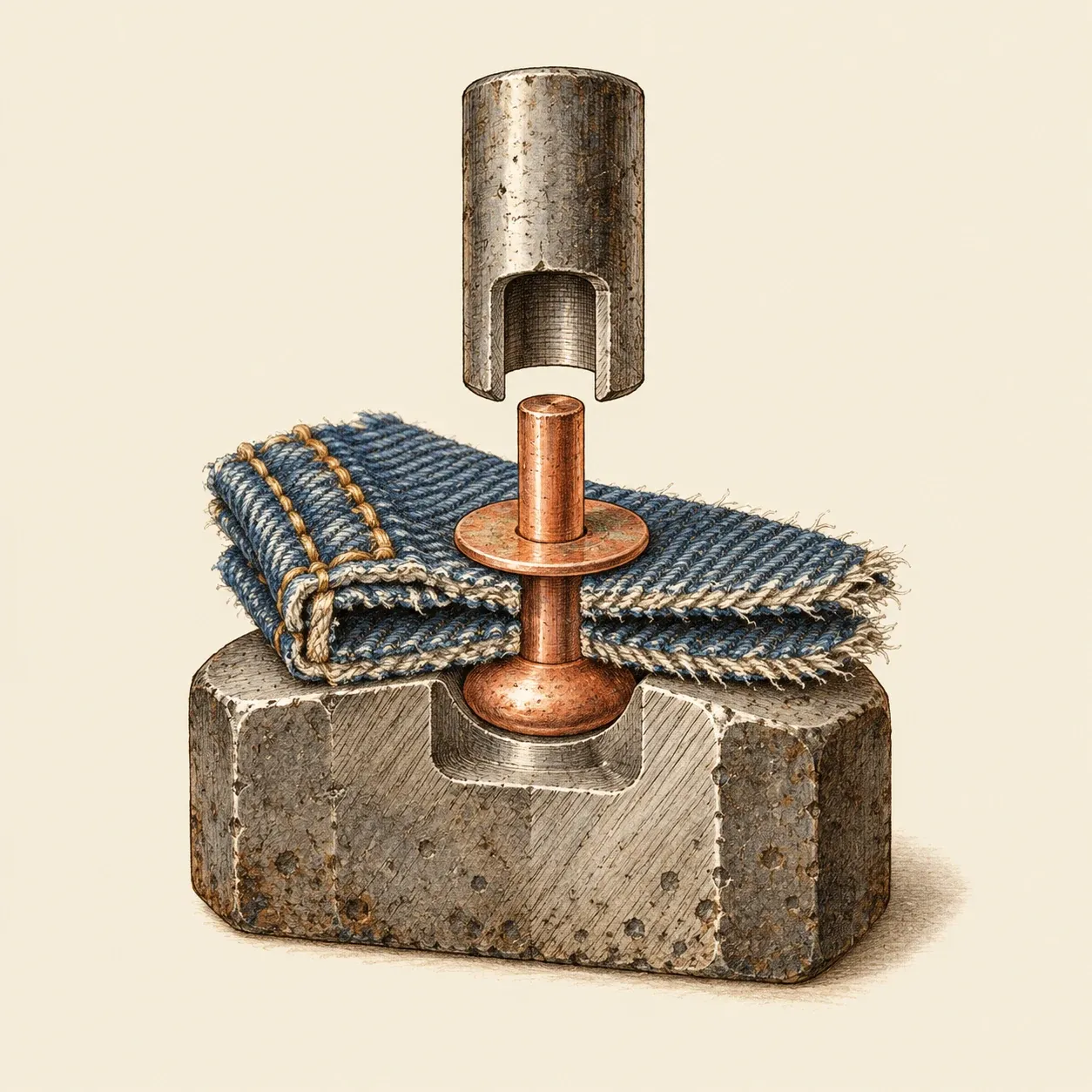 The hollow setter presses the washer down before the end of the shank is cut and spread.
A riveted pocket shows the principle on a small scale. Cut a rectangle of denim about 20 by 30 cm and a pocket about 15 by 15 cm. Fold the edges of the pocket under by 1 cm and press them with an iron. Sew the top edge of the pocket down, then stitch the pocket onto the panel along the sides and bottom with two parallel rows of stitches, by hand with a strong needle and thread or on a sewing machine.
At each top corner of the pocket, punch a small hole through both layers. Push a copper rivet through from the front, put its washer on the back, and set it on a hard surface such as a steel block or an anvil. Place the hollow end of a rivet setter over the shank and strike it with a hammer to press the washer down tight on the cloth. Cut the shank with end cutters about 2 mm above the washer, then hammer that stub with the cupped recess of the setter until it spreads into a dome over the washer. Pull hard on the pocket: the corners hold. Wear safety glasses when hammering, keep the fingers holding the punch out of the way, and never set rivets on your lap. Take care with the hot iron.
History and evolution
Hardwearing blue cloths with a white thread were known in Europe long before jeans. The word “jean” comes from Genoa, in Italy, and appears in accounts from the sixteenth century, while “denim” comes from the French “serge de Nîmes”. A group of seventeenth-century paintings from northern Italy, now given to an artist called the Master of the Blue Jeans, show poor people dressed in blue cloth with white threads.
The riveted work trouser began in Reno, Nevada. Jacob Davis, a tailor born in Riga, bought cotton duck and denim from the San Francisco wholesale house of Levi Strauss & Co. In late December 1870 the wife of a labourer asked him for a pair of strong trousers for her husband. Davis made them of white duck and fixed the pocket corners with the copper rivets he used to fasten straps on horse blankets. In a sworn deposition of 1874, Davis himself put that first pair in the first week of January 1871, saying he had not managed to deliver it before New Year as the customer wanted. According to Levi Strauss & Co.’s archive, he sold 200 pairs of riveted trousers in eighteen months and by 1871 was riveting denim trousers as well.
Davis could not afford a patent on his own and wrote to Levi Strauss proposing a joint one. The application was filed on 9 August 1872, and on 20 May 1873 the United States granted patent 139,121 for rivets at the corners of pocket openings. The patent notes that rivets had already been used in the seams of shoes. Davis moved to San Francisco to run production, first with women sewing at home and then in a factory. From 1888 electric cutting machines with an upright reciprocating knife, made by George Eastman in Buffalo, New York, let clothing factories cut cloth by machine instead of by hand.