Monowheel
A vehicle that rides inside its single wheel
Contents
- 1Traction wheel
- 2Track on the inner rim
- 3Traversing wheel
- 4Guide pulleys
- 5Hand cranks and band wheels
- 6Saddle
A monowheel is a vehicle with a single wheel so large that the rider sits inside it. A smaller wheel, pressed down by the rider's weight, rolls along the inside of the rim, and the big wheel turns as long as that small wheel is driven. Richard Hemming of New Haven, Connecticut, patented a hand-cranked one on 13 July 1869. In the early 1930s John Archibald Purves showed a motor-driven version, the Dynasphere. In a monowheel the rider's frame tends to swing round inside the wheel when braking or accelerating hard.
What it is
A monowheel has only one wheel, and the rider travels inside it. The large outer wheel, the traction wheel, touches the ground and carries everything. Inside it, a frame with a seat hangs low, held on the rim by small wheels that run round a track on its inner face. The rider, or an engine on the frame, turns one of those small wheels, and the big wheel rolls along the road around them.
On a unicycle the rider sits above the hub. In a monowheel the rider’s weight hangs below it, inside the rim, and there is no front wheel to turn. Hemming’s rider steered by leaning to one side or by touching the ground with a foot, and started by running a few steps astride the saddle.
How it works
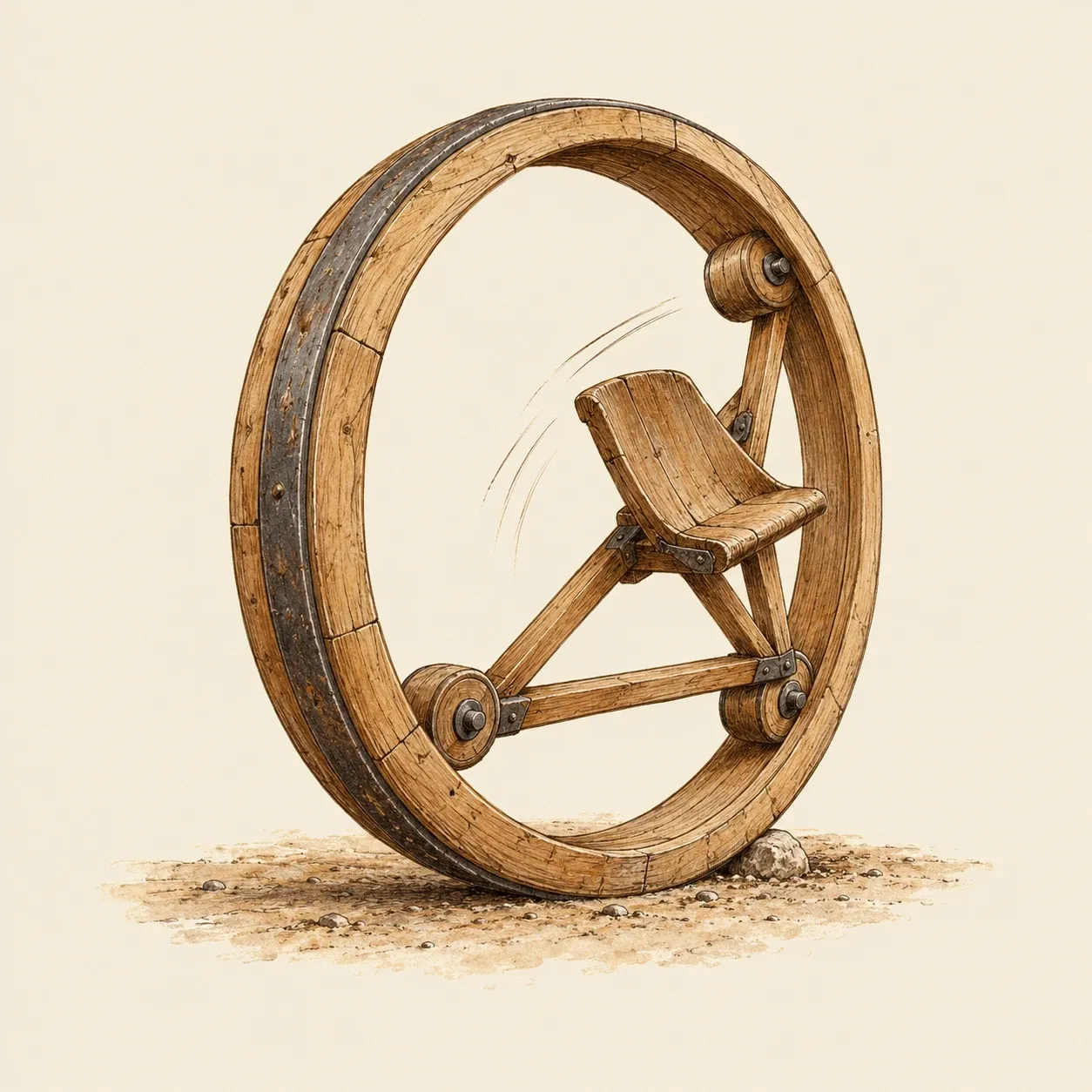 When the wheel stops sharply, the frame keeps going and swings forward round the inside of the rim.
In Hemming’s patent of 1869, the traversing wheel is a grooved wheel that rests on a rib on the inside of the traction wheel, and the rider’s weight rests on it through the saddle. Guide pulleys on a curved arm, the reach, run on the same rib and keep the frame in line with the rim. The rider turns two hand cranks fixed to a pair of band wheels, and bands pass from these to pulleys on the shaft of the traversing wheel, which turns round the inside of the rim.
As the traversing wheel climbs a little way up the inside of the rim, the weight of rider and frame presses on the rim just ahead of the lowest point of the big wheel. That weight, acting ahead of the point where the wheel touches the ground, makes the big wheel roll forward. The patent places the seat so that most of the weight inside the wheel stays below the centre, and the book on velocipedes published in 1869 describes the rider keeping the driving wheel slightly ahead of the centre of gravity.
Because the frame only hangs inside the rim, nothing but its weight keeps it at the bottom. When the vehicle accelerates hard, the frame swings backwards round the rim; when it brakes hard, the frame and rider swing forwards and upwards. This is called gerbilling.
How to do it
A toy car inside a ring of card shows how a monowheel moves and why the rider swings round when it stops. You need a small pull-back toy car about 5 cm long, a sheet of thin card, scissors, a ruler, sticky tape and a smooth floor.
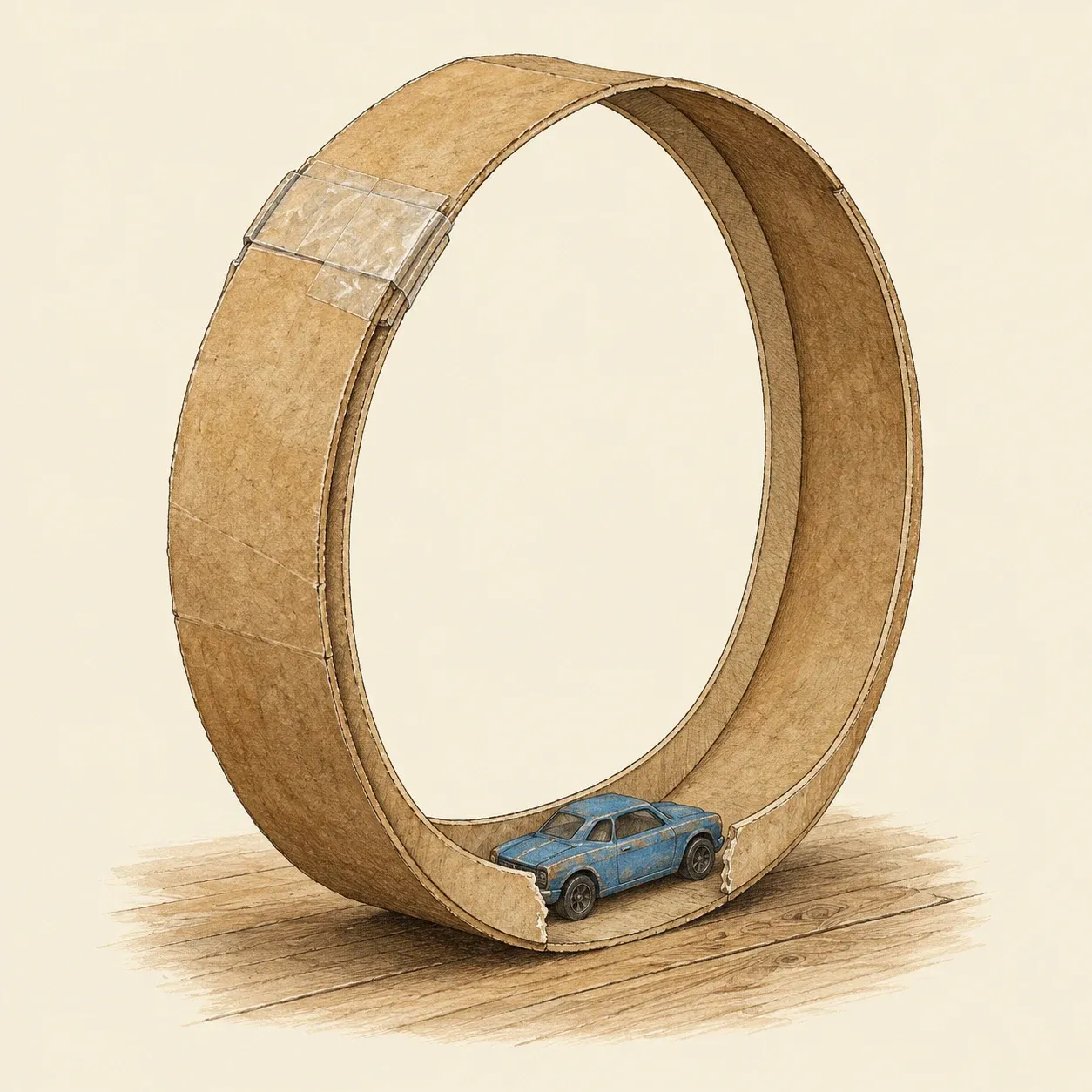 The toy car drives up the inside of the ring and the ring rolls forward around it.
Cut a strip of card 6 cm wide and about 70 cm long, joining two pieces with tape if needed, and two narrower strips 1.5 cm wide and the same length. Tape the narrow strips along both long edges of the wide strip, standing up on the same side, so that they make a channel a little wider than the car. Bend the strip into a ring with the channel on the inside, about 22 cm across, and tape the ends together firmly so that the inside surface is smooth. Wind up the car by pulling it backwards, set it at the bottom of the inside of the ring and let it go: the car climbs a little way up the inside, stays near the bottom, and the ring rolls along the floor. Put a book in the ring’s path: when the ring stops against it, the car runs on round the inside of the ring.
History and evolution
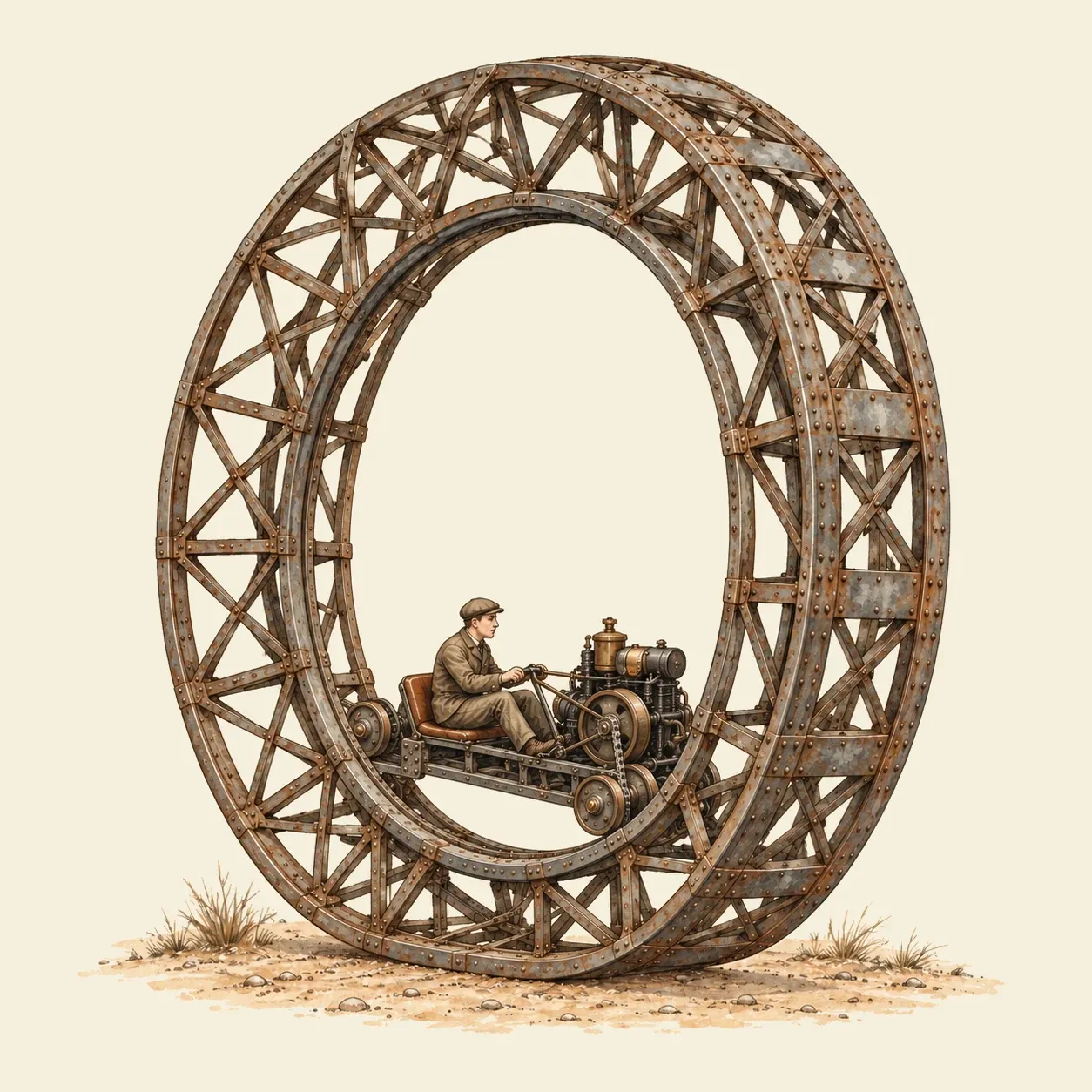 Purves’s Dynasphere: an open lattice wheel around a seat and an engine.
On 13 July 1869 Richard Hemming of New Haven, Connecticut, received a United States patent for a velocipede made of a traction wheel large enough to hold the rider, driven from inside by a traversing wheel worked with hand cranks. A book on velocipedes published that year in New York described his machine, with a double rim, a tightening pulley for the bands and an awning over the rider’s head, and called it the “Flying Yankee Velocipede”. According to the book, Hemming had invented it two years earlier and had only recently put it on the market. It was one of many velocipedes of those years, soon after cranks and pedals had been fixed to the front wheel of the bicycle.
Several inventors later put an engine inside the wheel. The engineer John Archibald Purves built the Dynasphere, a light lattice shell shaped like a sphere with its sides cut off. Inside it a trolley carrying the engine and the seat ran on a double track, its wheels driven by chains, and the driver steered by moving the track sideways so that the shell leaned and turned. Purves demonstrated it in the early 1930s on the beach at Weston-super-Mare, where newsreel cameras filmed it. The trolley’s tendency to swing round inside the wheel when braking or accelerating counted against it.