Saxophone
A single reed on a conical brass tube
Contents
- 1Mouthpiece and single reed
- 2Ligature
- 3Octave key and vent on the neck
- 4Conical brass body
- 5Padded key cup over a tone hole
- 6Bell
The saxophone is a wind instrument with a conical brass tube, sounded by a single cane reed clamped to a mouthpiece. Its wide tone holes are closed by padded cups worked through keys, and an octave key lifts every note an octave. Adolphe Sax had a bass saxophone at the Brussels industrial exhibition of 1841 and patented a family of eight saxophones in Paris in 1846.
What it is
A saxophone is a tube of brass that widens steadily from the mouthpiece to the bell. In the common sizes the tube is folded: a curved neck carries the mouthpiece, the straight body runs down to a U-shaped bow, and a flared bell turns up and forward. A row of holes runs along the tube, most of them too wide for a fingertip to cover, so each is closed by a cup lined with a leather pad and moved by a key. Rods and steel springs link the keys so that the fingers of two hands can work them all.
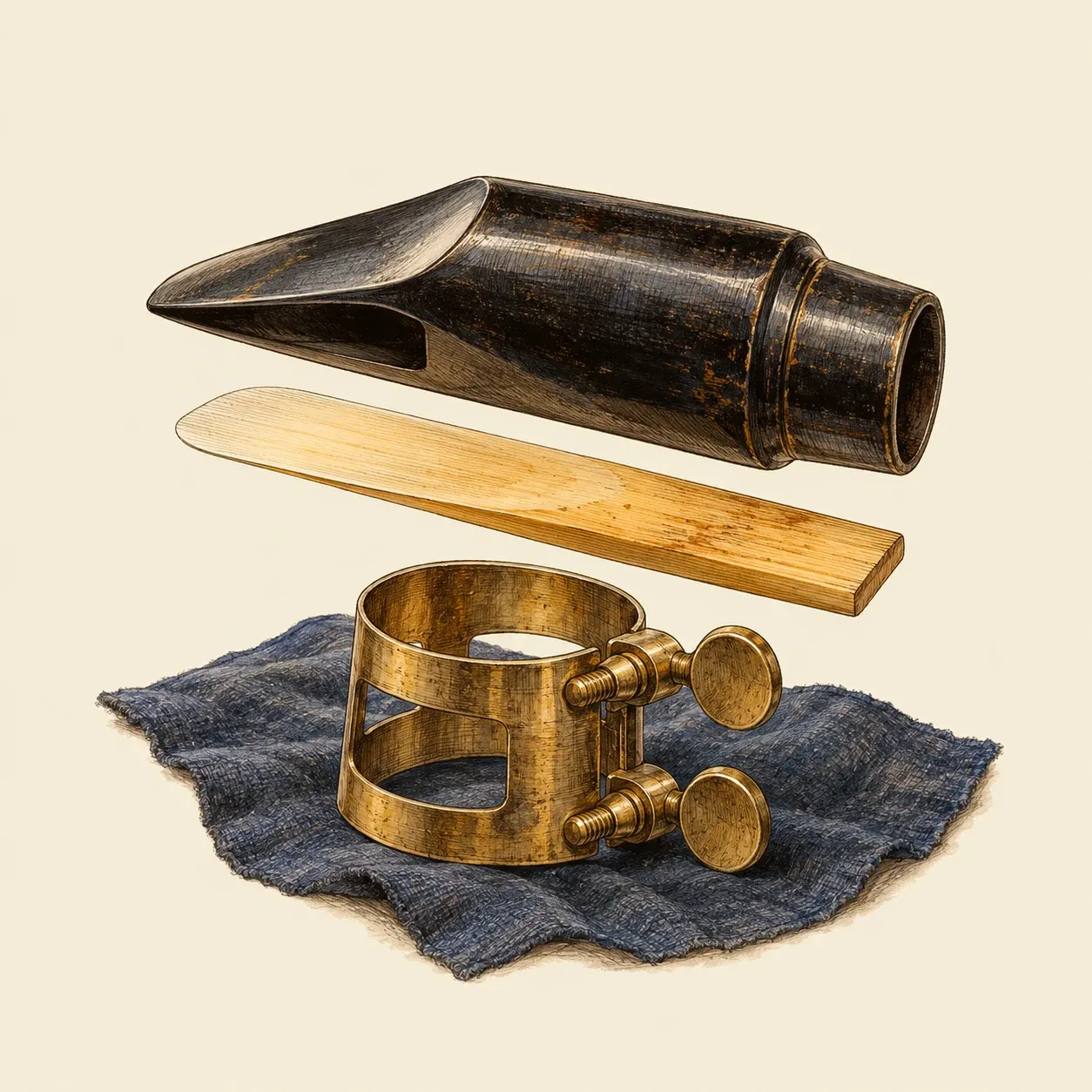 The reed is clamped against the flat underside of the mouthpiece by the ligature.
The sound starts at the mouthpiece, a hollow beak with a flat underside and a long opening in it. A flat reed cut from cane covers the opening and is held by a band of metal or cord called the ligature. Only the thick heel of the reed is clamped; its thin tip stands a little away from the tip of the mouthpiece, leaving a narrow slit. The player takes the tip of the mouthpiece between the lips, with the reed resting on the lower lip.
Four sizes are used most: the soprano in B-flat, the alto in E-flat, the tenor in B-flat and the baritone in E-flat. The saxophone is made of metal and played with a reed, and acousticians class it with the woodwinds. Sax’s contemporaries counted it among the brass, the “brass instruments with a reed”, as Berlioz put it in 1842.
How it works
When the player blows, the air rushing through the slit pulls the tip of the reed towards the mouthpiece and closes it, then the reed springs back. The reed works as a valve that lets the air into the tube in puffs. The air column inside the tube has natural frequencies of its own, and the pressure waves returning from the far end push the reed in step with them. The tube sets the note and the reed keeps it going.
With all holes closed, the whole length of the tube sounds and gives the lowest note. Opening a hole lets the pressure escape there, as on a flute, and the tube behaves as if it ended near that hole. Opening the holes one by one from the bell upwards raises the pitch by about a semitone at each step.
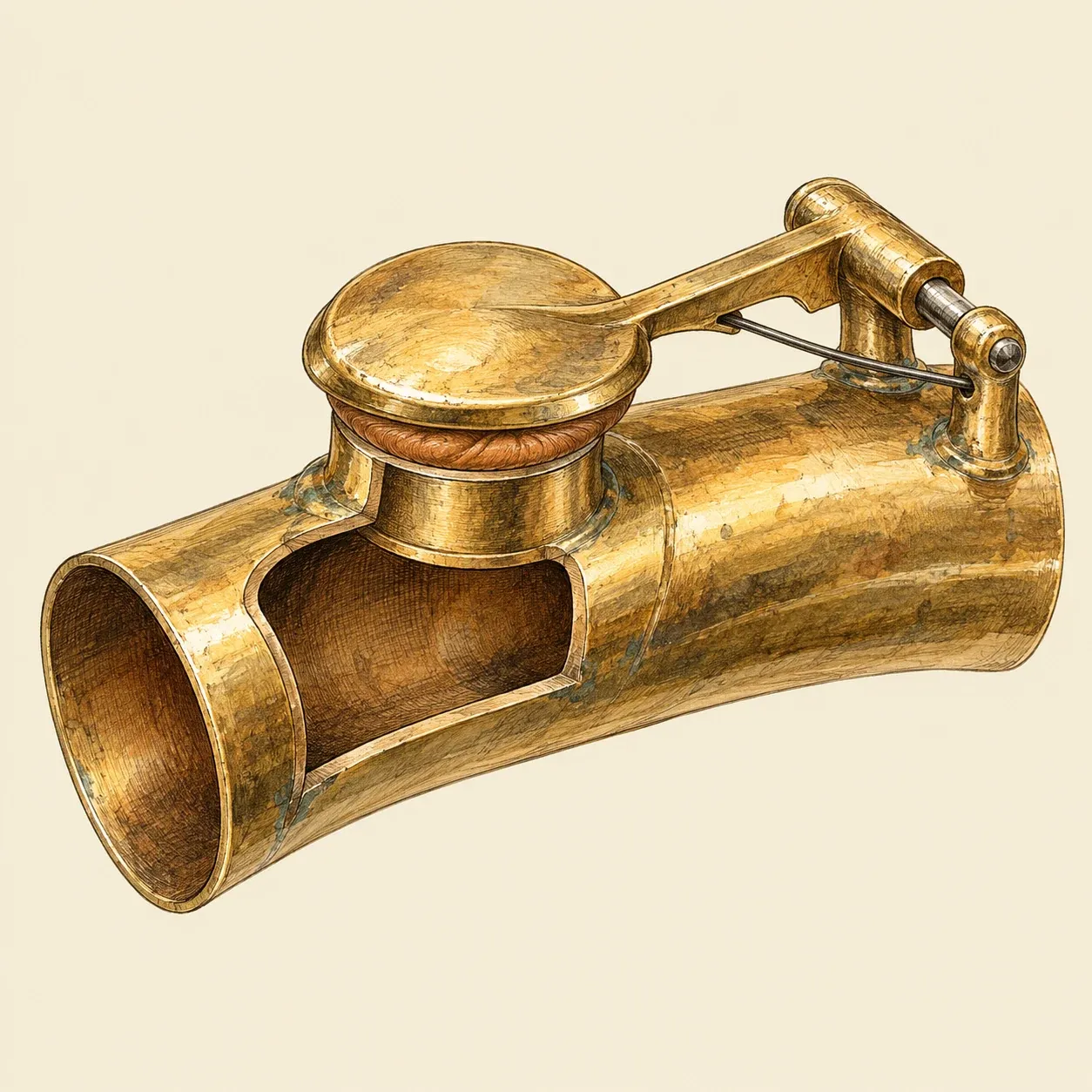 A steel spring keeps each cup open or closed until a finger moves its key.
A cone has resonances at every multiple of its lowest frequency, while a tube closed at one end and of constant width, like that of the clarinet, has only the odd multiples. This is why the saxophone overblows to the octave, where the clarinet jumps to the twelfth, and why a fingering gives the same note name in both registers. A small vent near the mouthpiece, opened by the octave key under the left thumb, disturbs the lowest resonance so that the next one, an octave higher, takes over. Saxophones have two such vents, one for the lower notes of the upper register and one for the higher; on modern instruments a single key opens the right one depending on the note fingered.
A complete cone would end in a point at the reed. The mouthpiece is shorter and wider than that missing tip but holds about the same volume of air, and together with the springy reed it takes its place. Makers shape it so that the octaves come out in tune.
How to do it
A saxophone is made in a specialised factory. Brass sheet is cut and pressed into the tapered body, and the seam is soldered. The rims of the tone holes are drawn outwards from inside the tube, the bow and the bell are formed separately and soldered on, and the posts that carry the keys are soldered to the body before the keys and pads are fitted and adjusted by hand. The difference that makes it a saxophone can be heard with a much simpler setup.
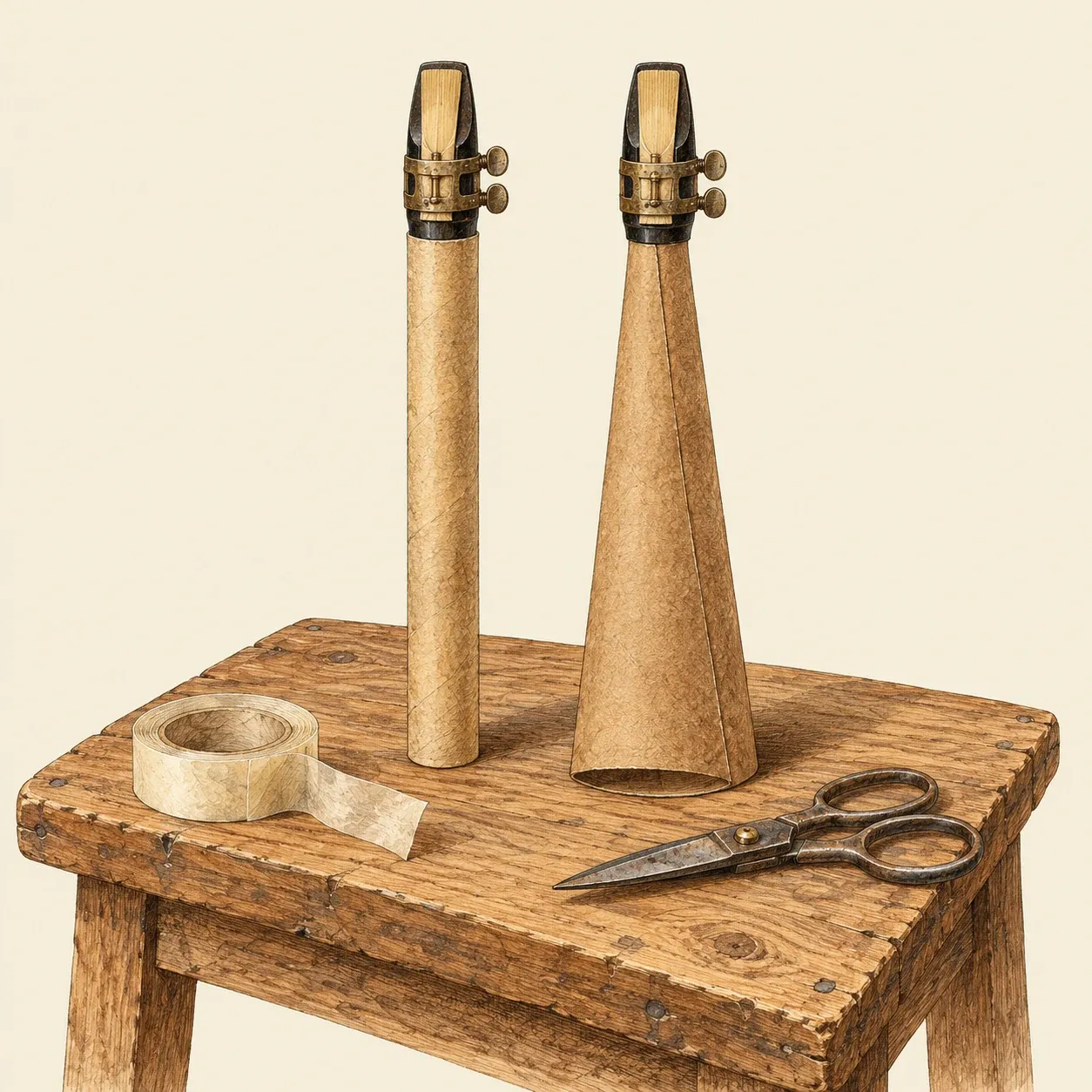 The same mouthpiece on a cylinder and on a cone of the same length.
Take a clarinet or saxophone mouthpiece with a reed and its ligature. Fit it into a straight plastic tube about 50 cm long whose inside diameter matches the end of the mouthpiece; seal the joint with tape if needed. Then roll a cone of the same length from stiff paper, starting at the diameter of the mouthpiece and widening to 6 or 7 cm at the far end, tape it, and fit the mouthpiece to its narrow end.
Blow each one gently. The cylinder gives a low, dark note and the cone a higher one: a cone sounds higher than a cylinder of the same length, and the more it widens, the higher it sounds. Then blow a little harder, with a firmer lip, until each jumps to its next note. On the cylinder the jump is about a twelfth. On the cone it is much smaller, close to an octave, but it is a true octave only if the mouthpiece holds about as much air as the missing tip of the cone; with too little air in the mouthpiece the jump is wider than an octave. Drilling a few side holes in the cylinder or the cone and covering them with the fingers turns either into a crude instrument.
Safety. A mouthpiece goes in the mouth: use your own, wash it with warm soapy water before and after, and do not share it. Cut the plastic tube with a fine saw while it is held in a clamp, and smooth the cut ends. Blow without forcing, and stop if you feel dizzy.
History and evolution
Adolphe Sax, born in Dinant in 1814, worked in the Brussels workshop of his father, Charles-Joseph Sax, a leading maker of wind instruments, and made his name with improvements to the bass clarinet. At the industrial exhibition held in Brussels in August 1841 he showed his clarinets and won a medal. The printed catalogue of the exhibition also lists a “bass saxophone, in brass, with reflector and mouthpiece, newly invented”, which he does not seem to have entered officially.
In March 1842 Hector Berlioz reported that Sax had fitted a clarinet mouthpiece to an ophicleide, the keyed brass bass of the time. That June, after Sax had demonstrated his instrument in Paris, Berlioz described the “Saxophon” in the Journal des débats: a brass instrument shaped rather like the ophicleide, with nineteen keys, a mouthpiece like that of the bass clarinet and a range of three octaves. Sax settled in Paris in October 1842. On 3 February 1844, at a concert of Berlioz’s music in the Salle Herz, Sax played the saxophone in an arrangement of a hymn for six of his instruments. In December of that year Jean-Georges Kastner used it in his biblical drama Le dernier roi de Juda.
According to the music historian Mervyn Cooke, French military bands adopted the saxophone after the reform of military music in 1845. On 21 March 1846 Sax took out French patent no. 3226 for a family of eight saxophones. The oldest surviving saxophone is a baritone in E-flat engraved with the word “breveté” (patented) and dated 1846; the King Baudouin Foundation bought it in 2020 for the Musical Instruments Museum in Brussels. It found a lasting place in the dance bands of the 1920s, when jazz musicians first took it up seriously. Selmer, the Paris maker, bought the Adolphe Sax company in 1929.