Insulated electric cable
Carrying current inside a sheath that does not conduct
Contents
- 1Stranded copper conductor
- 2Oil-impregnated paper insulation
- 3Lead sheath
- 4Steel wire armour
- 5Outer covering of tarred jute
An insulated cable carries electric current along a metal conductor wrapped in a material that does not conduct, so the current cannot escape into the ground, into water or into another conductor. In 1795 Francesc Salvà, in Barcelona, described wires wrapped in pitch-coated paper and bound into a cable. In 1816 Francis Ronalds buried a telegraph wire in glass tubes in his garden at Hammersmith. Cables now carry power and signals under streets and across the seabed.
What it is
A bare wire on poles can carry current because dry air insulates it. A cable that runs underground, under water or inside a wall needs its own insulation: a layer around the conductor that does not conduct, so that the current stays in the metal and cannot leak into the earth, into the water or into a neighbouring conductor. The conductor is usually copper or aluminium. Around the insulation, cables laid in the ground or the sea add a sheath that keeps out water and an armour that resists crushing and digging.
Many kinds are made, from the thin flexible cord of a lamp to cables as thick as an arm that carry a city’s power at tens of thousands of volts. A cable may hold one conductor or several, each with its own insulation, inside a common sheath. Its cross-section is chosen for the current it must carry, and its insulation for the voltage it must withstand.
How it works
Every conductor has some resistance, so the current warms it, and the more current, the more heat. A conductor of larger cross-section carries more current for the same temperature rise. The insulation must stand that heat for decades: the cross-linked polyethylene of modern power cables is rated for 90 °C at the conductor.
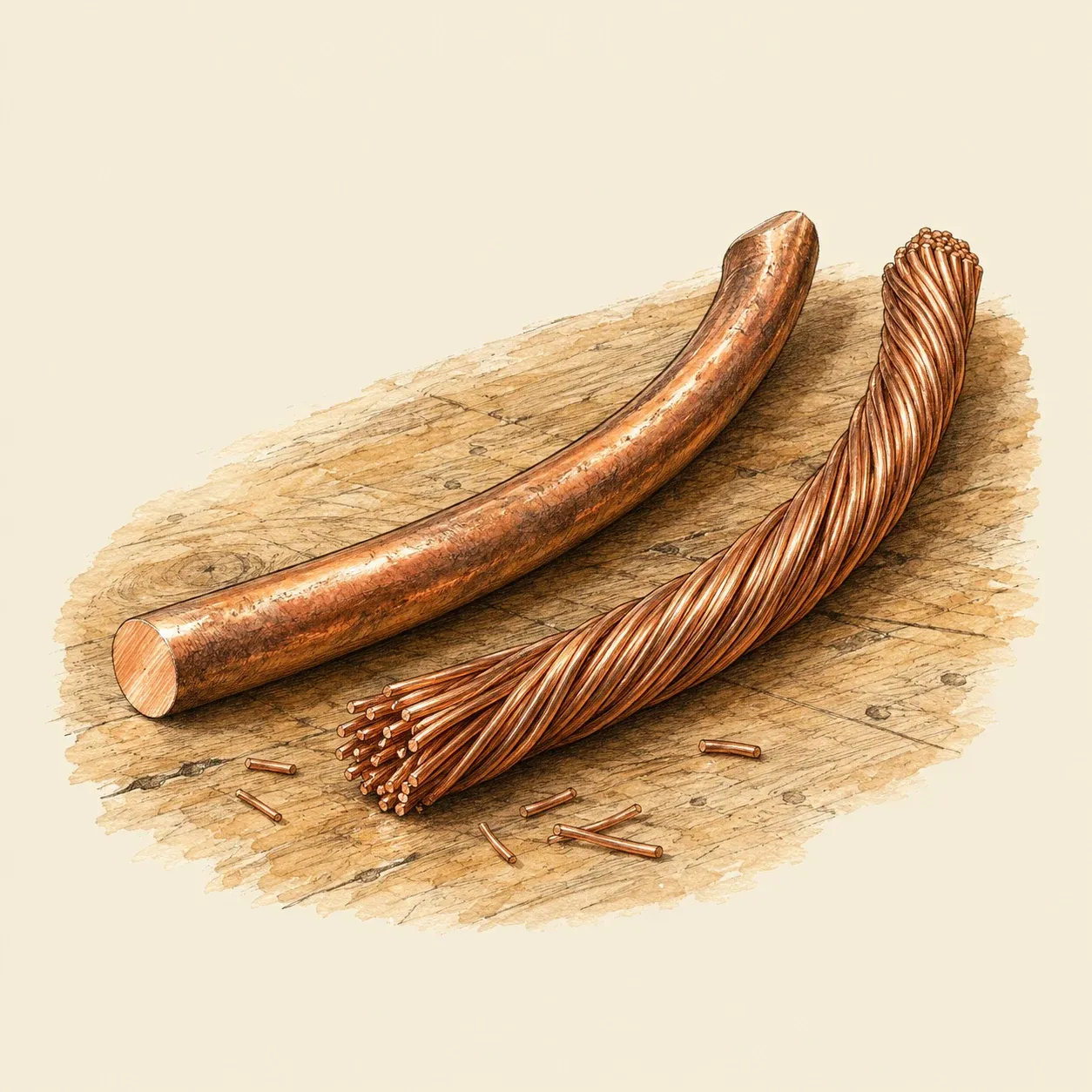 A solid conductor and a stranded one of the same cross-section: the stranded one bends far more easily.
Large conductors are made of many wires twisted together, which makes them flexible enough to be wound on a drum and laid in a trench. The insulation separates the conductor from everything at another voltage, and its thickness grows with the voltage the cable is built for. In medium and high voltage cables the electric field would crowd at the edges of the strands and at any void in the insulation and wear it away. A thin semiconducting layer on the conductor and another over the insulation smooth the field, so it runs evenly through the insulation.
Water is the enemy of most insulation, and of paper above all. For decades, power cables insulated with oil-impregnated paper were sealed in a seamless sheath of lead. Steel wires wound over the sheath protect it from stones and spades, and an outer covering, once tarred jute and now plastic, keeps the steel from rusting.
A cable is only safe within its rating and while its insulation is whole. Damaged insulation can make the sheath or the ground around it live, and an overloaded cable heats up and can start a fire. Before digging, check plans of buried networks with the operators. Laying, joining or repairing power cables is work for qualified electricians with certified materials.
History and evolution
In December 1795 Francesc Salvà described an electric telegraph to the Academy of Sciences in Barcelona. Each wire was wrapped in paper coated with pitch, and the wires were bound together with more paper into one cable, which he proposed to lay under the sea. In Munich Samuel Thomas von Sömmerring built a telegraph in 1809, and for a demonstration in 1810 he ran its wires round a whole house, coated with a solution of rubber and then varnished. In 1812 Pavel Schilling fired powder mines across the Neva, near St Petersburg, through an insulated cable laid across the river.
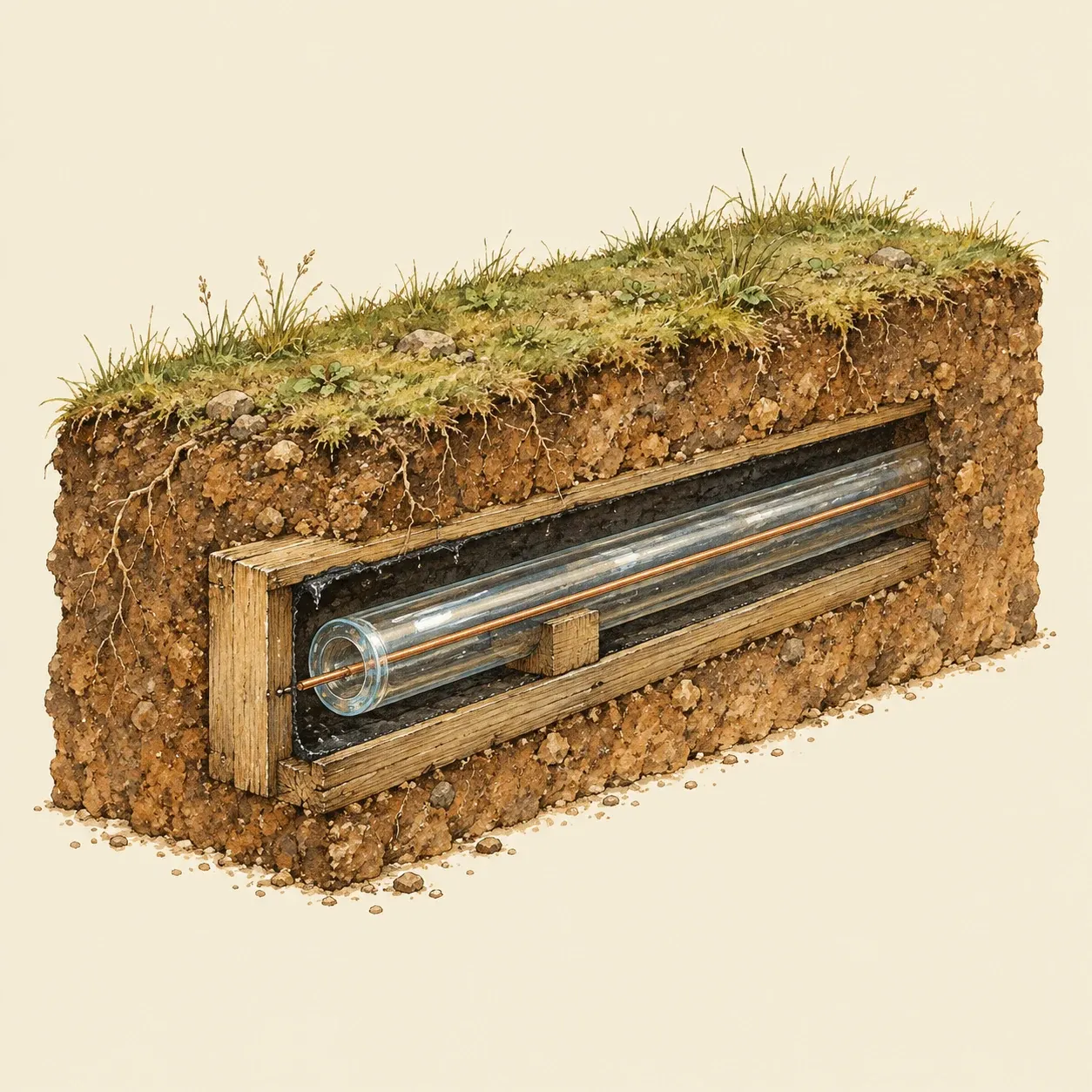 Ronalds laid each wire in a glass tube, inside a buried wooden trough lined with pitch.
In 1816 Francis Ronalds built an electric telegraph in the garden of his family’s house at Hammersmith, by the Thames. After trials with wire strung overhead, he dug a trench 160 metres long and 1.2 metres deep. Each conductor ran in a narrow glass tube, the tubes rested on small blocks in a wooden trough lined with pitch, and the joints between tubes were covered by glass sleeves sealed with soft wax. Sections of this line, dug up by later owners, are kept in museums.
The telegraph spread in the 1830s and 1840s, and a material from South-East Asia made cables under water possible: gutta-percha, the dried latex of Palaquium trees, which softens in hot water, can be moulded around a wire and hardens again as it cools. In 1848 Werner Siemens laid a cable across the harbour of Kiel, after devising a press that moulded warm gutta-percha around the wire in one seamless run.
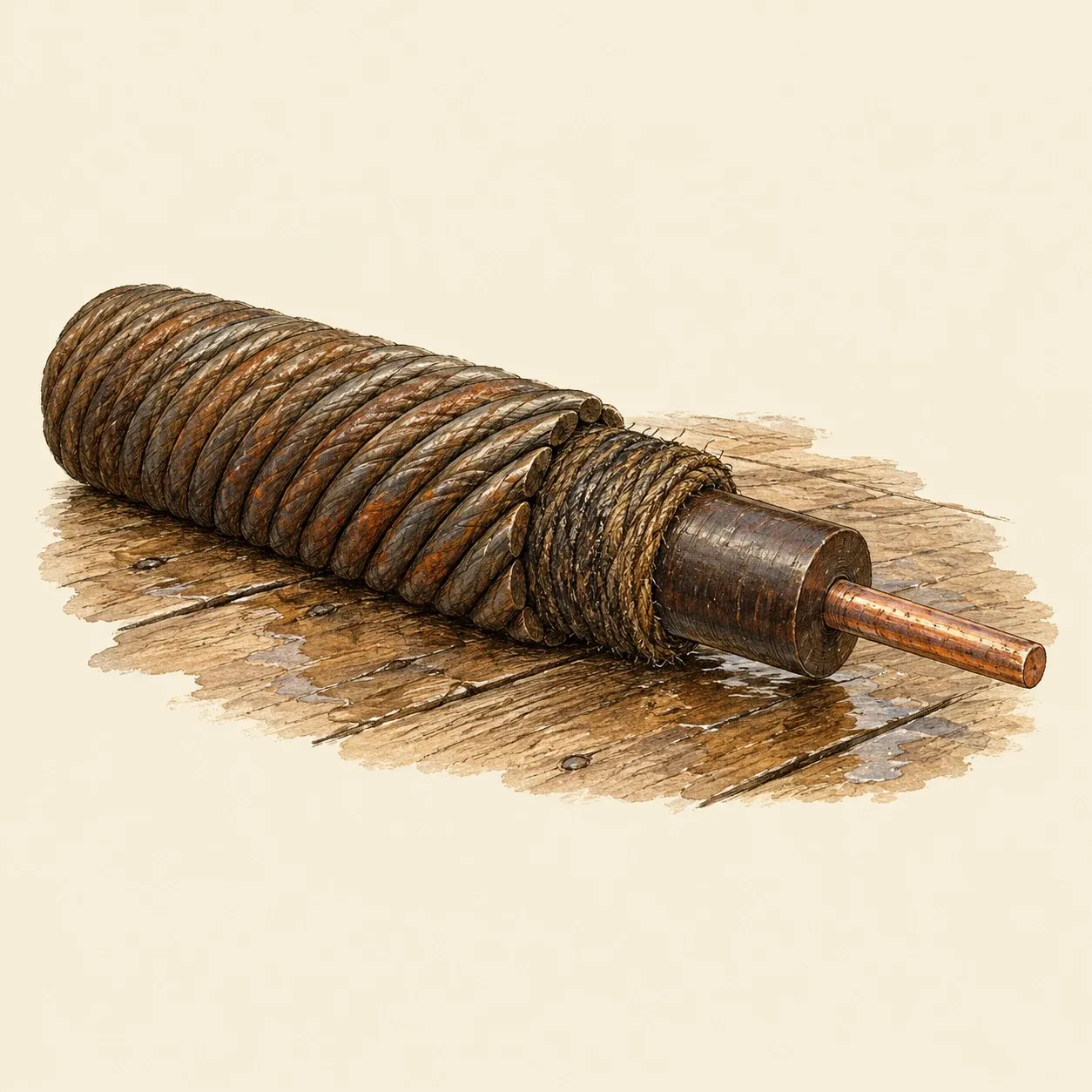 A submarine telegraph cable of the 1850s: copper, gutta-percha, hemp and iron wire armour.
The first cable across the Channel, in 1850, failed soon after it was laid. In 1851 the brothers Jacob and John Brett laid a lasting one from Dover to Calais, with two layers of gutta-percha and an armour of iron wires. The first transatlantic cable of 1858 worked for about a month. The cable of 1865 broke while it was being laid; in 1866 the Great Eastern laid a new one that worked, then recovered the end of the 1865 cable and completed it.
Power cables came with electric lighting. For the power station at Deptford, Sebastian Ziani de Ferranti designed cables for 10,000 volts made of two concentric copper tubes separated by layers of waxed paper. They went into service in 1890 and stayed in use until 1933. Paper insulation sealed in lead became the standard for underground power cables. In 1955 Frank Precopio and Alfred Gilbert of General Electric applied for a patent on polyethylene cross-linked with peroxides, and in 1957 the company applied for another on extruding it onto wire as insulation. Cross-linked polyethylene then began to replace impregnated paper in underground cables.