Eccentric-mass vibrator
Shaking with an off-centre weight
Contents
- 1Metal casing
- 2Electric motor, with field coils and armature
- 3Crescent-shaped eccentric weight on the shaft
- 4Handle mounted on a spring
- 5Rubber applicator
- 6Cord and plug
An eccentric-mass vibrator is an electric motor with a weight fixed off-centre on its shaft. As the weight spins, it tugs the motor first one way and then another, and the whole device shakes. United States patents of the early twentieth century already used this rotating unbalanced weight in electric massagers; today the same principle buzzes in phones and pagers and shakes the vibrating screens of industry.
What it is
An eccentric-mass vibrator turns rotation into shaking. A small electric motor spins a weight that is fixed to one side of its shaft, so that the weight’s centre of gravity lies away from the axis. Nothing in the device moves back and forth. The motor simply turns, and the uneven weight makes everything attached to it tremble.
The idea is found in many objects. Early in the twentieth century it was built into hand-held electric massagers, with a rounded metal body, a handle and a cord. Today a motor a few millimetres long gives the silent alert of a phone, and much larger unbalanced shafts shake the vibrating screens used to sort materials in industry. Some devices put the switch and the speed control in a separate unit, on a cord or linked by radio.
How it works
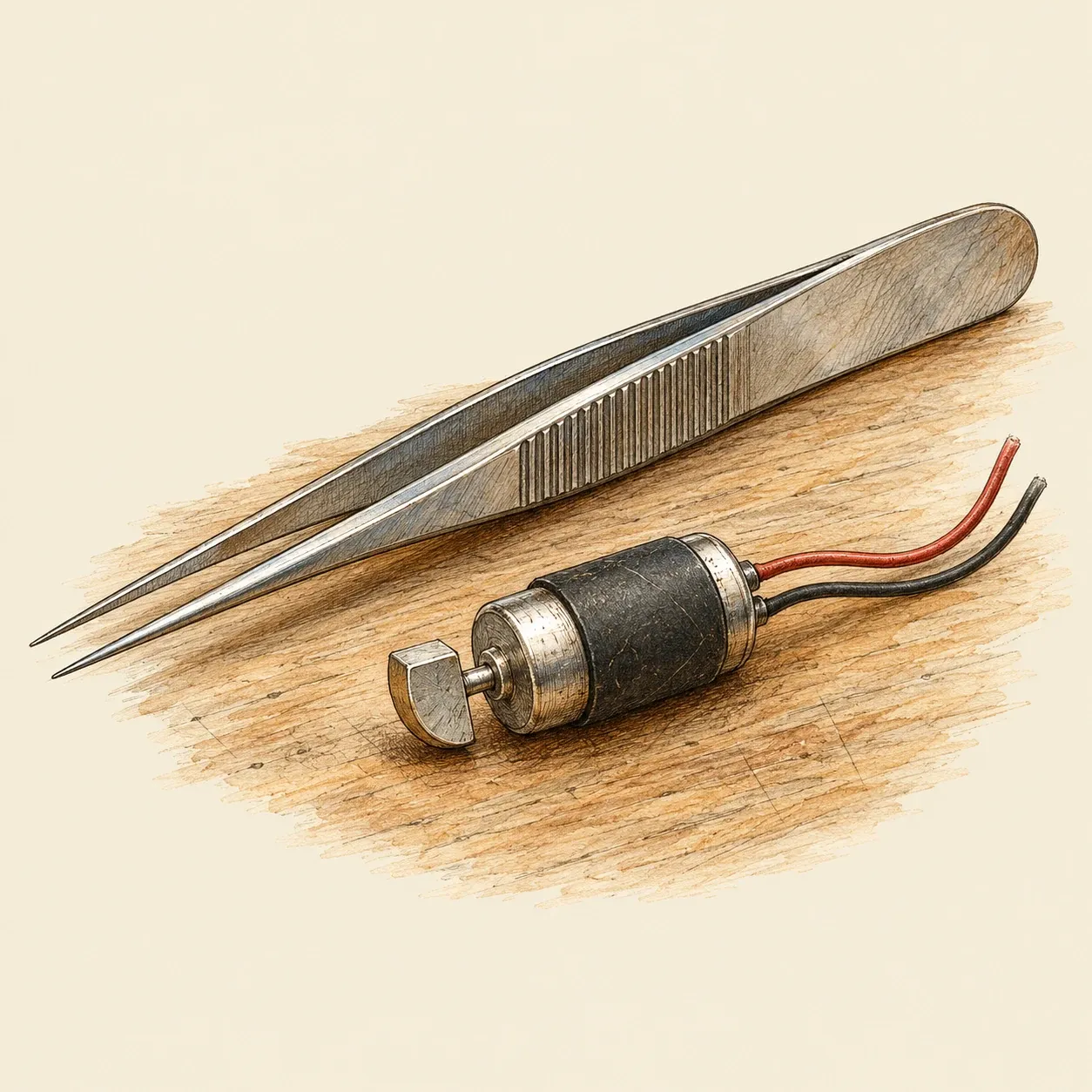 A phone vibration motor: the half-moon weight is all on one side of the shaft.
A weight that turns in a circle has to be pulled towards the centre at every instant, and the shaft does the pulling. In return the weight pulls on the shaft, outwards, towards wherever it happens to be at that moment. As it goes round, this pull points first up, then sideways, then down, then to the other side. The motor and its casing are pushed around in a small circle, and the hand, the table or the frame they rest on feels that as vibration.
The pull equals the mass of the weight, times its distance from the axis, times the square of the speed of rotation. Doubling the speed therefore makes the shaking four times as strong, and the shaking repeats once for every turn of the motor. A small direct-current motor runs faster when it gets a higher voltage, so turning up the voltage makes the buzz both quicker and stronger at once. To change the strength alone, the weight or its distance from the axis has to change. Willis Miller’s vibrator had a crescent-shaped weight that could be moved towards or away from the shaft for this purpose. Moving a weight along the shaft, parallel to the axis, leaves the pull the same and only changes where on the device it acts.
The person holding the device should feel as little of the vibration as possible, which is why Miller hung the handle of his massager on a spring. Two weights turning in opposite directions give a different motion, provided they are equal, turn at the same speed and are kept in step by gearing: their sideways pulls then cancel and their up-and-down pulls add, so the machine shakes along a straight line. Edward Mateer’s patent for vibrating screens treats such geared pairs of weighted shafts as an arrangement already known.
How to do it
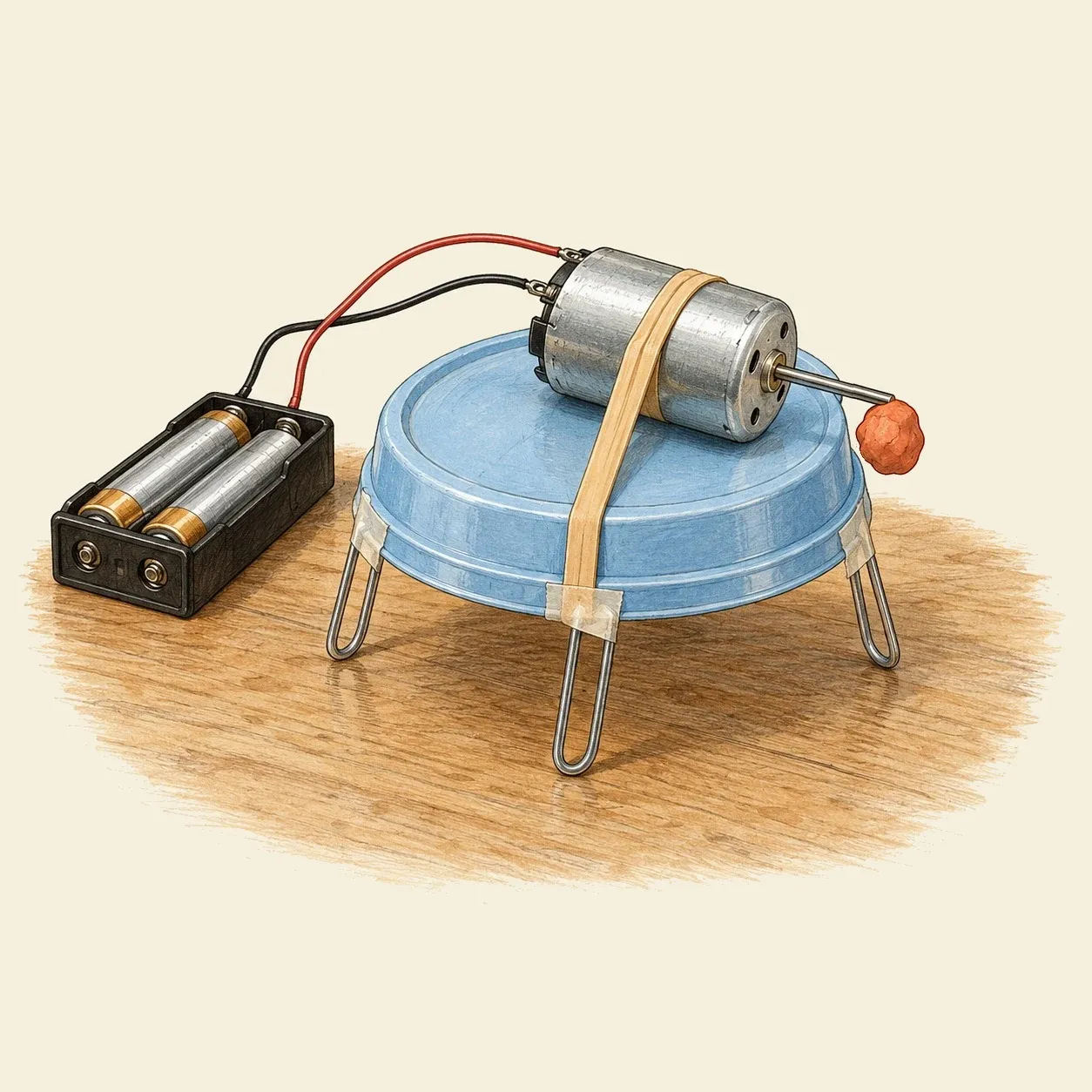 A vibrating walker: the clay blob throws the motor off balance and the lid shuffles across the table.
A vibrating walker shows the principle in a few minutes. You need a small direct-current motor of the kind sold for school science projects, which runs on two AA batteries, a holder for the batteries, a little modelling clay, a plastic lid from a tub, three paper clips and a rubber band or tape. Bend the paper clips into legs and tape them under the lid so that it stands up on its own.
Fix the motor on top of the lid with the rubber band, with its shaft sticking out over the edge. Press a pea-sized blob of modelling clay onto one side of the shaft, or onto a small piece of cork pushed onto it, so that the blob is clearly off-centre. Connect the motor to the battery holder and switch it on. The lid buzzes and shuffles across the table. Keep hair, loose sleeves and your face away from the spinning shaft: a blob that comes loose can fly off.
Now try the changes, disconnecting the batteries each time before you touch the clay. Move the blob closer to the shaft or make it smaller, and the walker calms down. Use a bigger blob and it shakes harder. Centre the clay all round the shaft, and the motor spins smoothly with almost no shaking, which shows that the vibration comes from the imbalance and not from the motor itself. A toothbrush head carrying a tiny vibration motor and a small battery makes a smaller version, often built in science classes.
History and evolution
 Before the spinning weight: a clockwork instrument that tapped with a small ivory hammer.
Earlier vibrating instruments worked by tapping. The English physician Joseph Mortimer Granville described his percuteurs, in which a train of gear wheels driven by a spring worked a lever with an ivory hammer, and announced a version driven by electricity made by the instrument makers Weiss and Sons. An unbalanced weight needs no hammer: plain rotation is enough. Early in the twentieth century George Trotter of Louisville, Kentucky, and William Olson applied separately for patents on electric massagers that shook because the motor turned an off-centre weight: Trotter fitted an adjustable eccentric weight to the motor shaft, and Olson fixed a weight to one side of the armature. Harry Fuller Waite of New York then applied for a patent on a massaging implement with an electric motor in its casing, a plug for a standard electric socket, and vibrations produced by what he called the reaction of a rotating unbalanced weight. Two later patents used the same idea: Charles Elliott unbalanced the armature of the motor itself, and Willis Miller fitted an adjustable weight to the shaft. Both mounted the handle so that it took up the vibration before it reached the hand.
Industry used pairs of unbalanced weights to shake screens. The principle reached small electronics with the pager. Later patents, among them those of Sholly Kagan and Alvin Feder, described radio pagers that vibrated when they were called; in Feder’s, the weight swung further out as the motor sped up. Tiny vibration motors became common in pagers and then in mobile phones, where they are still widely used. They run from the same battery as the rest of the device, and their motor is a miniature electric motor of the ordinary kind.