Synthetic nitrogen fertiliser
Nitrogen from the air for the fields
Contents
- 1Nitrogen fixation works
- 2Sacks of fertiliser
- 3Fertiliser spread on the soil
- 4Wheat crop
- 5Roots taking up nitrogen from the soil
Synthetic nitrogen fertiliser carries nitrogen taken from the air by industry to the roots of crops. Nearly all of it now starts as ammonia made from atmospheric nitrogen and hydrogen by the Haber-Bosch process. An experimental works at Westeregeln, in Germany, began making calcium cyanamide fertiliser from the nitrogen of the air at the end of 1904, arc works followed in Norway from 1905, and the first ammonia synthesis plant started at Oppau, in Germany, in 1913.
What it is
Crops need a good deal of nitrogen, which goes into their proteins and their green chlorophyll. The air around them is mostly nitrogen, but in a form they cannot use. They take it from the water in the soil, as nitrate or ammonium, and every harvest carries some of it away from the field. Farmers long gave it back with manure and with legumes, whose root bacteria fix nitrogen from the air, as in crop rotation. In the nineteenth century they also bought it, above all as saltpetre from Chile and as ammonium sulphate recovered from gasworks.
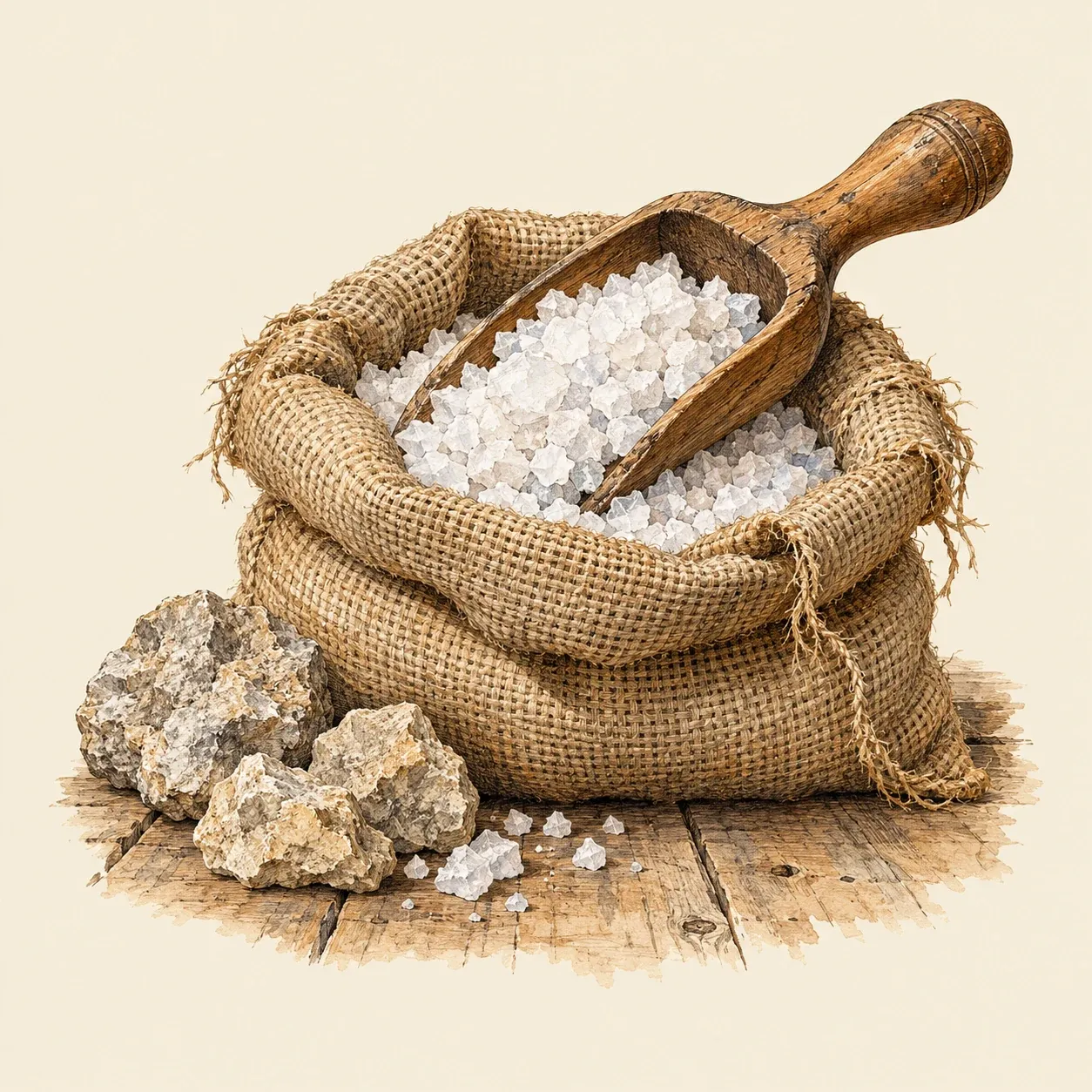 Chilean saltpetre, refined from caliche rock, was the main nitrogen fertiliser on the market before 1914.
Synthetic nitrogen fertiliser is nitrogen taken from the air by an industrial process and sold in a form that dissolves in the soil water. Nearly all of it now starts as ammonia, a compound of nitrogen and hydrogen. Some ammonia goes into the soil as it is, but most is made into other fertilisers, among them urea and, in the first years of the synthesis, ammonium sulphate. Before ammonia took over in the 1920s, two other industrial processes of the early twentieth century sold nitrogen from the air to farmers: calcium nitrate made with an electric arc, and calcium cyanamide.
How it works
The difficulty lies in the nitrogen molecule. Its two atoms are bound so tightly that only a great deal of energy separates them, and in nature this is mainly the work of certain soil bacteria. The industrial processes supply the energy as electricity or as heat from coal and gas.
The arc process of Kristian Birkeland and Sam Eyde used an electric arc to make a little of the nitrogen in the air combine with oxygen; what farmers bought in the end was calcium nitrate. In the cyanamide process, nitrogen was bound to calcium in electric furnaces, and the calcium cyanamide that resulted gives off ammonia in moist soil. Both used a great deal of electricity. The Norwegian arc works stood beside waterfalls, with generators driven by water; the cyanamide works at Knapsack, in Germany, was built on a lignite field and generated its electricity in its own power station.
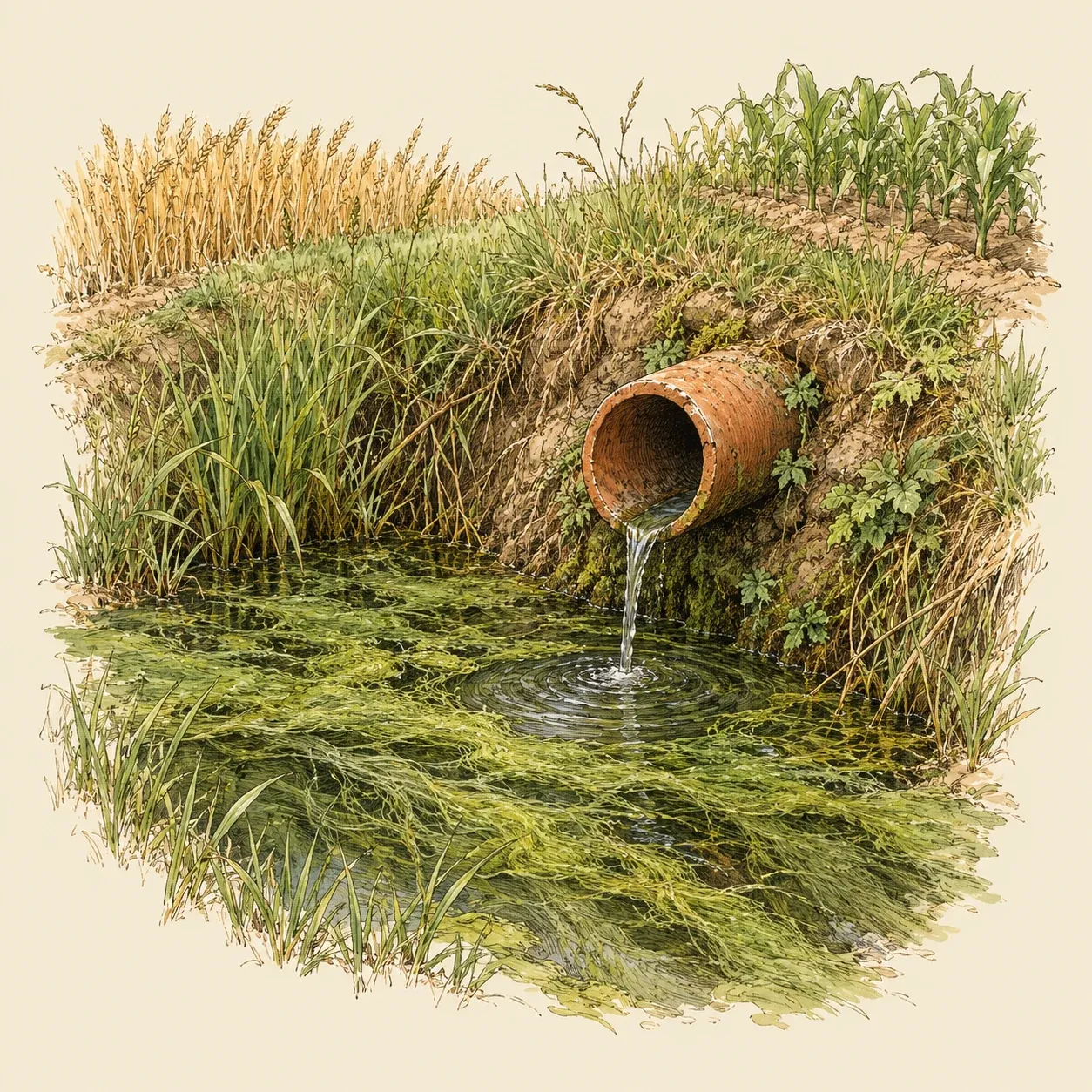 Nitrate that the crop does not take up drains out of the fields and feeds algae in ditches and rivers.
The Haber-Bosch process, which replaced them, combines nitrogen from the air with hydrogen to give ammonia. It needs far less electricity than the arc. The hydrogen now comes mostly from natural gas and, for most of the rest, from coal, so ammonia plants burn a great deal of fossil fuel and release a large amount of carbon dioxide.
In the field, the crop takes up the nitrate and ammonium dissolved around its roots. Nitrogen it does not use can be lost. Nitrate moves with water: it seeps down to the groundwater or runs off into ditches and rivers, where together with phosphorus it feeds algae, and when the algae die and rot the water runs short of oxygen. Some nitrogen also escapes to the air as ammonia, or as nitrous oxide, a greenhouse gas.
History and evolution
Until 1914, saltpetre from the caliche deposits of Chile supplied most of the nitrogen fertiliser sold in the world, and many feared that the deposits would run out. Chemists and engineers in several countries looked for a way to take nitrogen from the air instead.
Calcium cyanamide, which Adolph Frank and Nikodem Caro had learned to make from the nitrogen of the air, was proposed as a fertiliser in 1901. A rival process for making it was taken up in 1904 at Westeregeln, near Magdeburg, in Germany, where an experimental works began operating at the end of that year; Anthony Travis notes that it proved uneconomic. In Italy, he writes, the company of Frank and Caro set up a factory at Piano d’Orta around 1905; its first attempts failed, and production began in 1907. The Danish encyclopedia Lex dates the start of industrial production of calcium cyanamide to 1905, the company history of Evonik to 1908.
In Norway, the physicist Kristian Birkeland and the engineer Sam Eyde joined forces on the arc furnace in 1903, and in 1905 work began on a small factory at Notodden, supplied by a nearby hydroelectric station. Norsk Hydro was founded the same year, and its calcium nitrate went on sale as Norwegian saltpetre.
In Karlsruhe, Fritz Haber looked for a way to make nitrogen and hydrogen combine directly. By 1909 a bench apparatus he had built with Robert Le Rossignol produced liquid ammonia, and the chemical company BASF, which had taken up the process, gave Carl Bosch the task of making it work on an industrial scale. His team took it from the laboratory bench to large steel converters. The first plant started at Oppau, near Ludwigshafen, in 1913, and its ammonia was turned into ammonium sulphate for farmers.
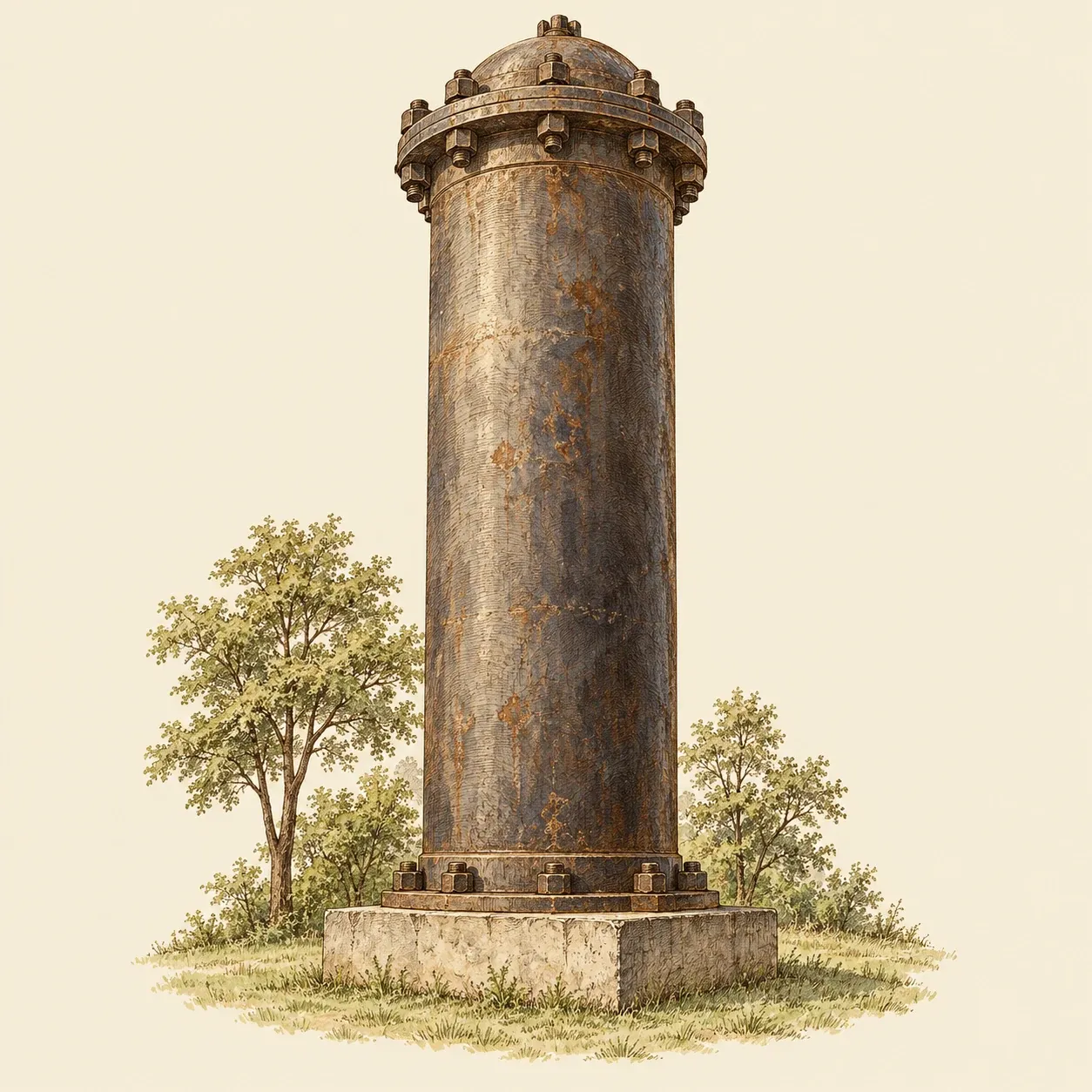 An ammonia converter from the Oppau works, now kept as a monument in Karlsruhe.
During the First World War Germany, cut off from Chilean saltpetre, turned much of the new ammonia into nitric acid for explosives, and opened a second, larger works at Leuna in 1917. Haber received the Nobel Prize in Chemistry for 1918, and Bosch shared the prize of 1931. By the mid-1920s Haber-Bosch had become the main way of fixing nitrogen, and Norsk Hydro itself built ammonia plants to replace its arc furnaces in 1928 and 1929.
Fertiliser use grew fast with the intensive farming that followed the Second World War. Vaclav Smil estimated that 40% of the world’s people in 2000 depended on food grown with synthetic nitrogen, and the team of Jan Willem Erisman put the share at 48% in 2008. The costs grew with it. The European Union adopted its Nitrates Directive in 1991 because of nitrate in groundwater and algal blooms in rivers and seas, and ammonia remains one of the most carbon-intensive products of heavy industry.