Battering Ram
A swinging beam against gates and walls
Contents
- 1Roof covered with raw hides
- 2Timber frame of the shed
- 3Suspension ropes
- 4Ram beam
- 5Metal head
- 6Wheels
A battering ram is a heavy beam driven again and again against a gate or a wall. In its developed form the beam hangs by ropes inside a roofed shed on wheels, so the crew only has to swing it, while hides on the roof protect them from fire and missiles. Texts from Ebla in Syria mention rams with a metal tip in the 24th century BC, and rams remained a standard siege engine until late antiquity.
What it is
A battering ram is a long, heavy beam used to strike a gate or the face of a wall again and again until it gives way. The simplest ram was a tree trunk carried and swung by a group of men. The developed ram of the Hellenistic and Roman world hung from the roof of a timber shed on wheels. Vitruvius, the Roman architect, calls such a shed the tortoise of the ram, because it moved slowly and sheltered the men inside as a shell does.
In a ram of this kind, the frame of the shed carries a ridge beam from which the ram hangs on ropes. The front end of the beam carries a heavy metal head that projects through an opening at the front. The roof and sides are covered with raw hides sewn together, which arrows and burning material could not easily get through, and the whole shed rolls on solid wooden wheels.
How it works
A hanging ram works like a pendulum. The ropes carry the weight of the beam, so the crew does not have to lift it. They pull the beam back by hand or with short ropes, let it swing forward and add a push as it goes. Each blow lands on the same spot. In the 4th century AD Ammianus Marcellinus described the beam hanging from a crossbeam like the arm of a balance, drawn back by many men and driven forward in repeated blows until the wall cracked.
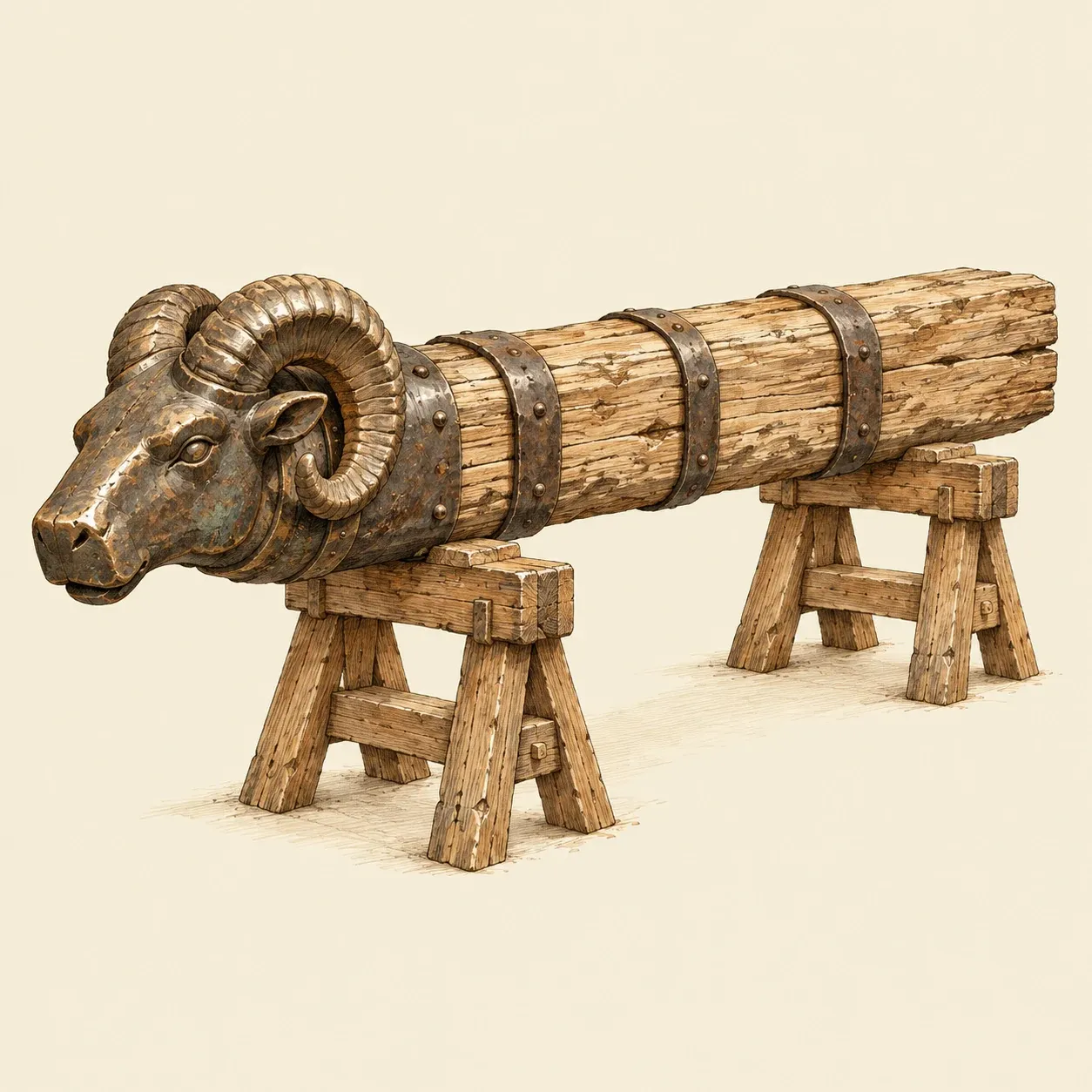 The metal head took the blows and protected the end of the timber from splitting.
The head concentrated the blow and protected the end of the timber, which would otherwise have split. The texts from Ebla speak of the tongue of the ram and of metal supplied for it, probably copper or bronze. Ammianus describes a head of iron shaped like the head of a ram, which gave the machine its name in Greek and Latin.
The shed mattered as much as the beam, because the crew had to work at the foot of the wall within easy reach of the defenders. Vitruvius describes sheds covered with planks, then with wickerwork, and then with raw hides stuffed with seaweed or with straw soaked in vinegar, to resist both missiles and fire. The defenders had their own answers. A relief from the palace of the Assyrian king Ashurnasirpal II at Nimrud shows men on the wall lowering a chain to catch the ram and turn it aside.
How to do it
A tabletop model shows how a hanging ram swings. It needs a board, four strips of wood for two A-shaped trestles, a round dowel for the ridge, a thicker dowel or broom-handle offcut about 30 cm long for the ram, string, small screws, wood glue, a drill and a saw, and a few wooden building blocks.
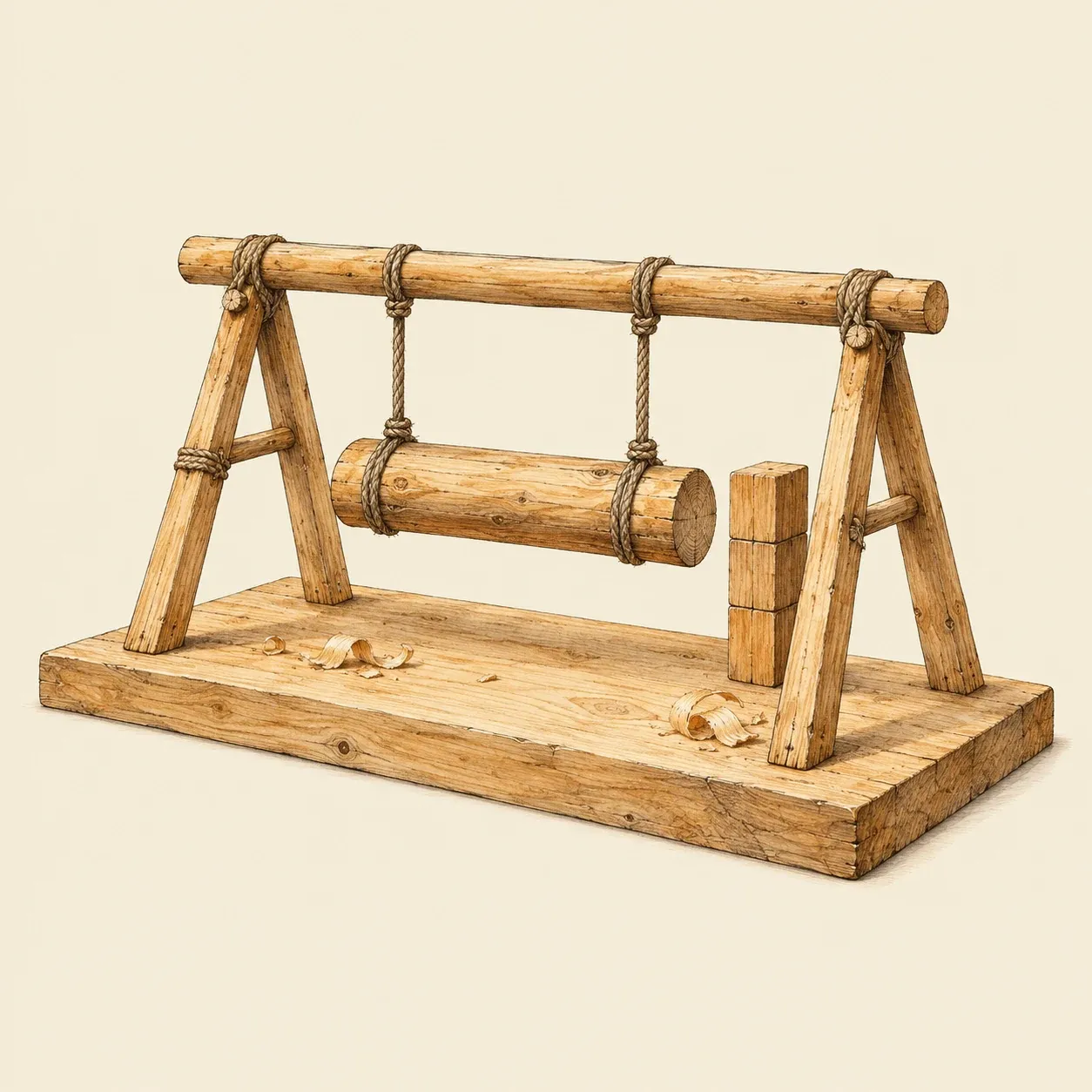 On the model, the ram hangs level from two strings and swings into a tower of blocks.
Make two A-shaped trestles by gluing and screwing two strips together at the top of each, and fix them upright at either end of the board. Drill a hole near the top of each trestle and push the ridge dowel through both. Drill a small hole across the ram near each end, thread a string through each, and tie both strings to the ridge so that the ram hangs level a few centimetres above the board. Build a small tower of blocks just in front of one end of the ram. Pull the ram back and let it go: watch how far each blow moves the blocks, and how a few small blows in the same place can do what one push cannot.
Safety. Keep fingers away from the path of the ram and from the falling blocks.
History and evolution
The archives of Ebla, in Syria, from the 24th century BC, use a word that Piotr Steinkeller, an Assyriologist at Harvard, identified in 1987 as the battering ram: literally the one-horned bull. A treaty between Ebla and Abarsal speaks of the rams and siege engines one party will supply. Accounts from Ebla record metal, probably copper, for the tongue of the ram of a city called Armi, and wool for a piece of felt to cover a ram. In the 18th century BC the kings of Mari, on the Euphrates, wrote of rams as ordinary equipment of a siege.
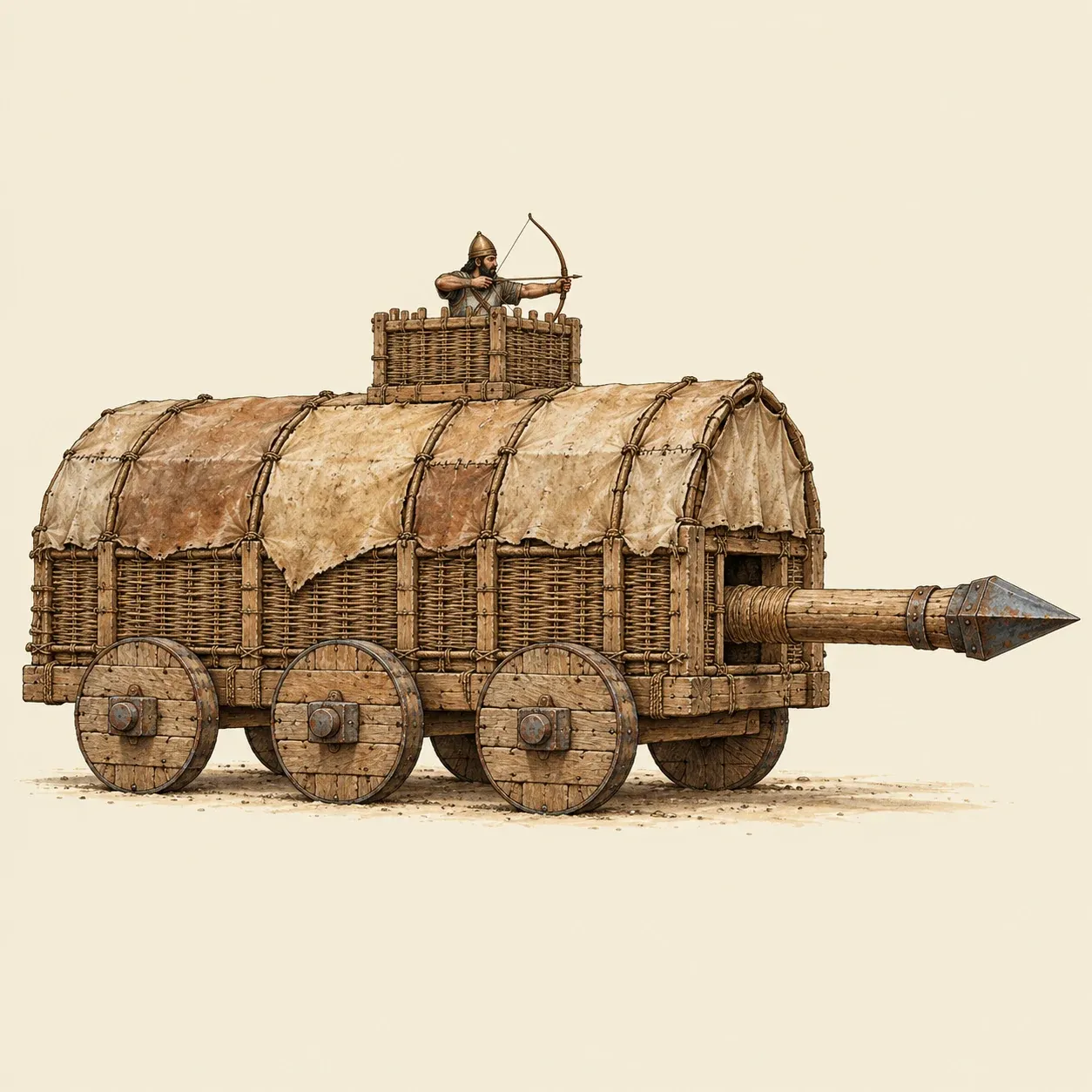 Assyrian reliefs show rams mounted in covered engines, with a turret for an archer.
The Assyrian kings had their sieges carved on the walls of their palaces. On a relief from Ashurnasirpal II’s palace at Nimrud, made between 865 and 860 BC and now in the British Museum, the ram of an Assyrian siege engine has broken the wall of a city, and bricks are falling.
The Greeks came to rams late. Sean Manning, a historian of ancient warfare, notes that rams are missing from early Greek art and poetry. The historian Diodorus writes that during the siege of Samos in 440 BC, Pericles’ engineer Artemon of Clazomenae was the first of all men to build rams and tortoises; by then rams had been in use in the Near East for some 2,000 years. Vitruvius tells a different story, in which the Carthaginians besieging Gades first swung a beam by hand, Pephasmenos of Tyre hung it from a frame, and Cetras of Chalcedon put the frame on wheels and roofed it with ox hides. He also describes a huge tortoise designed by Hegetor of Byzantium, whose ram was worked by a hundred men. Ammianus Marcellinus, writing in the late 4th century AD, still describes the hanging ram, though he adds that an armoured engine called the helepolis, a name first given to a great siege tower, had come to be preferred to it.