Siege Tower
A moving timber tower to reach the walls
Contents
- 1Top parapet
- 2Covering of raw hides
- 3Shuttered port
- 4Floors and stairs
- 5Wheels and base frame
A siege tower is a tall timber tower on wheels, pushed up to a city wall so that attackers can shoot down on the defenders or climb onto the wall. Its storeys are linked by stairs and its outside is covered against fire. Letters from Mari on the Euphrates already describe siege towers in the 18th century BC, and such towers were still built for the siege of Jerusalem in 1099.
What it is
A siege tower is a movable tower of timber, built near a besieged town and pushed up against its wall. From its upper floors archers and, later, catapults could shoot down onto the defenders, and from its top the attackers could try to get onto the wall itself. A tower built higher than the wall gave the attackers the advantage of height that the wall normally gave to the defenders.
The Roman architect Vitruvius, following Diades, an engineer of Alexander the Great, describes towers of ten storeys or more, narrowing towards the top, with windows on every side and on each floor a parapet covered with raw hides against arrows. The great tower that Demetrius built at Rhodes had on its front a port on each storey closed by a shutter, and its frame of heavy beams stood on eight wheels.
How it works
A tower that is tall and narrow topples easily, and it had to be moved over rough ground right up to the foot of a wall. Its builders kept it stable in two ways. They made the base broad and the top narrower: Vitruvius says the top should be a fifth narrower than the base. And they kept the heaviest parts low: thick beams in the base frame, and the wheels and axles under it. The lower the centre of weight and the broader the base, the further the tower can lean before it tips over.
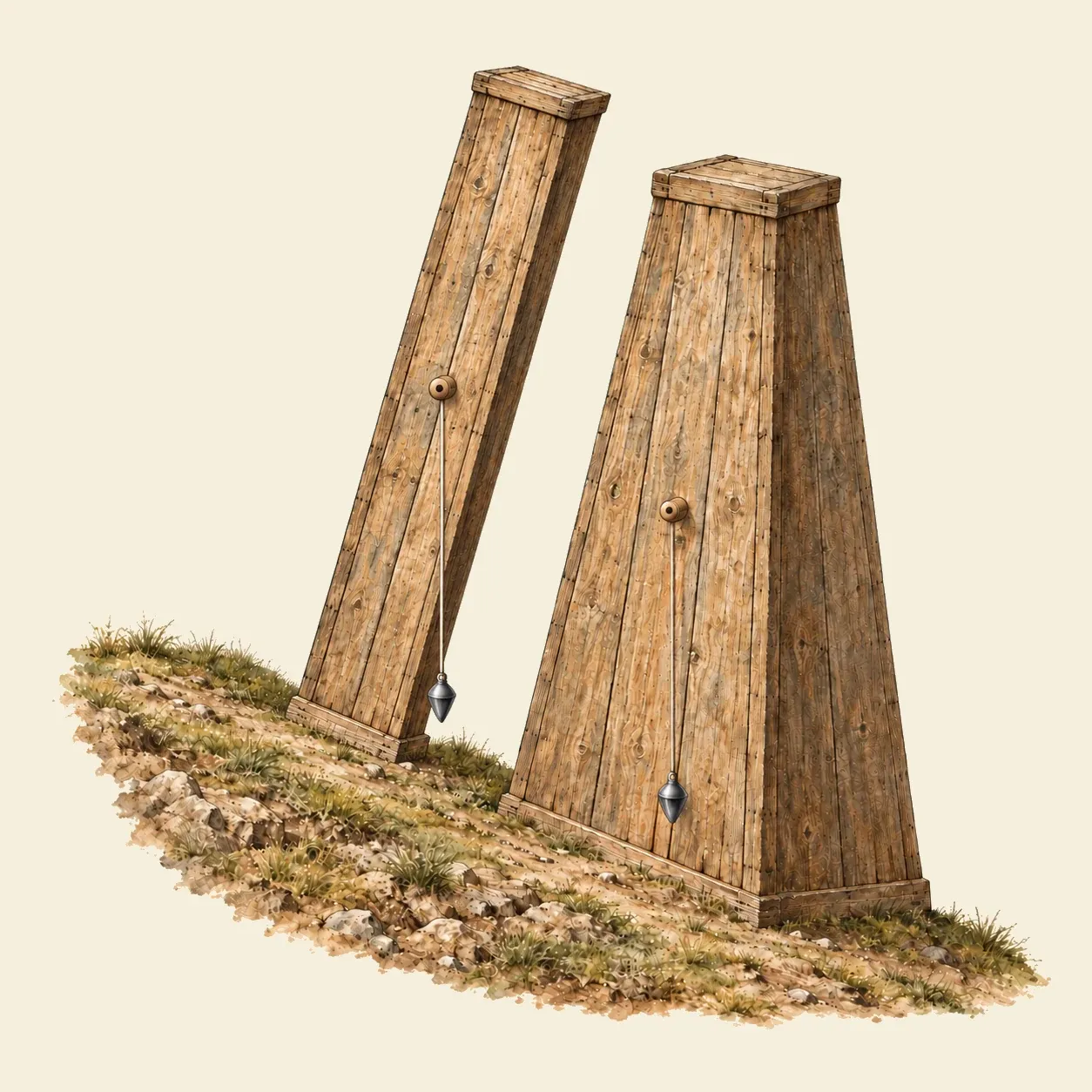 A tower tips over when the vertical through its centre of weight passes outside its base; a broad foot and a narrow top keep it inside.
The ground still had to be prepared. Attackers levelled a path and filled in the ditch in front of the wall, often under the cover of roofed sheds. Diodorus says the great tower of Demetrius at Rhodes had pivots on its wheels so that it could be turned in any direction, and that about 3,400 men, some inside and some behind, pushed it forward.
The crew inside had to be protected from missiles and above all from fire. The tower of Demetrius had iron plates nailed on its three exposed sides. Each storey had ports sized for the catapults that shot from them, closed by shutters of hides stuffed with wool, which a mechanism raised and lowered. Vitruvius covers the parapet of every floor with raw hides, and Ammianus Marcellinus describes an armoured engine covered with ox hides, hurdles of green twigs and mud. Inside, each storey of Demetrius’ tower had two broad stairways, one for carrying up ammunition and one for coming down.
How to do it
A cardboard model shows why siege towers were broad at the foot and weighted low. It needs corrugated cardboard, a ruler, a craft knife and cutting mat, glue, a dozen metal washers, a flat board about 40 cm long, a few books to prop it up and a protractor.
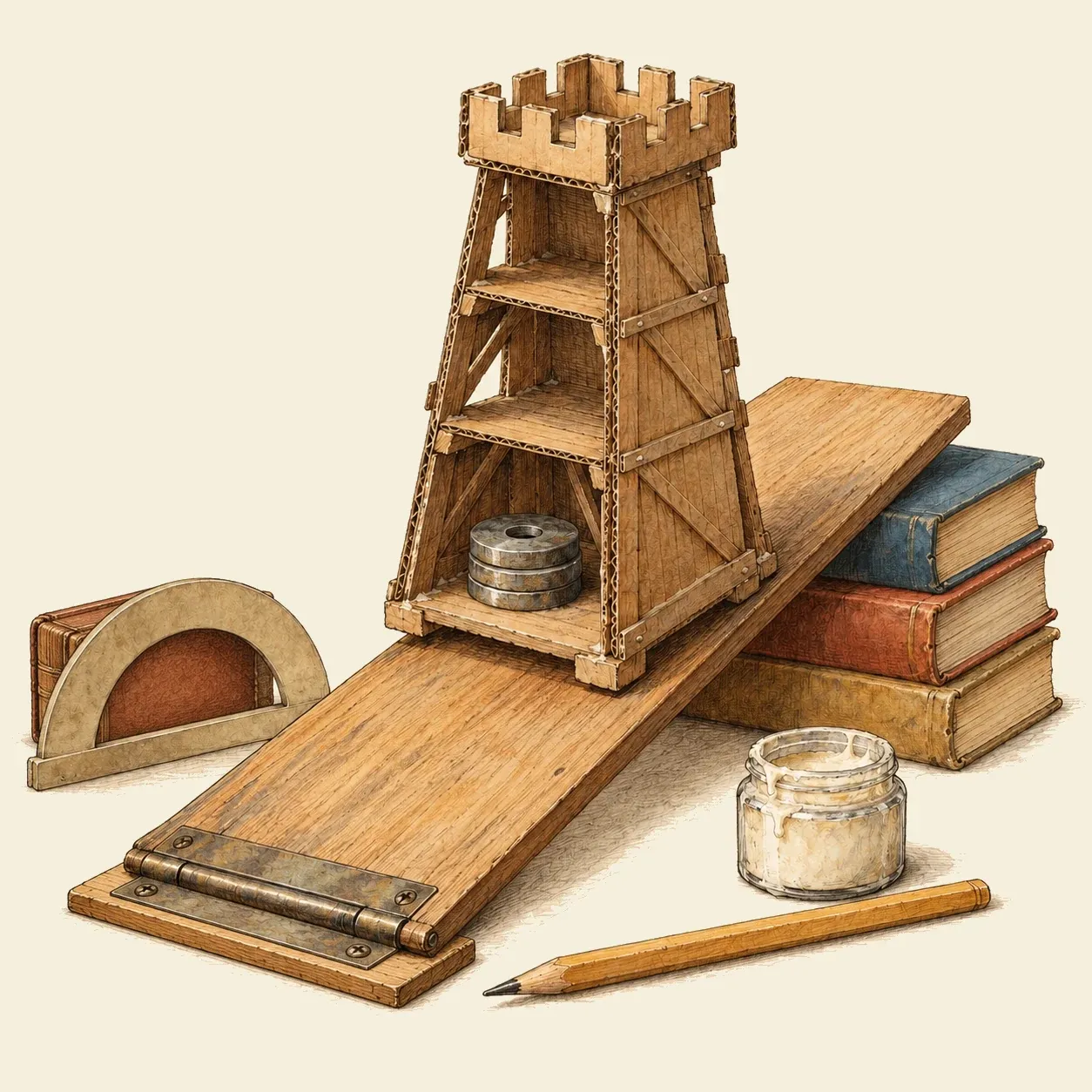 Tilting the board little by little shows at what angle each version of the tower falls.
Cut and glue two square tubes of the same height from cardboard: one straight, with the same width from top to bottom, and one whose sides lean inward so that its top is a fifth narrower than its base. Give each a few cardboard floors. Stand the straight tower on the board and raise one end of the board on books, a little at a time, until the tower tips over; note the angle with the protractor. Do the same with the tapered tower. Then glue the washers to the top floor of a tower and test it again, and finally move them to the bottom floor. The tapered tower weighted at the bottom should stand at the steepest angle.
History and evolution
Cylinder seals from Tell Beydar in Syria, of about 2400 to 2250 BC, have been read as showing siege towers and rams, but the reading is disputed. A stone relief found by chance in 2016 near Harput, in eastern Turkey, shows the capture of a fortified city, with a tall wooden tower standing by its walls while the city burns. Eşref Abay, Bülent Demir and Veli Sevin, who published it, date it to the early 2nd millennium BC from its style and from the Middle Bronze Age pottery found with it. Demir calls it the first picture of such a tower found in Anatolia or Mesopotamia and notes that Hittite texts mention these towers. In the 18th century BC, letters from Mari on the Euphrates describe siege towers and battering rams brought up earthen ramps to the walls of besieged cities.
On reliefs from the palace of the Assyrian king Ashurnasirpal II at Nimrud, made between 865 and 860 BC, an archer shoots from inside a wooden tower while the ram of an Assyrian siege engine breaks a city wall. In the Greek world, Diades, one of Alexander’s engineers, built towers that could be taken apart and carried. The largest tower of antiquity on record was the helepolis, the city-taker, that Demetrius built for his siege of Rhodes in 305/304 BC. Diodorus describes it as nine storeys high on a square base of almost 50 cubits a side, with catapults on every floor. The Rhodian engineer Diognetus defeated it by pouring water and mud onto the ground in its path, according to Vitruvius, so that it sank and could not be moved.
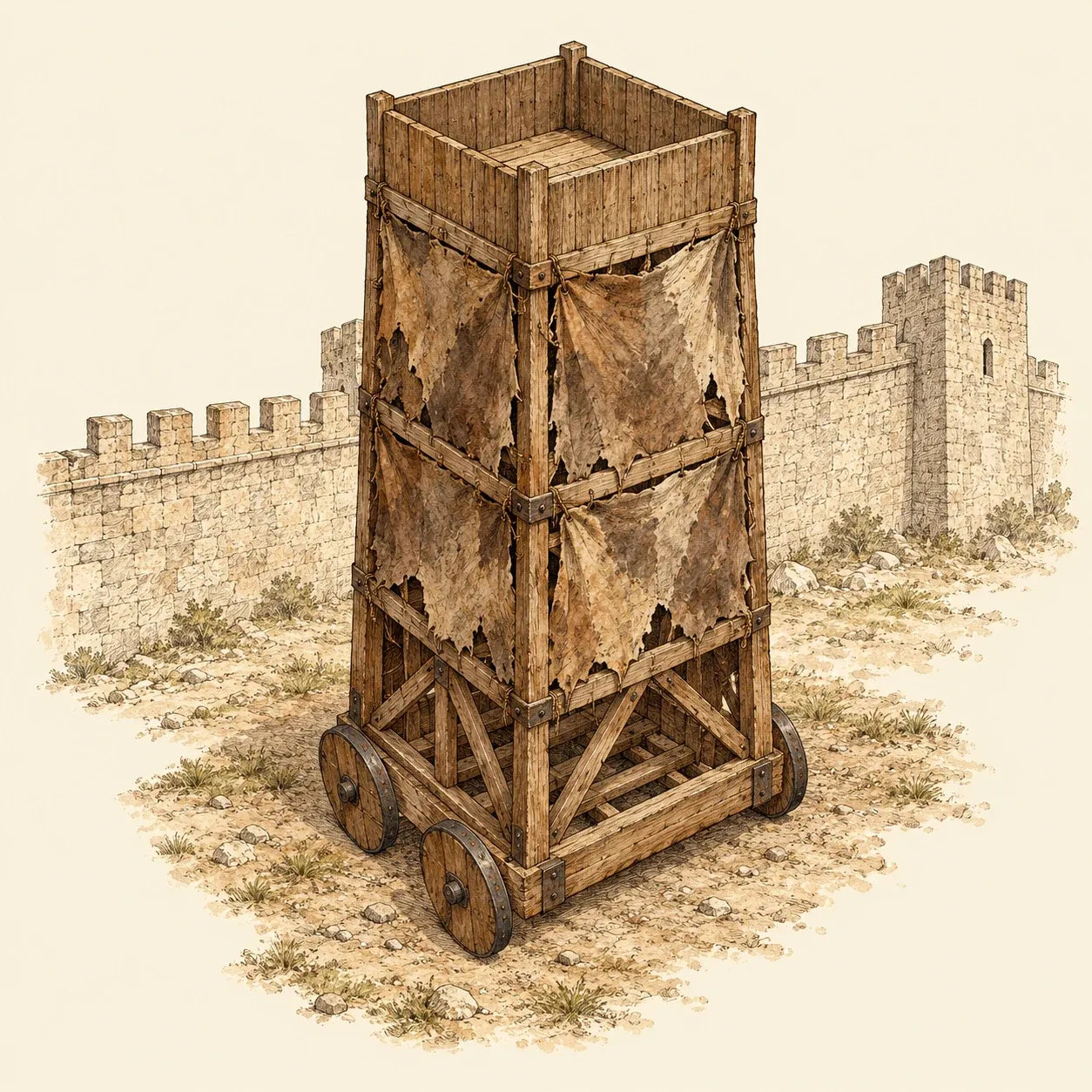 Medieval siege towers were still built of timber and rolled up to the walls on wheels.
The Romans used siege towers in their turn, and in the 4th century AD Ammianus Marcellinus describes a covered engine called the helepolis that was rolled up to the weakest part of a wall. Siege towers were still used in the Middle Ages. During the First Crusade, the army besieging Jerusalem in July 1099 built two wooden towers, one for Godfrey of Bouillon and one for Raymond of Toulouse, with timber that had to be brought from far away. A ditch had to be filled before Raymond’s tower could be moved up to the wall. From Godfrey’s side, a knight named Lethold climbed onto the wall, and the city was taken on 15 July.