Surgical instruments
Tools to cut, grasp, explore and stop bleeding
Contents
- 1Iron scalpel blade set in a bronze handle
- 2Blunt leaf-shaped end of the same handle
- 3Spring forceps
- 4Probe with an olive tip and a spatula
- 5Sharp hook
- 6Bone lever
Surgical instruments are the surgeon's hand tools: blades that cut, forceps that grasp, probes that explore, hooks that hold tissue aside and clamps that stop bleeding. A bronze lancet is named in the laws of Hammurabi, king of Babylon around 1750 BCE, and a Roman surgeon's house at Rimini held about 150 instruments of bronze and iron.
What it is
A surgeon’s instruments extend the hand. Each does one of a few jobs: cutting, grasping, exploring a wound, holding tissue aside, working on bone or stopping bleeding. A set gathers several of each in different sizes and shapes, because the right tool depends on the tissue and on how deep it lies.
A Roman kit of the first to third centuries CE, of the kind found at Pompeii and Rimini, already had most of these jobs covered. The scalpel had an iron blade slotted into a bronze handle, whose other end was a blunt leaf for separating tissue without cutting it. Next to it lay spring forceps bent from a single strip, a probe with an olive tip at one end and a spatula at the other, a sharp hook and a lever for bone.
How it works
A blade puts the force of the hand onto a very thin edge, so it parts tissue with little pressure and little crushing. The edge must be hard to stay sharp. The Sushruta Samhita asks for instruments of good, pure iron made by a skilled smith, and counts as faulty a blade too blunt to split a hair. Iron and then steel blades took the place of bronze.
Spring forceps are a strip of metal bent double. Squeezing the arms closes the jaws, and the spring of the metal opens them again when the fingers relax. Forceps with finger rings work like scissors: two levers turn on a pivot, and long handles with short jaws turn a light grip into a firm hold. Fine ridges across the jaws keep tissue from slipping.
A probe follows a wound or a channel to find its depth and direction, or a foreign body lodged in it, without cutting anything. The Sushruta Samhita notes that a finger or a hair will do when no probe is at hand. Hooks, blunt or sharp, and later retractors pull the edges of a wound apart so that the surgeon can see inside.
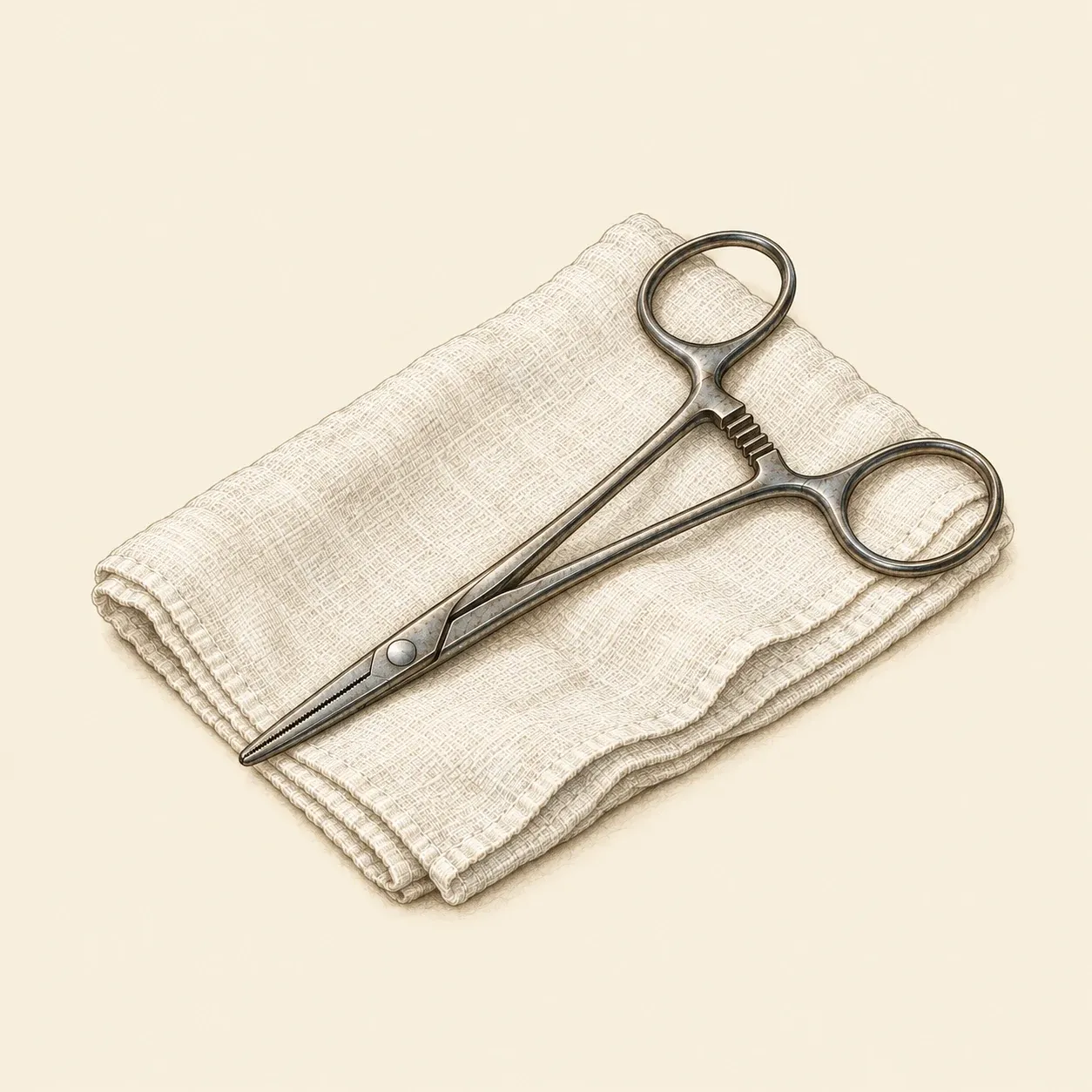 Once the ratchet near the rings is engaged, the forceps stay shut on the vessel without anyone holding them.
Bleeding was first stopped by pressure, by tying vessels or by heat. Al-Zahrawi, around 1000 CE, used cautery in some fifty kinds of operation, burning the tissue with heated irons. In the nineteenth century came artery forceps, clamps that crush the end of a vessel and stay shut. Thomas Spencer Wells added a ratchet that locks them, where before an assistant had to hold them closed, and Jules Péan sometimes left his forceps on vessels for hours.
An instrument that enters the body must also be free of germs. Handles of ebony, ivory or wood could not be cleaned properly, so after the arrival of antiseptic and aseptic surgery instruments were made entirely of metal, smooth and with few joints, to stand boiling or steam.
How to do it
These spring tweezers are for picking up small things such as seeds, beads or watch screws. They show how spring forceps work and are not for use on the body.
From brass sheet about half a millimetre thick, cut a strip 8 mm wide and 15 cm long with tin snips. File the cut edges smooth, round the four corners and run a gloved finger along every edge to check that no burr is left.
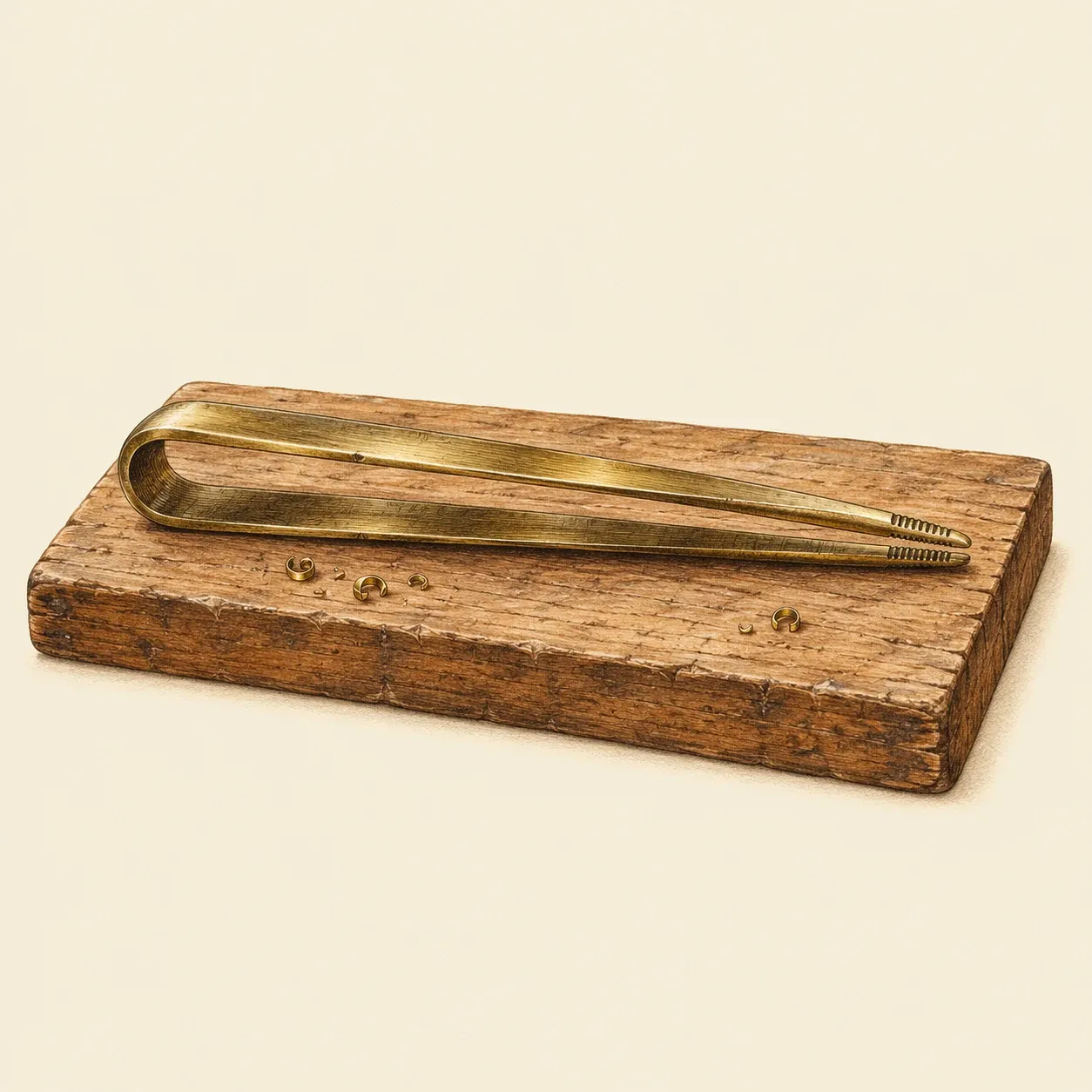 The U-bend is the spring: the closer and rounder it is, the more evenly the arms open.
Mark the middle of the strip. Clamp a round steel rod about 8 mm across in a vice, lay the strip over it at the mark and press both halves down around the rod until they face each other. Take the strip off the rod and squeeze the arms together so that the tips meet, then let go. They should spring back open by about a finger’s width. If one tip passes the other, twist that arm gently with flat pliers until the tips meet square. File the ends of the tips to a blunt point and file a few small grooves across the inner face of each tip with the edge of a fine file. Test them on a grain of rice: it should stay put when you squeeze lightly.
History and evolution
The oldest known operations were done with ordinary blades. At Ensisheim in Alsace, a man buried between 5100 and 4900 BCE had survived two operations in which pieces of his skull were removed. Openings like these, called trepanations, were cut, drilled or scraped through the bone with flint blades.
The oldest text to name an instrument kept for surgery is the law code of Hammurabi, king of Babylon from 1792 to 1750 BCE. It sets the fee of a physician who makes a deep incision or opens a man’s temple with a bronze lancet and saves him or his eye: ten shekels of silver for a free man. If the patient dies or loses the eye, the physician’s hand is to be cut off. More than a thousand years later, a medical encyclopedia from Nineveh still prescribed pricking an aching temple with a bronze knife.
The Sushruta Samhita, a Sanskrit encyclopedia of medicine about two thousand years old, counts 101 blunt instruments, of which it calls the hand the most important, and 20 sharp ones. Its forceps are named after the animals whose mouths their jaws copy, from lions and wolves to crows and vultures.
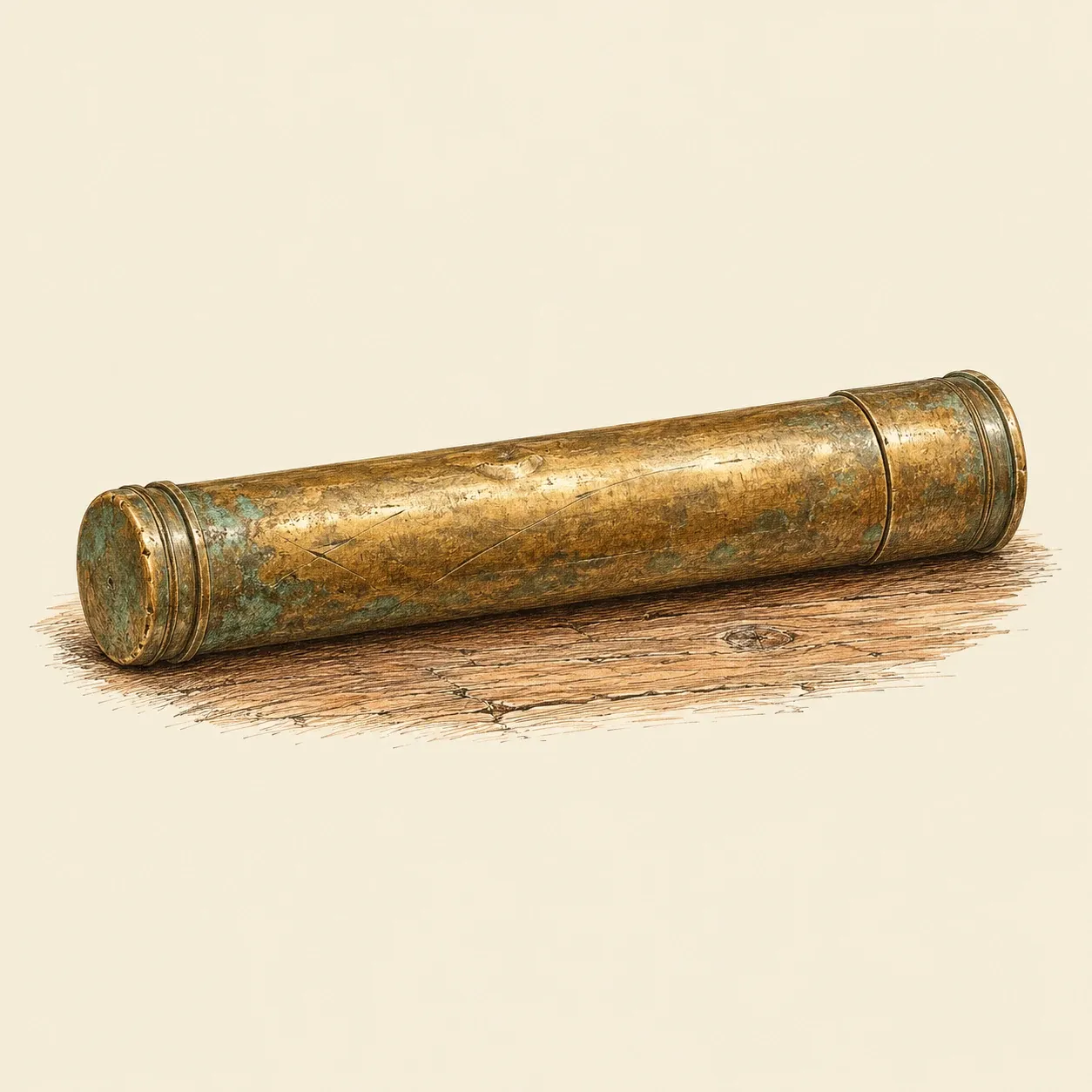 Roman surgeons kept their probes and forceps in cases such as the cylindrical one found at Pompeii.
Roman surgeons kept their instruments in cases and boxes. A set from Pompeii, buried in 79 CE, holds probes and forceps in a cylindrical case. In Rimini, building work in 1989 uncovered a house that fire had destroyed in the middle or late third century, with about 150 instruments of bronze and iron: scalpels, probes, forceps, dental forceps, levers for setting bones, a drill and tools for removing bladder stones. A scalpel handle found at Caerleon in Wales still holds the tang of its iron blade in a slot at one end, with a flat leaf-shaped end at the other.
Around the year 1000, Al-Zahrawi in Muslim Spain described more than 200 instruments in his surgical treatise. His drawings of them are among the earliest made to teach their use and to guide the people who made them. In 1902 the American surgeon Nicholas Senn praised plain instruments whose knives and retractors were forged from a single piece of steel, the shape aseptic surgery called for. In 1915 Morgan Parker patented in the United States a scalpel in two pieces, a metal handle and a detachable blade, so that a blunt blade could simply be replaced.