Surgical sutures
Closing a wound with needle and thread
Contents
- 1Curved needle with an eye
- 2Thread leaving the eye
- 3Square knot set beside the wound
- 4Wound edges brought together, slightly raised
- 5Loop of thread through the skin and the fat beneath
A surgical suture holds the edges of a wound together with thread carried by a needle, so that the tissue can knit with a narrow scar. The oldest known mention is in the Edwin Smith papyrus, an Egyptian surgical treatise copied around 1600 BCE, which tells the surgeon to draw gaping wounds together with stitches.
What it is
A suture is a stitch, or a row of stitches, that holds the two edges of a wound against each other until the body has joined them. A needle carries the thread in through the skin on one side, across the wound and out on the other side, and the two ends are tied. When the wound has knitted, the thread is cut and pulled out, unless it is made of a material that the body breaks down by itself.
The needle and thread are those of hand sewing, adapted to living tissue. The needle is often curved, so that it goes in and comes out through the same surface. The thread has to hold for days or weeks, stay thin enough to leave a fine mark and irritate the tissue as little as possible. Ancient surgeons used linen, wool, horsehair, sinew or gut. Most sutures today are synthetic fibres, made either as a single strand or as a braid.
How it works
A wound heals from its edges. New cells and fibres bridge the gap, and the narrower the gap, the less of them is needed. A stitch keeps the edges in contact and still during the first days, while the new tissue is weak.
The two sides of a stitch must match. The needle goes in at right angles to the skin, at the same distance from the edge on each side, and takes some of the layer beneath the skin as well. Celsus already gave this advice in the first century: a stitch caught in the skin alone tears out. Surgeons today aim for a loop that is wider at the bottom than at the surface, so that tightening it turns the edges slightly outward instead of rolling them in. They space the stitches about as far apart as each stitch lies from the edge, and set every knot to one side of the wound.
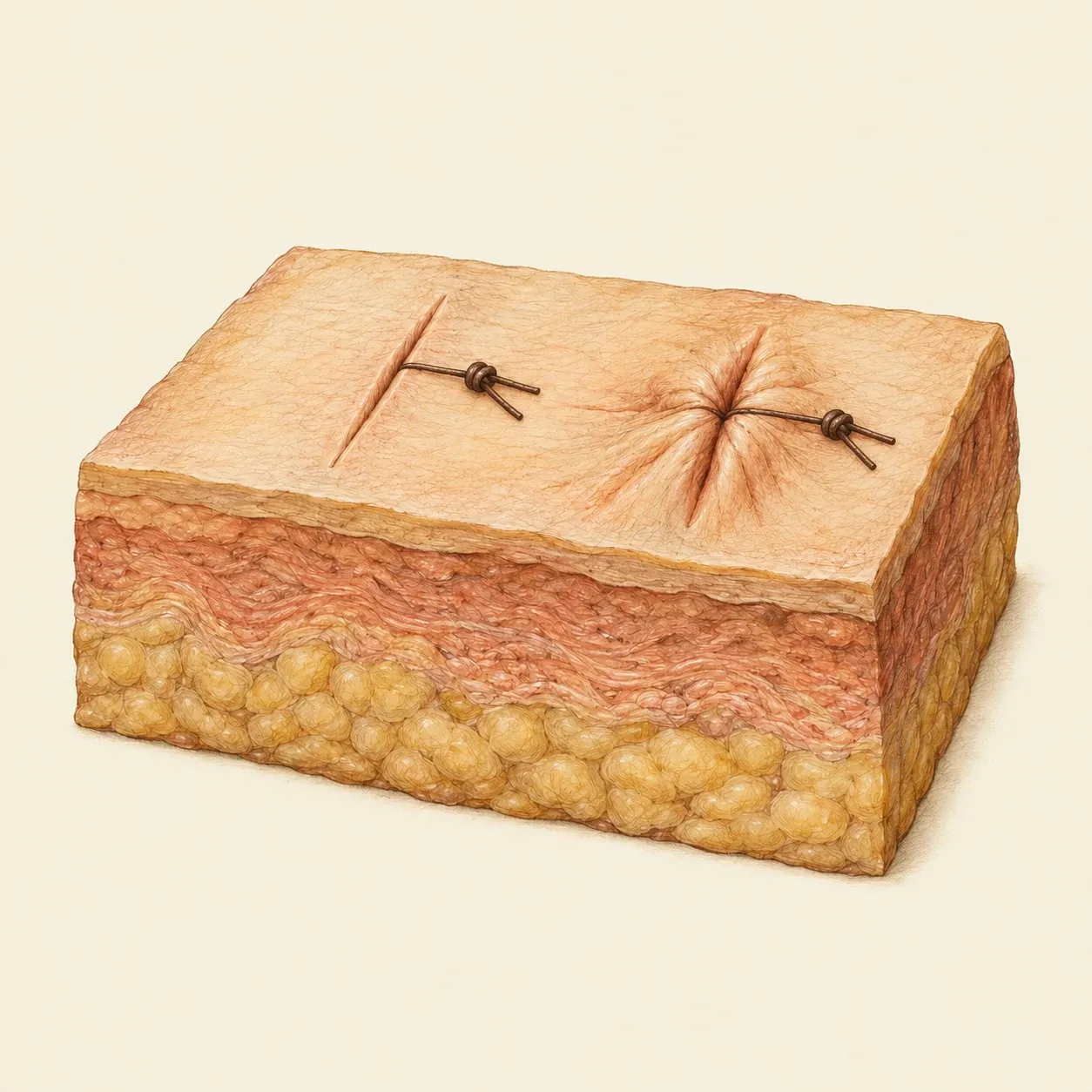 A stitch should only bring the edges together. Pulled too tight, it cuts into the skin as it swells.
Tension decides the result. A stitch should only bring the edges together. Tissue swells in the hours after an injury, and a stitch pulled tight before then cuts into the skin and starves it of blood, which leaves a worse scar. Celsus put it simply: the skin should follow the thread, with no force.
The material sets how long the stitch stays. Threads that the body does not absorb, such as nylon or polypropylene, are removed once the wound holds: the Merck Manual gives 3 to 5 days on the face and 10 to 14 days on the arms and legs. Absorbable threads are left in deeper layers, where nobody could reach them later, and the body breaks them down. A single strand slides through tissue easily and draws little fluid along it. A braid is more supple and its knots hold better, but it wicks fluid, and bacteria with it, into the wound.
How to do it
This is a training exercise on a pad, to see how a stitch and a knot behave. It is not a way to treat a wound.
Glue a piece of thick felt onto a block of firm upholstery foam. The felt stands for the skin and the foam for the fat beneath it. Pin or tape the pad to a board so that it cannot slide. On a cutting mat, cut a straight slit through the felt and a little way into the foam with a craft knife, moving the blade away from your other hand.
Use a curved upholstery needle, or a straight sewing needle if you have none, and an arm’s length of strong cotton or linen thread. With a pen, mark pairs of dots along the slit, one on each side, each dot the same distance from the cut. Space the pairs as far apart as a dot is from the edge.
Push the needle in at the first dot at right angles to the felt. Turn your wrist so that the needle follows its own curve down into the foam, under the slit and up to the opposite dot. Pull the thread through until a short tail is left on the first side.
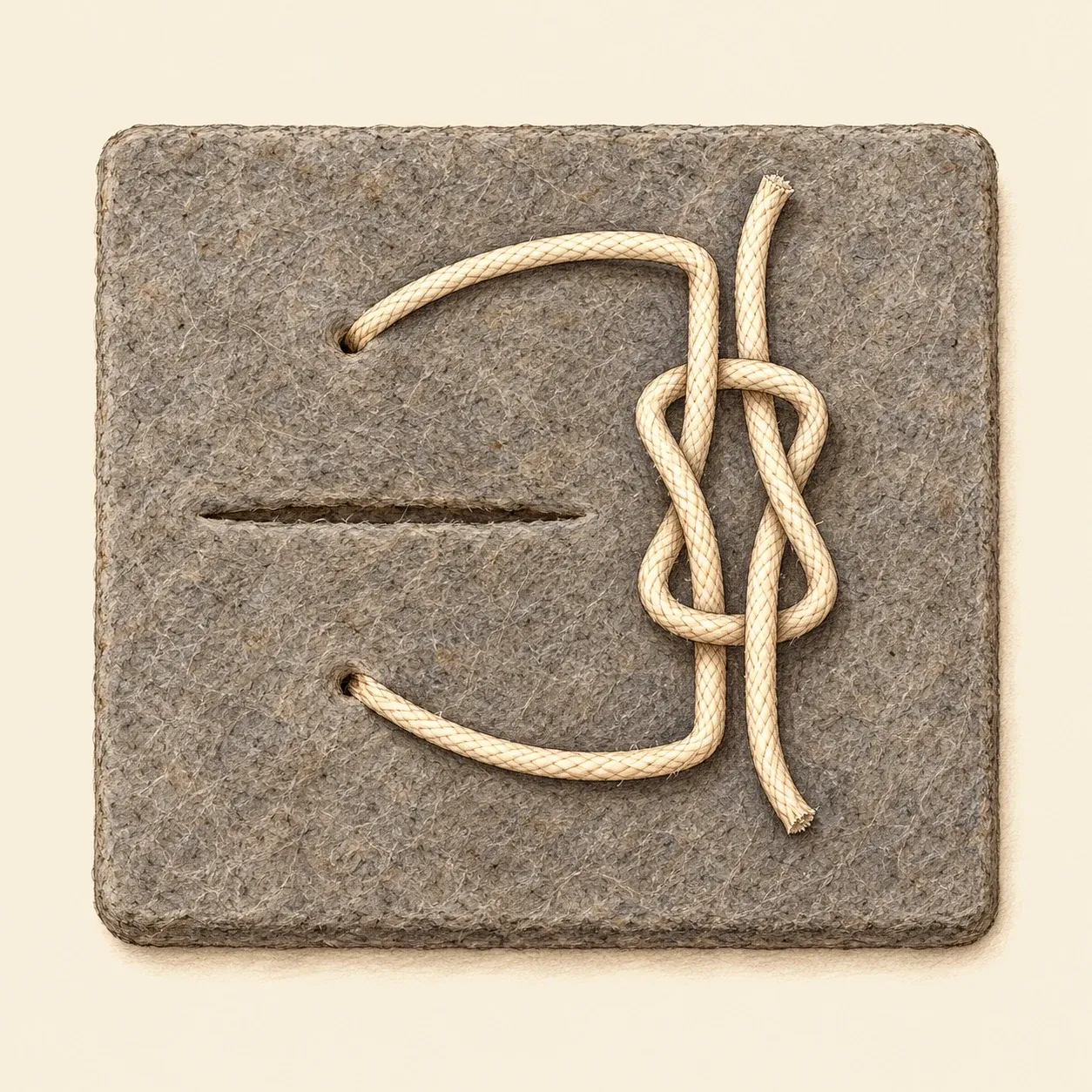 In a square knot, the two strands on each side leave the knot side by side. If they cross, the knot is a granny knot and can slip.
Tie a square knot. Wrap the long end once round the tail and pull the two ends apart until the edges of the slit just meet. Make a second wrap in the opposite direction and tighten it. Slide the knot off the slit to one side, trim the ends and start the next stitch. When the row is done, compare the stitches. One pulled too tight puckers the felt and cuts into it, a loose one lets the slit gape, and one that goes deeper on one side leaves the two edges at different heights.
Safety. Never stitch the skin of a person or an animal. Closing a wound safely takes a properly cleaned wound, sterile instruments and thread, local anaesthesia and training to judge what lies beneath, and a dirty wound that is stitched shut can become infected.
History and evolution
The Edwin Smith papyrus, a surgical treatise copied in Egypt around 1600 BCE, is the oldest known text to mention stitching a wound. In six of its cases, gaping wounds of the eyebrow, nose, ear, lip, throat and shoulder, the surgeon is told to draw the edges together with stitches as soon as he has examined the wound. For other wounds it prescribes two strips of linen laid across the cut, an early form of adhesive closure. James Henry Breasted, who translated the papyrus in 1930, dated its lost original to the Old Kingdom, before 2500 BCE.
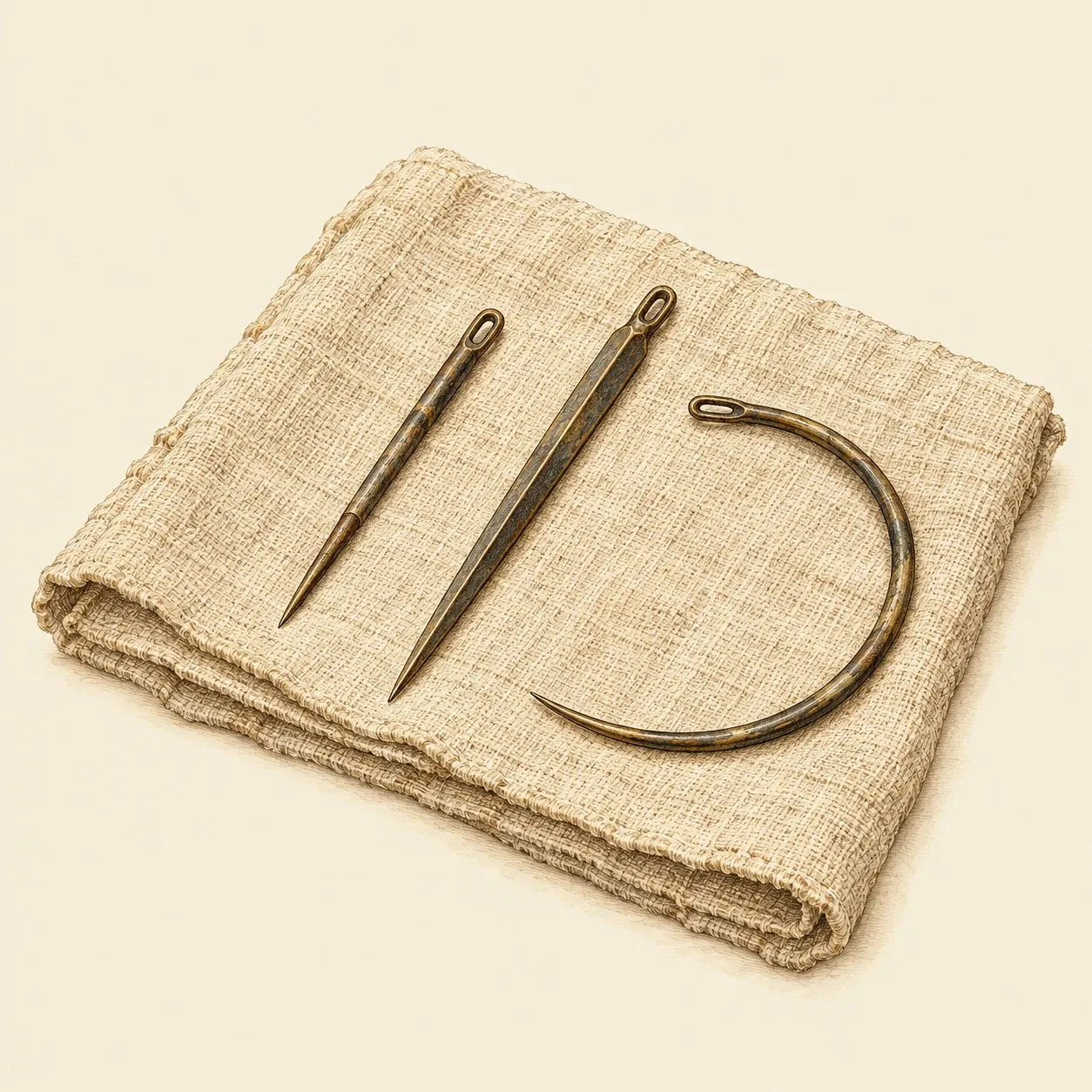 The three needles of the Sushruta Samhita: round, three-sided and bow-shaped, each for a different part of the body.
The Sushruta Samhita, a Sanskrit medical encyclopedia, gives far more detail. Indian tradition places Sushruta around 600 BCE, while the Suśruta Project led by Dominik Wujastyk dates the text to about two thousand years ago. It says that a wound must be cleaned before it is sewn, since a hair, a speck of dust or a fragment of bone left inside will fester. The thread may be fine cotton, hemp, flax or other plant fibres, a strip of leather, plaited horsehair or sinew. The text names three needles: a round one two fingers long for joints and thin flesh, one with a three-sided body three fingers long for fleshy parts, and one curved like a bow for the belly and the scrotum. It should enter neither too near the edge, where the stitch tears out, nor too far from it, where it hurts.
In Rome in the first century CE, Celsus recommended stitches for wounds in soft parts such as the ear, the nose, the lip, the eyelid or the skin of the throat and the belly. Where a fleshy wound gaped too wide for its edges to meet, he used clasps called fibulae, which drew them partly together. He wanted a soft wool thread, not twisted too hard, and stitches spaced neither so far apart that they failed to hold nor so close that they inflamed the wound.
Gut thread, made from the intestines of sheep, cattle or goats and long called catgut, was used for centuries, but any thread could carry infection into a wound. Joseph Lister, who brought antiseptic methods into surgery, published in 1869 how he tied arteries with gut treated with carbolic acid to keep it free of germs. The Science Museum in London keeps a jar of catgut that he prepared on 10 March 1875, still in its carbolic oil.
Synthetic polymers took over in the twentieth century. In 1971 E. J. Frazza and E. E. Schmitt described an absorbable thread spun from polyglycolic acid. Skin is now usually closed with single strands of nylon or polypropylene, while braided absorbable threads serve in deeper layers.