Blood transfusion
Giving blood from one person to another, safely matched
Contents
- 1Bag of red cells
- 2Spike pushed into the port of the bag
- 3Drip chamber with its mesh filter
- 4Roller clamp that sets the flow
- 5End connector that screws onto the cannula
A blood transfusion passes blood, or one of its parts, from a donor into the vein of a patient who has lost blood or cannot make enough of it. It became safe once doctors could match blood groups and keep blood from clotting. The first transfusion into a person was made in Paris on 15 June 1667, with the blood of a lamb.
What it is
A transfusion replaces blood that the body has lost or cannot make. Today it is rarely whole blood. A donation is collected into a sterile plastic bag that already holds a solution to stop clotting, then tested for infections and separated into red cells, plasma and platelets. Each patient receives only the part they need: red cells to carry oxygen after bleeding or in severe anaemia, platelets or plasma to help the blood clot.
At the bedside, the bag hangs above the patient and empties by gravity through a giving set. A hollow spike pierces the port of the bag, the blood drips through a chamber that holds a mesh filter, and a roller clamp on the tube sets the flow. The end of the line screws onto a thin plastic cannula already placed in a vein of the arm.
How it works
Red blood cells carry markers on their surface called antigens. Someone of group A has the A antigen, group B has the B antigen, group AB has both and group O has neither. The plasma holds antibodies against the antigen the person lacks: a group B person has anti-A, a group O person has both anti-A and anti-B. If group A cells are given to a group B patient, the patient’s anti-A binds to them and destroys them in the bloodstream, a reaction that can kill. A second antigen, RhD, divides each group into positive and negative.
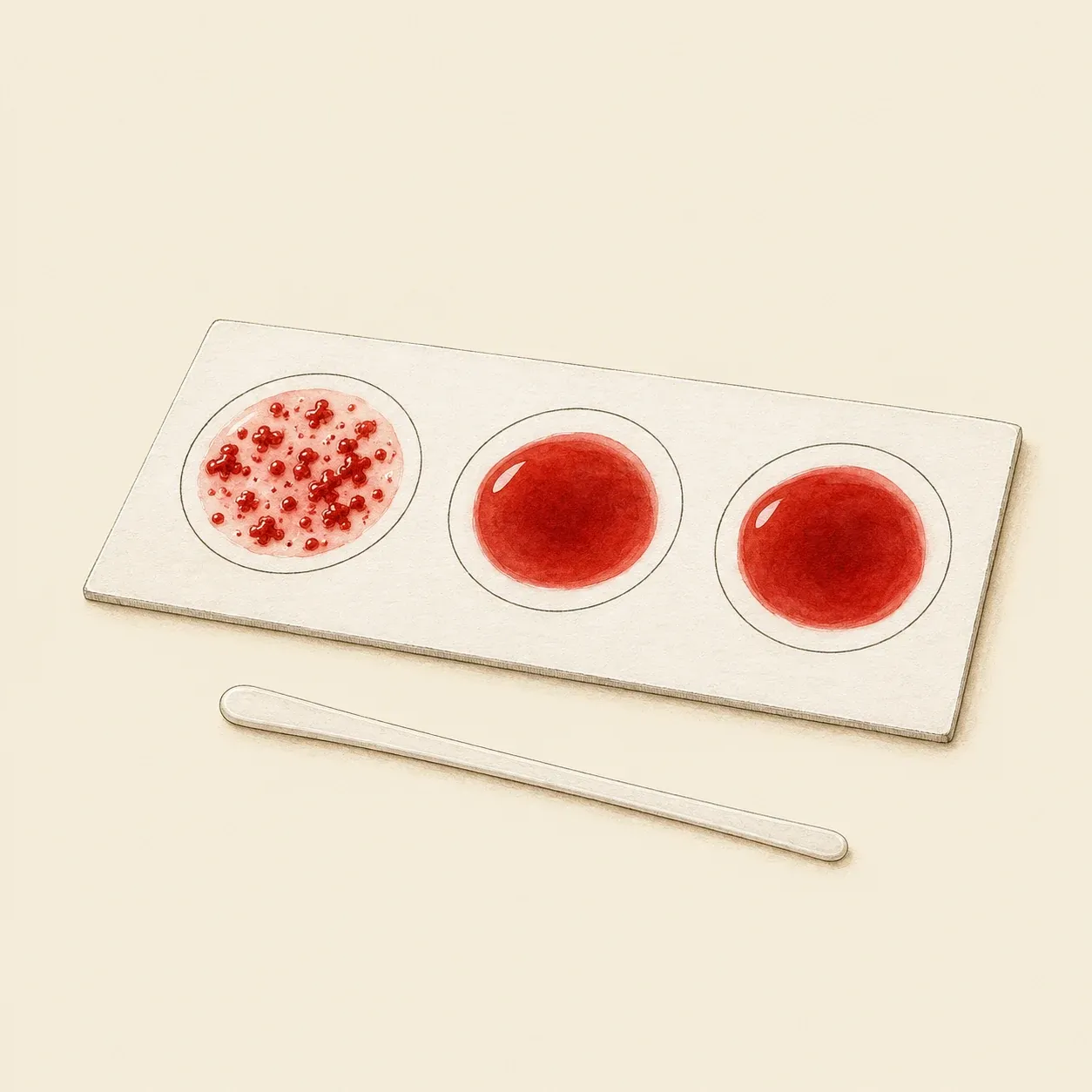 A drop of red cells clumps when it meets antibodies against its own antigen.
The laboratory finds the group by mixing a sample of red cells with reagents that contain anti-A or anti-B antibodies. Where the matching antigen is present, the cells stick together in visible clumps; where it is absent, the drop stays smooth. Cells that clump with neither reagent are group O. Before a transfusion, the patient’s plasma is also tested against donor red cells, and in the crossmatch it is mixed with cells from the donation chosen. The blood is given only if nothing reacts.
Blood clots within minutes once it leaves the body, so donations are collected into a citrate solution, which keeps them liquid. Red cells last longer in the cold. They are kept at 2 to 6 °C in a dedicated blood refrigerator for five to six weeks, depending on the country and the storage solution, while platelets are stored at 20 to 24 °C on a machine that rocks them gently. Once a bag of red cells leaves the refrigerator, the transfusion must be finished within four hours, and the giving set has a filter of 170 to 200 micrometres to hold back small clots.
How to do it
A transfusion is given only by trained staff, with tested blood, sterile sealed equipment and a cannula placed by a nurse or doctor. This model uses water and shows only how gravity and a clamp control a drip. Nothing in it touches the body.
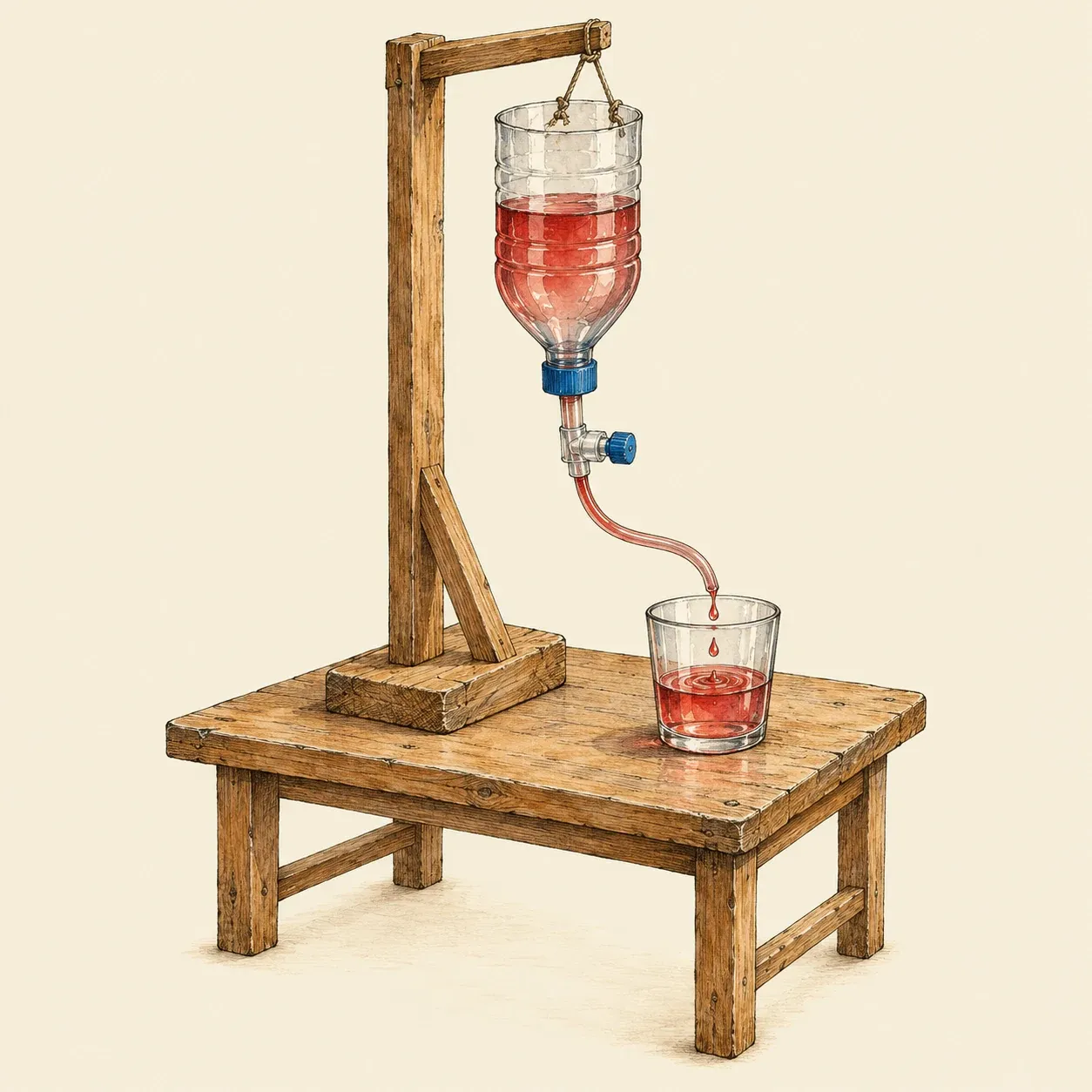 Raising the bottle makes the water drip faster; the valve slows it again.
Cut the bottom off a clean 1.5 litre plastic bottle. Drill a hole in its cap just narrow enough to grip a length of clear aquarium airline tubing, push 2 cm of tube through and seal round it with glue. Fit a small aquarium control valve halfway along the tube. Hang the bottle neck down from a hook, a shelf or a stand, close the valve and pour in water tinted with a few drops of food colouring. The open bottom lets air in as the water level falls. Put a glass on the table below the free end of the tube.
Open the valve a little and count the drops falling into the glass for one minute. Then raise the bottle by 30 cm and count again: the higher the water stands above the end of the tube, the faster it drips, because the pressure at the outlet grows with that height. Turn the valve to bring the rate back down. Squeeze the tube between finger and thumb and the drip stops at once.
Safety. Use only water, and never fit a needle or put the tube on the skin, in the mouth or into any body opening.
History and evolution
William Harvey described the circulation of the blood in 1628. In Oxford in 1656, Christopher Wren injected liquids into the veins of dogs through a quill tied to a bladder. In 1665 and 1666 Richard Lower passed blood directly from one dog into another and showed that a dog bled almost to death could be revived with the blood of a second dog.
On 15 June 1667 in Paris, the physician Jean-Baptiste Denis and the surgeon Paul Emmerez treated a 15-year-old boy who had been bled many times during a long fever. They gave him blood from the carotid artery of a lamb, and Denis reported that he recovered. In London that November, Lower and Edmund King transfused sheep’s blood into a man named Arthur Coga through silver pipes and quills. Soon afterwards one of Denis’s patients, Antoine Mauroy, passed urine as black as soot after his second transfusion, which is now read as the destruction of the transfused cells. When Mauroy died months later, his widow accused Denis. He was cleared, but the Paris Faculty of Medicine forbade transfusion without its consent, and the practice was abandoned for a century and a half.
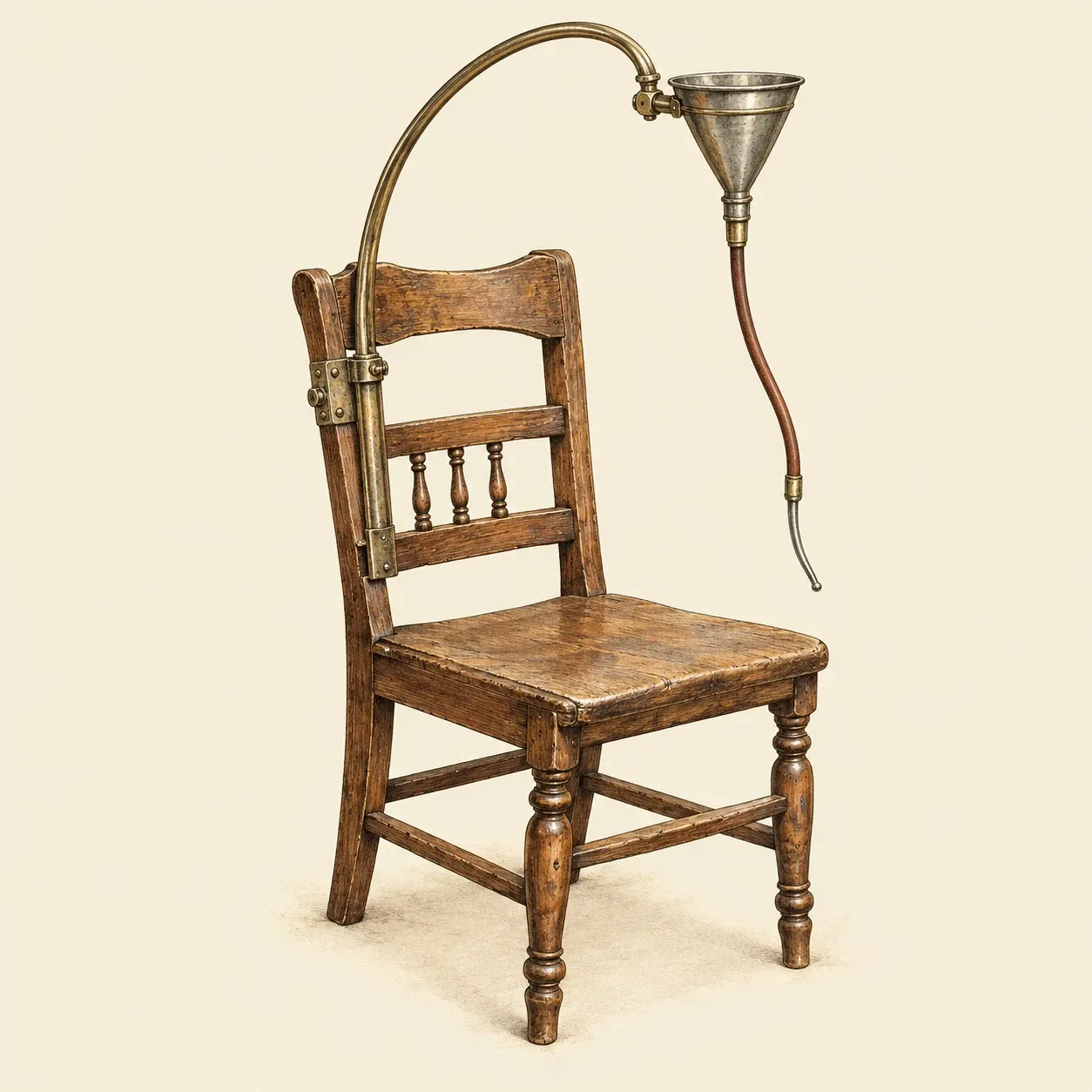 Blundell’s gravitator let the donor’s blood run from a raised funnel down into the patient’s vein.
The London obstetrician James Blundell returned to it to save women bleeding after childbirth. From his experiments on dogs he concluded that blood from another species was dangerous, and in 1818 he gave human blood by syringe to a dying patient. By 1830 he and his colleagues had made ten transfusions with human blood. In 1829 The Lancet published the case of a woman who recovered from bleeding after childbirth with blood from Blundell’s assistant, and in the same year he described the gravitator, a funnel held above the patient from which the blood ran down a tube by its own weight. Some patients had fever, back pain and dark urine, the signs of incompatible blood.
In 1901 Karl Landsteiner, in Vienna, explained why mixing the blood of two people sometimes made the cells clump: people belong to different blood groups. In New York in 1907 Reuben Ottenberg, following a suggestion of the Chicago pathologist Ludvig Hektoen, grouped and crossmatched donor and patient before a transfusion. Blood could already be given indirectly, by syringe or through Blundell’s gravitator, but it clotted within minutes and had to go from donor to patient at once. Anticoagulants allowed it to be collected and given later. In 1914 Albert Hustin in Brussels transfused blood kept liquid with sodium citrate and glucose. Luis Agote in Buenos Aires did the same later that year, and Richard Lewisohn in New York in 1915. Richard Weil showed in 1915 that citrated blood could be kept in a refrigerator, and in 1916 Francis Peyton Rous and Joseph Turner made it last longer by adding glucose. In 1917, at the battle of Cambrai, blood collected and stored in advance was given to the wounded, from the first depot of the British army, set up by the American doctor Oswald Robertson.
Hospitals then began to keep stocks. In 1937 Bernard Fantus set up a blood bank at Cook County Hospital in Chicago and gave it that name. The Rh system, described in 1939 and 1940, explained many of the reactions that still occurred between blood of the same ABO group. Around 1950 Carl Walter and William Murphy developed the plastic bag, which did not break like glass bottles and made it possible to separate one donation into several components.