Jaw harp
A plucked tongue sounded through the mouth
Contents
- 1Bone frame
- 2Tongue cut from the frame
- 3Narrow slit round the tongue
- 4Hole and cord at the root of the tongue
- 5Mouth cavity
A jaw harp is a small instrument with an elastic tongue fixed at one end to a frame. Held against the lips and plucked or jerked by a string, the tongue vibrates, and the player's mouth acts as a resonator that brings out one overtone after another. The oldest known are thin bone harps from Shimao in northern China, dated to about 2000 BCE.
What it is
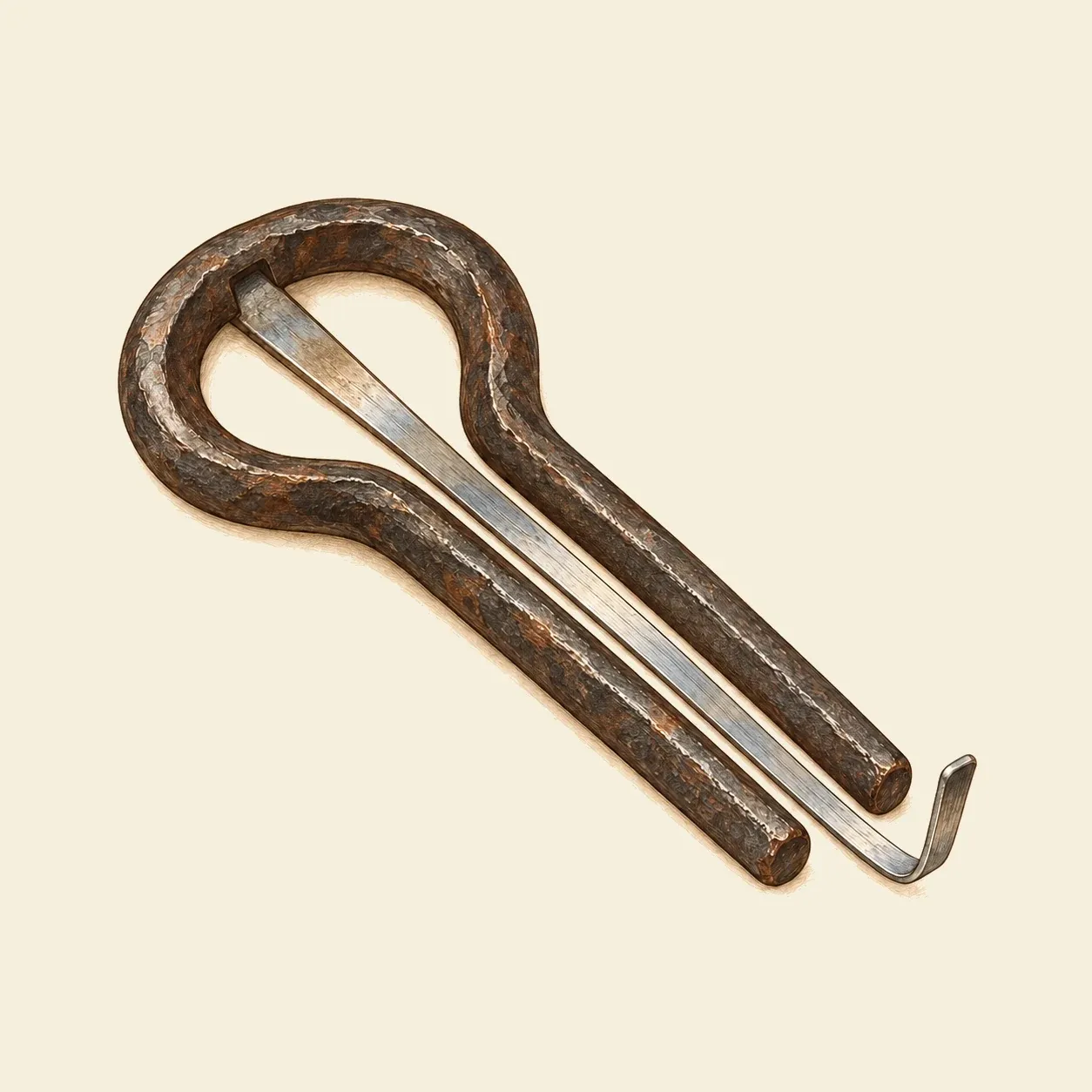 An iron jaw harp of the European kind, with a separate steel tongue.
A jaw harp is a small instrument made of a frame and an elastic tongue, or lamella, fixed to the frame at one end and free at the other. The player holds the frame against the parted lips or the front teeth and sets the tongue vibrating by plucking it with a finger, tapping it or jerking a string tied to the frame. The tongue gives the basic note and the player’s mouth shapes the sound. The instrument has many names: jew’s harp or mouth harp in English, kouxian in Chinese, mukkuri among the Ainu of Hokkaido.
Jaw harps fall into two families. In the first, the tongue is cut out of the frame itself, so frame and tongue are a single piece of bamboo, wood, bone or sheet metal. These are the most varied in Asia, and many are sounded by pulling a string. In the second, the tongue is made separately and fixed to the frame. The lubu of Taiwan has one or more tongues of brass or copper tied to a bamboo frame with fine thread. The European jaw harp belongs to this family: its steel tongue is set in a bow-shaped frame of iron or brass, is longer than the frame and is bent out of its plane, so that the player can pluck its free end with a finger.
How it works
Once plucked, the tongue swings to and fro through the narrow gap between the two sides of the frame at its own frequency, the fundamental. Each time it passes through the frame it lets a short puff of air through and cuts it off again. In a 1974 acoustics paper, C. J. Adkins showed that these short, regular pulses excite the air in the player’s mouth. A train of pulses repeated at a steady rate contains the fundamental and a whole series of harmonics at two, three, four and more times its frequency.
The mouth works as a resonator. The player changes its natural frequency by moving the tongue, jaw and lips, much as when saying different vowels. The cavity reinforces the harmonic nearest its own resonance and leaves the others faint, so the ear hears a melody picked out of the harmonics of one fixed note. Adkins found that when the mouth is tuned higher, the pitch heard follows the resonance of the mouth itself and can slide smoothly. Breathing in and out through the instrument while it sounds changes the tone again.
The gap between tongue and frame has to be very narrow. In his experiments Ola Kai Ledang found that it should not exceed about 0.2 mm for the harmonics to come out distinctly, because the air squeezed through the gap is part of the sound. For this reason some scholars class the jaw harp as a wind instrument with a free reed, like the reed of a mouth organ, while the standard classification places it among the plucked idiophones. Gjermund Kolltveit, who has studied the instrument at length, concludes that it is both at once.
How to do it
A harp of bamboo sounded with a string, like the Ainu mukkuri, needs only a strip of dry bamboo, a fine saw, a sharp knife, sandpaper and some thin, strong cord. Museum examples of the mukkuri are about 15 cm long and 1.5 cm wide. Split a strip of that size from the wall of a dry, mature cane and keep the hard outer skin. Shave the inner side flat until the strip is thin but still stiff.
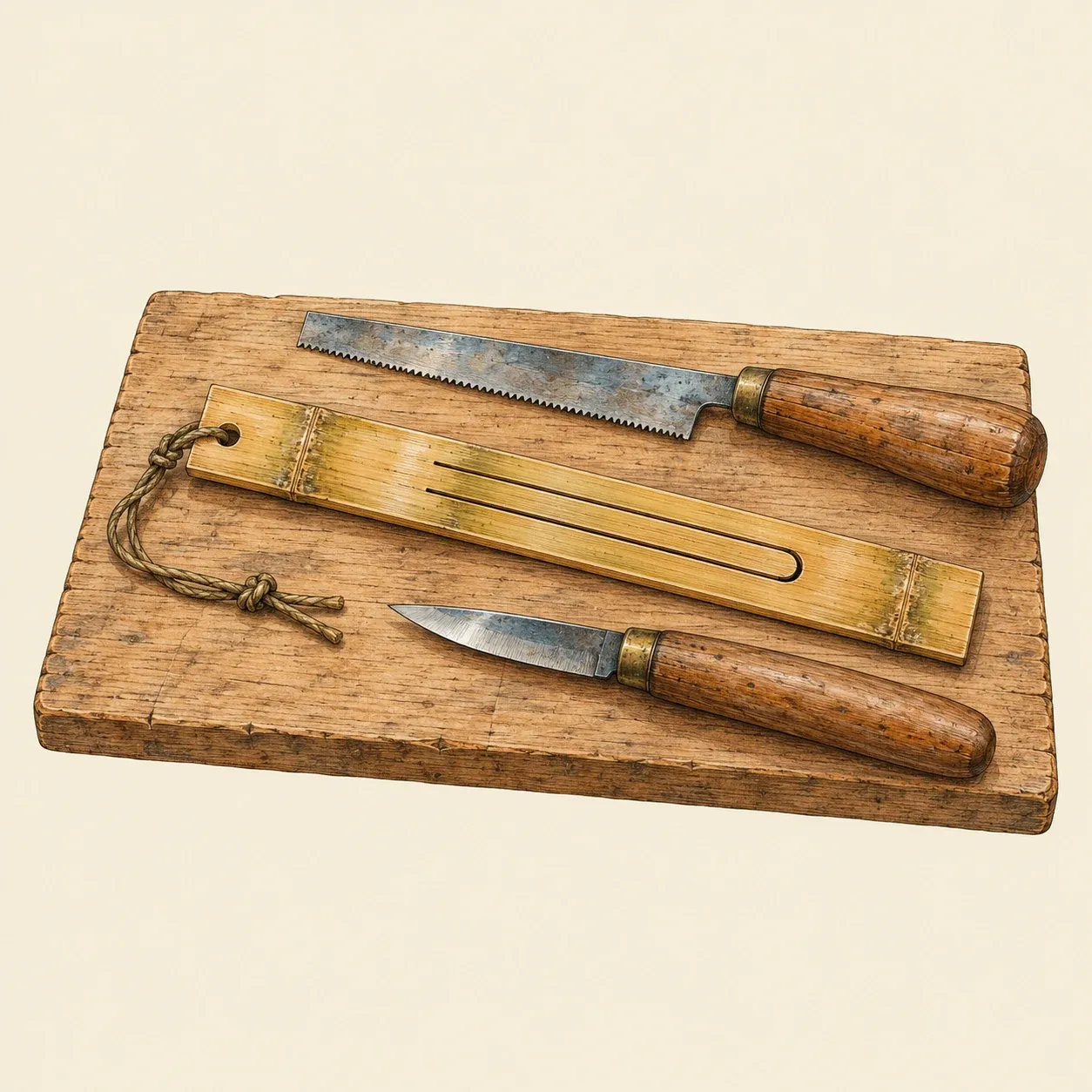 The tongue is sawn free on three sides and stays joined to the frame at its root.
Draw the tongue down the middle of the strip, leaving a narrow band of frame on each side and a solid piece beyond each end of the tongue. With the finest saw you have, or the point of the knife, cut along both sides and across one end of the tongue, so that it stays attached at the other end, its root. Keep the cuts as narrow as you can: the closer the frame hugs the tongue, the clearer the sound. Thin the tongue a little from the inner side until it springs freely when flicked and passes through the slit without catching. Sand every edge of the frame, above all those that will touch the lips.
Bore a small hole in the frame beyond the root of the tongue and tie the cord there, with a small stick at its far end for a grip. Tie a short loop of cord through a hole at the other end of the frame to hold the harp by.
To play, hold the loop in one hand and rest the frame lightly against your parted lips, with the tongue in front of your open mouth and your teeth clear of it. With the other hand, pull the cord sharply along the line of the harp: the jerk sets the tongue vibrating. Change the shape of your mouth as if saying different vowels, and breathe gently in and out, to bring out different notes.
Safety: clamp the bamboo while sawing and always cut away from your body. Split bamboo has edges sharp enough to cut, so sand them smooth before the harp goes near your mouth. Never bite the harp or put it inside your mouth, keep your face out of the line of the cord when you pull it, and wash a harp before anyone else plays it.
History and evolution
The oldest known jaw harps come from the Shimao site in Shaanxi, northern China. More than twenty were found there in 2016 and 2017. The excavators date them to about 2000 BCE and describe thin strips of bone about 9 cm long and 1 cm wide, each with a fine tongue cut in its middle. The jaw harp researchers Gjermund Kolltveit, Áron Szilágyi and Leo Tadagawa reported on them after a symposium devoted to the find, held at Shenmu in 2019.
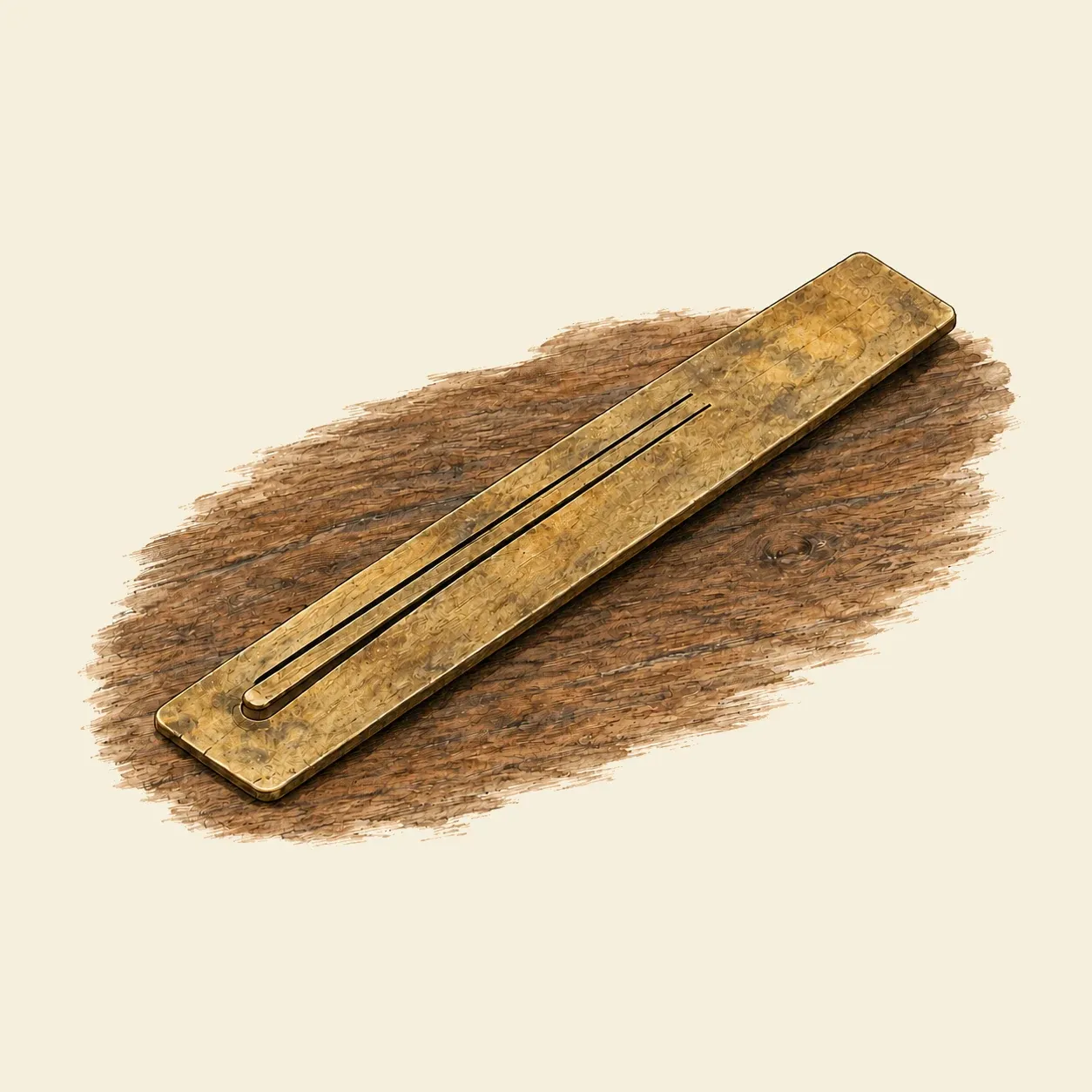 The reed of a mouth organ: the Book of Songs gives it the same name, huang, as the jaw harp.
Before the Shimao harps were published, Kolltveit counted as the oldest two bone harps from Jianping Shuiquan in Liaoning, of the Lower Xiajiadian culture, which the Chaoyang City Museum dates between 2146 and 1029 BCE. A bone harp 9.8 cm long from a cemetery near Chifeng in Inner Mongolia, of the Upper Xiajiadian culture (1200–600 BCE), has a small hole at the base of the tongue, probably for a string. The Chinese Book of Songs calls the instrument huang, the same word as the reed of the mouth organ, in lines such as “blow the sheng, beat the huang”.
Harps with a separate metal tongue appear much later. Leo Tadagawa dates two from Omiya in Japan to the first half of the tenth century. In Europe, Kolltveit, who catalogued 830 jaw harps from excavations, places the oldest reliably dated ones around 1200 CE and most between 1200 and 1700, and he regards the claims that the Romans, Saxons or Vikings knew the instrument as resting on vague sources. Other researchers list older finds. Aleksey Nikolsky and his colleagues cite an iron harp from Echimăuți in Moldova dated 900–1000 CE. They and Kolltveit also report harps with the tongue cut from the frame, in bone, horn, copper or bronze, from the Urals and the Volga region, the oldest from the Perm region and dated between the second century BCE and the third century CE. From about 1200 the iron harp appears to have spread quickly across the continent.
In 1917 the musicologist Curt Sachs described the iron harp as the last stage of an evolution that began with bamboo harps in South-East Asia and travelled north-west to Europe. Kolltveit finds no archaeological support for that sequence. He thinks it more likely that both forms arose in Asia and spread west separately.