Splints and casts
Holding a broken bone still while it heals
Contents
- 1Linen bandage wound in a spiral
- 2Wooden splint on the palm side
- 3Tie holding the splints
- 4Radius and ulna set end to end
- 5Break across both bones
A splint or a cast holds a broken bone still so that its ends can knit in line. The oldest known splints, boards of palm bark wrapped in linen, were found on a thigh bone and a forearm in Egyptian tombs of the Fifth Dynasty, around 2450 BCE. Plaster bandages, introduced in 1852, became the standard cast.
What it is
A broken bone heals only if its ends stay in place long enough for new bone to join them. A splint is a rigid strip laid along the limb and tied on. A cast is a rigid shell moulded all the way round it. Both hold the fragments in line and keep the limb from moving at the break.
Ancient healers used boards of wood or bark, bundles of reeds or stiffened linen over a linen bandage, held on with ties. In the nineteenth century plaster of Paris took over: bandages loaded with plaster are wetted, wound round the padded limb and harden within minutes. Plaster now shares the work with casts of synthetic tape such as glass fibre.
How it works
Bone mends in stages. After a first phase of inflammation, a callus of new tissue forms round the break and slowly turns to bone, which is then reshaped over months. If the fragments move during the first two stages, the new blood vessels tear and the union is delayed. The NHS gives about 6 to 12 weeks for a broken arm or wrist to heal.
To stop that movement, a splint must hold more than the break itself. The usual rule is to immobilise the joint above and the joint below, the wrist and the elbow for a forearm. Padding goes between the skin and the splint, with extra over places where bone lies just under the skin, such as the wrist and the point of the elbow, because a hard edge pressing there for weeks wears a sore. Hippocrates already kept his splints off the bony points of the wrist.
An injured limb swells for a day or two. A splint that does not go all the way round leaves room for this, which is why a closed cast is often put on only once the swelling has gone down, a few days later. Hippocrates waited until the seventh day before adding his splints. A shell that is too tight squeezes the swollen tissue until blood can no longer flow through it and nerves and muscles start to die, a condition called compartment syndrome. Growing pain, numbness or pale or bluish fingers under a cast mean that it must be checked at once.
Plaster of Paris is gypsum that has been heated to about 120 °C to drive off part of its water. The name comes from the quarries near Paris where the gypsum was dug. Mixed with water, the powder takes the water back and becomes gypsum again: it sets in 5 to 15 minutes and gives off heat as it does so. It reaches full strength only after one to three days of drying.
How to do it
This exercise is done on a cardboard model, to see how a splint is laid and how plaster sets. It is not first aid, and splints, bandages and plaster must never be tried on a person or an animal.
Tape two kitchen-roll tubes together at a right angle to make an upper arm and a forearm bent at the elbow. Tape a hand cut from stiff card to the end of the forearm. Glue a bottle cap behind the elbow and another on the back of the wrist: they stand for the bones that lie just under the skin there.
Cut a strip of corrugated cardboard long enough to run from the knuckles along the underside of the forearm and up behind the elbow. Score it across at the elbow and bend it into an L, then fold its long edges up to make a shallow trough. Line the trough with folded cloth or cotton wool, thicker where the bottle caps will rest, and lay the arm in it.
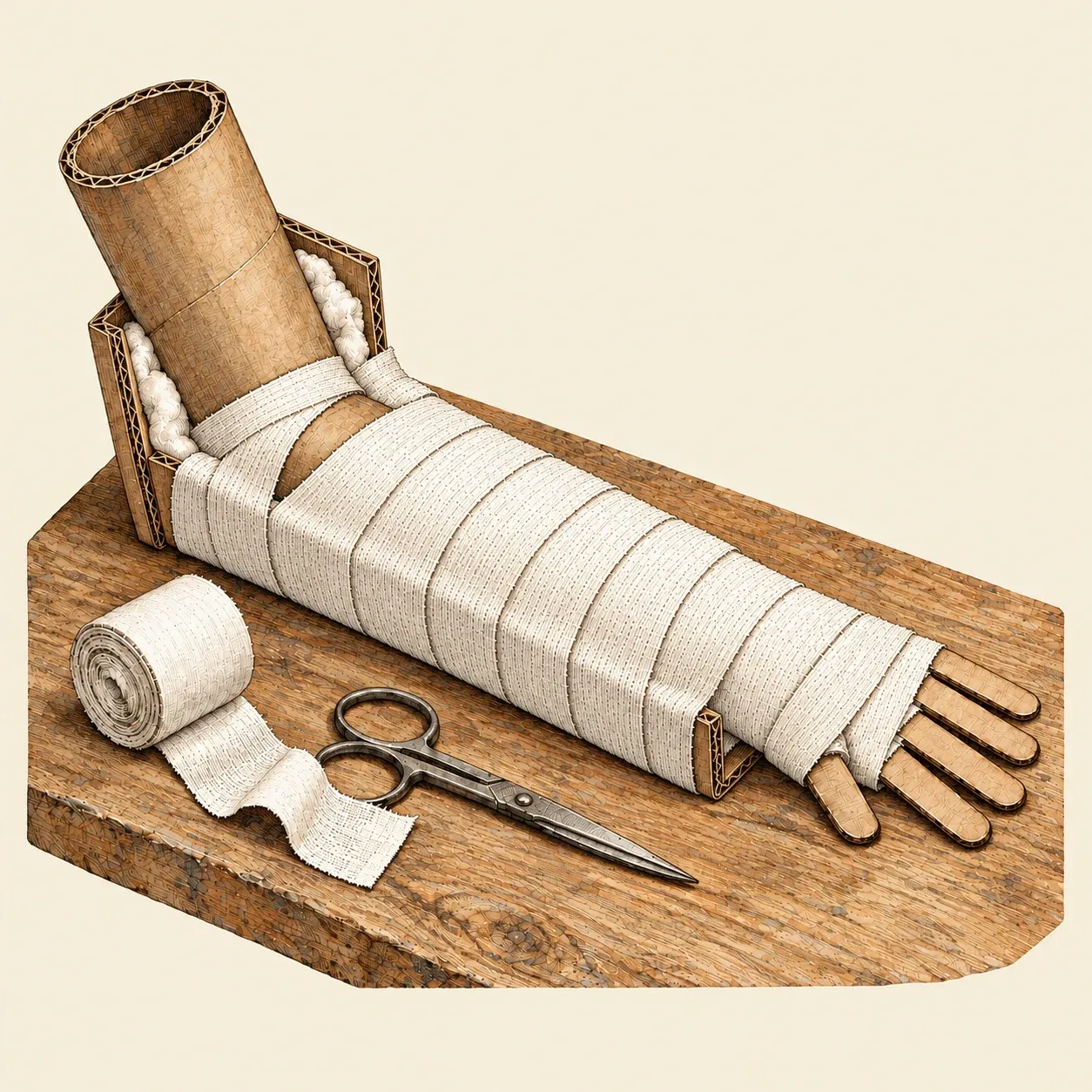 Each turn covers half of the one before, and the fingertips stay uncovered, where a nurse would check that blood still reaches the hand.
Wind a cotton bandage round the arm and the trough together, from the hand towards the elbow, each turn covering half of the one before. Keep it firm, but loose enough that a finger slides under it. Leave the fingertips showing. Then try plaster on a separate tube wrapped in cloth padding. Cut a few strips from a roll of plaster bandage sold for model-making, dip one in cold water for a few seconds and lay it round the tube, smoothing it with your palm. Lay the next strip half over the first. Within minutes the plaster turns warm and stiff. Leave it a day or two before handling it.
Safety. Plaster heats up as it sets: never wrap it round a hand, a finger or any other part of the body, as it can cause serious burns.
History and evolution
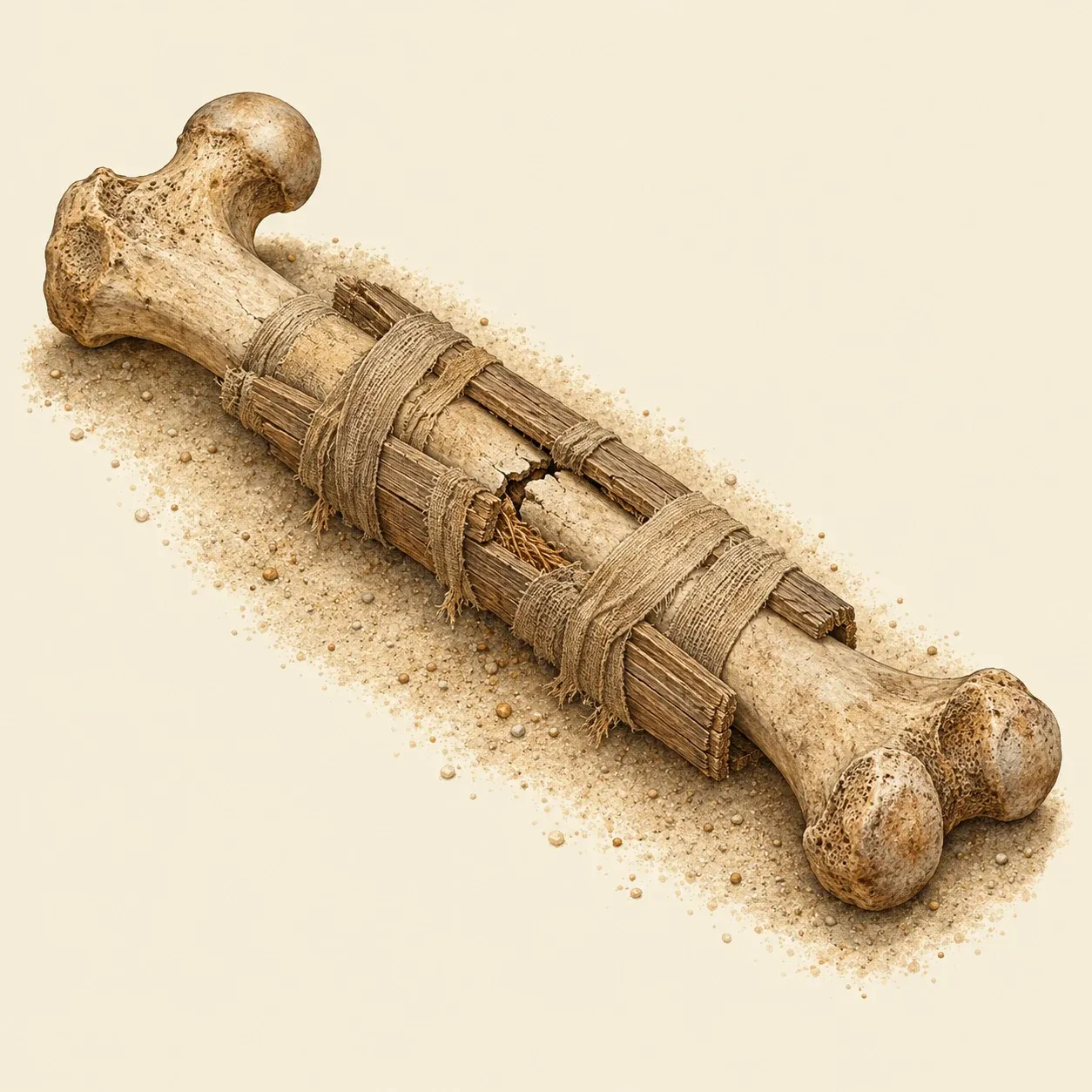 Linen-wrapped bark splints on a broken thigh bone, of the kind found in Egyptian tombs of the Fifth Dynasty.
The oldest known splints were found in 1903 at Naga ed-Der, about 160 km north of Luxor, by George Reisner’s expedition, which Phoebe Hearst paid for. They came from tombs of the Fifth Dynasty, between 2494 and 2345 BCE, and Grafton Elliot Smith published them in 1908. A teenage girl’s broken thigh bone was bound with boards of palm bark wrapped in linen, padded and held by linen bandages. A pad of palm fibre at the break still carried traces of blood, a sign that the bone had pierced the skin, and the bone had not healed, so she probably died soon after. A forearm with both bones broken had been splinted with stacked reeds and three roughly shaped braces of palm bark, and it shows little healing either.
The Edwin Smith papyrus, copied around 1600 BCE, treats a broken collarbone and broken upper arms. The bones are first pulled back into line, then held with what the text calls two splints of linen. James Henry Breasted, its translator, thought these might be wooden splints wrapped in linen, or strips of stiffened linen moulded on the limb, much like a modern cast.
The Greek treatise On Fractures, attributed to Hippocrates, bandages a broken forearm first and adds splints all round it on the seventh day, once the swelling has gone. The splints are tied just tightly enough to stay in place, since their job is to keep the bandage still, not to squeeze, and they are adjusted every third day. The text expects the forearm to knit in about thirty days. Hippocrates also stiffened bandages with wax and resin. Around the year 1000, al-Zahrawi used clay mixed with gum, or flour with egg white. Into the nineteenth century, surgeons hardened bandages with egg white and later with starch, which the Belgian surgeon Louis Seutin made popular but which took hours to set.
Antonius Mathijsen, a Dutch army surgeon at Haarlem, published his plaster bandage in 1852. He rubbed dry plaster powder into strips of coarse cotton, which were wetted at the bedside, wound round the limb and set in minutes. The Russian surgeon Nikolai Pirogov, who had watched a sculptor at work, used cloth soaked in liquid plaster for the wounded of the Crimean War. Mathijsen’s way of making the bandages remained in use until about 1950, and factory-made plaster bandages appeared in Germany in the early 1930s.
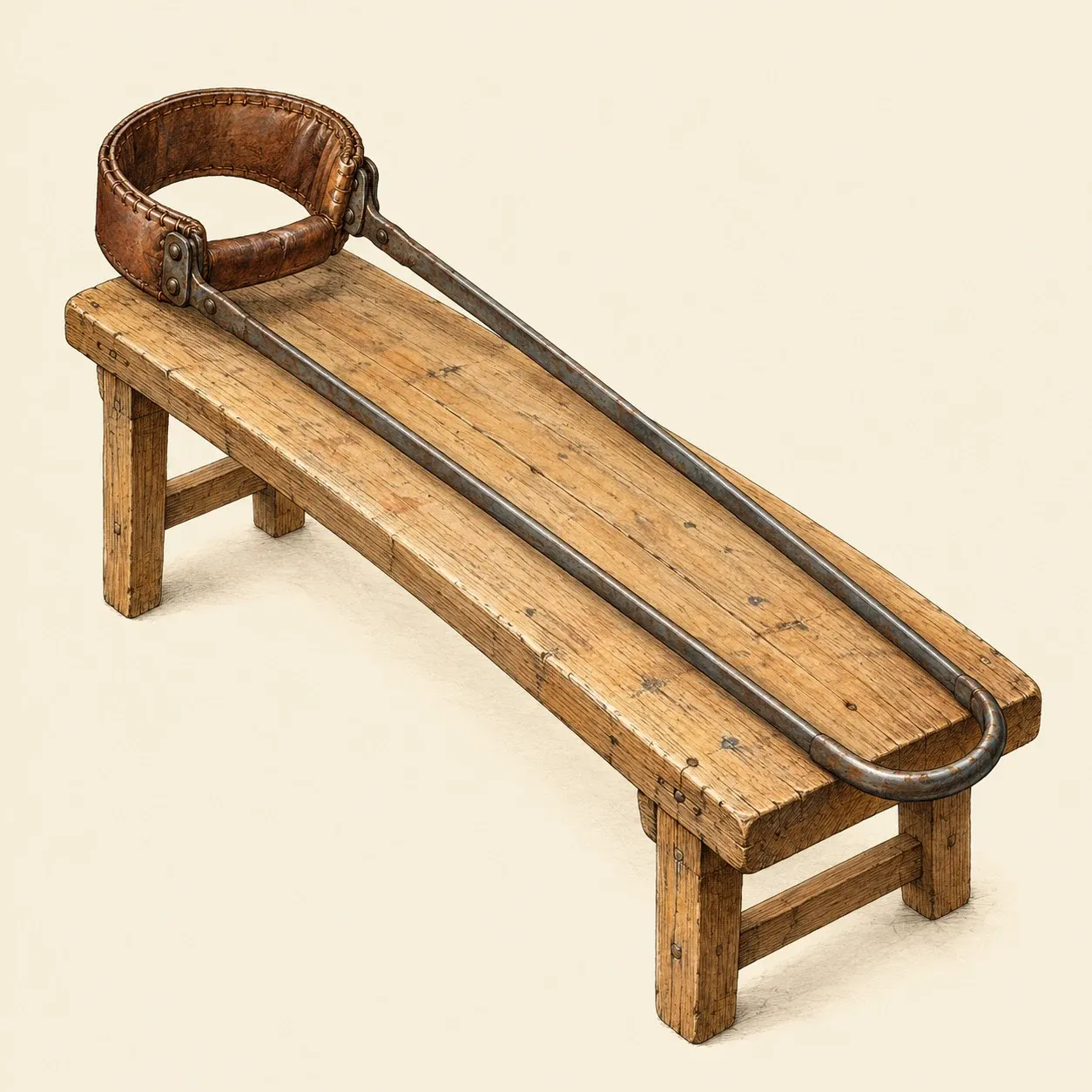 The Thomas splint: an iron frame whose padded ring rests against the top of the thigh.
During the First World War, a break of the thigh bone from a bullet or shell fragment was often fatal. The Thomas splint, an iron frame with a padded leather ring at the top of the thigh, had been designed by the Welsh surgeon Hugh Owen Thomas in the nineteenth century. His nephew Robert Jones, consultant orthopaedic surgeon to the British Army from December 1914, pushed for its use at the front from 1916. It held the leg still for the journey to hospital while leaving wounds open for dressing. The UK National Archives gives a fall in deaths from these fractures from 80% to 20% by 1918, and other accounts give lower final figures.