Tipi
A cone of poles under a cover of sewn hides
Contents
- 1Foundation poles tied where they cross
- 2Cover of bison hides sewn with sinew
- 3Smoke flap on its outside pole
- 4Wooden pins closing the cover above the door
- 5Liner tied to the poles inside
- 6Fireplace ringed with stones
A tipi is a cone of long poles wrapped in a roughly semicircular cover of sewn bison hides, later of canvas: the portable home of the peoples of the North American Plains. Rings of stones that held down lodge covers become common on the northwestern Plains about 4,500 years ago, and in 1541 the Coronado expedition described hide tents whose poles were dragged by dogs.
What it is
A tipi is a tent in the shape of a cone. Long, straight poles lean together and cross near the top, and a cover cut as a rough semicircle is wrapped round them and pinned shut at the front, above and below the door. Two flaps at the top of the cover, held out by poles of their own, guard the smoke hole. The cover reaches the ground and is staked down, or in earlier times weighed down with stones. For centuries it was made of bison hides, scraped, dressed soft without the hair and sewn edge to edge with sinew, the sewing done with awls. Canvas bought from traders took their place in the second half of the 19th century.
Among the Plains peoples the women usually made the tipi, raised it, struck it and kept it in repair. Among the Blackfoot it belonged to the woman, who also cut and prepared the poles. Men painted designs on some covers, and each design belonged to the man who painted it. Unlike a hut, which is built where it stands and left behind, a tipi travels with its family: the poles and the cover move from camp to camp.
How it works
The frame starts with a few poles tied together into a stable tripod or pyramid. Most Siouan-speaking peoples began with three poles; western peoples such as the Crow and the Blackfoot used four. A Blackfoot woman laid four poles of about equal length on the ground, tied them at their crossing with a thong about 4.5 m long and raised them. The other poles were then laid into the fork, the two door poles last. The cover was tied to one more pole, raised at the back, and carried round both sides of the frame to be pinned together at the front. She then moved the feet of the poles in or out until the cover was tight. Clark Wissler, in his study published in 1910, says that an average woman did the whole job in thirty minutes or less.
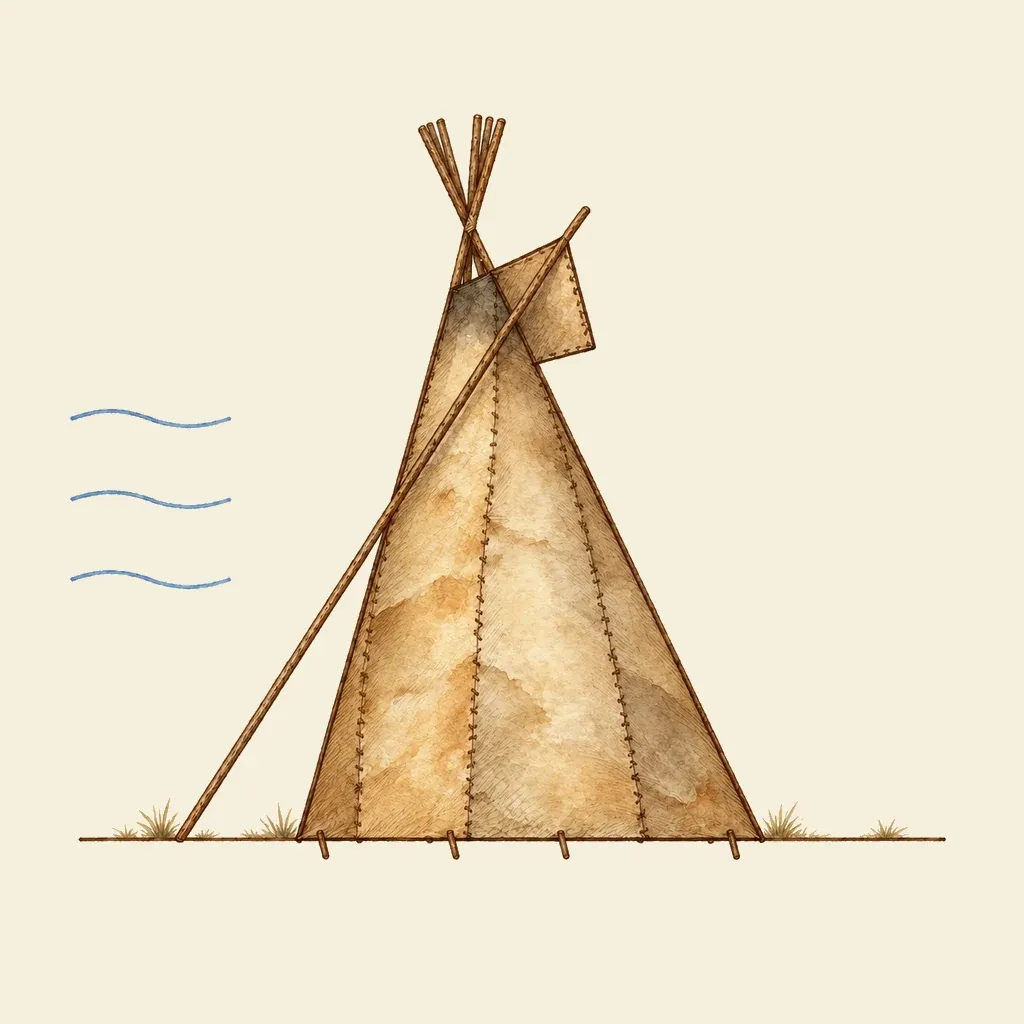 The steep back faces the wind; the smoke hole opens on the sheltered front.
A tipi is not a symmetrical cone. The back poles stand a little closer to the centre, so the back is steeper and the front slopes more gently. The steep back faces the wind, and the door and smoke hole are on the sheltered side; among the Blackfoot the door always faced east. The smoke hole opens in front of the crossing of the poles, so the fire is laid a little forward of the centre, towards the door.
The two smoke flaps work like adjustable vanes. By moving the outside poles that hold their tips, the family set them against the wind so that it could not blow the smoke back down, and opened or narrowed the hole to control the draught. At night, with the fire low, or when rain fell, the flaps could close the hole partly or completely.
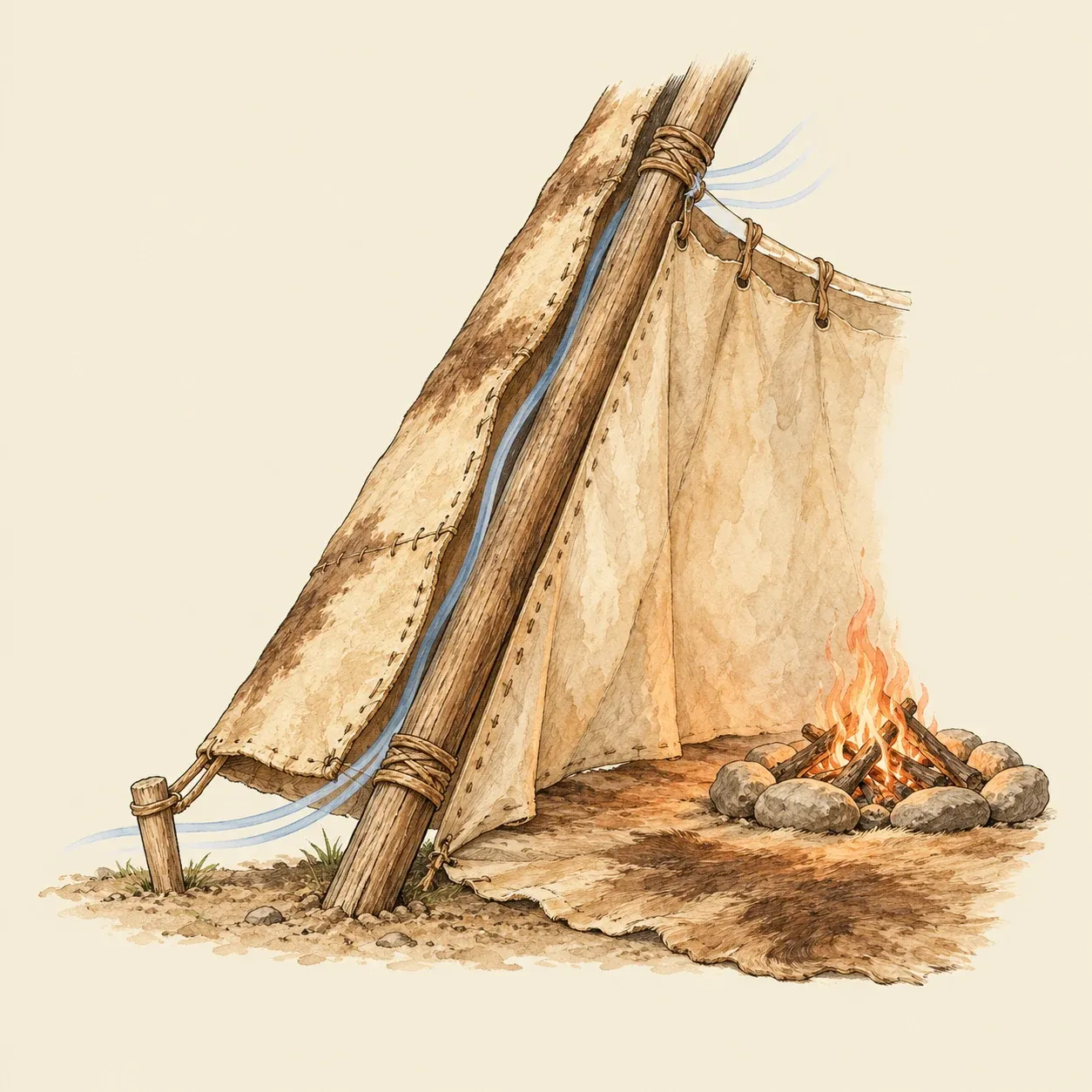 Air enters under the cover, rises behind the liner and leaves by the smoke hole, without blowing across the people inside.
Most of the Blackfoot tipis that Wissler saw had a liner, a band of hide or cloth tied to the poles on the inside; the skin liners in his museum were about 1.8 m high. Air comes in under the edge of the cover, rises in the space between cover and liner and leaves over the heads of the people inside, so the tipi is ventilated without a draught across the floor. The liner also stops rain that runs down the poles from dripping inside. In winter the liner, the fire and hides spread on the ground kept the lodge warm; in summer the sides of the cover could be rolled up to let the breeze through.
How to do it
A table model shows the frame, the tilt and the smoke flaps. Cut twelve straight sticks of equal length from garden canes or dowels and sharpen one end of each. Lay four of them together and tie them with a long string at a point a hand’s width below their tips, then stand them up and spread their feet into a rectangle, the shorter side towards the front. Lean the remaining sticks into the fork round the sides and back, leaving a gap at the front for the door poles, which go in last.
Make the cover from a sheet of cotton cloth. Its radius is the distance from the feet of the poles to their crossing. Draw a semicircle with that radius, using a string and a pencil pinned at the middle of the straight edge, and cut it out. At the middle of the straight edge, leave one small tongue of cloth standing out on each side of the centre point; these become the smoke flaps. Tie the centre point to one more stick, lay that stick at the back of the frame, and wrap the cover round both sides to the front. Close it with a row of thin wooden pins pushed through both edges above the door and one or two below it. Push a thin stick into a small hole in the tip of each flap. Move the feet of the poles until the cover is tight, bringing the back ones a little closer to the centre to give the cone its tilt, then hold the lower edge down with pebbles or small pegs.
Sharpened sticks and pins can injure the eyes: point them away from faces and blunt the pins once they are in place. Cut the cloth on a table, away from your hands. Never put a candle, incense or any flame in the model, as dry cloth catches fire easily. A full-size tipi is another matter: its poles, often around 7 m long, are heavy and can fall on someone, so the foundation is raised by several people and never in a strong wind. A fire inside a full-size tipi must stay small, with the liner in place and the flaps set for the wind, and must never be left burning unattended or with the flaps closed over it. Keep water at hand and fit a carbon monoxide alarm, because a smouldering fire in a closed space gives off this odourless gas, which can kill.
History and evolution
Across the northern Plains, people weighted the edges of lodge covers with stones, and when the camp moved on the stones stayed behind in a circle. Todd Kristensen and Emily Moffat estimate that well over a million such rings lay on the grasslands of present-day Alberta, Saskatchewan and Manitoba when Europeans arrived. In the 1980s John Brumley and Barry Dau measured more than 700 surviving rings in Alberta: they averaged 4.6 m across, from 2.3 m to almost 9 m. In Wyoming, Carl Spath’s study for the National Register finds them in large numbers from the Middle Plains Archaic, which he dates from 4,500 to 3,000 years ago; the few older circles reported are uncertain in shape and purpose. Spath also notes that brush and timber shelters were often ringed with stones as well, so a ring can mark another kind of lodge. At British Block in Alberta, John Brumley counts at least 51 rings of tipi size, 19 of them set in a camp circle opening to the north; the camp was used between about 4,250 and 3,550 years ago. The Encyclopedia of the Great Plains considers that tipis have probably been in use since the Middle Archaic, about 4,000 years ago, while Kristensen and Moffat place the origin of the design more than 5,000 years ago.
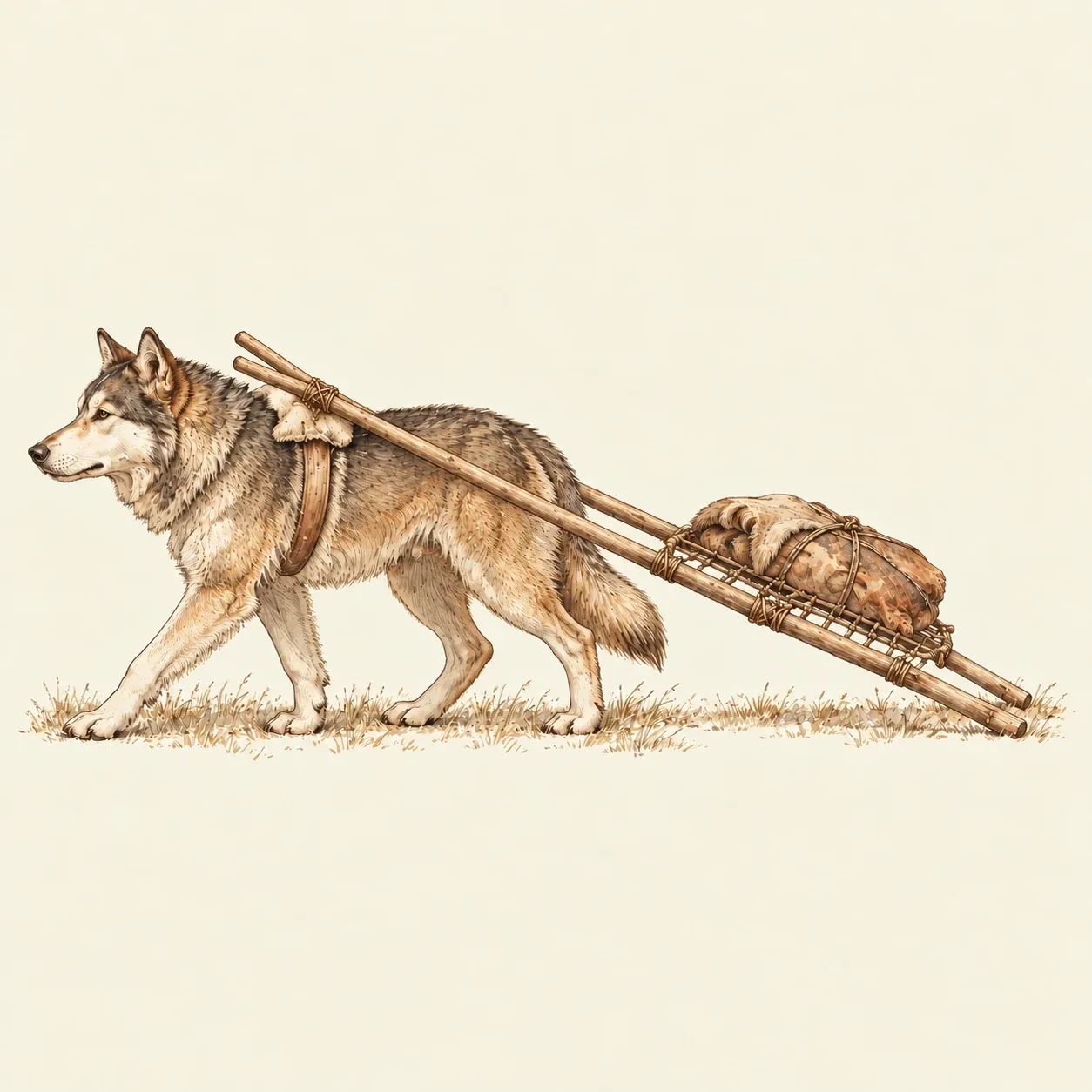 Before horses, dogs dragged the poles and carried the folded covers.
Before horses, dogs moved the camp. In 1541 the expedition of Francisco Vázquez de Coronado met bison hunters on the Plains whom the Spaniards called Querechos. Coronado wrote to the king that they lived in small tents of bison hides, tanned and greased, and that their dogs carried the tents, the poles and their belongings. Pedro de Castañeda, who travelled with the expedition, added that the poles came together and were tied at the top, that the dogs dragged them along the ground, and that the skin of the tents was dressed on both sides without the hair. The Blackfoot elders whom Wissler questioned remembered large dogs that dragged tipi poles, the strongest of them hauling skin covers, on a frame of two poles called a travois. The Encyclopedia of the Great Plains puts a day’s march in the dog era at 8 to 10 km.
With horses, the tipi poles themselves served as a travois, a camp could travel 16 to 24 km a day, and lodges grew larger. According to the Encyclopedia of the Great Plains, a tipi 5.5 to 6 m across used sixteen to eighteen poles 6.7 to 7.6 m long. The number of hides in a cover varied with its size, and sources differ: twelve to fourteen among the Blackfoot according to Wissler, thirteen to sixteen for a tipi 4.6 to 4.9 m across in the Encyclopedia of the Great Plains, and an average of twenty-four, up to almost sixty for the largest, according to Kristensen and Moffat. A Northern Plains lodge of about 1850 at the Buffalo Bill Center of the West, about 5.8 m across, has a cover of thirteen bison hides sewn with sinew.
Bison hides remained the material of tipi covers until the second half of the 19th century. Once the herds had been largely destroyed, by the 1880s, hides grew scarce, and people made their covers from canvas bought from traders. In his 1910 study Wissler reports that practically all Blackfoot covers were canvas, and canvas tipis are still raised today.