Hut
A frame of branches under a covering of leaves and grass
Contents
- 1Frame branches set round the edge of the hollow
- 2Ties where the branches cross
- 3Covering of leafy branches, grass and reeds in overlapping rows
- 4Floor dug into the ground
- 5Grass bedding
- 6Hearth
A hut is a shelter built from what grows nearby: a frame of branches or poles carrying a covering of leafy branches, grass, reeds, bark or hides. The oldest huts whose walls survive stood at Ohalo II, on the shore of the Sea of Galilee, about 23,000 years ago: oval brush huts raised over shallow hollows dug into the ground.
What it is
A hut is the simplest kind of built house. Its frame is made of branches or slender poles cut nearby and set in the ground. Over the frame goes a covering of whatever the place offers: leafy branches, grass, reeds, sheets of bark, woven mats, hides or a coat of mud. A hut can stand where there is no cave or overhanging rock to shelter in, and it needs no tools beyond a cutting edge of stone and something to tie with.
Frames take a few common shapes. Saplings bent over in arches and tied to one another make a dome, as in the wigwams of the Ojibwe around the Great Lakes. Thick branches set in a ring and leaned inwards make a low rounded heap. The huts of Ohalo II had walls of thick branches round a hollow in the ground and no post in the middle. Heavier houses are framed with squared beams held by cut joints, as in timber framing. A tent such as the tipi is packed up and carried from camp to camp, while a hut stays where it was built.
How it works
The frame carries the covering and stands up to the wind. A bent sapling pushes outwards at both feet like a drawn bow, and the ground holds them in place. Where two arches cross, a tie of cord or bark keeps them from sliding past each other. Horizontal hoops lashed round the arches at every crossing turn the separate arches into a lattice that does not lean over in a gust.
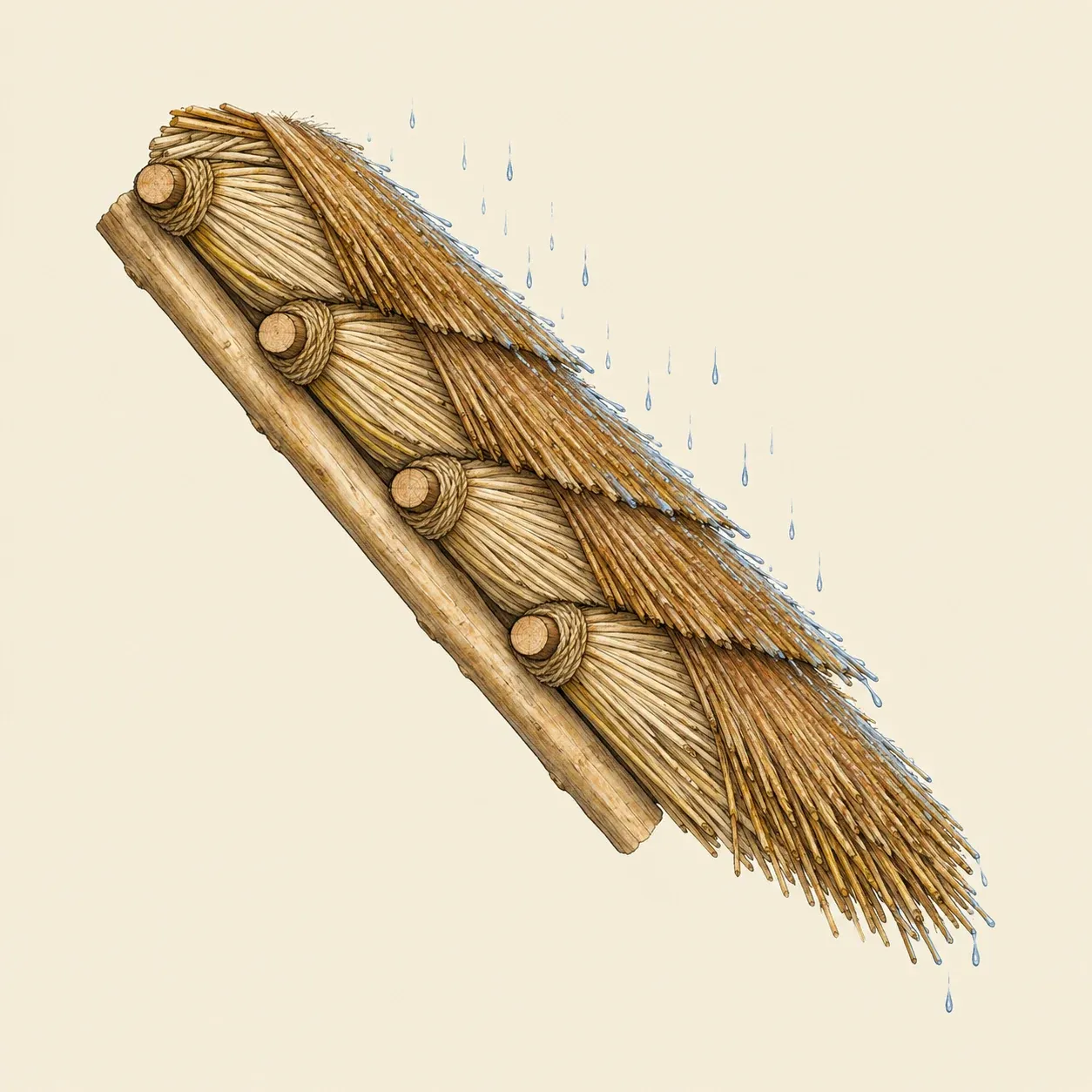 Each row covers the top of the row below, so rain runs off the outside from stem to stem.
The covering keeps out rain through its slope and its layers. Grass, reeds or leafy branches are laid with the stems pointing down the slope, starting at the bottom, and each row overlaps the one below it. Wigwam builders laid bark and mats in the same order. A drop that lands on the outside runs along the stems to the lower edge of its row and falls onto the next row down, so only the outer part of the covering gets wet. The steeper the slope, the faster the water leaves; on a flat top it soaks in. A thatched house roof works the same way, and Historic England notes that deep thatched eaves shed rainwater without any gutters.
Digging the floor gives shelter from cold and wind. At Ohalo II each hut stood over an oval hollow dug into the soft ground, 10 to 40 cm deep at the centre depending on the report, so the lowest part of the wall was earth. In Hut 1 the people slept on bundles of grass laid along the walls, around a hearth in the middle. A fire inside warms a hut, and its smoke escapes through the loose covering or through a hole left at the top.
How to do it
This garden hut follows the wigwam methods described by NativeTech and by the Cowasuck Band of the Pennacook-Abenaki. Choose level ground with soft soil and no rock just beneath, and ask the owner before cutting any wood. Mark a circle 3 to 4.3 m across with a cord tied to a central peg, and space points round it about 90 cm apart. At each point open a hole about 30 cm deep with a stake. Cut fresh, flexible saplings long enough to arch over the circle and overlap the one opposite, and trim off the side branches.
Plant two saplings in opposite holes, bend them towards each other, twist the tips together and lash the overlap with cord. Do the same with the pair at right angles, then with the remaining holes, keeping two neighbouring saplings at the front as the sides of the door. Lash every point where two arches cross.
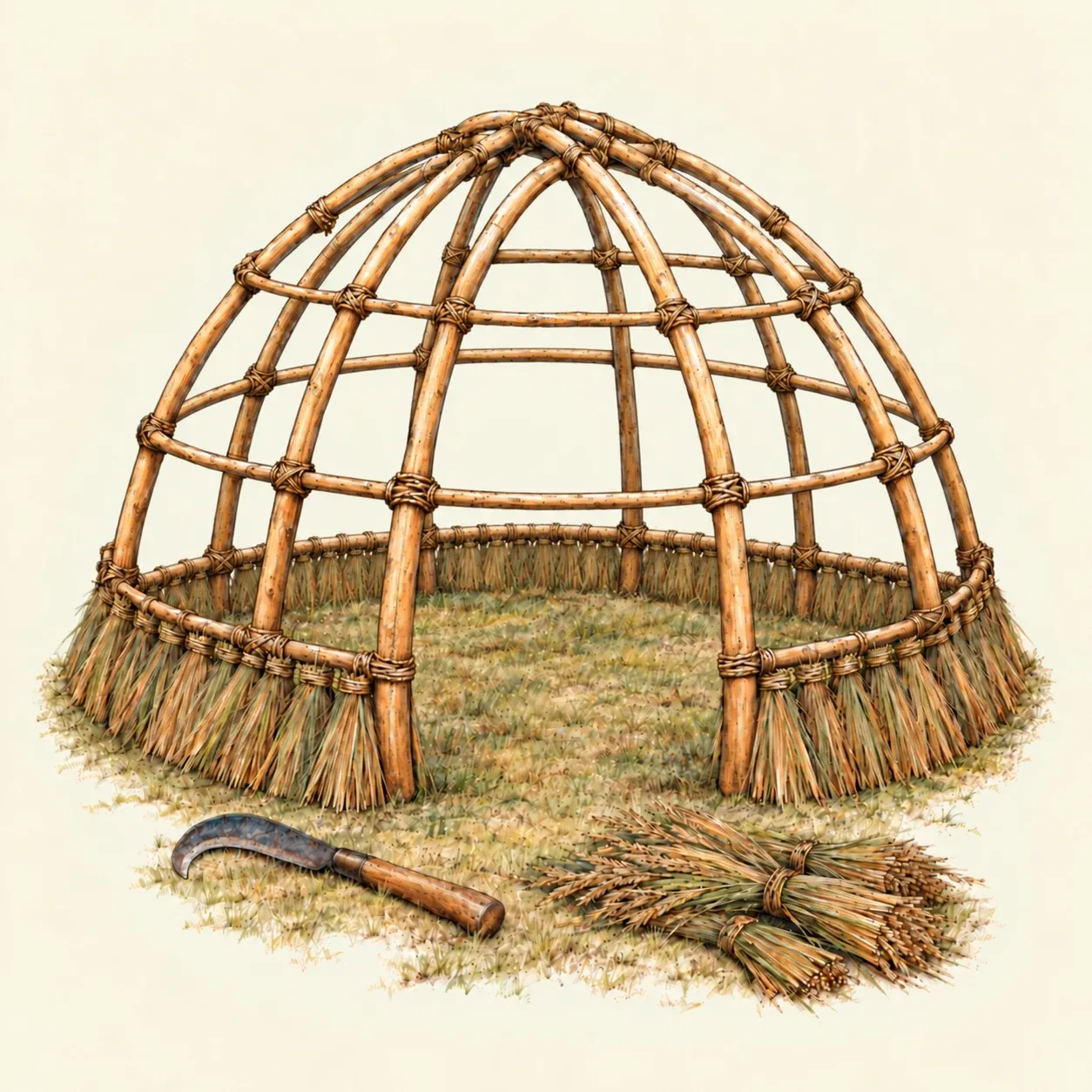 The hoops tie the arches into a lattice, and the covering starts at the bottom.
Lash three or four horizontal hoops of thinner saplings round the frame, one close to the ground and the others higher up, the lowest stopping at each side of the door, and tie every crossing. Cover the frame from the bottom up. Tie bundles of grass, reeds or bracken to the lowest hoop with the stems pointing down, then tie the next row to the hoop above so that it hangs over the top of the first, and carry on to the crown. Sheets of bark can take the place of the bundles, laid in the same overlapping order. Close the top with a last bundle or a sheet of bark.
A bent sapling stores energy and whips back if a tie slips or the wood cracks. Wear eye protection, keep your face out of its path and have a helper hold the tip while you lash. Cut away from your body and sheathe the blade between cuts. Never light a fire, candle or stove inside or near a hut of dry grass or leaves: the covering catches at once and burns in moments. Check that the frame stands firm before going in, do not let anyone climb on it, and take it down when the wood starts to rot.
History and evolution
Older shelters have been claimed, but none has kept its walls. At Kalambo Falls in Zambia, waterlogged river deposits held two logs joined crosswise by a notch cut into one of them, dated by luminescence to at least 476,000 years ago. Lawrence Barham’s team suggests that such work could have served for a raised platform, a walkway or the foundation of a dwelling; no hut was found. At Terra Amata, in Nice, Henry de Lumley reconstructed oval huts from post holes and stones in levels about 400,000 years old, the longest 14.9 m according to the Smithsonian. Paola Villa found stone tools that fitted back together across several of these levels, and Dick Stapert judged that this casts serious doubt on de Lumley’s hut. At Molodova I in Ukraine, a Middle Palaeolithic ring of mammoth bones about 8 by 7 m enclosed fifteen hearths, which Stapert takes as a sign of several occupations with different uses. At Kostenki 11 in Russia, a ring built about 25,000 years ago from the bones of at least 60 mammoths is older than Ohalo II, but Alexander Pryor’s team doubts that people lived in it for long, partly because so wide a space would have been hard to roof.
The oldest huts whose walls survive belong to Ohalo II, a camp on the shore of the Sea of Galilee in Israel. After it was abandoned the lake covered it, and fine sediment sealed it in water poor in oxygen, so the plant remains did not rot. Dani Nadel’s excavations found six brush huts, five of them with complete oval outlines. Their walls were thick branches of tamarisk, willow and oak, covered with smaller leafy branches and grass, and no post hole was found in or around any of them. More than 40 radiocarbon dates place the camp 22,500 to 23,500 years ago. Hut 1 had three floors laid one over another, and the lowest kept a layer of grass bedding. A study of plant silica led by Monica Ramsey found many reeds and sedges in that hut, probably laid as thatch on the frame. It found the same plants at Kharaneh IV in Jordan, where a hut was built about 20,000 years ago.
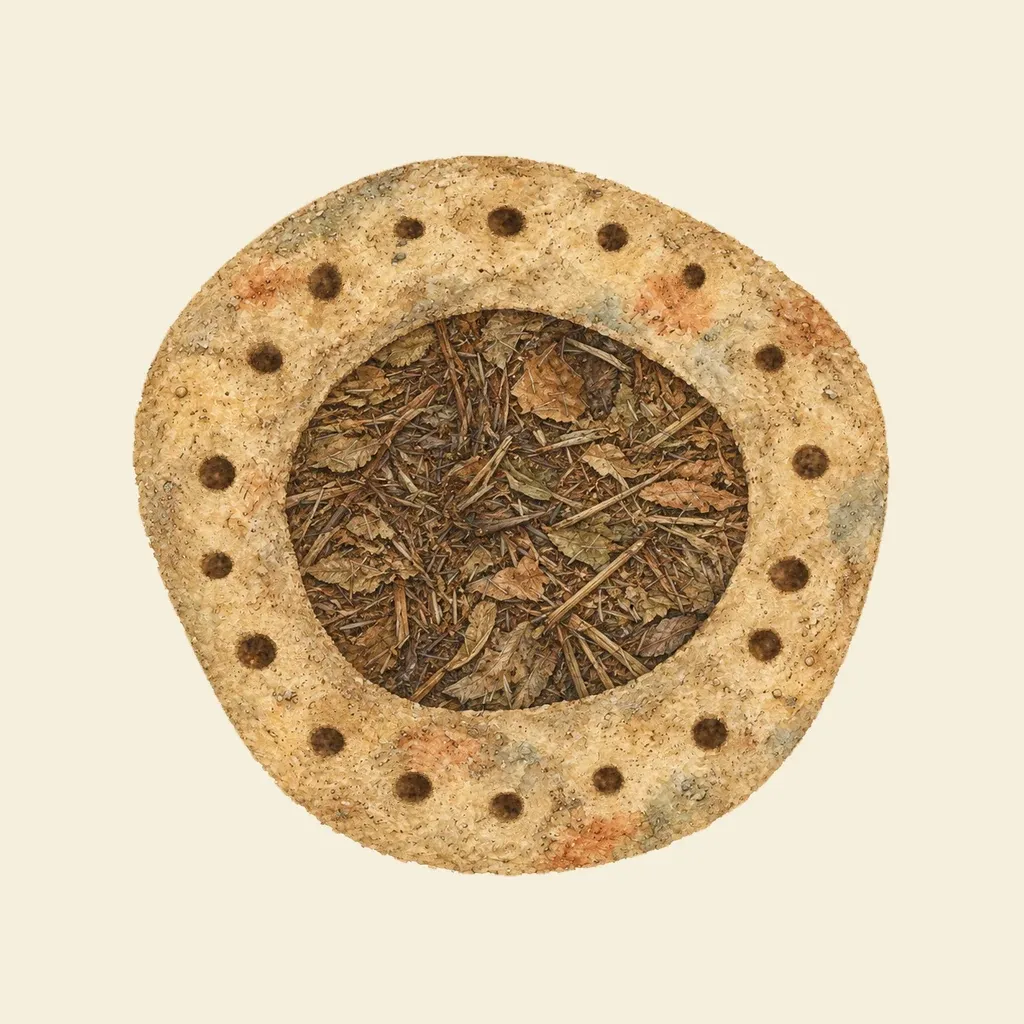 A ring of 18 post holes about 3.5 m across around a hollow filled with plant material.
In Britain the oldest known house stood beside a former lake at Star Carr, in North Yorkshire, by 8500 BCE. None of its wood survives. A ring of 18 post holes about 3.5 m across surrounds a hollow centre that had been filled with plant material. It is at least 500 years older than the house at Howick, in Northumberland, which had been the oldest known.
Bent-sapling huts remained the usual home of many peoples into the twentieth century. Among the Ojibwe of the Great Lakes, women set saplings in a circle or oval, bent each one over to meet a sapling from the opposite side and tied them with bark cord or rawhide thongs, then hung birch bark or woven cattail mats on the dome. In 1938 Sister Inez Hilger saw two families staying in a wigwam at Ponsford, on the White Earth Reservation in Minnesota, during the spring Midewiwin ceremonies. Its frame of ironwood saplings measured 3.7 by 4.9 m and stood 1.8 m high under a roof of birch bark, and old blankets and calico had replaced the traditional bulrush mats.