Spring traps
Energy stored in bent wood or steel
Contents
- 1Wooden frame cut from a single piece
- 2Hinged valves, closed
- 3Spring rods held in holes at the ends
- 4Steel jaws, closed
- 5Flat steel spring
A spring trap catches an animal with energy stored in bent wood or steel and set free by a trigger, so that jaws, flaps or a noose close on it. The oldest pictures proposed as spring traps are Egyptian: a bird-trap hieroglyph attested from the Old Kingdom (2686–2181 BCE), and pigeon traps painted around 2000 BCE in a tomb at Beni Hasan. The oldest surviving examples are wooden treadle traps from the bogs of northern Europe and Ireland, placed in the Bronze Age by pollen analysis and in the 6th and 7th centuries CE by radiocarbon.
What it is
A spring trap uses energy stored in advance to catch an animal. Setting the trap bends something springy, a growing sapling, a rod of willow or hazel, or a steel spring, and a catch holds it bent. When the animal moves a trigger, the catch lets go and the spring returns to its shape. As it does, it closes a pair of jaws, shuts a flap on a leg or pulls a noose tight. The energy comes from the person who set the trap. The animal only releases it, which is why a light touch can close a strong trap.
The family is wide. Some spring traps hold the animal alive by a leg, or by the neck or body in a noose, until the trapper returns. Others are made to kill at once, like the break-back trap used for rats and mice and the steel traps set in mole runs. Springs of bent wood need only wood and cord. Steel springs needed a smith who could temper the metal so that it bent and came back without breaking, and from the 19th century they came from factories.
How it works
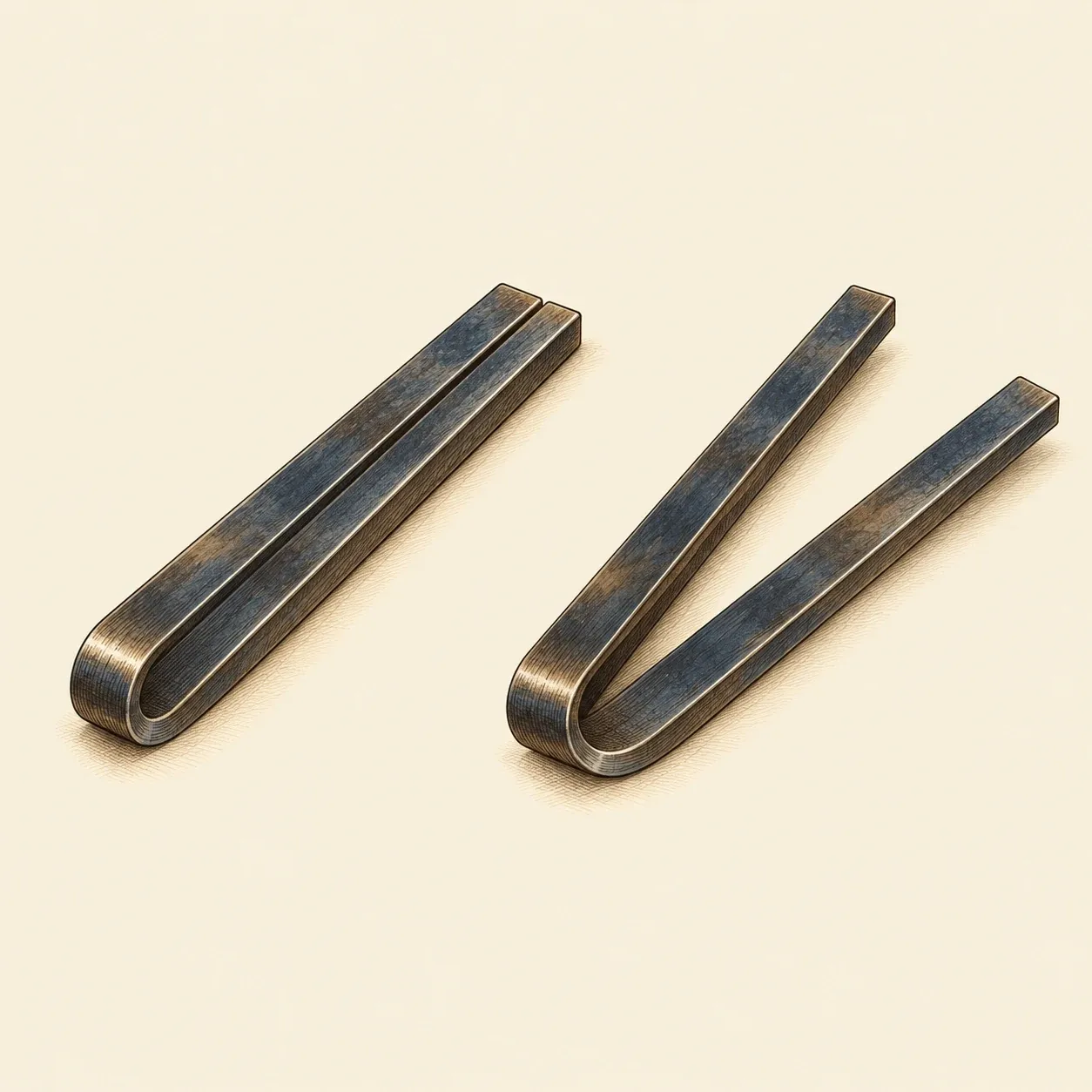 A steel spring squeezed shut holds the work spent on it and gives it back as it opens.
A springy material gives back most of the work spent bending it, as long as it is not bent past its limit. A bow stores energy the same way before it drives an arrow. In a trap, a catch keeps the bent wood or steel loaded until the animal disturbs it.
What the spring does once released decides the kind of trap. In the wooden treadle traps found in bogs, rods of flexible wood shut one or two hinged valves on the leg of an animal that had stepped through an opening in the frame. In a spring snare, a bent pole straightens and pulls a noose of rope tight. In a steel jaw trap, springs drive two jaws together.
The trigger cannot choose its victim. A trap set for a fox can take a dog, a cat or a protected bird, and critics of the steel leg-hold trap called it both inhumane and indiscriminate, since the jaws can cut or break the limb they hold. These are the reasons governments began to restrict spring traps in the 20th century. Under the Agreement on International Humane Trapping Standards, signed by the European Community, Canada and Russia in 1997 and 1998, a killing trap meets the standard only if at least 80% of a test group of at least twelve animals of the target species become unconscious and insensible within a set time, 45 seconds for the stoat, and stay so until death. Trapping is regulated in many countries, and what is allowed depends on the place, the species and the trap.
History and evolution
Snares worked by a bent sapling leave little behind, since wood and cord rarely survive. The oldest pictures proposed as spring traps are Egyptian. Joachim Dagg and Dagmar Budde trace the hieroglyph of this kind of bird trap back to the Old Kingdom, 2686–2181 BCE. The tomb of Khety at Beni Hasan, decorated around 2000 BCE for a provincial governor of the early Middle Kingdom, shows two pigeon traps, one closed over a bird and the other open with a pigeon flying towards it. Francis Llewellyn Griffith, who published the scene in 1900, thought each trap was made of two wooden frames with nets that closed by a spring or by falling, and noted that the pictures do not show the mechanism clearly. Dagg, in a history of mouse traps, reads it as a torsion trap sprung by a twisted cord on one side of the base.
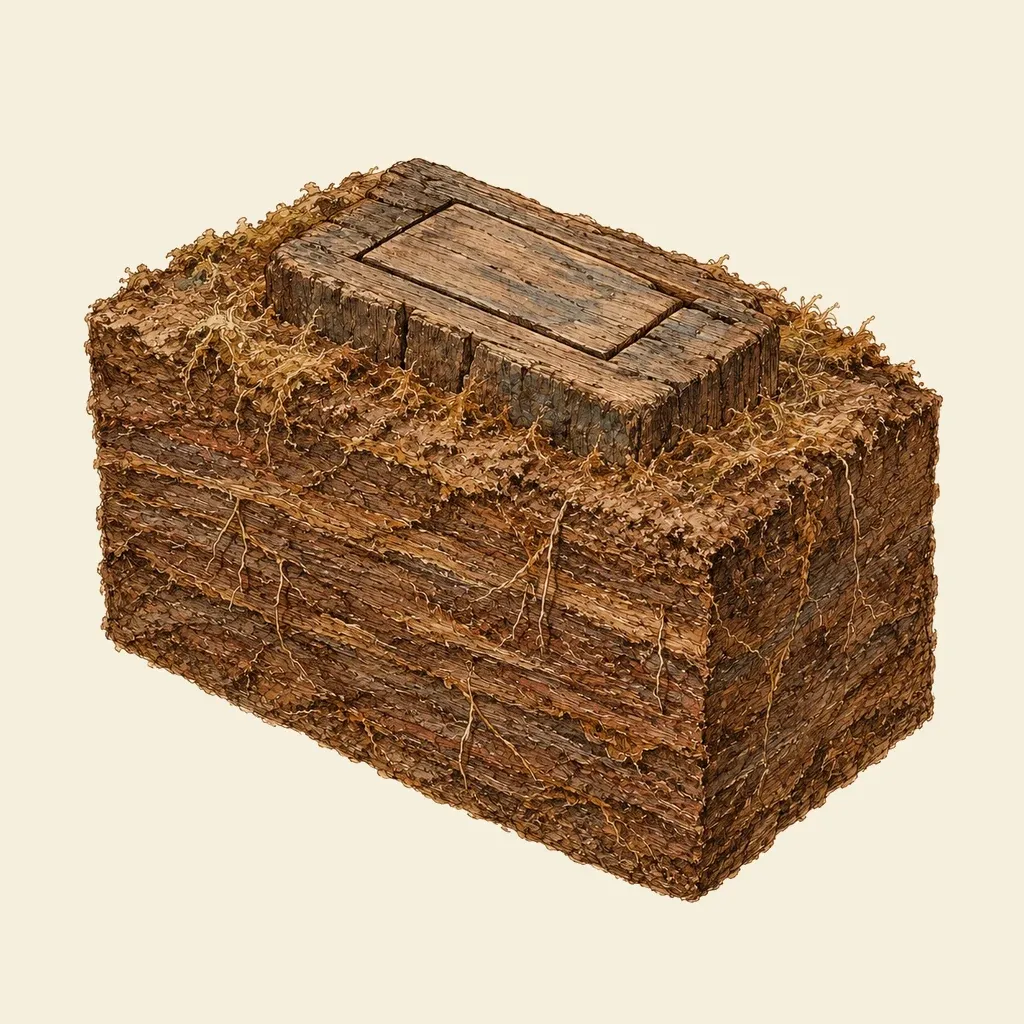 The oldest surviving spring traps are wooden treadle traps preserved in peat.
The oldest spring traps that survive are wooden treadle traps preserved in peat. Patricia Long and Gillian McCarthy list finds from Ireland, Britain, southern Scandinavia and central Europe. Their dating is uneven. Pollen analysis of the surrounding peat placed some Scandinavian traps in the Middle Bronze Age and the Iron Age, and a trap from Drummacaladdery in County Donegal in the Late Bronze Age. The radiocarbon dates obtained so far are early medieval. A trap from Auquharney Moss in Aberdeenshire, cut from an alder trunk with a birch valve and a willow spring, dates to the 6th or 7th century CE, and one of a group of nine traps from Larkhill in County Fermanagh is also early medieval. The two-valve trap of Prumpelstown Lower in County Kildare still held fragments of hazel rods in the holes at its ends.
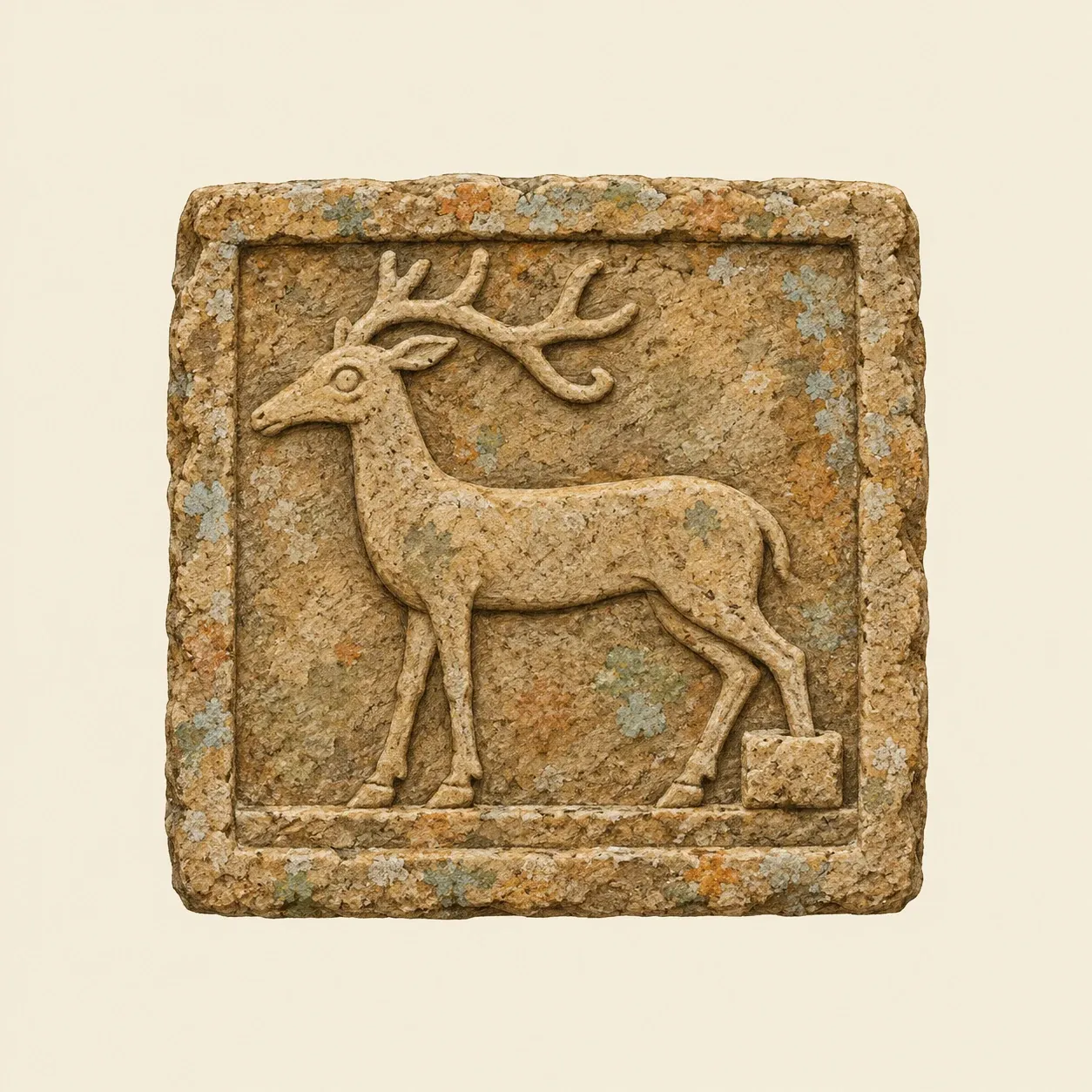 Early medieval Irish carvings show a deer caught by a hind leg.
Ethnographic research has found that in Europe such traps were mostly set for deer, and the only wild animal bones found near the Prumpelstown trap were those of red deer. Carvings on an early medieval grave slab at Clonmacnoise and on a high cross at Banagher, both in County Offaly, show a deer held by a hind leg in what looks like a treadle trap. Early Irish law texts also mention a pierced board in connection with a deer pit.
A book printed in London in 1590 and attributed to Leonard Mascall describes several spring traps for vermin. In one, a pole bowed down to the ground snatches a fox up in a noose. Another, a foot trap, takes its force from a bent tree. A small trap for mice uses springs that pull threads tight, and a trap made entirely of iron has two springs of steel that snap two hoops set with iron pins together. A. W. Schorger begins his history of the steel trap in North America with the woodcut of this iron trap. Moles were caught with the same idea. A wooden mole trap in the Museum of English Rural Life has two string nooses that a hazel switch pulls tight inside the tunnel, and the museum notes that Gervase Markham wrote at length on catching moles in the early 17th century. Its barrel trap, a wooden tube whose snares are worked by a coiled wire spring, was favoured by Scottish professional mole catchers before the Second World War.
In North America, blacksmiths adapted European traps for the fur trade in the early 19th century. Sewell Newhouse, a trap maker from Oneida County in New York State, joined the Oneida Community, a religious commune, around the middle of the century, and his small workshop grew into a factory making traps of iron and steel in several sizes. Spring traps for the house followed: an American patent granted to William Hooker in 1894 describes a mouse trap whose jaw is driven by a coiled spring of wire.
Restrictions came in the 20th century. Under the Pests Act of 1954, only approved spring traps could be used in England and Wales from 31 July 1958, which ended the legal use of the steel leg-hold trap known there as the gin trap. An order of 1958 exempted break-back traps commonly used for rats, mice and other small ground vermin, and traps of the kind commonly used for moles in their runs. The Game & Wildlife Conservation Trust describes the Act as probably the first national law to limit trapping methods on grounds of humaneness, and the Fenn trap, a spring trap that kills, was brought in during the 1950s to replace the gin trap. The European Community banned the use of leghold traps, defined as traps that hold an animal’s limb between tightly closing jaws, by 1 January 1995 at the latest.