Chocolate making
From fermented seed to chocolate
Contents
- 1Cacao pod cut open, seeds in white pulp
- 2Roasted bean split open: thin shell around the nib
- 3Stone metate and its grinding stone
- 4Cocoa liquor, the ground paste
- 5Pot of a hydraulic cocoa press, cut away
- 6Cocoa butter running from the press
Chocolate is made from the seeds of the cacao tree. They are fermented in their pulp, dried, roasted, shelled and ground into a fatty brown paste, which can be drunk, pressed into cocoa butter and cocoa powder, or mixed with sugar and extra butter into a bar. The oldest traces of cacao, in pottery from Ecuador, are about 5,300 years old.
What it is
Chocolate begins as the seeds of the cacao tree, Theobroma cacao. The ripe pods are cut from the tree and split open, and inside the seeds sit packed in a sweet white pulp. Each seed, or cocoa bean, is a thin shell around a nib. The nib is rich in a fat, cocoa butter, but raw it tastes sharp and astringent.
Making chocolate is a chain of steps. On the farm the seeds are fermented and dried. In the workshop they are roasted, shelled and ground into a paste called cocoa liquor or cocoa mass, the base of every chocolate product. Mesoamerican cooks ground it by hand on a stone metate warmed by a small fire and drank it beaten to a froth. Since the nineteenth century, factories have also pressed the paste to separate cocoa butter from cocoa powder, or refined it with sugar into bars.
How it works
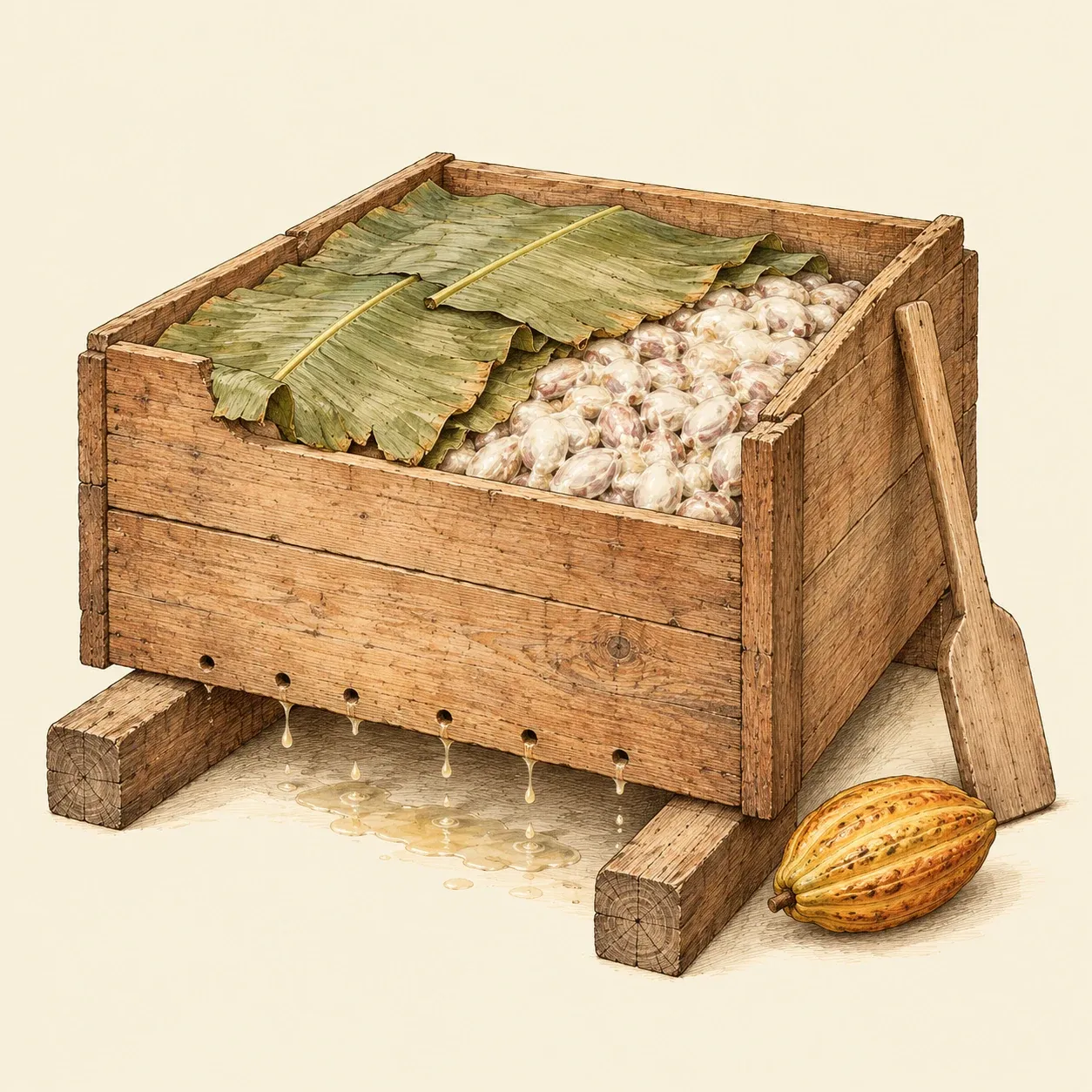 The pulp ferments around the seeds under banana leaves, and its juice drains away.
Fermentation happens on the farm. Seeds and pulp are piled in heaps covered with leaves, in leaf-lined pits, or in wooden boxes with holes in the bottom. Yeasts turn the sugars of the pulp into alcohol, then bacteria turn the alcohol into acetic acid. Within two days the mass warms to 40–45 °C, the pulp breaks down and drains away, and the acid and heat kill the seed. Inside it, reactions begin that later give the flavour and colour of chocolate. Turning the mass lets air in and evens out the heat. The more common Forastero beans ferment for about five to seven days, the Criollo type for one to three.
The beans are then dried in the sun or in dryers, from about 60% water down to 6 to 7.5%. Drying must be slow, with the beans no hotter than 65 °C: too fast and they stay acid and bitter, too slow and mould sets in.
Roasting develops the flavour, lowers acidity and astringency, deepens the colour and loosens the shell. Most factories blow air at 110 to 150 °C through rotating drums for 20 minutes to 2 hours, until the beans hold only about 1% water. A cracking and winnowing machine then breaks the beans and blows the light shells away from the heavier nibs, much as chaff is cleared after coffee roasting.
Grinding tears open the cells of the nib and releases its fat. Cocoa butter melts just below body temperature, so the warm ground nibs turn into a thick brown liquid, the cocoa liquor, which sets hard as it cools. In a hydraulic press, warm liquor is squeezed until much of its butter runs out, leaving a hard cake that is milled into cocoa powder. Treating the nibs, liquor or powder with an alkali such as potassium carbonate darkens the colour and mellows the flavour; the method is called Dutch processing after its Dutch inventor.
Eating chocolate is liquor mixed with sugar, extra cocoa butter and, for milk chocolate, milk powder. The mixture is ground fine, then conched: worked and aired in a warm machine for 4 to 72 hours at 55 to 88 °C, which develops the flavour and smooths the texture. Last comes tempering. Cocoa butter can set in six crystal forms, each melting at its own temperature. Only one, form V, which melts at about 34 °C, gives a glossy bar that snaps cleanly; the others make it soft, waxy or crumbly. Tempering uses carefully controlled heating and cooling so that the chocolate sets in form V.
How to do it
A small batch of drinking-chocolate tablets needs cocoa nibs sold roasted and ready to eat, sugar, and a stone mortar or a sturdy food processor. Check the label: raw beans and raw nibs are not suitable, because a home oven gives no proof that the roast has killed the bacteria they may carry.
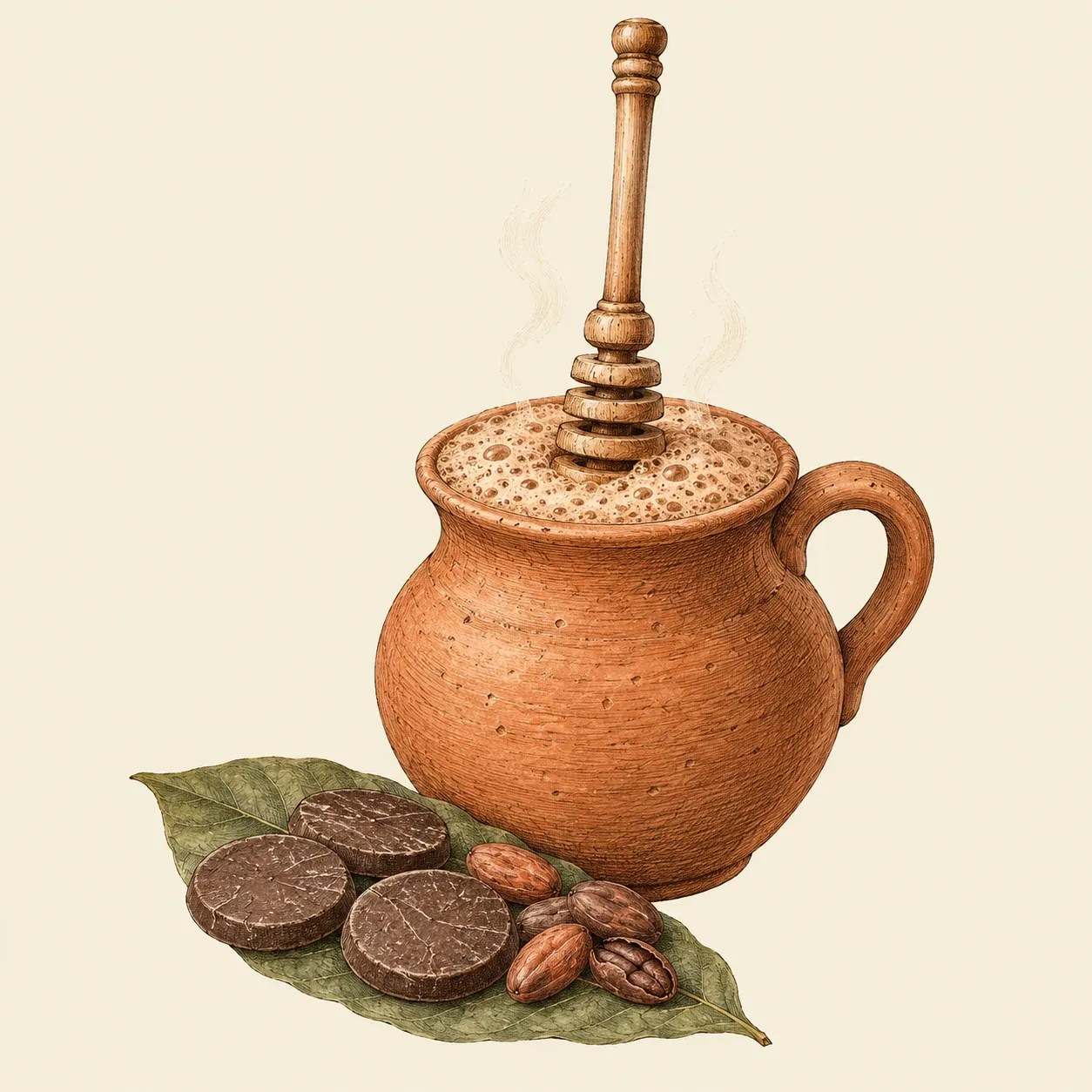 A wooden beater whips the drink into a foam.
Warm the mortar with hot water and dry it well. Grind a few spoonfuls of nibs at a time. They first turn to a dry, sandy powder, then, as the cocoa butter melts, to a glossy paste. Grind in sugar to taste. Shape the paste into small round tablets on baking paper and leave them to set in a cool place. Without tempering they will look dull or streaked, which does not matter for a drink.
To serve, melt one tablet in a cup of hot milk or water over low heat and whisk until it foams. Before eating chocolate existed, Europeans bought chocolate in solid pieces and made their drink in much the same way.
History and evolution
Cacao is native to the upper Amazon basin. At Santa Ana-La Florida, in southeastern Ecuador, cacao starch grains, theobromine and ancient DNA have been found in pottery, including stirrup-spout bottles, about 5,300 years old. This find shows that people there prepared cacao seeds as well as the pulp and kept them in vessels, but not how, and the researchers think the result was probably not chocolate.
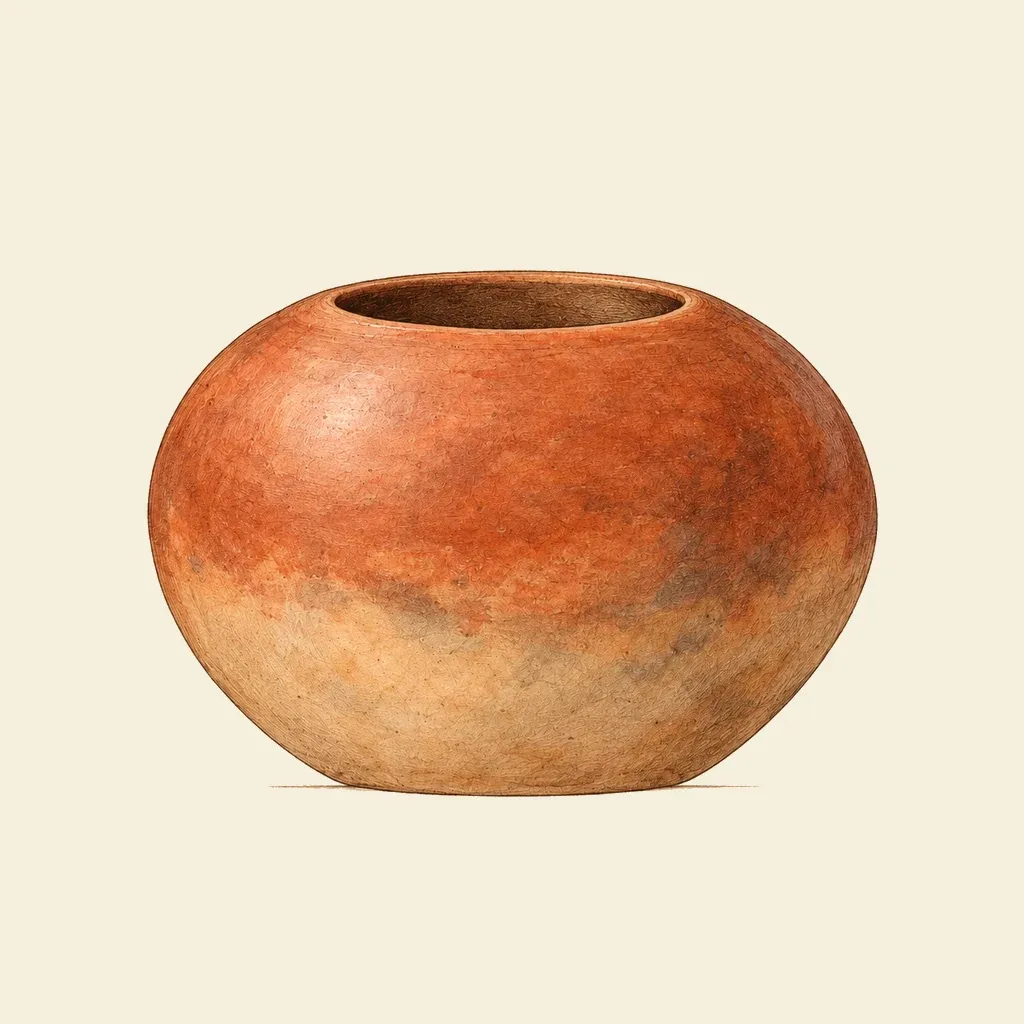 The oldest cacao residue in Mesoamerica comes from a neckless jar like this one.
In Mesoamerica, the oldest cacao residue comes from a neckless pottery jar at Paso de la Amada, on the Pacific coast of southern Mexico, dated 1900–1500 BCE. Theobromine, the compound that marks cacao, then appears in many vessels at the Olmec centre of San Lorenzo. The chemistry cannot tell whether these pots held a drink of ground seeds or a beer fermented from the pulp. At Puerto Escondido in Honduras, where cacao appears in a spouted bottle from shortly after 1150 BCE, John Henderson and his colleagues argue that the first cacao drinks were of the second kind and that chocolate made from the seeds came later; Terry Powis and his colleagues point out that fermenting the pulp is not a necessary step. Neither the Ecuadorian nor the Mexican find proves the whole chain of fermenting, roasting and grinding that makes chocolate.
A vessel from an Early Classic Maya tomb at Río Azul, in Guatemala, held cacao residue and bears glyphs read as kakaw, “cacao”; such inscriptions helped scholars decipher Maya writing. When the Spanish reached Mexico in 1519, the Aztec drink was made from sun-dried beans whose nibs were roasted in clay pots and ground on a metate over a small fire, with vanilla, spices or maize. The paste was shaped into small cakes, which were later broken up in hot water and beaten to a foam.
Cacao beans reached Spain in the sixteenth century, and the first recorded shipment arrived from Veracruz in 1585. Sweetened with sugar and flavoured with cinnamon and vanilla, the hot drink spread from the Spanish court across Europe in the seventeenth century.
In 1828 a Dutch patent was granted for pressing much of the cocoa butter out of the liquor, leaving a cake that could be ground into cocoa powder. The Metropolitan Museum’s catalogue of early American silver credits it to Casparus van Houten, while the Dutch National Archives give the pressing method to his son, Coenraad Johannes. The butter this freed made solid chocolate possible: in 1847 the English firm of Fry and Sons mixed cocoa butter back into liquor with sugar to make a moulded eating chocolate. In the 1870s Daniel Peter, in Switzerland, added milk. Rodolphe Lindt, who opened a factory in Bern in 1879, invented the conche, a machine with shell-shaped troughs in which the chocolate is worked for hours.