Frame saw
A thin blade held in tension
Contents
- 1Arms, one shaped as a handle
- 2Crossbar, in compression
- 3Doubled cord, in tension
- 4Toggle, resting against the crossbar
- 5Toothed steel blade, in tension
A frame saw keeps a thin blade straight by stretching it in a frame. In the joiner's bow saw, a twisted cord pulls the tops of two wooden arms together, the arms bear on a crossbar, and their lower ends pull the blade tight. Roman painters showed frame saws at work before 79 CE.
What it is
A frame saw holds its blade by both ends and stretches it. A thin strip of steel pushed through wood on its own would buckle. Held in tension between two points, it stays straight, and a narrow blade cuts a narrow kerf. The frame does the work that a thick, stiff plate does in an ordinary handsaw.
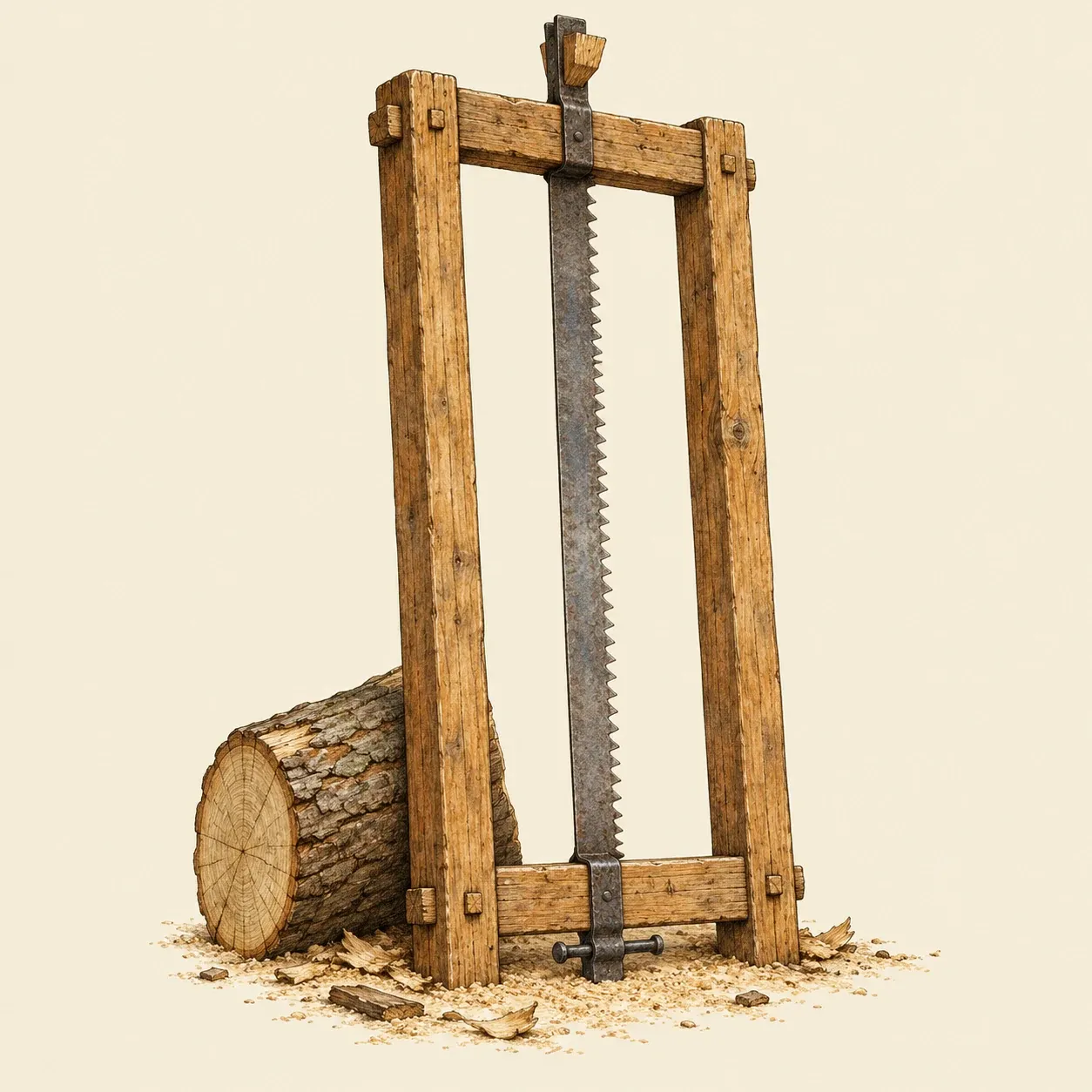 In the large frame saw, a rectangle of timber holds the blade stretched down its middle.
There are two main kinds. Large frame saws, a rectangle of timber with the blade across it, were worked by two sawyers to cut beams and planks. The smaller bow saw is a one-person tool for the joiner’s bench. Two wooden arms, also called cheeks, stand on either side of a crossbar. A cord runs across their tops and the blade across their feet. Joseph Moxon, describing the joiner’s tools in London in 1678, groups the frame or bow saw with the saws “accommodated for a single man’s use”, which “cut forward”. The distance between the blade and the crossbar limits how far the saw can reach into a board before the frame meets its edge.
How it works
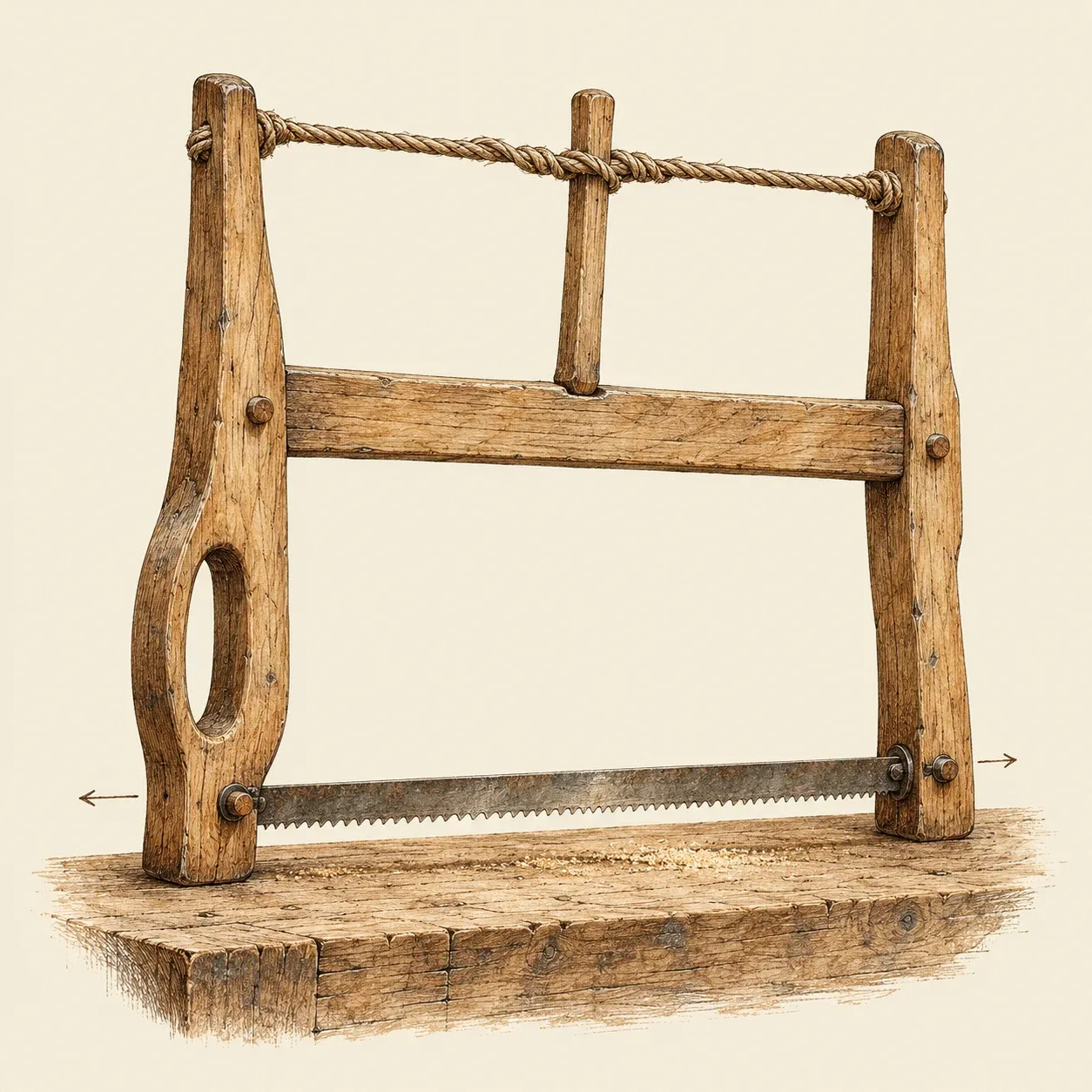 The cord pulls the tops of the arms together; their feet pull the blade tight.
Each arm is a lever that pivots on one end of the crossbar. The cord is doubled, and a flat stick, the toggle, is pushed between its two strands at the middle. Turning the toggle twists the strands around each other and shortens the cord, which draws the tops of the arms together. Their feet move apart and stretch the blade. The cord and the blade are in tension, and the crossbar between them is in compression. Once the blade is tight, the toggle is turned until it lies against the crossbar, which stops the cord from unwinding. Moxon puts it in one sentence: the “twisted cord and tongue in the middle” draw the upper ends of the cheeks closer so that the lower ends spread wider apart and strain the blade straighter.
The teeth point away from the user, so the saw cuts on the push stroke. Each tooth scrapes or chisels out a small chip, and the gaps between the teeth carry the sawdust out of the cut. On many bow saws the blade ends are held in round handles that turn in the arms, so the blade can be set at an angle to the frame and the frame clears the edge of the board in a long cut.
The teeth are also set: bent alternately a little to the left and to the right. The kerf is then wider than the blade itself, and the blade runs through the cut without rubbing or jamming. Too much set makes the saw wander and wastes effort on a wider cut. Because the kerf removes wood, two pieces sawn from a board are together narrower than the board was.
How to do it
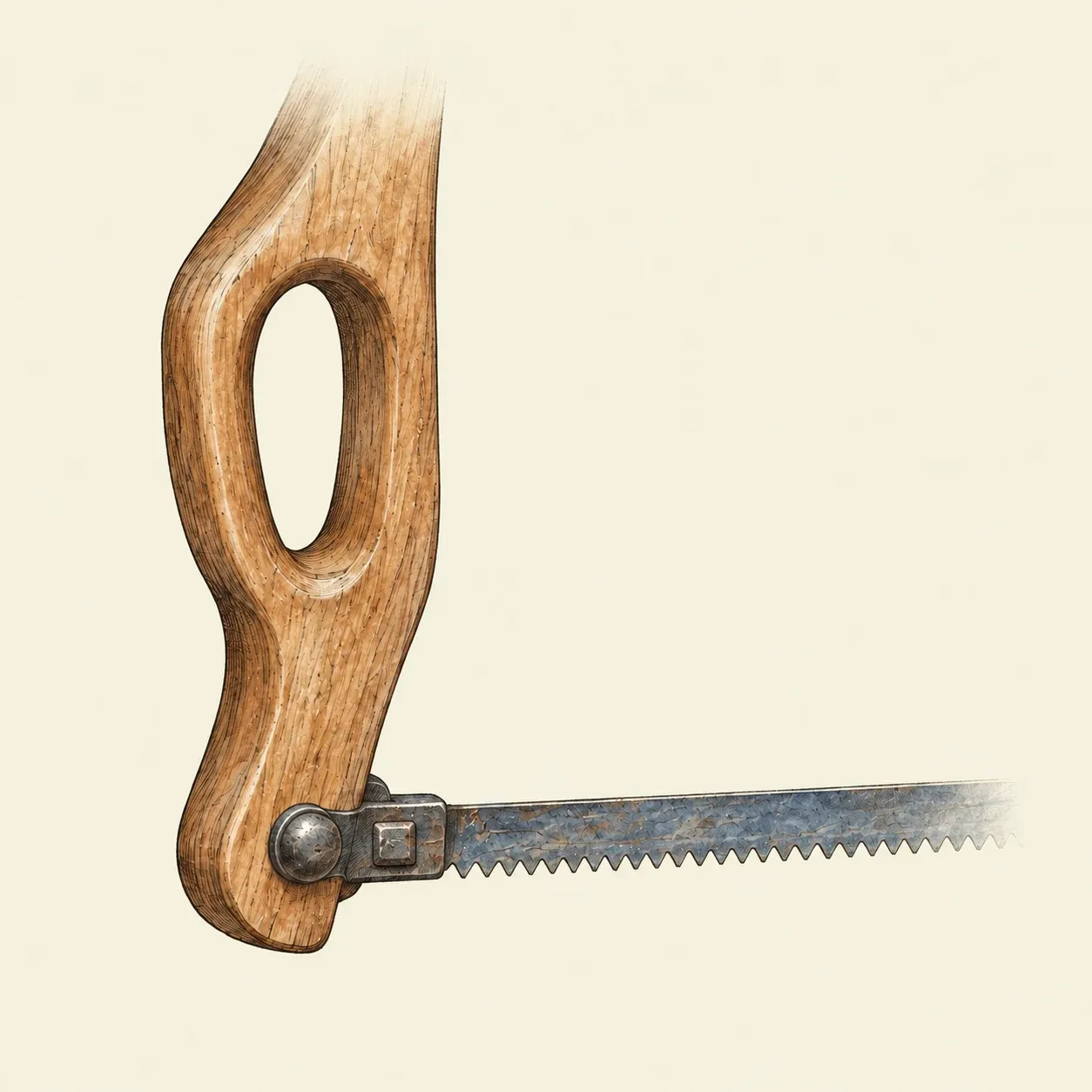 The end of the blade sits in an iron strap pinned through the foot of the arm.
Buy the blade: a bow-saw or turning-saw blade of about 300 mm for wood, with a hole at each end. The frame is made of a straight-grained hardwood such as ash or beech, free of knots. Cut two arms about 2 × 3 cm and 30 cm long and a crossbar of the same section.
Fit the crossbar. Cut a short tenon at each end of the crossbar and a matching shallow mortise halfway up each arm. Do not glue them: the arms must be able to rock on the tenons. Make the crossbar so long that, with the arms parallel, their feet are about 1 cm closer together than the two fixing points of the blade.
Fix the blade. Saw a slot up into the foot of each arm, as deep as the blade is wide, and drill a hole across it. Set the blade ends in the slots, teeth pointing away from the arm you will hold, and fix each with a steel pin or a nail passed through the arm and the hole in the blade. In place of a slot, each blade end can also sit in a folded iron strap, held by the same kind of pin through the foot of the arm. Keep the tooth guard on the blade for every step.
Tension it. Cut a notch near the top of each arm. Tie a strong cord of hemp or linen, 2 to 3 mm thick, into a closed loop that passes once round both tops, in the notches: two parallel strands then run between the arms. Push a flat stick 15 to 20 cm long between the two strands at the middle and turn it, a little at a time, until the blade is straight and gives a clear note when plucked. Turn the stick on until it rests against the crossbar.
History and evolution
The frame saw appears in Roman art before 79 CE, when Vesuvius buried the town of Herculaneum. A small painting from the House of the Deer shows two winged Cupids working a frame saw. It was found in 1748, engraved for the first volume of the Antichità di Ercolano in 1757 and taken to the museum in Naples. Roman saws had iron blades, which Latin authors call ferrea, “made of iron”.
A mosaic from the synagogue of Khirbet Wadi Hamam in Galilee shows builders and craftsmen at work, one of them with a bow saw. Uzi Leibner, who excavated the site, dates the floor to the late third or early fourth century. The large two-man frame saw stayed in use for cutting planks from logs until mechanical saws took over.
In 1678 Moxon described the joiner’s frame saw with its twisted cord and toggle. The Science Museum in London keeps a late eighteenth-century frame saw of wood, steel and cord. Later frame saws often replaced the cord with a steel wire or a threaded rod. With a cord-and-toggle frame, a worn blade can be replaced and the rest of the tool kept.