Wood waste recovery
Chipping sawmill leftovers into mulch, fuel and boards
Contents
- 1Offcuts and slabs
- 2Disc chipper
- 3Pile of chips
- 4Stack of particleboard panels
- 5Sacks of wood pellets
- 6Ring of mulch around a tree
Wood waste recovery takes the slabs, offcuts, shavings and sawdust of sawmills and joinery shops, and the branches cut by tree surgeons, and turns them back into raw material. Chipped and sorted, the same stream becomes mulch for gardens, pressed logs and pellets for stoves, and boards bonded with resin. In 1603 Hugh Plat, in London, described coal balls made with the sawdust of sawn boards, and in 1924 William H. Mason, at Laurel, Mississippi, turned the chips a sawmill burned as waste into hard boards.
What it is
Every sawmill and joinery shop leaves behind slabs, edgings, offcuts, shavings and sawdust, and tree surgeons leave heaps of branches. Wood waste recovery collects this material, cuts it down to chips or finer particles and puts it back to use, where it would otherwise be burned in a waste furnace or dumped.
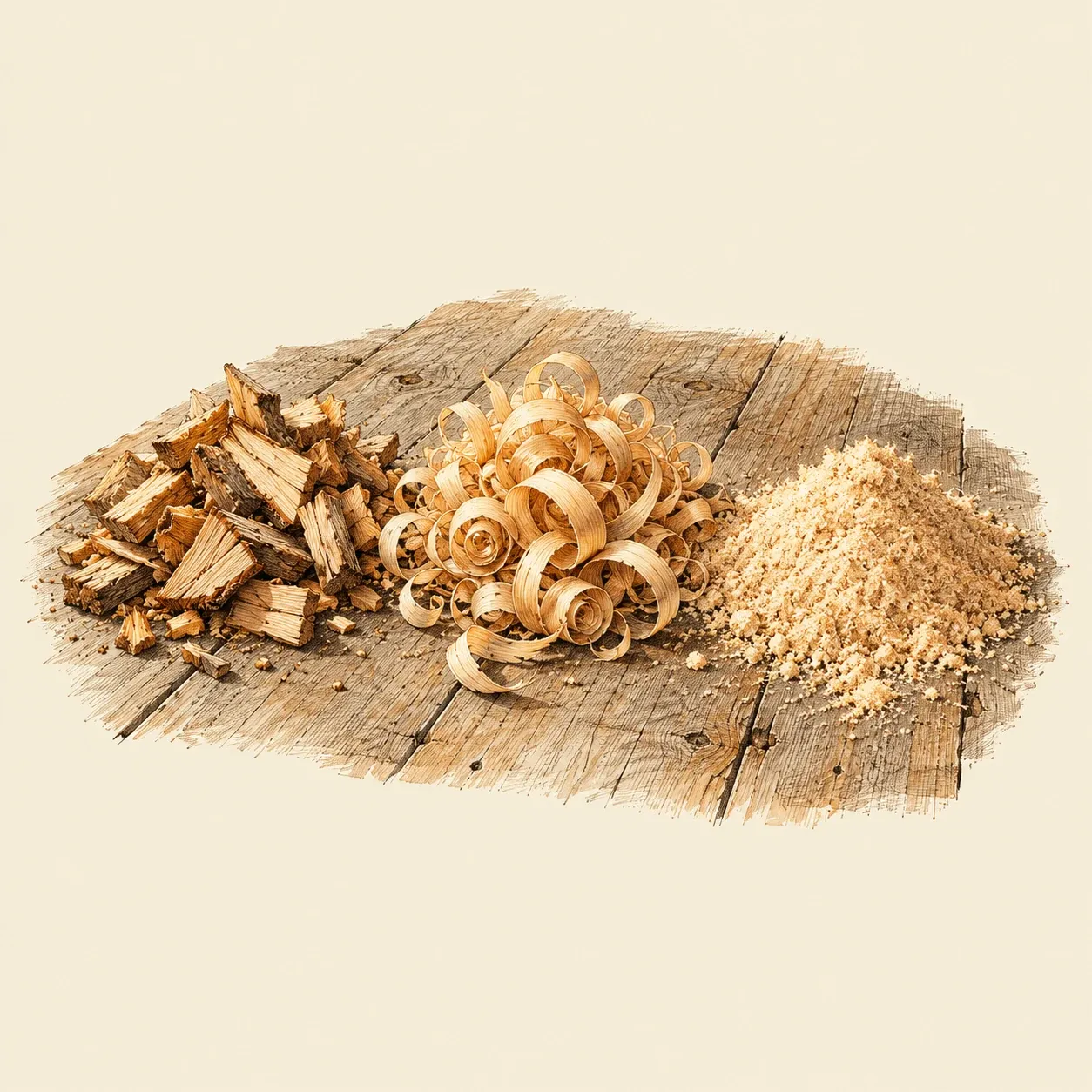 Chips, shavings and sawdust: the three sizes of wood waste that sawmills and workshops produce.
The material goes to three main outlets. Coarse chips that still carry bark and leaves are spread as mulch around trees and shrubs. Dry sawdust and shavings are pressed into pellets and logs for stoves and boilers. Clean chips, sawdust and planer shavings are bonded with resin and pressed into particleboard for furniture and building.
Not all wood waste can be reused this way. Timber recovered from demolition can include wood treated with preservatives such as chromated copper arsenate, and once chipped into mulch even a small share of it can release arsenic into the soil. Treated wood therefore has to be sorted out of the stream that is chipped for gardens or burned in stoves.
How it works
A chipper cuts wood with knives set on a heavy rotating disc or drum. In a disc chipper the wood is fed against the face of the disc and each knife slices off a chip as it passes. In a drum chipper the blades sit along a spinning cylinder that bites into the wood as it comes in.
Spread around trees and shrubs, a layer of chips holds moisture in the soil, evens out its temperature and smothers weeds. The chips rot slowly and release their nutrients to the soil over the years. The layer is laid as a ring that thins out towards the trunk, since mulch piled against the bark keeps it wet and lets fungi in.
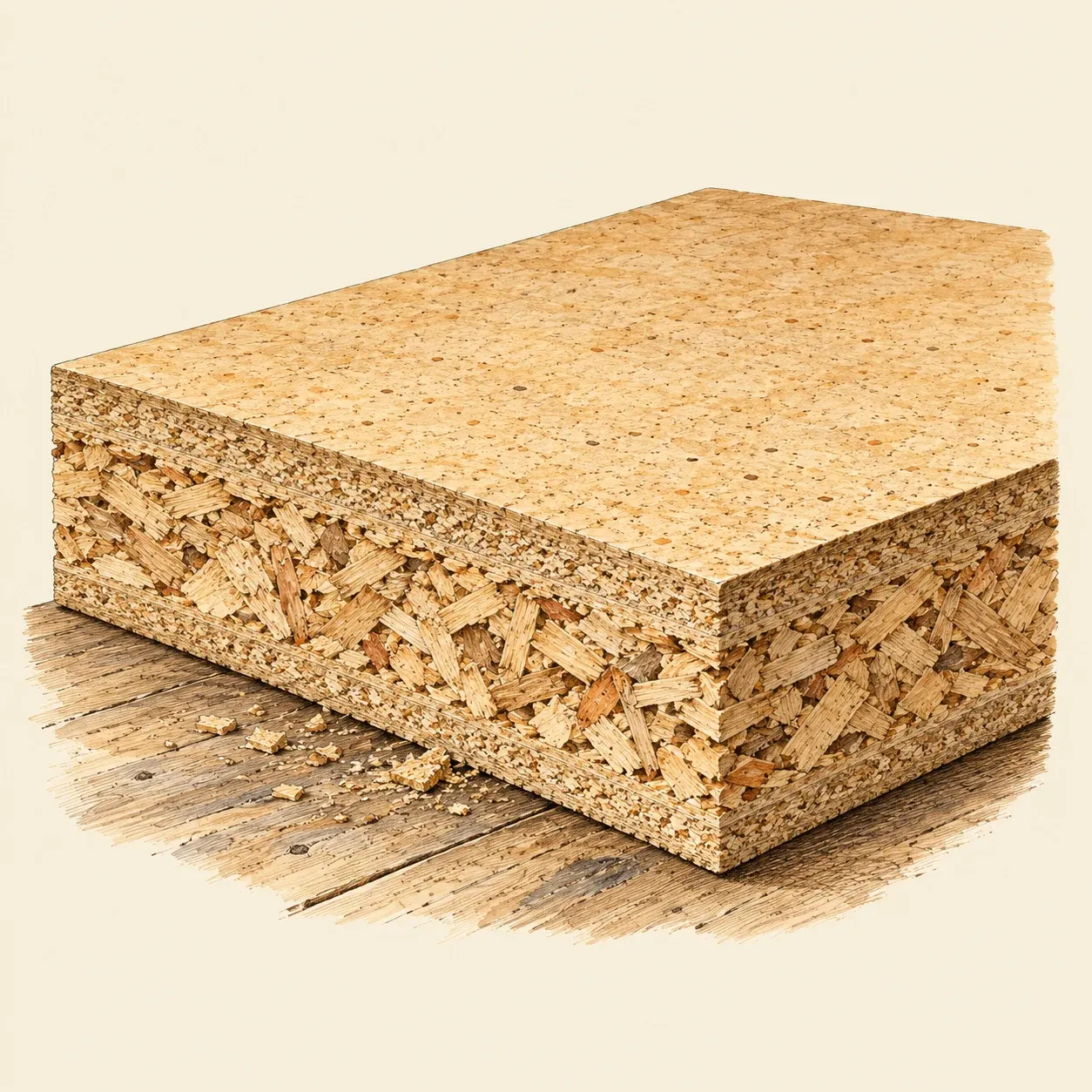 The edge of a particleboard panel: fine particles on the faces, coarser chips in the core.
Fuel pellets and pressed logs can hold together without glue, because lignin, the natural binder that holds wood fibres together, also binds the particles.
Particleboard is made of chips, sawdust and shavings bonded with a synthetic resin, a modern adhesive, and compacted into a solid panel in a press. Many boards have three layers, with fine particles on the faces and coarser ones in the core, which makes the board stiffer in bending. Fibreboard, such as hardboard and medium-density fibreboard, starts instead from wood broken down into separate fibres, as in Mason’s process.
History and evolution
Sawmills long treated their waste as a nuisance. In London in 1603, Hugh Plat published a pamphlet on coal balls, a cheap fuel, some of them made with the sawdust of sawn boards. A United States patent of 1849 for fire-kindling material also listed sawdust among its ingredients, and an 1864 patent covered a fuel made from wood waste. In 1887 Ernst Hubbard, in an article published in Germany, proposed making boards from waste materials. In 1905 Watson took up the idea in the United States.
At Laurel, Mississippi, heaps of chips and lumber ends from the mills went to a large waste furnace. William H. Mason, a former assistant of Thomas Edison, looked for a use for them, and in 1924 he found a way to break wood chips down into separate fibres and press the fibres back together into hard boards. Lumber companies backed him, and a plant at Laurel was soon making the boards, sold as Masonite, for building.
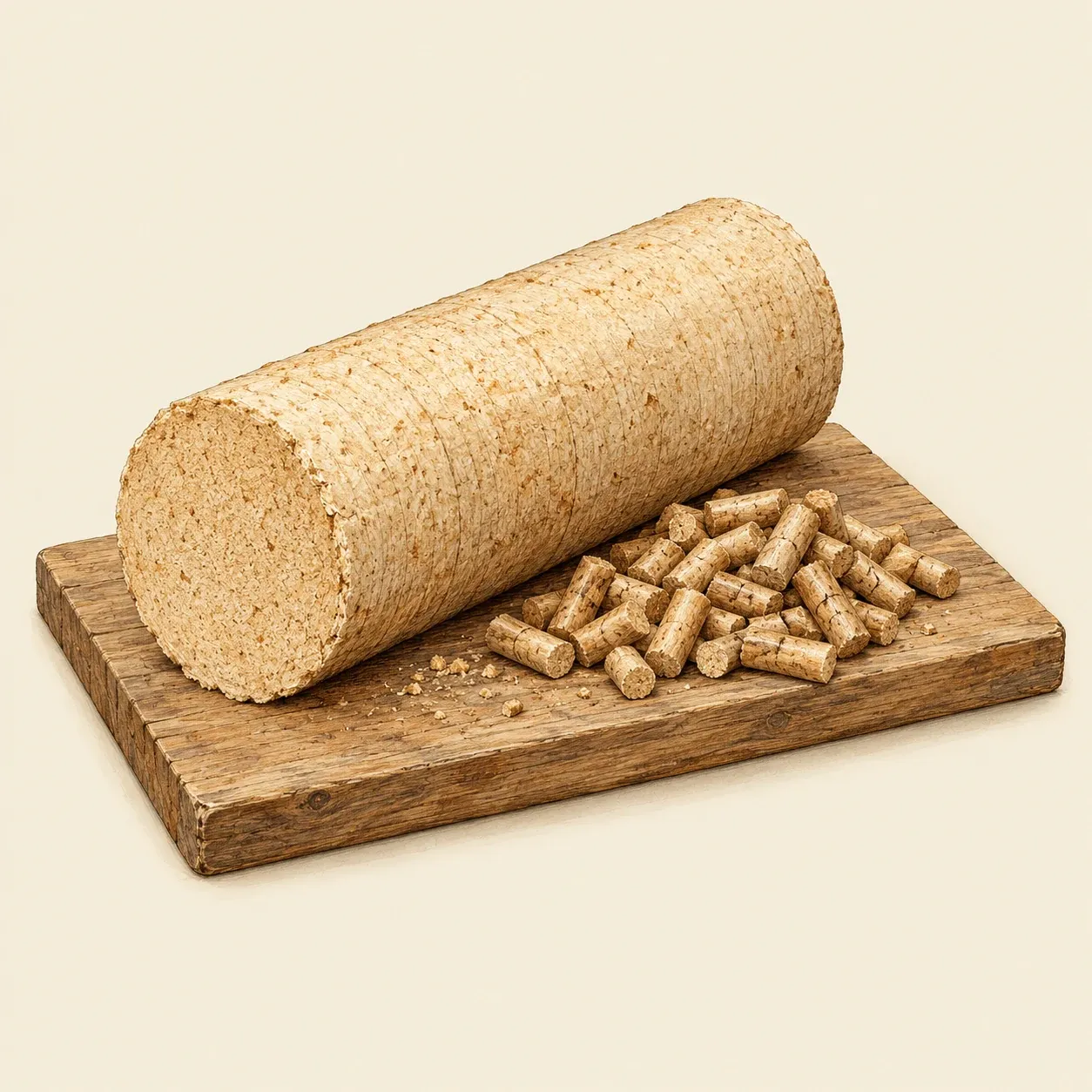 A pressed sawdust log and a handful of wood pellets, two fuels made from sawmill waste.
In the 1930s sawmills in the United States began pressing sawdust and shavings into fire logs, sold as Pres-to-logs, which held together without any added glue. Wood pellets for stoves and boilers came later and are made on the same principle.
Boards of glued wood particles had been proposed and tried for decades. The first particleboard made on an industrial scale came from a plant in Germany in 1941. After the war, Wilhelm Klauditz’s wood research institute at Braunschweig took the work on particleboard further.
Landscape mulch has since become a major market for recovered wood and garden waste. Wood from building and demolition sites has joined that stream, and studies in Florida and in the United Kingdom have shown that preservative-treated timber mixed into it can leach arsenic, chromium and copper into the soil.