Shuriken
Small Japanese blades made to be thrown
Contents
- 1Point of a four-pointed shaken
- 2Central hole
- 3Flat iron plate, seen edge on
- 4Point of a bō-shuriken
- 5Tail of the bō-shuriken
A shuriken is a small Japanese blade made to be thrown, a weapon small enough to be held inside the hand, as its name says. The two main forms are the bō-shuriken, a straight spike, and the shaken, a flat plate with several points, better known as the throwing star. The great dictionary of the Japanese language cites a chronicle of about 1602 that already names the cross-shaped shuriken, and many martial schools of the Edo period taught their use as a secondary art.
What it is
A shuriken is a small blade made to be thrown at an opponent. The word, written with the characters for hand, inside and blade, names a weapon small enough to be hidden in the palm. Nakabayashi Shinji, in the Heibonsha encyclopedia, sorts them into five shapes: short-sword, needle, nail, blade and wheel. The first four are straight, mostly spikes of iron or steel called bō-shuriken. The wheel forms are thin, flat plates with several points around the edge, called shaken or kurumaken and known outside Japan as throwing stars.
Shuriken are known above all from the Japanese martial arts. In the Edo period (1603–1868) shuriken-jutsu, the art of throwing them, was taught by many schools alongside the sword and other weapons.
How it works
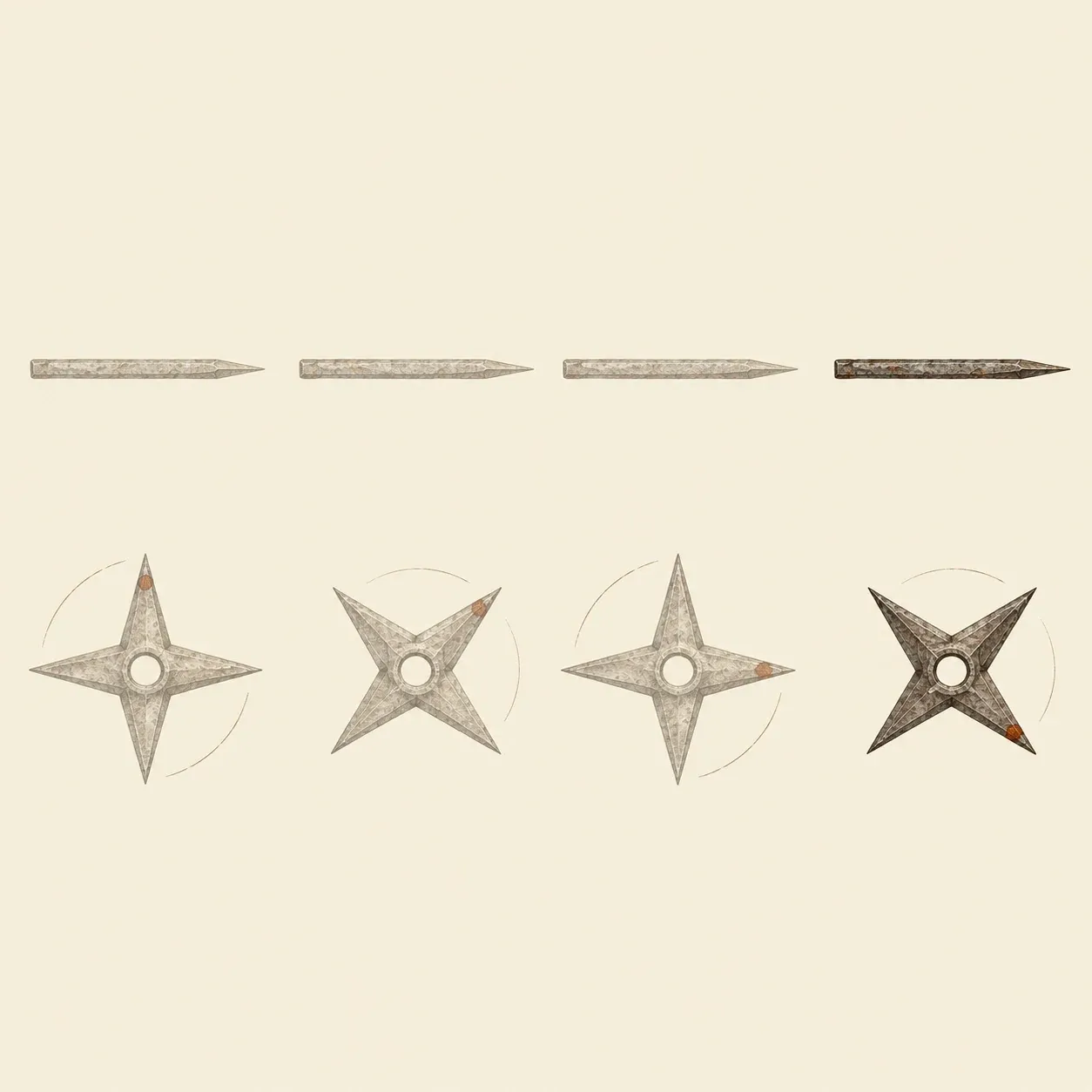 A straight shuriken flies point first, while a star turns as it flies.
A straight shuriken has to arrive point first. Nakabayashi groups the ways of throwing it into three: a direct throw, in which the spike flies without turning, and throws in which it makes half a turn or turns over completely before it arrives.
A flat star works differently. It spins around its centre as it flies, and the spin keeps it flat in the air, as a spinning top or a gyroscope keeps its axis. Because its points are spread around the whole edge, one of them is always at the front, whatever the angle the star has turned through. Many shaken also have a round hole in the centre.
How to do it
A display model shows the two main forms side by side and is never thrown. It needs a sheet of thick grey card, a stiff board as a backing, a compass, a ruler, a pencil, glue and a craft knife.
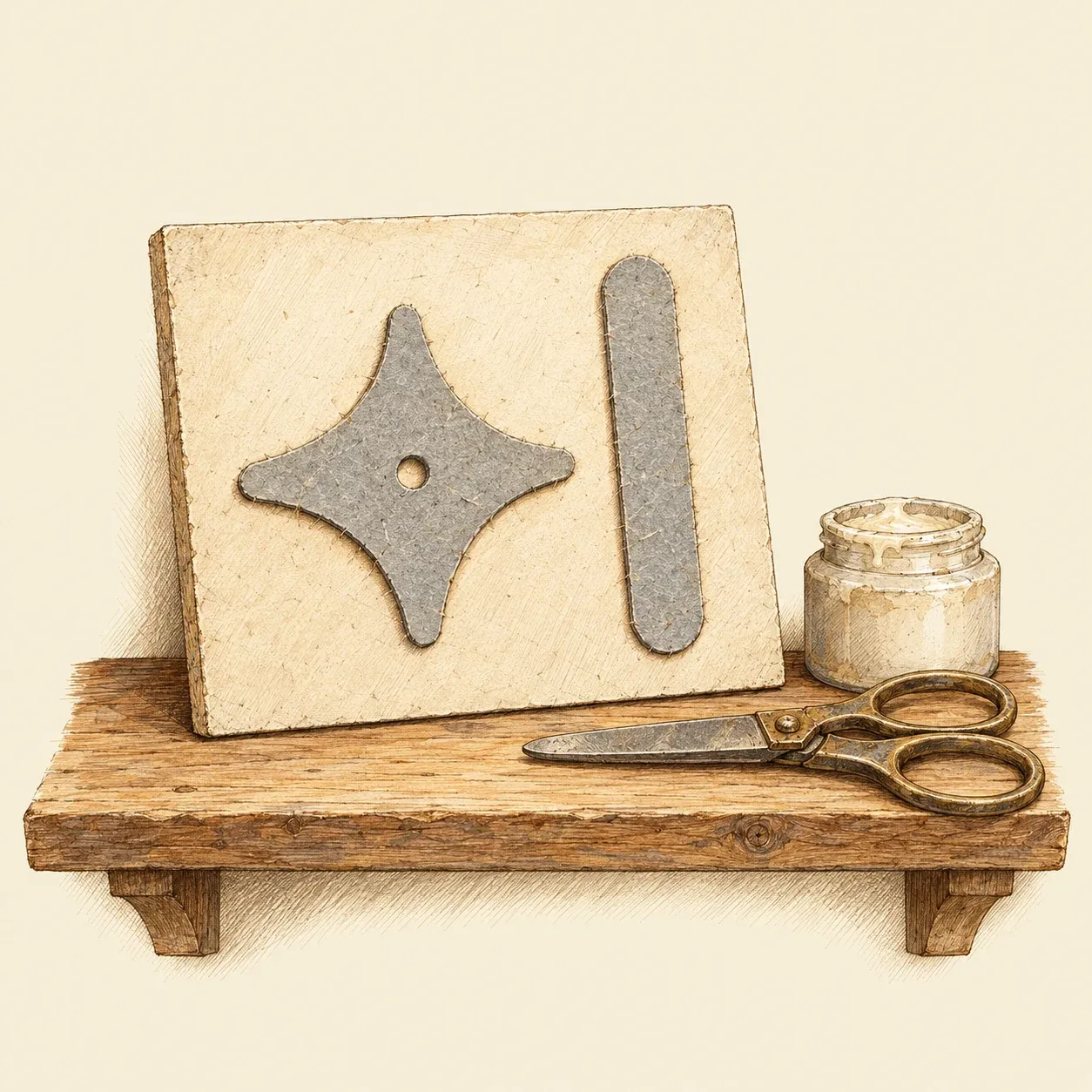 Glued flat on a board, the model shows the two forms without ever leaving the wall.
Draw a circle on the card, then four points spaced at right angles around it, and join them into a four-pointed star. Round off every tip into a curve the width of a finger, and draw a small circle in the middle for the hole. Cut out the star and the hole with the craft knife. Cut a straight strip of card for the bō-shuriken, about as long as your hand, and round both ends. Glue both pieces flat on the board, side by side, and press them under a weight until the glue has set.
Safety. The model is for display only: never peel it off the board and never throw it or anything shaped like it at a person or an animal. Real shuriken are dangerous weapons, and in several countries it is illegal to make, carry or own them.
History and evolution
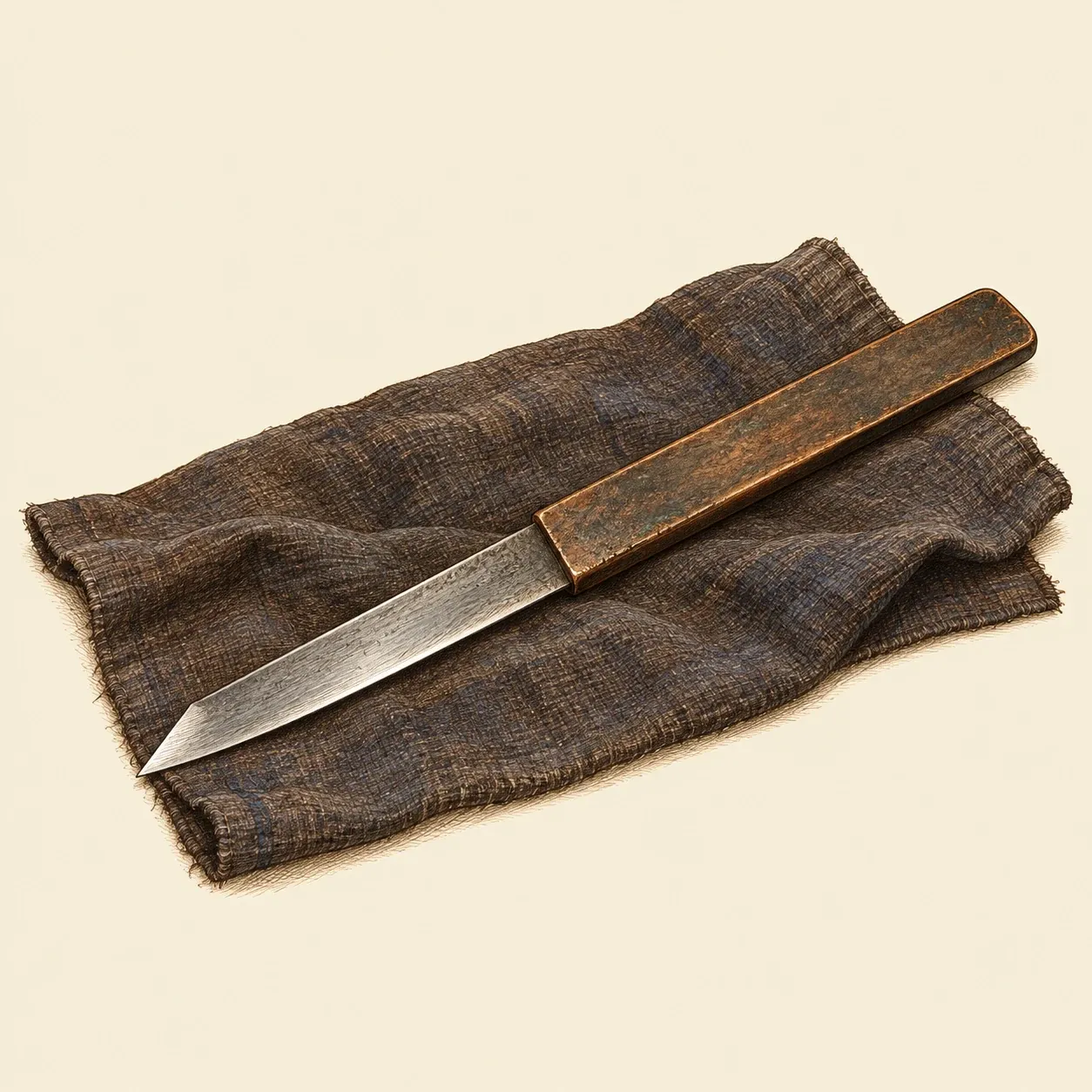 Small knives thrown in an emergency were probably the forerunners of the shuriken.
Throwing small blades is older than the word. Saitō Shin’ichi, in the Shōgakukan encyclopedia, sees its probable forerunners in the hand-thrown arrows mentioned in the Taiheiki, a chronicle of the 14th century, and in small knives thrown in an emergency. The small utility knife carried in the scabbard of a sword is the kogatana, and its handle the kozuka. At first, Saitō writes, the name applied to kozuka and the like and to the act of throwing a small knife on the spot, and chronicles such as the Ōsaka gunki and the Jōzan kidan record such throws.
According to Nakabayashi, the shuriken took its own shape and its name at the end of the Muromachi period, which closed in 1573. The Nihon kokugo daijiten, the great dictionary of the Japanese language, gives as its earliest example of the word the Muromachi-dono nikki of about 1602, which already lists the cross-shaped shuriken among the fighting techniques of a warrior. Yamada Yūji of Mie University finds the word in the Gunpō jiyōshū, completed in 1618, and notes that when it first appeared is not yet settled. In 2022 the archaeologist Iwata Akihiro proposed that flat stones from castle sites in Saitama prefecture were forerunners of the throwing star, and linked them to the siege of Odawara in 1590; he noted that Edo-period shuriken have the same structure but are made of steel.
Under the long peace of the Edo period, shuriken-jutsu became an art of the martial schools. The Heibonsha encyclopedias name among them the Negishi-ryū, the Shirai-ryū, the Yagyū Shinkage-ryū and the Katori Shintō-ryū, and date the spread of nail and needle shapes, and of the schools that used them, to the late 18th century. Today most people picture the shuriken as the weapon of the ninja. Yamada Yūji, a historian of the ninja at Mie University, has said that he could not find any record of ninja using shuriken.