Pencil
A solid mark in a wooden grip
Contents
- 1Lead of fired graphite and clay
- 2Lower half of the casing, with its groove
- 3Upper half of the casing
- 4Glued joint
- 5Sharpened point
A pencil is a stick of solid marking material held in a casing for the hand. Its modern lead is graphite fired with clay, set between two glued strips of wood. The oldest known description and picture of a pencil are in a book on fossils that Conrad Gessner published in Zurich in 1565.
What it is
A pencil is a rod of solid marking material, the lead, inside a casing that the hand holds and that protects the brittle lead. Drawn across paper, it leaves a grey to black line that needs no drying and can be rubbed out. Despite its name, a pencil lead contains no lead metal. It is made of graphite, a soft form of carbon, and since the end of the eighteenth century the graphite has been mixed with clay and fired. The casing is usually two strips of cedar glued together around the lead, then shaped with six flat faces or rounded.
One construction gives a whole family of pencils. Changing the share of clay makes the lead harder or softer, and replacing the graphite with pigment, a binder and wax gives coloured pencils. Each pencil is sharpened by cutting away the wood at one end until the lead shows.
How it works
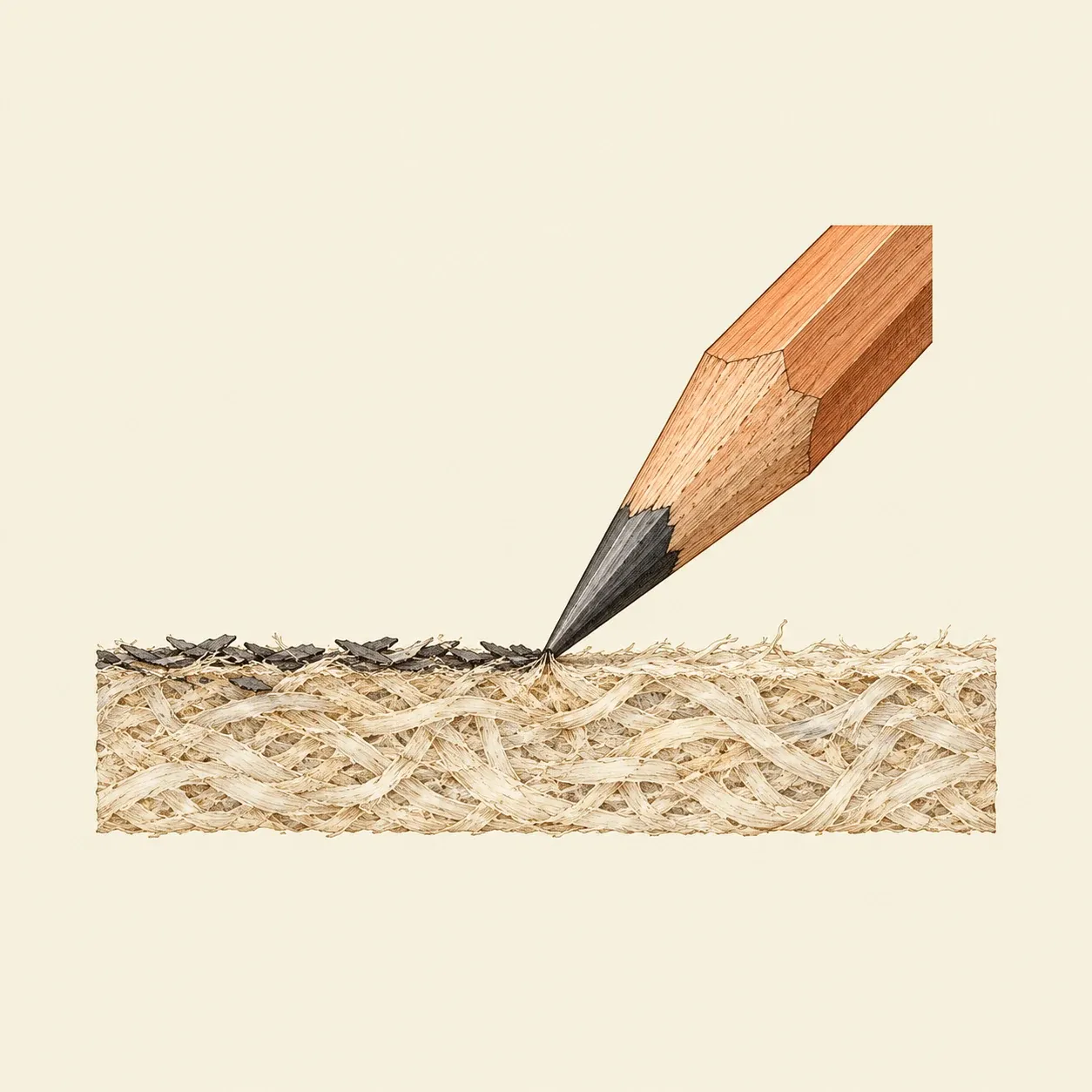 Seen much enlarged, the rough fibres of the paper scrape tiny flakes off the point, and the flakes form the line.
Graphite is built of thin sheets of carbon that slide easily over one another. When the point moves across paper, the rough fibres scrape off tiny flakes, which stay caught on the surface and form the line. Pressing harder takes off more flakes and darkens the line.
Pure graphite is soft and snaps easily. For a modern lead, fine graphite powder is mixed with clay and water, pressed through a die into thin rods, dried, then fired at 1,000 °C or more in a sealed container or an oxygen-free kiln, as graphite burns in open air at that heat. The fired clay forms a hard network that holds the graphite. More clay gives a harder lead that keeps its point longer and draws a paler line, while more graphite gives a softer, blacker mark. Makers sort the leads into grades, with H for hard, B for black and HB in between.
Coloured pencil leads are made in much the same way, but they are not fired, because the heat would change the colours. They contain a pigment or dye, a filler such as kaolin or talc, a binder such as a plant gum, and wax, either mixed into the paste or soaked into the dry leads. The wax makes the line smooth and also makes it hard to rub out.
How to do it
Firing a lead needs a kiln that reaches 1,000 °C without air, which is beyond a home workshop, so use a graphite lead bought from an art shop. The casing is the part you can make, by the method of the pencil works: two grooved strips of wood glued face to face around the lead.
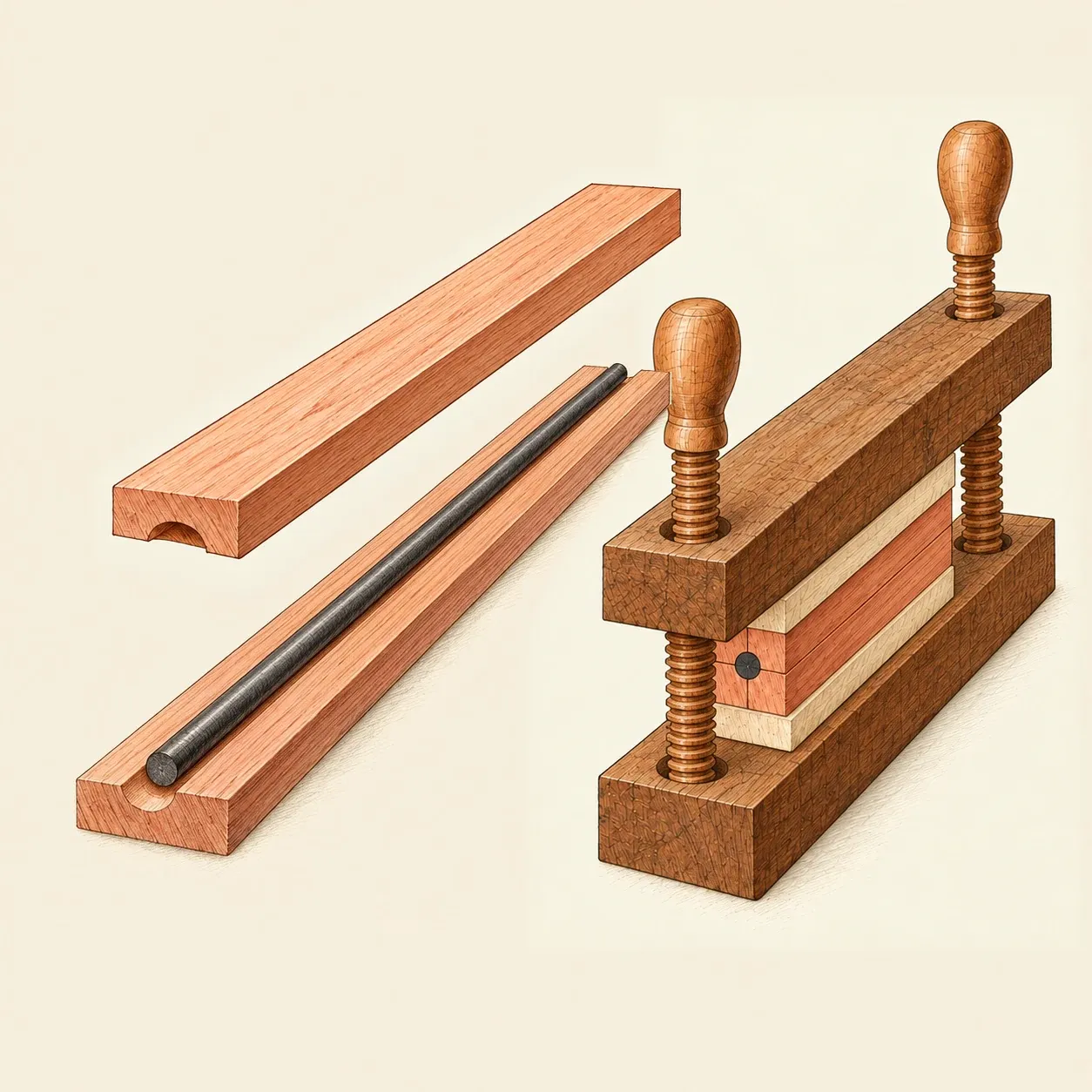 Two grooved strips close round the lead; once glued and clamped, they are planed into a pencil.
Saw two strips of a soft, straight-grained wood such as cedar or lime, a little longer than the lead and each slightly thicker than half the finished pencil, and plane their faces flat so that they meet without a gap. Along the middle of one face of each strip, cut a groove of half-round section, half as deep as the lead is thick, with a small round file or a gouge. Lay the lead in one groove and close the second strip over it. The two grooves together should hold the lead without play, and the strips should meet flat without rocking.
Spread a thin coat of wood glue on both flat faces, keeping it out of the grooves, lay the lead in, close the strips and clamp them between two pieces of scrap wood. Leave the glue to set overnight. Plane the block into a hexagon, taking the same amount off each face so that the lead stays in the centre, and sand it smooth. Sharpen one end with a knife, in short strokes away from you, until the wood forms a cone and a few millimetres of lead show.
Saws, planes, gouges and knives cut deeply. Hold the work in a vice or a clamp, never in the hand you are cutting towards, and always cut away from your body. Keep the tools sharp, as a blunt edge slips more easily. Fine wood dust irritates the lungs, so sand outdoors or in a well-ventilated room. Do not try to fire a lead yourself.
History and evolution
Before graphite, people marked lines with lead itself. Scribes ruled pages and sketched with points of lead alloy, sometimes set in a holder, and in fourteenth-century Italy artists drew with styles of lead and tin whose faint lines could be wiped away with breadcrumbs.
In the sixteenth century, a deposit of unusually pure, solid graphite was worked at Borrowdale, in Cumberland in the north-west of England. Local shepherds had long used it to mark their sheep. It was taken for a kind of lead and called black lead or plumbago, a confusion that left pencils with their “lead”.
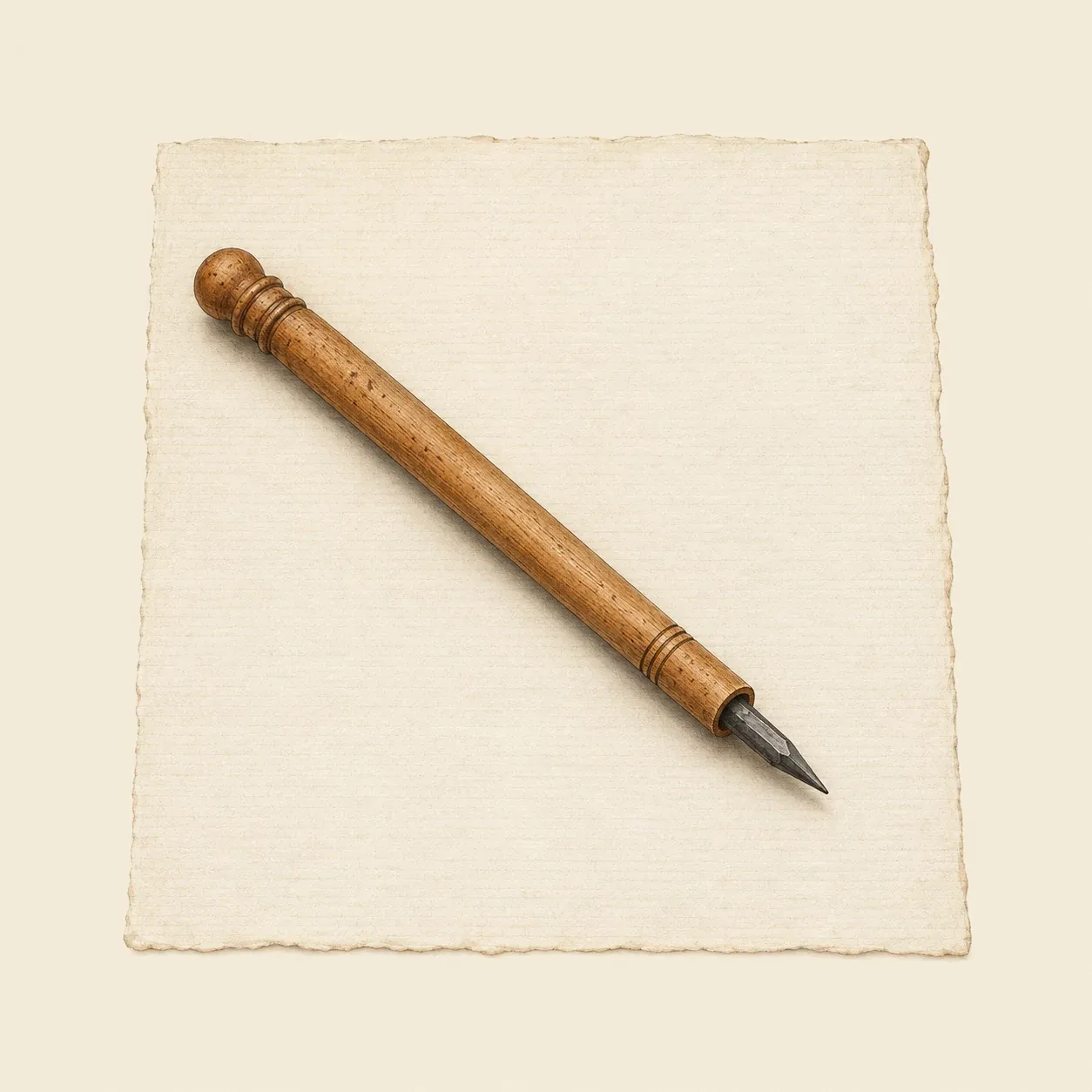 A pencil after Gessner’s woodcut of 1565: a stick of marking material shaved to a point and set in a wooden handle.
The oldest known description of a pencil was printed in Zurich. In his book on fossils of 1565, the naturalist Conrad Gessner pictured a stylus for writing, made of a kind of lead that he believed to be artificial and that some people, he had heard, called English antimony. It was shaved to a point and inserted in a wooden handle. His woodcut shows the marking stick in one end of a tube and a knob at the other. Historians take his “lead” to be Borrowdale graphite.
Borrowdale graphite needed no preparation: it was sawn into sticks and set in wood. By the eighteenth century, pencil makers glued a stick of graphite into a grooved strip of pine or cedar and glued a second strip over it. The pencil was usually square in section, sometimes hexagonal, octagonal or round. Makers who had only poorer graphite tried melting it with sulphur, which gave brittle leads that barely marked. In Germany, pencil makers appear in the parish registers of Stein, near Nuremberg, from 1726, and Kaspar Faber began making pencils there in 1761. In 1779 Carl Wilhelm Scheele showed that graphite is a form of carbon, and the mineral later took its name from the Greek graphein, to write.
At war with Britain, France could no longer obtain Cumberland graphite. In 1794 the French Agency of Mines asked Nicolas-Jacques Conté for a lead that needed no English material. He mixed ordinary powdered graphite with clay, shaped it and fired it, and on 7 January 1795 he filed a patent for these “artificial pencils”. By changing the share of clay and the firing, he could make leads of different hardness, and his method is still the basis of pencil making. In the nineteenth century, works such as A. W. Faber’s at Stein pressed the paste through dies, fired the leads in closed pots of clay or iron, and planed the glued casings round, square, oval, hexagonal or triangular. Margaret Holben Ellis and Brigitte Yeh date the first coloured pencils on sale to the early nineteenth century, while other accounts place them in the early twentieth. They served at first mostly for marking and checking, and in 1924 A. W. Faber offered more than sixty colours for artists.