Milling machine
A turning cutter and a moving table
Contents
- 1Column
- 2Stepped pulley of the spindle
- 3Overarm and arbor support
- 4Cutter on its arbor
- 5Table with the work in a vice
- 6Saddle and knee
A milling machine cuts metal with a rotating cutter that has many teeth, while the work, clamped on a table, is moved past it along guided slides. It shapes flat faces, slots, grooves and gear teeth. Janello Torriani, clockmaker to Charles V, built a machine with a rotating file to cut the teeth of clock wheels, which the chronicler Ambrosio de Morales described in 1575. Milling machines for general work were in use in American arms factories by 1818, and Brown & Sharpe's universal milling machine of 1862 added the knee that still carries the table of many machines.
What it is
A milling machine removes metal with a cutter that turns on a fixed axis, while the work moves past it. This is the reverse of the lathe, where the work spins and the tool stays still. Because the work can be fed in straight lines in three directions, a milling machine makes flat faces, steps, slots, keyways and the teeth of gears, and it can cut the spiral grooves of a drill.
A common workshop type since the late 19th century is the horizontal knee-and-column machine. The cutter sits on a horizontal shaft, the arbor, driven from the spindle in the top of a heavy column. The work is clamped on a table that rests on a saddle, and the saddle on a knee that slides up and down the front of the column. In a vertical machine the spindle points down and carries an end mill, a cutter with teeth on its end and its sides.
How it works
Each tooth of the cutter takes a small chip as it passes through the work, then leaves the cut and has time to cool before it comes round again. With many teeth, the cutter removes metal fast and leaves a fairly smooth face. The table moves the work slowly under the cutter; how far it moves for each turn of the cutter decides the size of the chips and the finish of the surface.
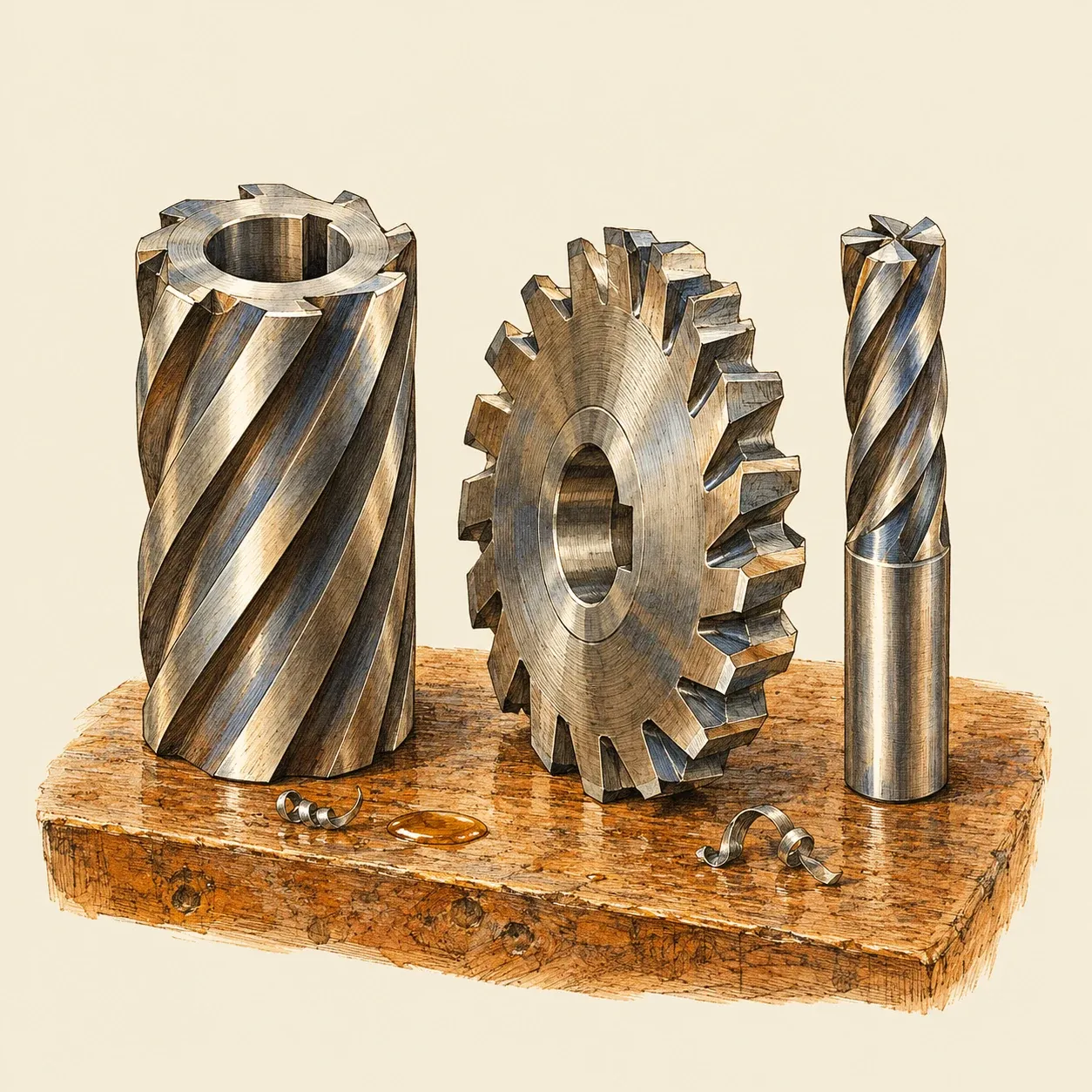 A plain cylindrical cutter, a side-and-face cutter and an end mill.
The shape of the cutter decides the shape of the cut. A plain cylindrical cutter with spiral teeth faces a flat surface; a disc cutter with teeth on its rim and both faces cuts slots and steps; a cutter whose teeth have the profile of a gear space cuts one tooth space at a time. On a horizontal machine the arbor is held at both ends, in the spindle and in a hanging support on the overarm, so that it does not bend under the cut.
Three slides set the work against the cutter. The table moves lengthwise, the saddle crosswise and the knee up and down, each on its own screw turned by a hand wheel with a graduated dial; on larger machines a geared drive moves the table on its own. To cut teeth spaced exactly round a wheel, the work is mounted on a dividing head, which turns it by a set fraction of a turn between cuts. On Brown & Sharpe’s universal machine of 1862 the dividing head could also be geared to the table, so that the work turned while it moved along and the cutter left a spiral groove.
The cut is rough on the machine. The cutter grabs the work, and on a horizontal machine the table can be pulled along by the cutter when the work is fed in the same direction as the teeth move. Work is held in a vice or bolted to the table, and the slides are locked when they are not being moved.
How to do it
This demonstration shows the principle of milling by hand, in candle wax. The cutter turns on a fixed axis and the work is pushed past it on a guided table. It takes two people. You need a geared hand drill, a bench vice, an 8 mm wood bit or a small rotary rasp, a block of candle wax or paraffin about 3 cm thick, a smooth board about 30 cm long, a straight batten, two clamps and a piece of wood to push with.
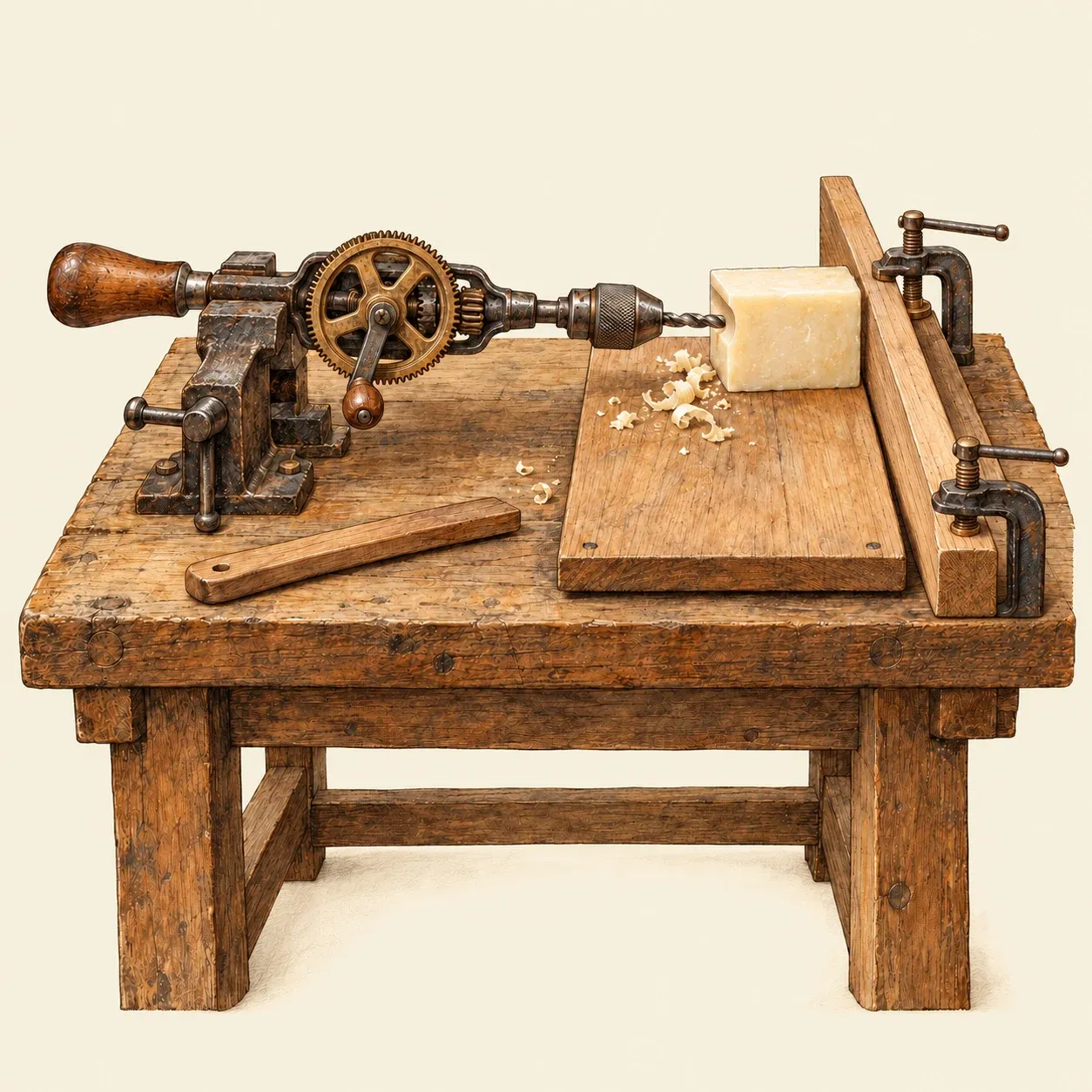 The drill stays where it is and the wax is fed past the turning bit along the fence.
Close the vice gently on the frame of the hand drill so that the drill lies level, with the bit pointing sideways over the bench and the crank free to turn. Clamp the batten to the bench at right angles to the bit, as a fence. Fix the block of wax near the front edge of the board with a few drops of melted wax. Put the board on the bench against the fence and slip thin pieces of card under it until the bit is level with the middle of the wax.
One person turns the crank steadily. The other keeps the board against the fence and pushes it slowly with the piece of wood, so that the side of the wax meets the turning bit and moves past it. The bit cuts a groove along the block. Push slowly, and the groove comes out clean; push fast, and the bit tears lumps out of the wax. Add a card under the board to cut a second groove lower down, as the knee raises the work on a real machine.
History and evolution
Clockmakers needed many wheels with evenly spaced teeth, and cutting them one by one with a file was slow. The answer was the wheel-cutting engine, in which a small rotary cutter cut the tooth spaces of a brass wheel blank while a plate under the blank divided the turn into equal steps.
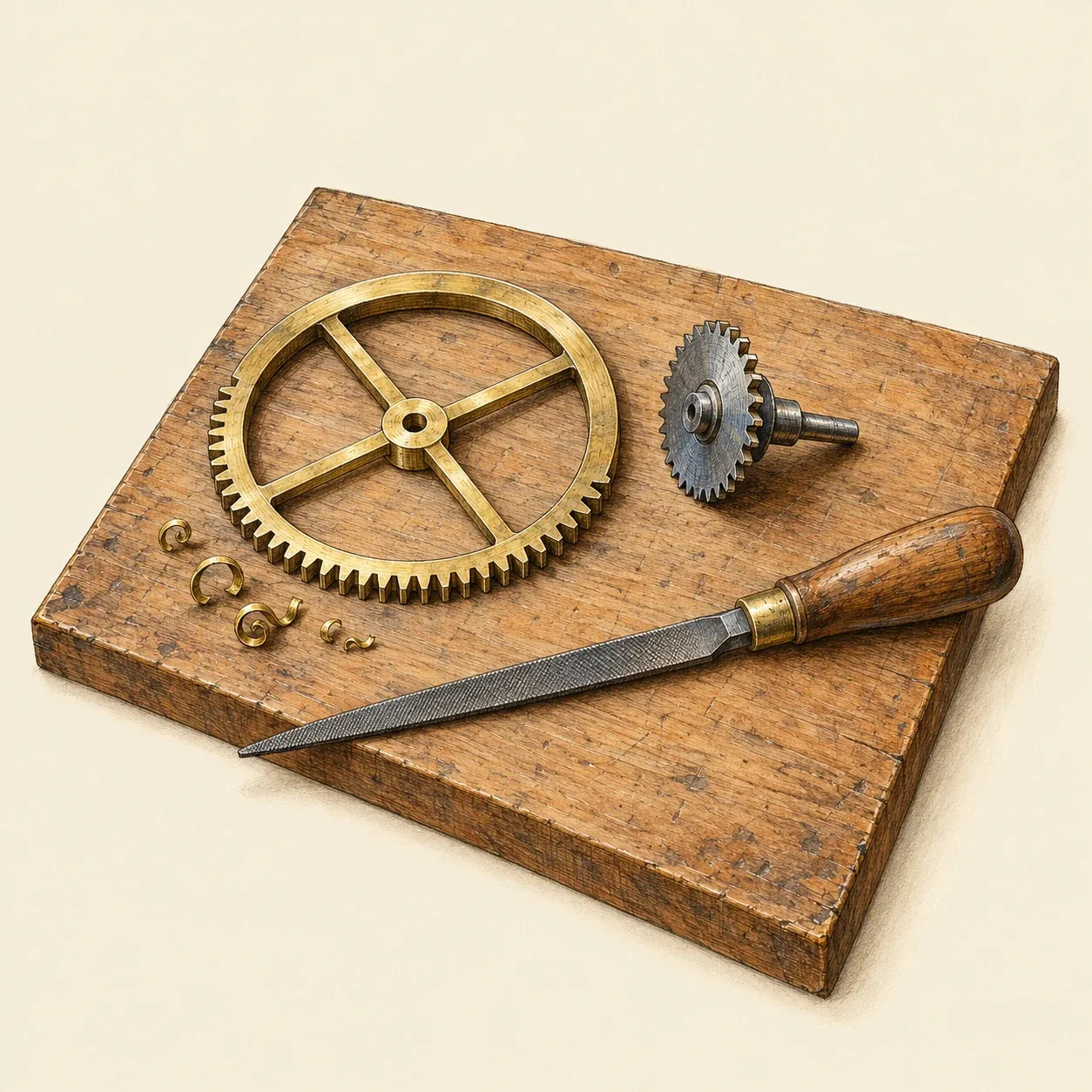 A small rotary cutter cut the tooth spaces of a wheel one after another, where the file had been used before.
The oldest known machine of this kind was built by Janello Torriani, clockmaker to Charles V and Philip II; the chronicler Ambrosio de Morales described it in 1575, and the historian Cristiano Zanetti identifies its cutter as a rotating file. The Science Museum in London keeps a later English example, attributed to Humphrey Marsh of Highworth from a signature under its plate. The blank sits on a spindle carried by a plate, and the cutter turns in a frame on bearings, driven through gears by a handle, so that it can be swung into the blank as the cut goes deeper. Such engines spread through the 18th century: the Winterthur Museum holds one made in the 1770s by Nathaniel Dominy IV, hand-cranked, for cutting brass clock wheels; the museum notes that it divided the teeth exactly and spared the clockmaker cutting each one with a file.
Milling machines for general work grew out of the American arms factories, where the government wanted gun parts that would fit any gun of the same model. In 1813 Simeon North of Middletown, Connecticut, signed a contract for 20,000 pistols with interchangeable parts, and the American Precision Museum credits him with the first known milling machine, in use by 1818. It shaped parts that had been filed by hand. A machine long credited to Eli Whitney and dated about 1818 seems in fact to have been built after his death in 1825, according to the historian Edwin Battison. In England, Richard Roberts brought out in 1834 a slotting drill that milled grooves in the bearing brasses of locomotives, an early vertical milling machine.
In 1862 Joseph R. Brown of Brown & Sharpe in Providence delivered his universal milling machine to the Providence Tool Company, where Frederick Howe needed to cut the spiral flutes of twist drills, until then filed by hand. Its table was carried on a knee and could be swung at an angle, and it had a geared dividing head. In 1952 the Servomechanisms Laboratory of the Massachusetts Institute of Technology fitted a Cincinnati Hydrotel milling machine with motors on its three slides, driven by commands punched on paper tape: it was the first numerically controlled machine tool, and the computer-controlled machining centres of today descend from it.