Jet pump
A fast jet that drags another fluid along, with no moving parts
Contents
- 1Water inlet channel
- 2Narrowing and air holes at the head of the pipe
- 3Drop pipe, where the water carries the air down
- 4Wind box with its striking stone
- 5Water outlet below the level of the pool
- 6Air pipe to the tuyère of the forge
A jet pump moves one fluid with another: a fast jet of water, steam or air leaves a nozzle and drags the surrounding fluid along with it, with no piston, wheel or valve. The oldest known description is the water trompe that Giambattista Della Porta saw in Rome blowing furnaces, printed in his Natural Magic in 1589.
What it is
A jet pump moves a fluid by means of another fluid. A fast jet of water, steam or air comes out of a nozzle, and the fluid around it is dragged along and carried out with the jet. The device has no piston, impeller or valve. It needs only a supply of driving fluid, under pressure or falling from a height, and it can then lift water, draw air, mix two liquids or push water into a boiler.
The same idea goes under several names. An eductor or ejector is driven by a liquid or by steam and is used to draw or mix another fluid. An injector uses a jet of steam to force water into the boiler that made the steam. A laboratory water pump hangs on a tap and draws air out of a flask. The trompe, or water blower, uses a stream of falling water to draw in air and blow a furnace.
In a forge trompe, water from a channel drops down a vertical pipe with air holes near its top. The falling water carries the air down into a closed wind box, where the water strikes a stone and runs out at the bottom while the air gathers at the top. A pipe takes this air to the tuyère, the nozzle through which the blast enters the forge fire. The trompe gave a steady blast without bellows, and it was used at iron forges in Italy, Spain and other Mediterranean countries until the 19th century.
How it works
A pipe that narrows to a nozzle makes the driving fluid speed up, and as its speed rises, its pressure falls. The jet leaves the nozzle into a chamber that has a second opening, the suction port. There the pressure around the jet is lower than in the fluid outside, so that fluid flows in towards the jet.
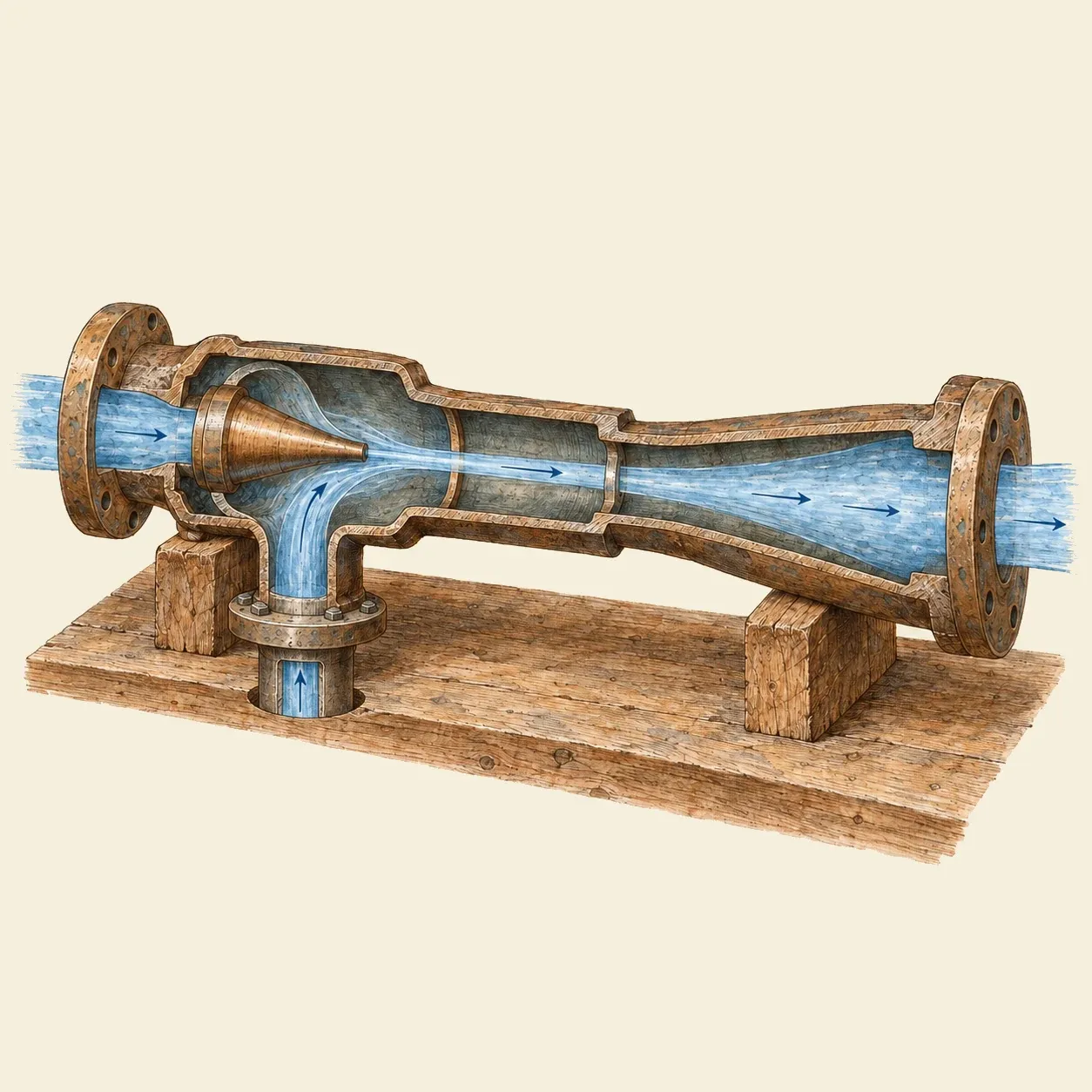 The nozzle makes a fast jet, the throat lets it drag the drawn fluid along and the widening cone turns speed back into pressure.
Beyond the nozzle the jet and the drawn fluid enter a straight throat together. The fast jet slows down and the slow fluid speeds up, until they move as one stream. The mixture then enters a diffuser, a cone that widens slowly. As the stream slows in it, its speed turns back into pressure, so that the mixture leaves at a higher pressure than the fluid had at the suction port. Giffard’s steam injector works this way: the steam condenses in the cold water it draws in, and the mixture leaves the diffuser at a pressure a little above that of the boiler, so that it can enter it.
In a trompe the driving fluid is water and the drawn fluid is air. At the head of the drop pipe the water passes a narrowing, and just below it air holes open to the outside air. The falling water draws air in through the holes and carries it down as bubbles. At the bottom the mixture enters the wind box and strikes a flat stone. The bubbles rise and the air collects under the lid, while the water leaves through an opening that stays under the surface of the outer pool, so that no air escapes that way. The air in the box pushes the water inside it below the level outside. The difference between those two levels sets the pressure of the blast.
A modern well pump uses an ejector too. A centrifugal pump at the surface sends part of its water down to a nozzle placed in the well or in the pump body. The jet lifts the well water with it, and the pump sends the rest of the water to the house.
How to do it
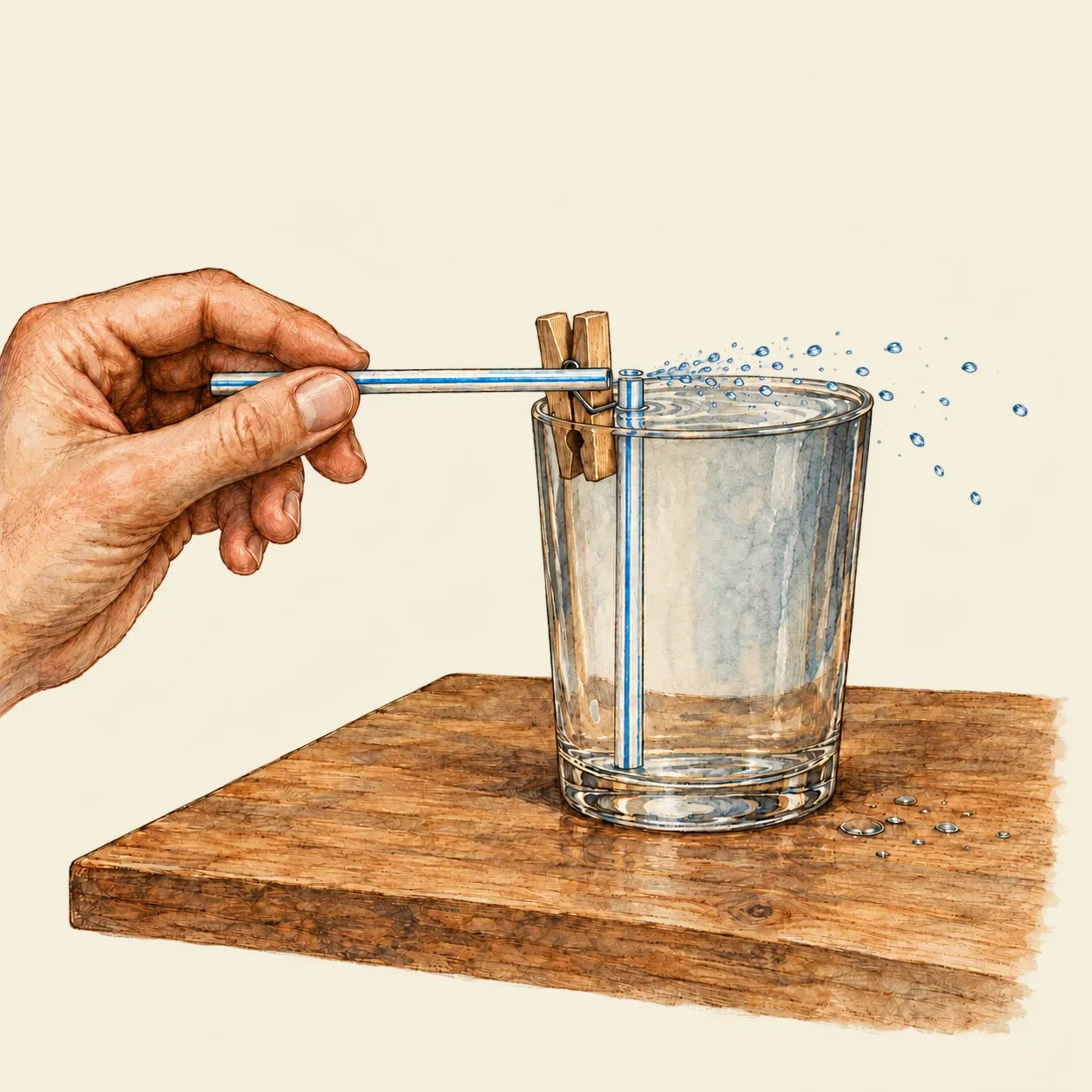 Blowing across the top of the upright straw lifts the water and throws it out as a spray.
Two drinking straws and a glass of water make a working jet pump of the atomizer kind. Fill a glass with clean water nearly to the top and set it on a tray or over a sink. Cut one straw in two with scissors. Stand one piece upright in the water, so that its top end sticks out a little above the surface. Hold the other straw level, with its end against the top of the upright piece and at right angles to it, so that its opening points across the opening of the upright straw.
Blow hard and steadily through the level straw. The air must pass over the top of the upright straw, not into it. Water climbs up the upright straw and leaves its top as a spray of fine droplets carried away by your breath. The fast air lowers the pressure above the upright straw, the air pressing on the water in the glass pushes the water up, and the jet of air breaks it into drops. If nothing happens, push the upright straw deeper so that less of it stands above the water, and bring the two ends closer together.
Safety: use clean water only, never another liquid, and work over a tray or sink and wipe up spills so that nobody slips. Blow through the straws, never suck. Never apply a straw, a water pump or any other suction device to any part of the body. Industrial ejectors and steam injectors work with high pressures, steam and sometimes chemicals, and only trained staff should handle them.
History and evolution
In 1589 the Neapolitan scholar Giambattista Della Porta published in Naples the expanded twenty-book edition of his Natural Magic. Its book on air explains how air can do the work of bellows: water poured through a funnel into a small closed chamber drives the air out through a hole with enough force to blow brass and iron furnaces. He wrote that he had seen it in Rome. Historians of metallurgy read this as the oldest known description of the trompe. The device spread to forges in Italy, Spain and other Mediterranean countries; the Catalan forges were known for it, and French gave it the name trompe, by which English writers also called it.
By the late 18th century the trompe had a theory. In 1797 the Italian physicist Giovanni Battista Venturi published his experiments on the way a moving fluid drags along the fluid beside it, and the Encyclopaedia Britannica of 1801 credited him with the first accurate explanation of the water blower.
The French engineer Henri Giffard, who built a light steam engine to drive the airship in which he flew in 1852 (see airship), looked for a lighter way to feed water to a boiler than the steam pumps of his time. In 1858 he patented his injector, in which a jet of steam from the boiler forces water into the same boiler. It had no moving parts, and railways took it up to feed the boilers of their locomotives.
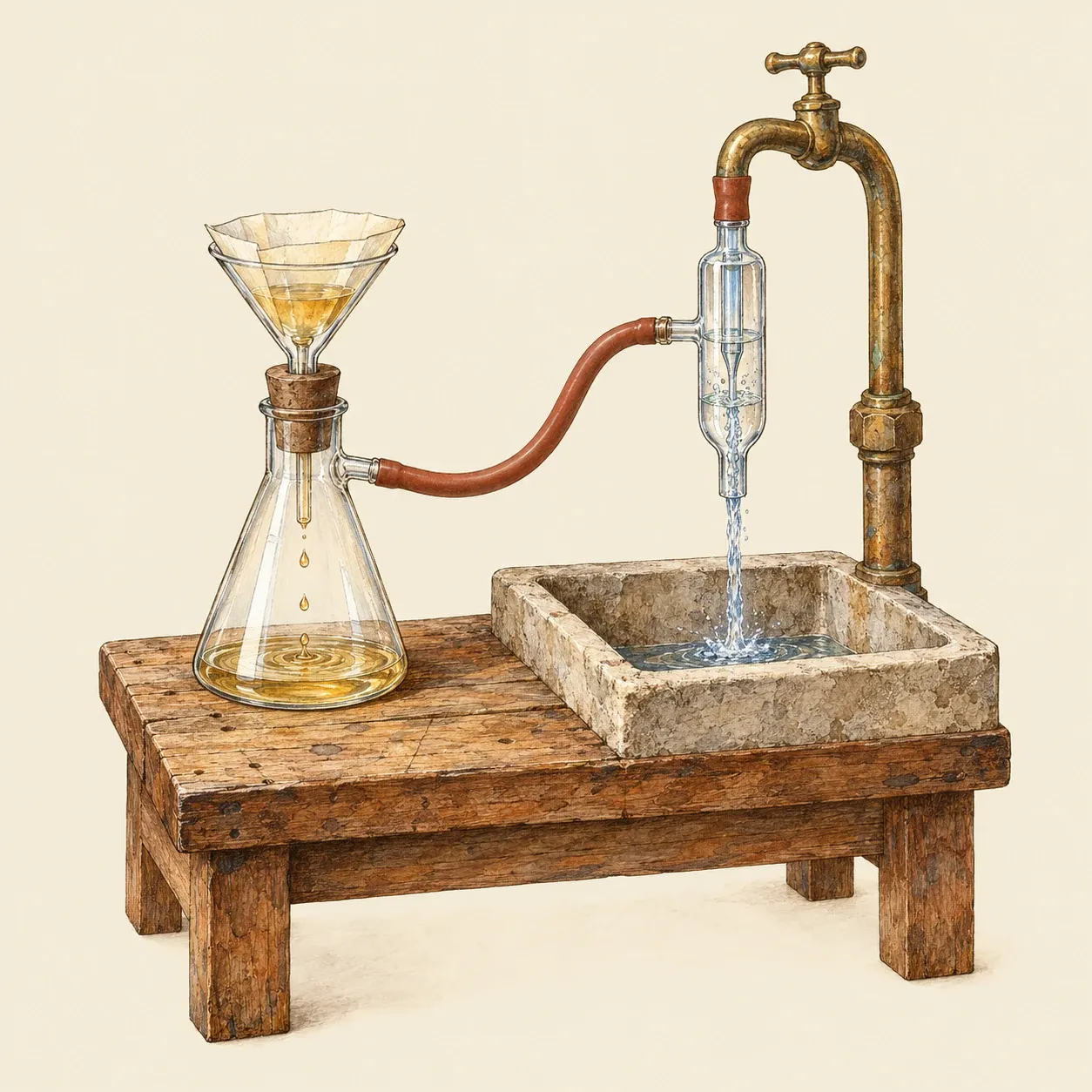 A glass water pump on a tap draws air out of a flask, and the air outside presses the liquid through the filter.
In 1865 Hermann Sprengel, a chemist working in London, described an air pump in which a thin stream of falling mercury carries air out of a vessel in small pockets between the drops. In 1868 Robert Bunsen published a filtering arrangement with a thick-walled flask, a glass water pump built on Sprengel’s principle, a pressure gauge and a safety trap. The pump came to be called the Bunsen pump, a name Sprengel contested in a letter to Nature in 1881. The glass water pump on a tap became a common piece of laboratory equipment for filtering. Jet pumps later spread wherever a driving fluid was at hand and moving parts were a nuisance: ejectors lift water from wells together with a centrifugal pump at the surface, and eductors mix and move liquids wherever a supply of water under pressure is available.