Sugar making
From sweet juice to crystals
Contents
- 1Copper cauldron of boiling juice
- 2Fire chamber under the cauldron
- 3Conical clay mould
- 4Sugar loaf crystallising in the mould
- 5Jar collecting the molasses
Sugar making draws the sweet juice out of sugar cane, sugar beet or maple sap, boils away most of its water and lets sucrose crystallise from the thick syrup. The crystals are then separated from the dark liquor left around them, molasses. In the first century CE, Dioscorides and Pliny the Elder described a white, brittle honey from Indian reeds that was used as a medicine.
What it is
Sugar is sucrose, which plants make in their leaves and store in their stems, roots or sap. Sugar cane, a tall tropical grass, keeps it in the juice of its stalks, the sugar beet in its root, and the sugar maple of North America in the sap that rises in spring. Making sugar means taking the sucrose out of the plant and turning it into dry crystals that keep and travel.
The work runs in stages. The juice is extracted, by crushing the cane or by soaking slices of beet in hot water. It is cleaned and boiled down to a thick syrup. The syrup is then brought to the point where sucrose comes out as crystals, and these are separated from the dark liquor that remains, the molasses. Brown sugars keep some of that liquor. Raw cane sugar is made white by refining: the crystals are dissolved again, the solution is cleaned and the sugar is crystallised once more. Beet factories usually make white sugar directly from the purified juice.
How it works
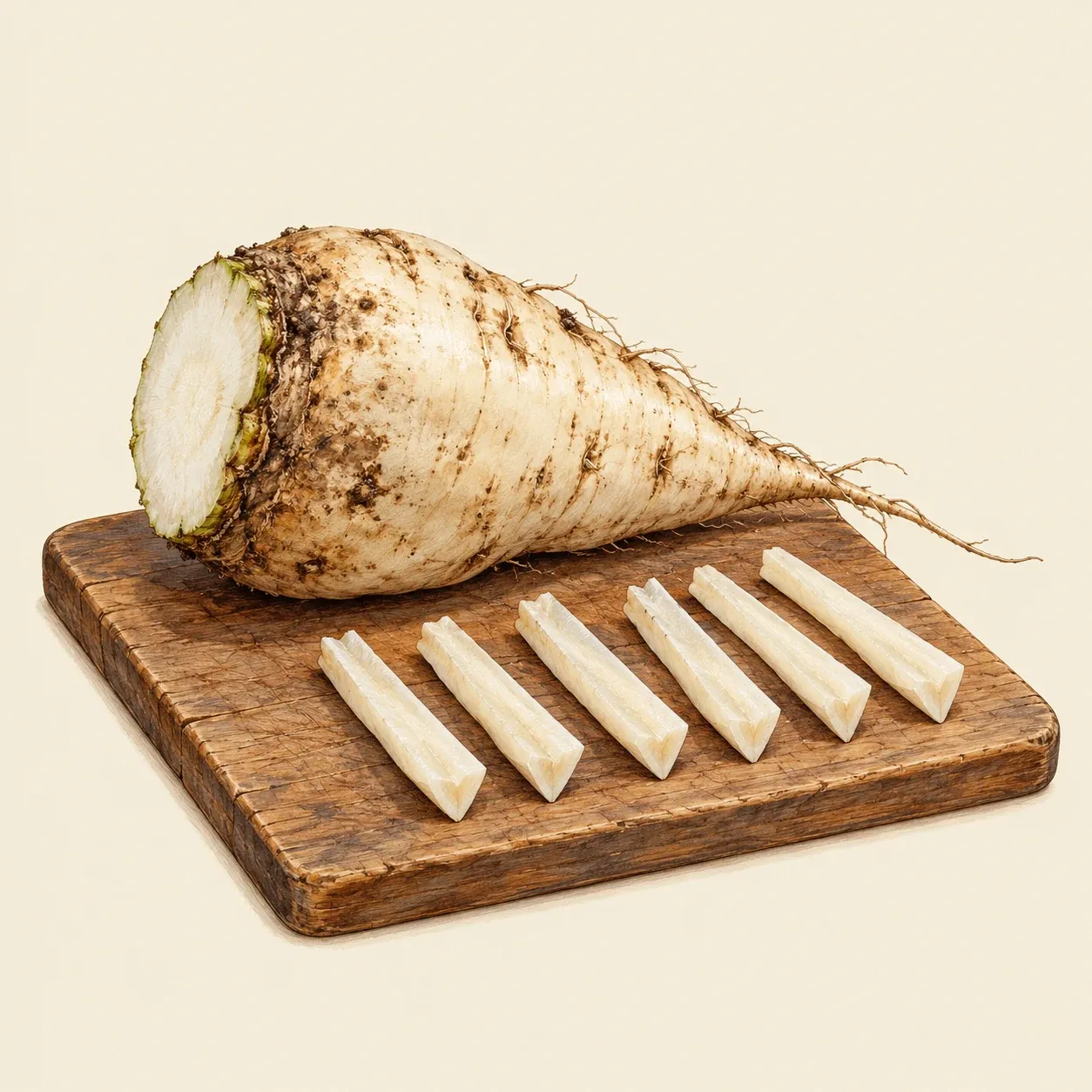 Beet is cut into thin strips, called cossettes, so that hot water can draw the sugar out of as many cells as possible.
In a cane mill the stalks are shredded and then pressed between several sets of heavy rollers. Water is sprayed onto the crushed cane before the last mill, and the thin juice from each mill is sent back to the one before it, so that the cane is washed of its sugar as it goes. The fibre left at the end, called bagasse, fuels the factory boilers. Sugar beet is sliced into thin strips that move through a long vessel against a stream of water kept at 50 to 80 °C. The sugar leaves the cells and passes into the water, which comes out with 10 to 15% sugar.
The raw juice also carries plant acids and other impurities. Cane factories heat it to about 95 °C and add lime, which neutralises the acids and forms a heavy sludge that settles out, taking impurities with it. Beet juice is limed and then bubbled with carbon dioxide, which turns the lime into small crystals of chalk that carry impurities down as they settle.
Then the water must go. Boiling a thin juice down takes a great deal of heat, and factories save it with a row of evaporators. Steam heats the first one, the vapour boiled off the juice heats the second, and so on down the row, each vessel being held at a lower pressure so that the juice boils at a lower temperature. Cane juice leaves the evaporators as a syrup of about 65% solids.
Sucrose dissolves far better in hot water than in cold. A syrup that holds more sugar than it can keep in solution is supersaturated, and its sucrose begins to form crystals, which grow far more easily on crystals that already exist than from nothing. In the vacuum pan the syrup boils under reduced pressure, at a temperature low enough not to brown it, until it is supersaturated. It is then seeded with very fine sugar, and the crystals grow as more syrup is drawn in. The mixture of crystals and syrup, the massecuite, goes to centrifuges whose perforated baskets spin the liquor out and hold back the crystals. The liquor is boiled again for a second and a third crop of crystals, and the final molasses is used for animal feed or to make rum.
Before centrifuges, gravity did the separating. The boiled syrup was poured into conical moulds of fired clay, with the hole at the tip stopped, and left to set. The moulds were then stood point down on jars and unstopped, and the molasses drained into the jars. Refiners poured wet clay or clean syrup over the broad end of the loaf; the liquid seeped down through it and washed it whiter, while the tip, where the molasses gathered, stayed brown. Modern refineries wash raw sugar in warm syrup to loosen its film of molasses, dissolve it, clean the solution with lime, remove its colour with activated carbon or bone char, and crystallise it again.
How to do it
Two kitchen experiments show the two halves of the process: drawing sugar out of a plant, and growing crystals from a syrup.
To see how sugar leaves a beet, peel a sugar beet, or a red beetroot if no sugar beet can be found, and cut it into thin strips. Put them in a bowl, cover them with hot water and leave them until the water is lukewarm. Lift out the strips and taste the water: it has turned sweet, because the sugar has passed out of the cut cells into it.
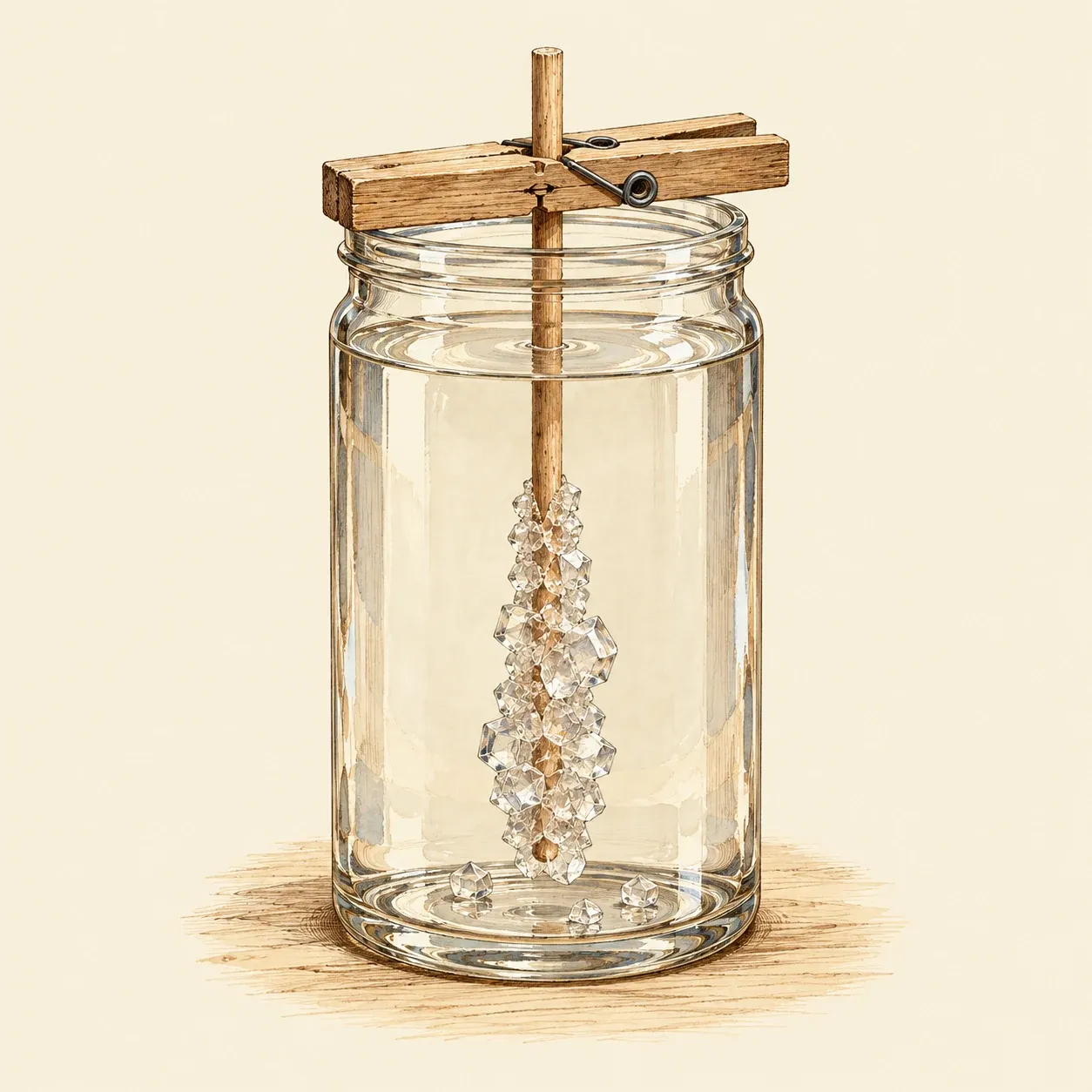 Sugar crystals grow on a stick that was first rolled in sugar, which gives them crystals to build on.
To grow crystals, first make seeds for them. Wet the lower half of a few wooden skewers, roll them in sugar and leave them to dry for a day. In a saucepan, warm 500 ml of water without letting it boil and stir in 1.5 kg of sugar a little at a time, waiting for each addition to dissolve, until no more will go in. Let the syrup cool a little, pour it into tall glasses or jars and stand a skewer in the middle of each, held by a clothes peg laid across the rim, with its tip a little above the bottom. Leave the jars undisturbed for a week or more. As the syrup cools and slowly loses water, sugar comes out of solution and builds crystals on the seeded skewer. To take the stick out, break the crust that forms on top.
Safety. Hot sugar syrup sticks to the skin and causes serious burns. Children should do this only with an adult, who handles the hot pan.
History and evolution
Sugar cane was known in India long before the Common Era, and Sanskrit texts name a whole family of products made from its juice. The Arthaśāstra, a treatise on government, lists syrup, jaggery, massecuite, soft brown sugar and crystal sugar together. The Suśruta Saṃhitā, a medical text, describes juice pressed out by chewing or by a machine and then boiled down or dried in the sun to a syrup, to jaggery, a solid brown mass, and finally to crystals called śarkarā, drained of their dark mother liquor. The dates of both texts are debated, and James McHugh, who has studied this vocabulary, notes that little is known of how refining was done in the earliest periods.
Writers around the Mediterranean knew the product by the first century CE. Dioscorides describes a concreted honey called saccharon, found in reeds in India and Arabia, that looks like salt and breaks between the teeth. Pliny the Elder, writing in 77 CE, adds that the Indian kind was better than the Arabian: a honey gathered from reeds, white like gum, brittle to the teeth, the largest pieces the size of a hazelnut, and used only in medicine.
In the eastern Mediterranean, sugar works clustered in the plain of Acre, around the Sea of Galilee, along the Jordan valley and at the southern end of the Dead Sea, and from the 13th century above all in Cyprus. Water-driven mills crushed the cane, at one site an old Byzantine screw press was reused to press it, and the juice was boiled in copper cauldrons set over fire chambers.
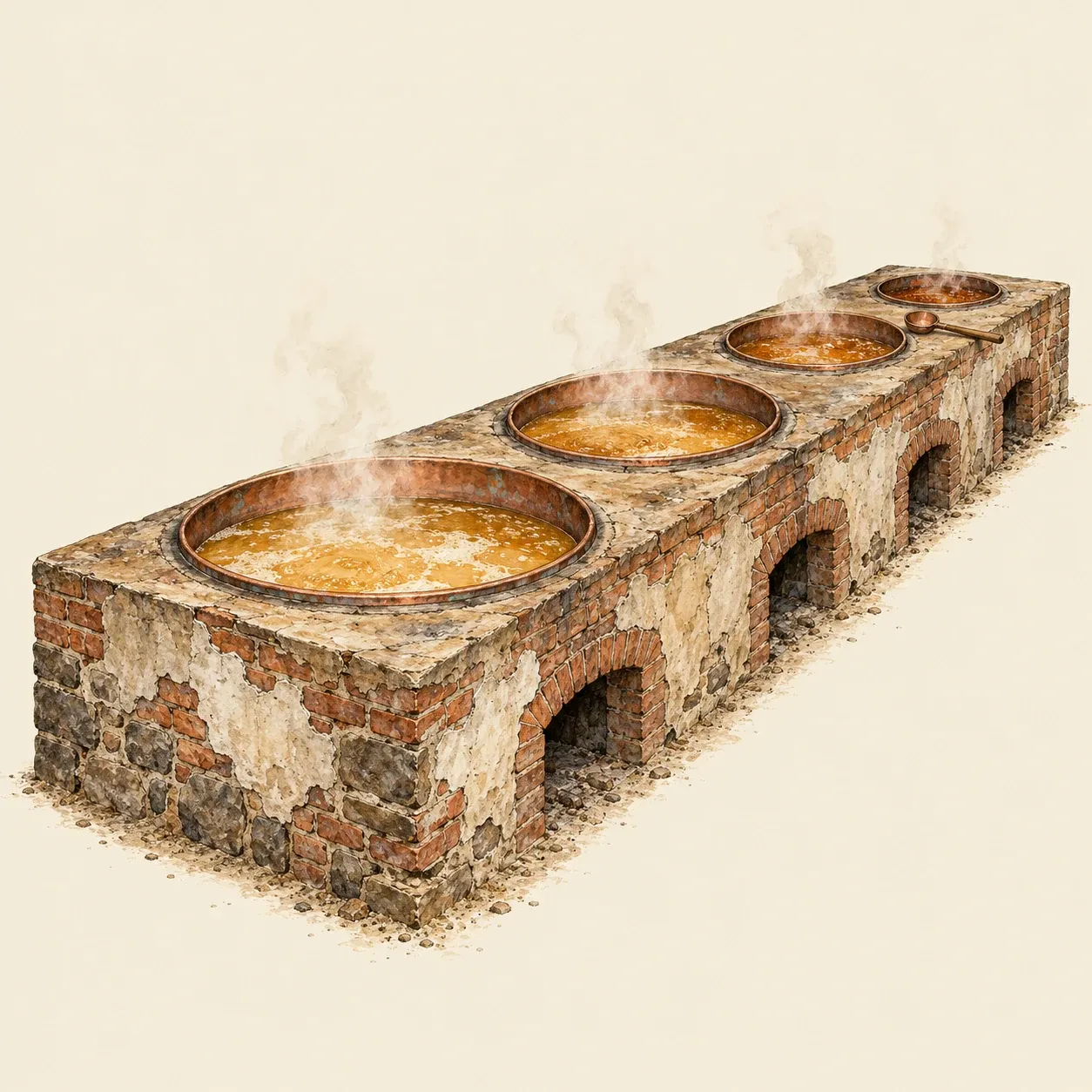 The juice was ladled from one open copper pan to the next, each smaller than the one before.
The Portuguese grew cane on Madeira and then on São Tomé, in the Gulf of Guinea. Excavating the estate of Praia Melão, worked from the 16th century, Maria Dores Cruz and her colleagues describe São Tomé as the first plantation economy in the tropics based on growing sugar alone with the labour of enslaved people, a model later carried to the Americas. Fragments of conical sugar moulds found there resemble those of Madeira. In Brazil and the Caribbean, enslaved Africans cut and crushed the cane and boiled its juice in a row of four or five open copper pans of decreasing size, ladling it from one to the next and skimming off the scum. Scalds and burns were common.
In 1747 the Berlin chemist Andreas Sigismund Marggraf extracted sugar from dried beet roots with boiling alcohol and identified its crystals under the microscope as the same sugar as that of cane. His pupil Franz Carl Achard began breeding beets for sugar near Berlin in the 1780s and, with the support of King Frederick William III of Prussia, built a beet sugar factory at Cunern, in Silesia. It was producing by 1802, and some accounts date its founding to 1801.
Two inventions changed the boiling. The English chemist Edward Charles Howard developed the vacuum pan around 1812 and patented it in 1813: under reduced pressure the syrup boils at a lower temperature, without caramelising or burning. In Louisiana, Norbert Rillieux, a free man of colour, installed his first multiple-effect evaporator in 1834 according to the Historic New Orleans Collection, or in 1843 according to the American Chemical Society, and patented the system in 1843 and 1846. Sugar makers as far away as Cuba and Mexico asked him about it, and beet sugar works in France, Germany, Austria and Russia adopted it widely.