Cotton candy machine
A spinning head that flings melted sugar out into threads of sugar glass
Contents
- 1Treadle and crank
- 2Bevel gears that turn the vertical shaft
- 3Ring burner under the head
- 4Spinning head where the sugar melts
- 5Slit at the rim through which the sugar is flung out as threads
- 6Bowl where the threads gather
A cotton candy machine melts sugar in a heated head that spins fast and flings it out through small openings at its rim. The jets stretch into threads that cool in the air before the sugar can crystallise, so they set as a glass, and pile up in the surrounding bowl as a light floss. William Morrison, a Nashville dentist, and the confectioner John C. Wharton applied for the first patent in December 1897.
What it is
A cotton candy machine turns ordinary granulated sugar into a cloud of fine threads. At its centre is a small head that is heated and spins quickly. Sugar poured into it melts, is thrown outward and escapes through narrow openings at the rim in thin jets. The jets stretch into very fine threads that harden in the air and collect in a wide bowl around the head, where the operator gathers them on a stick or a paper cone.
The machine has four parts that every version shares: a source of heat to melt the sugar, a spinning head with small openings, a drive to turn it, and a bowl to catch the floss. In the first patented machine, applied for in 1897 and granted in 1899, a foot treadle turned the head through gears and a gasoline burner heated it from below. Later machines use an electric motor and an electric heater in the head. The floss itself is nothing but sugar and air, often tinted and flavoured.
How it works
Heat melts the sugar inside the head. Spinning then does two things. The rotation drives the liquid sugar outward against the wall and squeezes it through the openings at the rim, and the moving rim throws each jet out into the air. Drawn out in flight, each jet thins into a long thread.
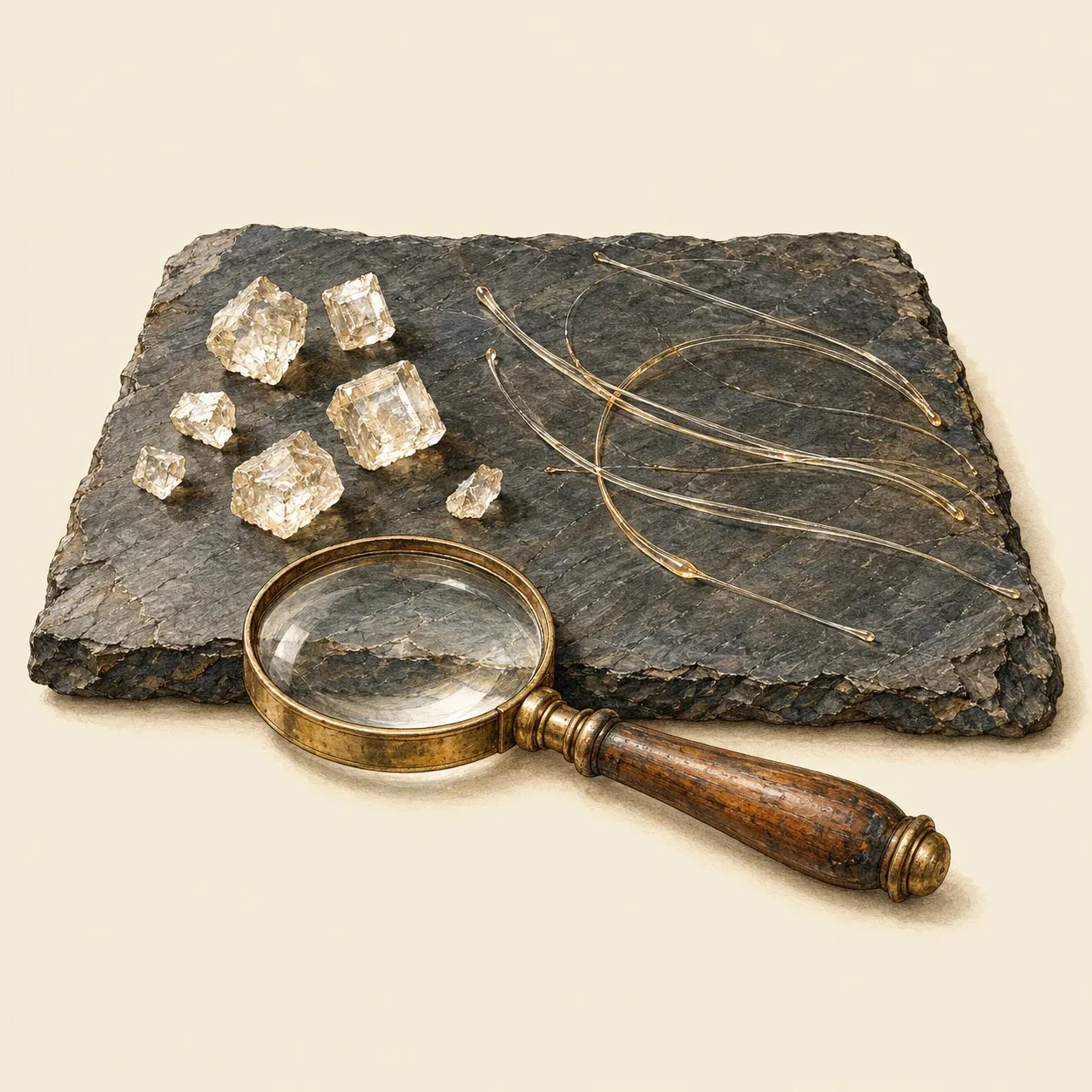 Granulated sugar is crystalline; spun sugar has no facets because it has set as a glass.
The thread is so thin that it cools almost at once. Sugar molecules need time to line up into the orderly pattern of a crystal, as they are in the grains of granulated sugar. A melted thread cools faster than that, and the molecules are frozen in the disordered arrangement of the liquid: the thread is a glass, like a strand of glass wool, which is made from molten glass in a spinning head on the same principle. Countless such threads, crossing and tangling, trap air between them, so a handful of floss holds very little sugar.
The parts that do not turn keep the heat and the threads apart. In the machine of the first patent a fixed metal cylinder surrounded the head and shielded the threads from the burner below, and a wide guard on the table caught them as they flew out. Modern machines keep the same layout, with the heating element built into the spinning head and the motor underneath, out of the way of the sugar.
How to do it
A heated head full of melted sugar spinning fast is not a home project: melted sugar is far hotter than boiling water and sticks to the skin while it burns. The two halves of the principle, the throw and the glass, can be seen cold.
 The turning cup flings a jet of water from each hole, the way the head of the machine flings out melted sugar.
Make three or four small holes with a pin around the side of a paper cup, near the bottom. Tie three strings to the rim and knot them together above the cup. Outside, well away from people, fill the cup with water and swing it round in a circle by the knot, or twist the strings and let them unwind so that the cup spins. Water escapes from every hole in a jet that bends into a spiral, trailing behind the hole as the cup turns, before it breaks into drops. Spin faster and the jets go further. The head of the machine does the same with melted sugar, from many more openings.
Then look at the glass. Put a few grains of granulated sugar and a small tuft of shop-bought cotton candy side by side on a dark plate and examine them with a magnifying glass. The grains are little blocks with flat, shining faces; the threads are smooth and round, with no faces at all. Touch the tuft with a drop of water: the threads collapse and dissolve at once, because they are mostly air around very thin sugar.
History and evolution
Confectioners made spun sugar long before machines. According to Historic Hudson Valley, cooks in 15th-century Italy were already drawing melted sugar into fine strands with a fork, a slow craft used for decoration.
The machine came from Nashville, Tennessee. William Morrison, a dentist, and John C. Wharton, a confectioner, applied for a patent on a candy machine on 23 December 1897 and received it on 31 January 1899. Their patent describes a pan topped with an inverted funnel, turning on a vertical shaft, with a narrow opening all round its edge, a fixed cylinder around it, and a burner of gasoline vapour below. A treadle worked like that of a lathe drives the shaft through bevel gears, though the patent allows any other power. Guinness World Records describes the partners’ device as an electric candy machine, and the company formed to sell the floss was called the Electric Candy Company.
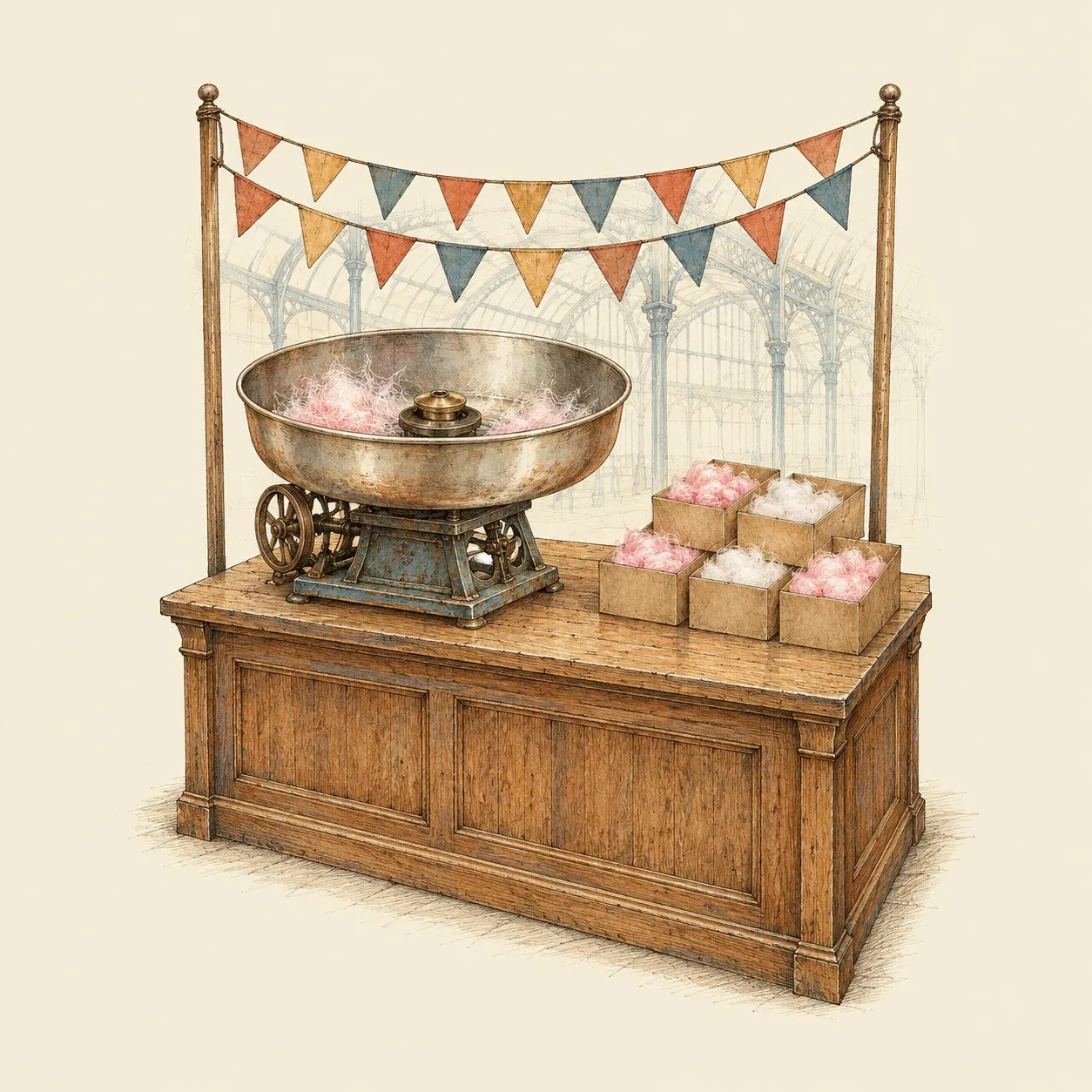 At the 1904 St. Louis fair the floss was sold in small boxes.
The floss made its name at the St. Louis World’s Fair of 1904, where it was sold as “fairy floss” for 25 cents a box; Guinness gives about 68,000 boxes sold and Historic Hudson Valley 68,655. The machine then became a fixture of fairs, circuses and seaside stalls, and electric models followed.
The principle has found other uses. In 2016 Leon Bellan, an engineer at Vanderbilt University in Nashville, described using cotton candy machines to spin networks of fine threads, comparable to the smallest blood vessels, from a polymer that later dissolves, as templates for channels in artificial tissue.