Oil well
Drilling down to petroleum and pumping it up
Contents
- 1Wooden derrick
- 2Walking beam on its post
- 3Engine house
- 4Horsehead of the pumpjack
- 5Crank and counterweights
- 6Wellhead
An oil well is a narrow hole drilled down to a layer of rock that holds petroleum, lined with steel pipe, through which the oil comes up, on its own or lifted by a pump. The familiar nodding pumpjack works a piston pump at the bottom of the hole through a long string of rods. Wells were drilled for oil in Trinidad in 1857 and at Titusville, Pennsylvania, in 1859, where Edwin Drake's well drew prospectors to the region.
What it is
An oil well is a narrow hole drilled from the surface down to a layer of rock that holds petroleum. It is lined with steel pipe that holds up its walls, and its top is closed by a wellhead, a set of valves that controls what comes out.
In a new field, the pressure of the gas and water in the rock can be strong enough to push the oil to the surface by itself. As the field is emptied, the pressure falls and the oil has to be lifted. The nodding pumpjacks seen on oil fields do that work on wells that no longer flow by themselves.
Wells bring up flammable gas and oil, and sometimes hydrogen sulfide, a poisonous gas. A well whose pressure is not held in check can blow out and catch fire, and rigs carry heavy moving equipment and high-pressure lines. Drilling and working wells is done only by trained crews under licence and inspection.
How it works
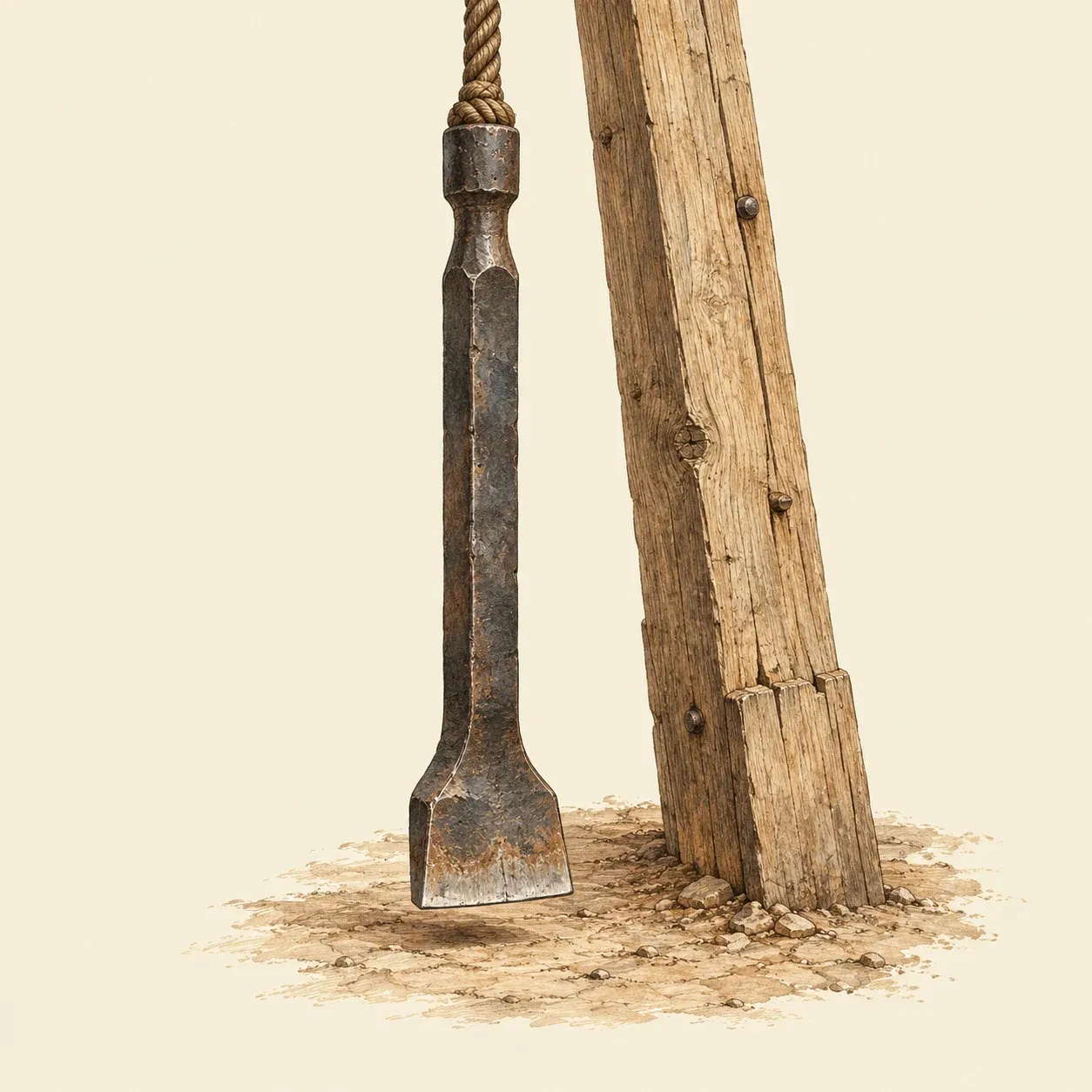 A cable-tool bit: lifted and dropped again and again, it pounded its way down through the rock.
The first wells were drilled with cable tools. A heavy iron bit hung from a rope at the top of a wooden derrick, and a walking beam, rocked by a steam engine, lifted it and let it drop, so that it broke up the rock a little at each blow. In the early twentieth century the rotary method spread: a bit at the end of a string of pipe is turned from the surface and cuts its way down.
The well is lined with pipe that holds up its walls, iron at first and later steel. At the top, valves and preventers can close the well if the pressure of the rock suddenly drives oil and gas up the hole.
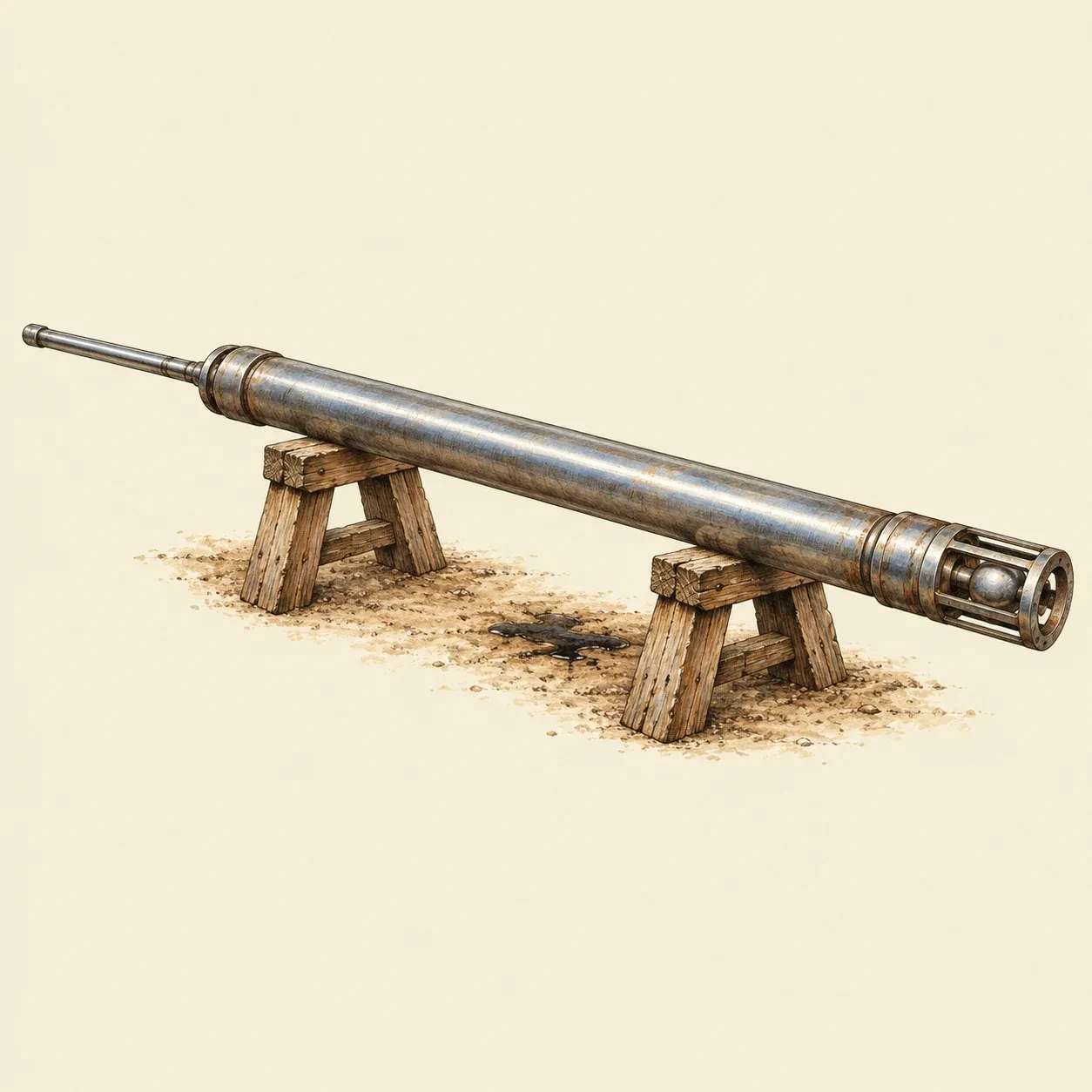 A bottom-hole pump, seated at the foot of the well; the rods work its plunger from the surface.
When the oil has to be lifted, a pump is set at the bottom of the well. It is a piston pump with two ball valves: one at the foot of the barrel, and one in the plunger that slides up and down inside it. On the upstroke, the valve in the plunger closes and lifts the column of oil above it, while the valve at the foot opens and lets oil from the rock fill the barrel. On the downstroke, the foot valve closes and the oil in the barrel passes up through the plunger, ready for the next stroke.
The pumpjack works the plunger from the surface through sucker rods, a string of steel rods hanging in the well. A motor turns a crank weighted with heavy counterweights, the crank rocks a long walking beam on its post, and the curved horsehead at the end of the beam raises and lowers the rods. The counterweights balance the weight of the rods and the oil, so the motor only has to supply the difference.
History and evolution
People collected petroleum from natural seeps and hand-dug pits long before anyone drilled for it. In Trinidad, in 1857, the Merrimac Company drilled a well for oil near the Pitch Lake, and the Geological Society of Trinidad and Tobago records that it produced oil.
In Pennsylvania, oil from seeps along Oil Creek was skimmed and sold as a medicine and then as lamp oil. The Seneca Oil Company hired Edwin Drake to find more. He applied the methods of salt-well drillers, with a wooden derrick, a steam engine in an engine house and cable tools, and protected the hole with iron pipe. On 27 August 1859 the well struck oil at a depth of about 21 m, and prospectors soon flocked to the region. For decades the wells were pumped by a wooden walking beam, rocked by an engine, which worked a string of sucker rods.
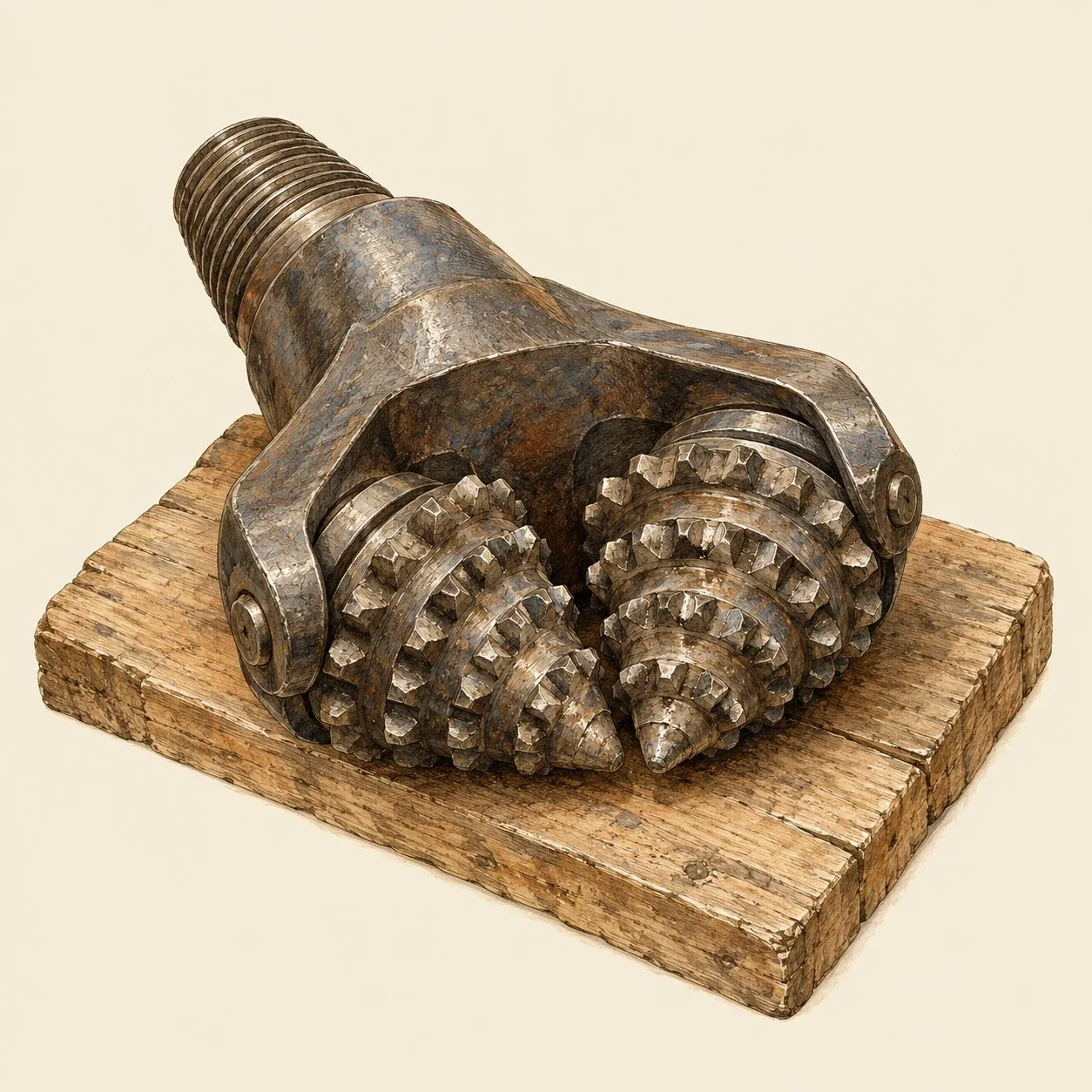 A two-cone rock bit: as it turns, its toothed cones roll on the bottom and crush the rock.
In Texas, on 10 January 1901, a well drilled by the rotary method at Spindletop, near Beaumont, blew out at a depth of about 350 m and threw a column of oil far above the derrick for nine days before it could be closed. Drilling then went deeper and harder rock had to be cut. In 1909 Howard Hughes Sr. patented a rock bit with two toothed cones that rolled on the bottom of the hole, and in 1922 James Abercrombie and Harry Cameron built the first successful ram-type blowout preventer, which closed a well by pushing two steel rams together across it. In 1925 Walter Trout, of the Lufkin Foundry and Machine Company in Texas, designed the counterbalanced pumpjack, now used on oil fields around the world.