Absorption refrigerator
Cold from a flame, with ammonia dissolved in water
Contents
- 1Vessel holding ammonia dissolved in water
- 2Connecting pipe
- 3Vessel where the liquid ammonia collects
- 4Tub of cold water
- 5Insulated cabinet
- 6Burner
An absorption refrigerator makes cold from heat. Liquid ammonia boils inside the cold box and takes heat from the food; water then soaks up the vapour, and a flame or an electric heater drives the ammonia out of the water again so the cycle can start over. Ferdinand Carré patented a machine working with ammonia and water in France in 1859. A continuous version with no moving parts, invented in Stockholm in 1922, still cools caravans and boats.
What it is
An absorption refrigerator cools a box with heat instead of a motor. Like any refrigerator, it lets a liquid boil inside the cold space so that it takes heat from the food, then turns the vapour back into liquid outside. A compression machine does this with a pump. An absorption machine uses a second liquid that soaks up the vapour, and a flame or an electric heater that drives it out again. In refrigerators the pair is ammonia, which boils, and water, which absorbs it; air-conditioning plants more often use water with a solution of lithium bromide.
The simplest form is an intermittent apparatus with two steel vessels joined by a pipe, of the kind Crosley sold in the United States from the late 1920s as the Icy Ball. It is heated to charge it, then cools a cabinet until it needs charging again. Continuous absorption refrigerators, heated all the time by a small flame or an electric element, are still made for caravans and boats, where they run on gas or electricity without a sound.
The circuit of an absorption refrigerator is a sealed steel vessel that holds ammonia under pressure. Ammonia is toxic and flammable: at high levels it burns the eyes, skin and lungs and can kill. Never open, puncture, heat, refill or repair such a circuit, on an old refrigerator or a collector’s apparatus alike; leave it to refrigeration specialists. A refrigerator with a gas or kerosene flame can give off carbon monoxide, which has no colour or smell. Run it only where it is installed for that use, with its back sealed off from the living space and its flue and vents clear, and never use a portable gas refrigerator in a tent, a closed vehicle or an unventilated room.
How it works
Water takes up ammonia gas very readily, a property Joseph Priestley noticed when he isolated ammonia in 1774. Cold water holds a great deal of it; warm the solution and the gas comes out again. An absorption refrigerator uses that difference twice in every cycle, once to drive the ammonia out of the water and once to take it back.
An intermittent apparatus works in two stages. First, heat drives the ammonia out of the strong solution in one vessel, and the vapour passes to a second vessel, where cooling turns it into liquid. Then, once the first vessel is cool again, its weak solution takes the ammonia vapour back. The pressure falls, so the liquid ammonia in the second vessel boils at a low temperature and draws heat from its surroundings. When all the ammonia has returned to the water, the apparatus must be heated again.
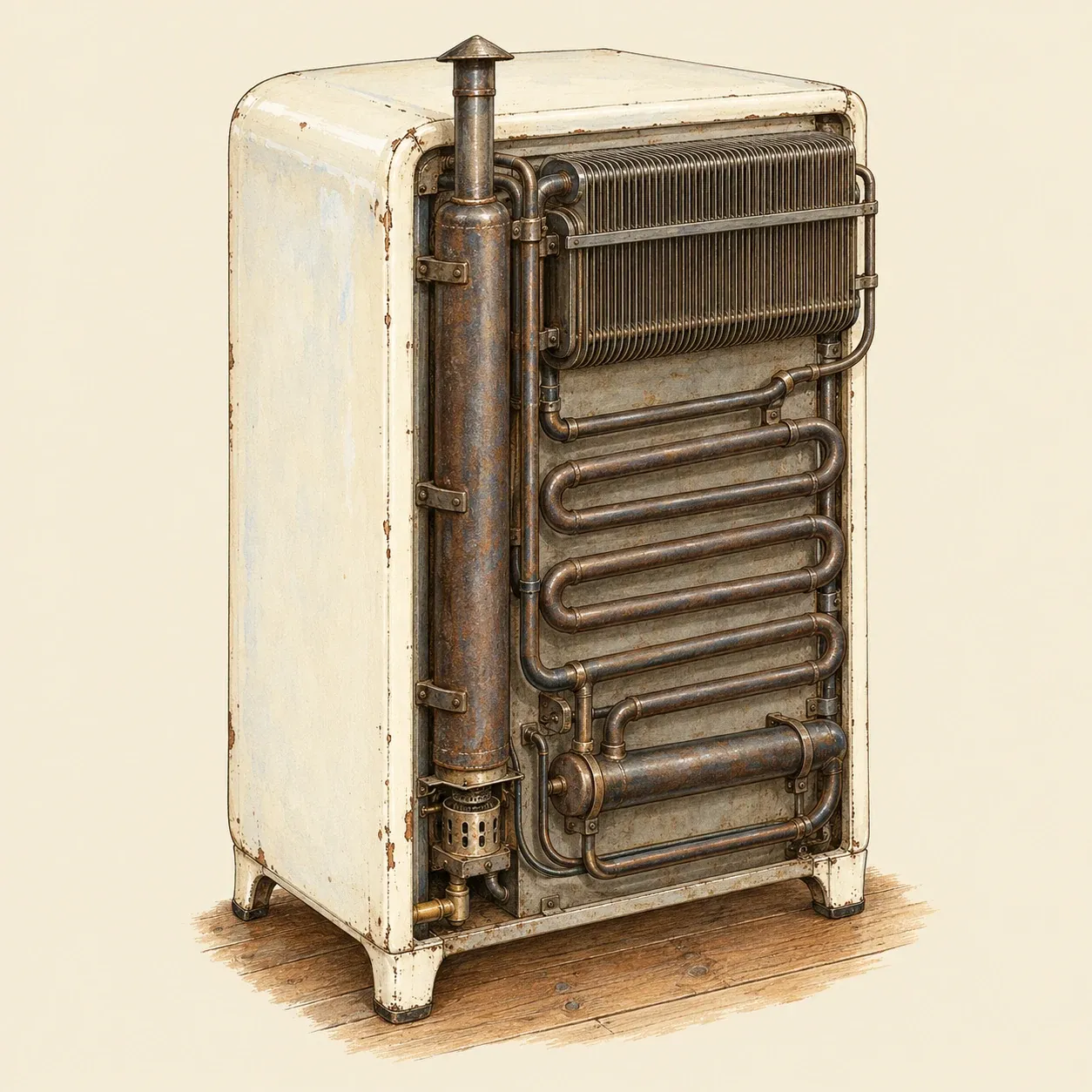 At the back of a gas-fired absorption refrigerator, a small flame under the boiler drives the whole circuit.
A continuous refrigerator runs the same steps at once, each in its own part of one sealed circuit. A small flame or an electric heater warms the boiler, where ammonia leaves the solution; the rising bubbles lift the liquid up a narrow tube, so the solution circulates without a mechanical pump. The ammonia vapour condenses in tubes at the back of the cabinet, runs into the evaporator inside and boils there. The weak solution trickling down through the absorber takes the vapour back and returns to the boiler. The circuit also holds hydrogen. The total pressure is about the same throughout, but in the evaporator the hydrogen lowers the partial pressure of the ammonia, so the liquid ammonia evaporates into it at a low temperature. In the absorber the water takes the ammonia out of the gas, and the hydrogen, which is not absorbed, returns to the evaporator. With no valve and no pump, the refrigerator has no moving parts at all.
History and evolution
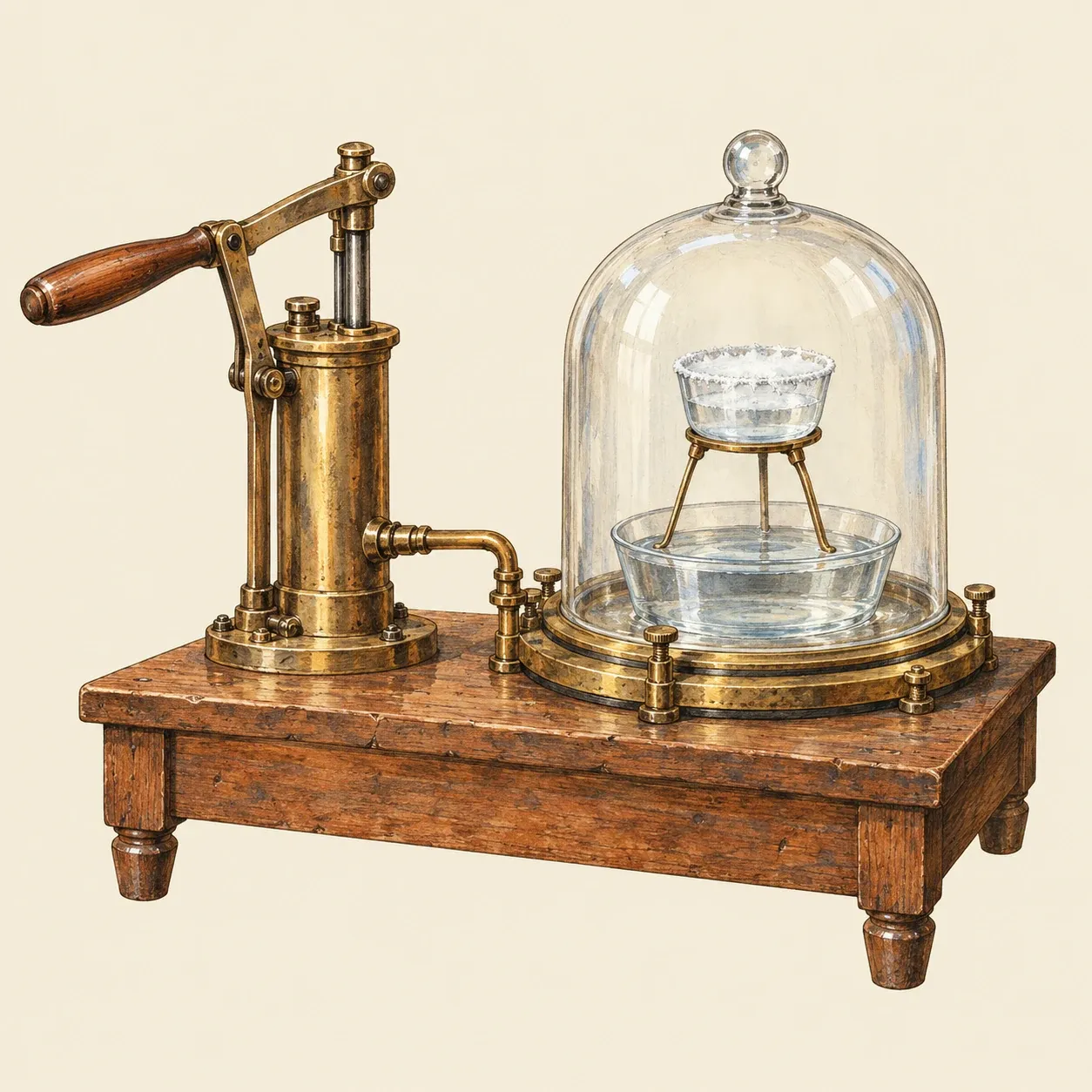 Leslie’s experiment: under the bell jar, a dish of sulphuric acid absorbs the vapour from a cup of water until the water freezes.
In 1810 John Leslie froze water with an air pump, using a wide surface of concentrated sulphuric acid to absorb the water vapour as fast as it formed. Writing in 1813, William Hyde Wollaston noted that the acid spared Leslie the very large pump that a vacuum alone would have needed. Ferdinand Carré’s brother Edmond later built an apparatus that chilled carafes of water or wine with water and sulphuric acid.
Ferdinand Carré (1824–1900), a French engineer, received a French patent in 1859 for an absorption machine that made ice with ammonia dissolved in water; the historian R. P. Multhauf dates the machine itself to 1858. It joined two vessels by a tube, heated one to drive off the ammonia and cooled the other to condense it, and it went into series production the following year. His American patent of 1860 lists several working pairs, ammonia and water among them, and describes the heated reservoir, the second vessel kept in cold water and the “intense cold” that follows once absorption begins. Carré’s machines stayed in use until the early 1900s, when compression machines replaced them.
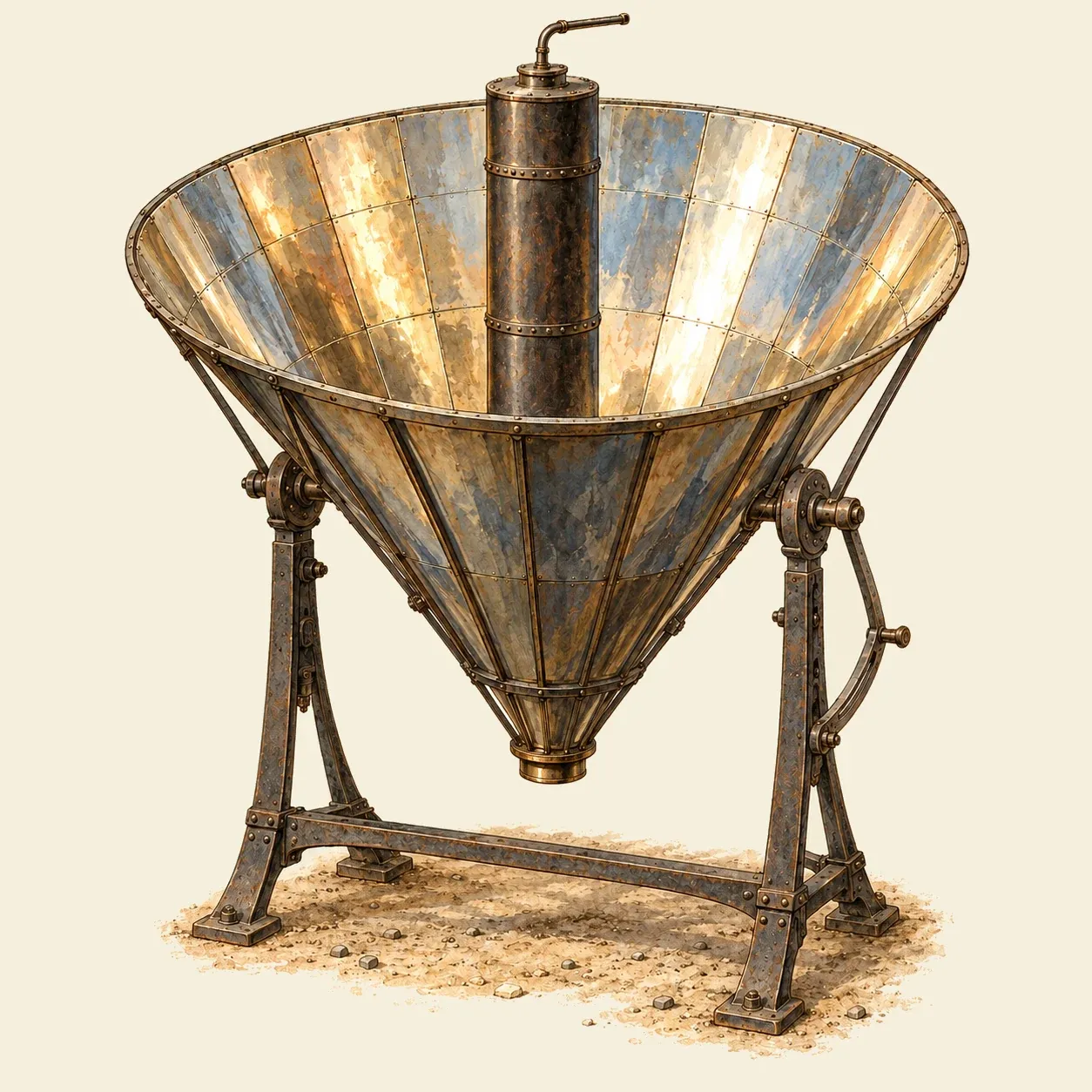 Augustin Mouchot’s solar reflectors concentrated sunlight on a boiler standing at their centre.
At the Paris Universal Exposition of 1878, Augustin Mouchot made ice with a Carré ammonia machine heated by concentrated sunlight.
In 1922 two engineering students at the Royal Institute of Technology in Stockholm, Baltzar von Platen and Carl Munters, presented a continuous absorption refrigerator that could run on electricity, gas or kerosene. Dometic dates its patent to 1923. The Swedish company Arctic bought the manufacturing rights, and Electrolux then bought Arctic. Electrolux dates its first absorption refrigerator on the market to 1925, ASHRAE dates the gas-fired household model to 1926, and Servel of Indiana sold it in North America before building it under licence.
In June 1927 David Forbes Keith of Toronto applied for a patent on the two-vessel intermittent apparatus that the Crosley company of Cincinnati sold as the Icy Ball to farm homes without electricity. Silent absorption refrigerators are still made for caravans and boats.