Clothes iron
Smoothing cloth with heat, weight and steam
Contents
- 1Bronze pan holding burning charcoal
- 2Long handle
- 3Flat, smooth base
- 4Sliding gate at the heel of the box iron
- 5Red-hot iron slug inside the box
- 6Wooden grip on two iron posts
A clothes iron smooths cloth with a hot, flat, heavy base, often helped by moisture. In China, bronze pan irons go back to the Warring States period (475–221 BCE): one was found at Tiemulike, in Xinjiang. A bronze pan of the Western Han period carries an inscription naming it the ironing pan of the household of Princess Yangxin, sister of the emperor Wu (reigned 141–87 BCE). Chinese irons held burning charcoal; European irons were heated in the fire or filled with a red-hot slug; electric irons were patented in 1882 and gained thermostats and steam in the 1920s.
What it is
An iron is a heavy tool with a flat, smooth base that is heated and pushed over damp or dry cloth to press out creases, set folds and pleats, and give linen a smooth finish. The earliest irons were pans of bronze with a long handle, filled with burning charcoal. Their flat bottom slid over the cloth while the user kept a hand well away from the heat.
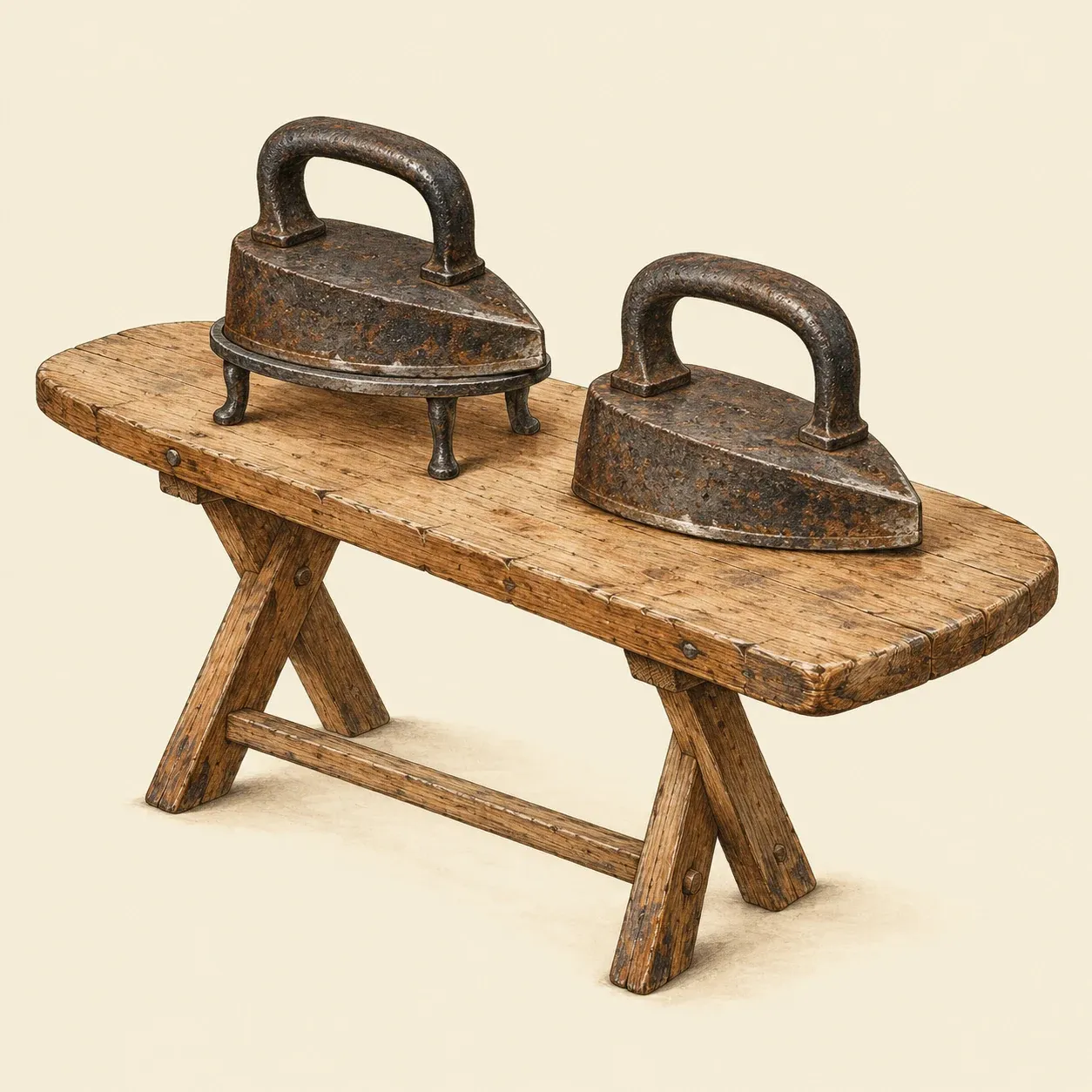 Solid irons were heated on the hearth or the stove and set down on a trivet between strokes.
Other irons carried no fire inside them. The simplest was a solid block of iron with a handle, heated on a hearth or stove and used until it cooled, then heated again. The box iron was hollow, with a gate at the heel: a slug of iron heated red-hot in the fire was dropped inside, so the outside stayed clean of soot and ash. Before electricity reached homes, some irons carried their own small burner fed by a tank of liquid fuel, and others were joined by a flexible pipe to the gas supply.
The modern iron is electric. A heating element inside warms an aluminium or steel soleplate, a thermostat keeps it at the temperature chosen on a dial, and in a steam iron a small tank of water feeds steam through holes in the soleplate.
How it works
Cotton and linen are made of cellulose, long chains of sugar molecules held side by side by weak links called hydrogen bonds. When cloth is crumpled and dries in that shape, the bonds settle around the folds and keep the creases in. Heat loosens these bonds, the weight and pressure of the iron flatten the fibres, and as the cloth cools and dries the bonds form again in the flat position. Wool and silk are proteins, but the same loosening and resetting takes place.
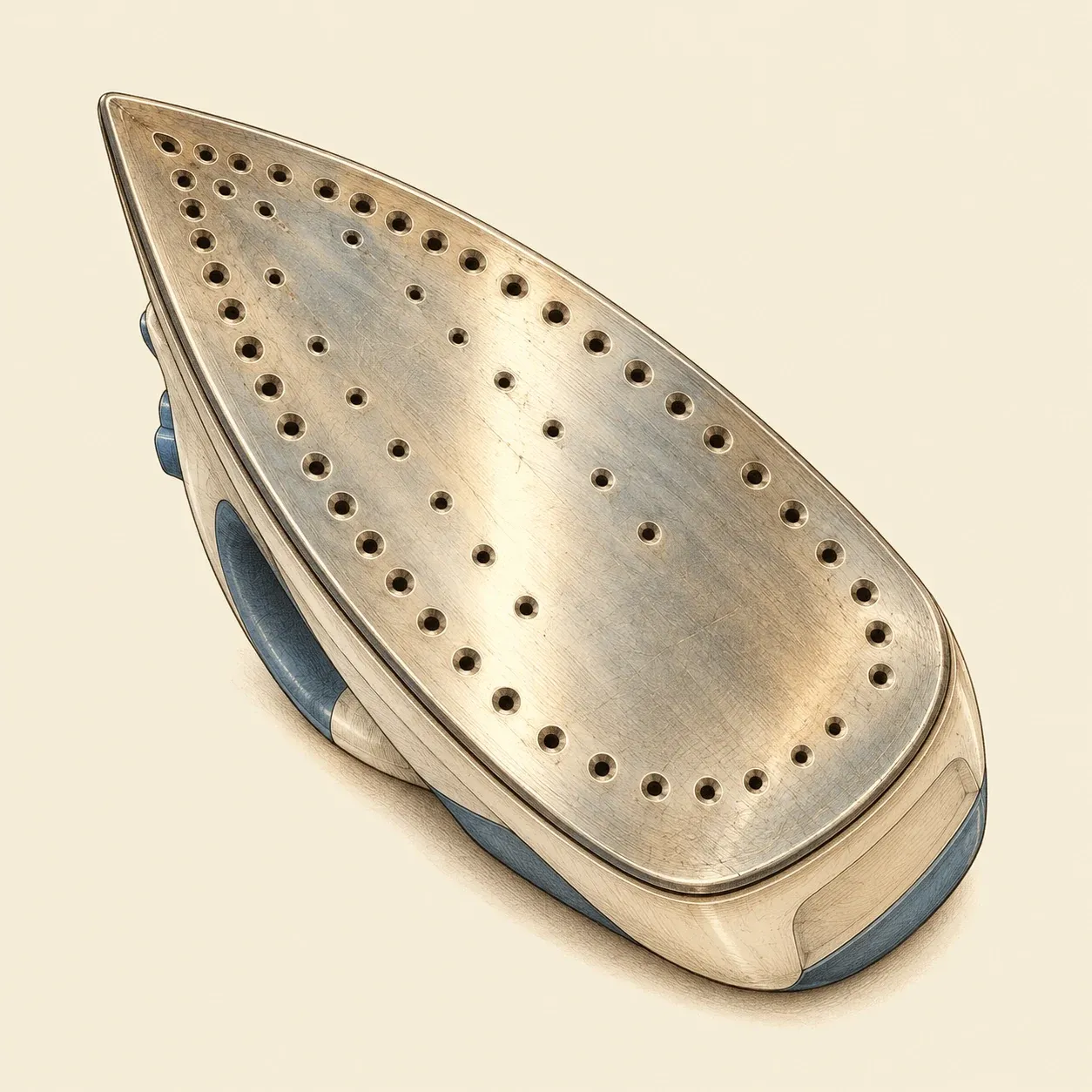 Steam leaves through holes spread over the soleplate.
Water makes the work easier. It slips between the chains, so damp fibres soften at a lower temperature than dry ones. For this reason linen was sprinkled with water or ironed slightly damp, and a steam iron sends steam into the cloth through holes in its hot soleplate. Water from the tank drips onto a hot chamber in the soleplate, turns to steam at once and escapes through the holes.
Each fibre needs its own temperature. Too little heat leaves the creases, and too much scorches the cloth. With a pan or a solid iron, the user had to judge the heat. The electric iron added a thermostat: a bimetallic strip bends as it warms and opens the contacts that feed the heating element, then closes them again as the iron cools. Irons of the 1930s already carried a dial marked silk, wool, cotton and linen.
An iron burns skin at a touch, can set cloth or paper alight if left face down, and its steam scalds. Use only a certified appliance, according to its instructions, unplug it after use and let it cool out of children’s reach. Never open, rewire or repair a mains iron yourself.
History and evolution
In China, irons go back at least to the Warring States period (475–221 BCE). The Maoling Museum writes that during the Spring and Autumn and Warring States periods the ironing pan became a household tool for pressing cloth. The collector He Xiwu, who listed the irons published in Chinese archaeological journals, cites a bronze iron of that period excavated in 1981–1982 at Tiemulike, in Xinyuan county, Xinjiang. A later iron names itself in its inscription. In the early 1980s, a pit near the tomb of the Han emperor Wu at Maoling, in Shaanxi, yielded bronzes from the household of his elder sister, Princess Yangxin. One small bronze pan carries an inscription that names it the “ironing pan of the Yangxin household” and gives its capacity as two sheng, about 400 millilitres. The Maoling Museum treats it as evidence of ironing pans in the middle of the Western Han period. Han irons were usually of bronze, with a rounded body, a wide rim that kept ash off the cloth, and a long handle. One from an Eastern Han noble tomb, now in the Handan Museum, has a scale marked on its handle so that it could serve as a ruler, and one in the Wuwei Museum ends in a dragon’s head.
Ironing in China was tied to silk. A scroll in the Museum of Fine Arts, Boston, attributed to the emperor Huizong after a painting by the Tang artist Zhang Xuan and dated to the early 12th century, shows court ladies stretching a length of newly woven silk while one presses it with a pan iron full of glowing charcoal. The art historian Lara Blanchard thinks Huizong was more likely its patron than its painter.
In Europe, irons were heated in the fire or on the stove. One manufacturing history dates the box iron to about the 15th century. The Emsworth Museum in England keeps a box iron of 1738 whose gate at the back is raised by a rod to let in a slug heated on the range; two slugs were used in turn. From the 1820s solid irons were often cast in iron, and in the early 20th century self-heating irons appeared, such as one of 1911 in Canada’s Ingenium collection, with a fuel tank pressurised by a small hand pump.
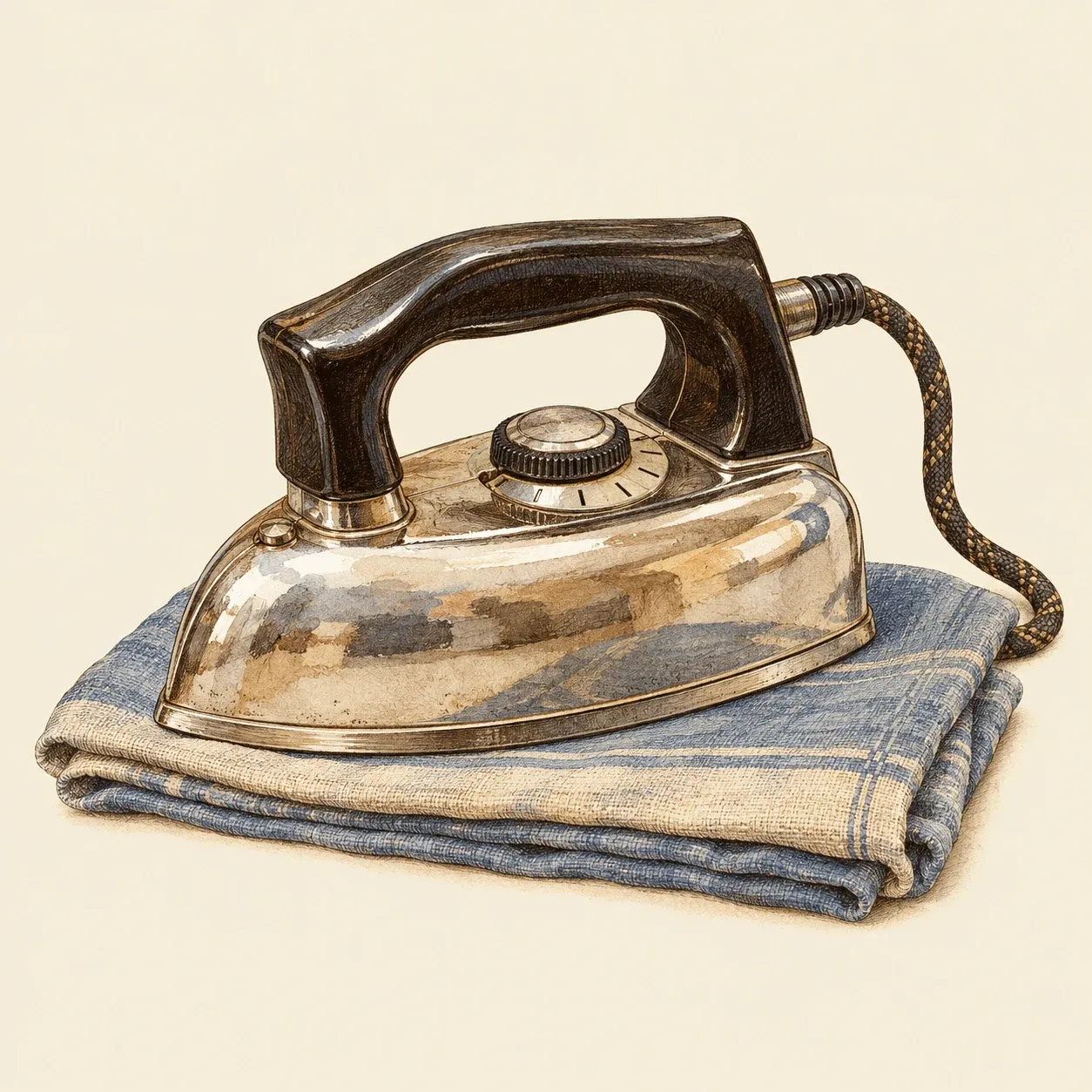 A dial on the iron sets the thermostat for silk, wool, cotton or linen.
In 1882 Henry W. Seely of New York patented an electric flat-iron. Its heating resistance, preferably of carbon, sat close to the face of the iron and took its current from the lighting circuit through a plug in a lamp socket. It was slow to warm up and cooled quickly in use. Cords made electric irons practical in the early 1900s. In the 1920s many irons gained thermostats, and the Eldec Company of New York brought out an electric steam iron in the middle of the decade, though steam irons became common only in the 1940s. Irons that could work either dry or with steam followed in the 1950s.