Tank
An armoured fighting vehicle on tracks
Contents
- 1Track running round the whole hull
- 2Sponson with a gun on the side of the hull
- 3Steering tail of two wheels
- 4Turret that turns all the way round
- 5Engine compartment at the rear
A tank is a fighting vehicle with a steel hull, guns fired from inside its armour, and two tracks that carry it over broken ground. It was born in Britain in 1915, when trench warfare had brought the armies of the Western Front to a halt, and engineers in Lincoln built Little Willie, the first working tank. Tanks went into battle at Flers-Courcelette in 1916, and the French Renault FT of 1917, with its gun in a turret that turns all the way round, set the pattern of later tanks.
What it is
A tank is an armoured fighting vehicle that runs on two tracks and carries a gun, machine guns or both. Its hull of steel plate protects the crew from bullets and shell fragments. Its engine and its tracks carry it across ground where wheeled vehicles stall, and its weapons fire from inside the armour while it moves.
The tank was a product of the First World War. From late 1914 the armies on the Western Front faced each other across lines of trenches protected by barbed wire and machine guns, and attacks on foot across open ground cost heavy losses. British engineers and naval officers designed the tank to cross that ground, crush the wire and carry guns up to the enemy trenches. Its main parts were already in existence: the internal combustion engine, armour plate of steel and the track of farm tractors.
How it works
The tracks spread the weight of the vehicle over two long strips of ground instead of the small patches under wheels, so a heavy vehicle can cross mud and soft soil without sinking. Each track is driven by a toothed sprocket and runs under a row of road wheels that carry the hull. Most tanks do not steer by turning wheels, as a car does. They make one track move more slowly than the other, so that the tank swings towards the slower side. The British tanks of 1916 also had a pair of wheels trailing behind them to help steer, which later models dropped.
On these first British tanks the track ran right round a tall hull shaped like a rhomboid, rising high at the front. The raised nose let the track climb a parapet and reach across a wide trench. The guns were mounted in sponsons, half-turrets standing out from each side of the hull. “Male” tanks carried small cannon and machine guns, “female” tanks machine guns only.
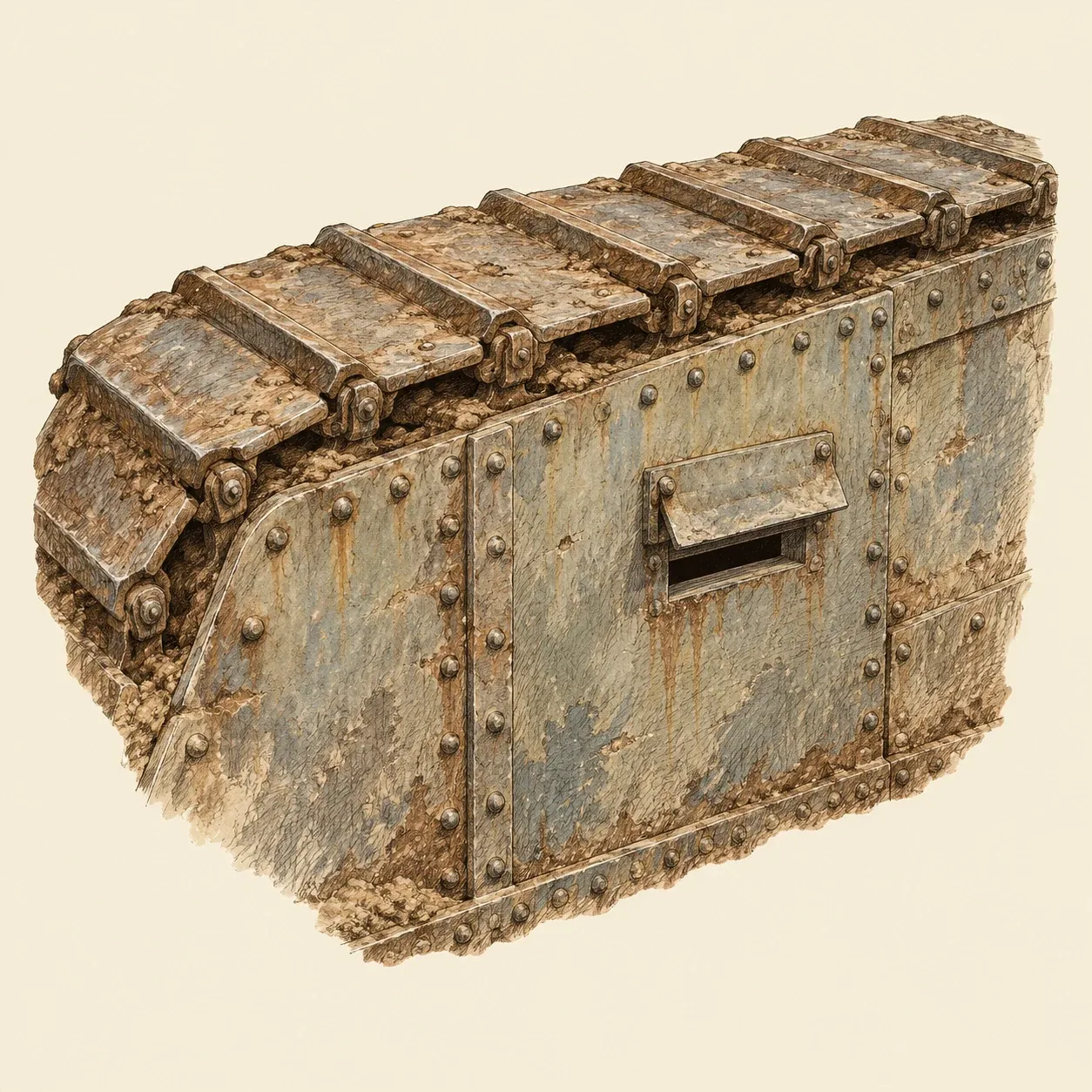 The first tanks were boxes of steel plate riveted together, with narrow slits for the crew to see through.
The hull is a box of steel plates or castings. Armour is heavy, and every gain in protection has to be paid for with a stronger engine, tracks and suspension. Later armour combined steel with layers of ceramics and other materials that resist hits better than steel of the same weight. The engine drives the sprockets through a gearbox, and the fuel it carries limits how far the tank can go.
Since the Second World War most tanks have shared one layout. The driver sits at the front of the hull and the engine is at the rear. In the middle a turret carries the main gun and turns all the way round, with the commander, the gunner and the loader inside it. The French Renault FT of 1917 was the first tank to carry its armament in a fully rotating turret, with the driver in front and the engine and gearbox behind.
A tank also depends on what follows it: fuel, ammunition, spare parts and repair crews. The British tanks of 1916 were slow and unreliable, and many broke down before they reached the enemy lines.
History and evolution
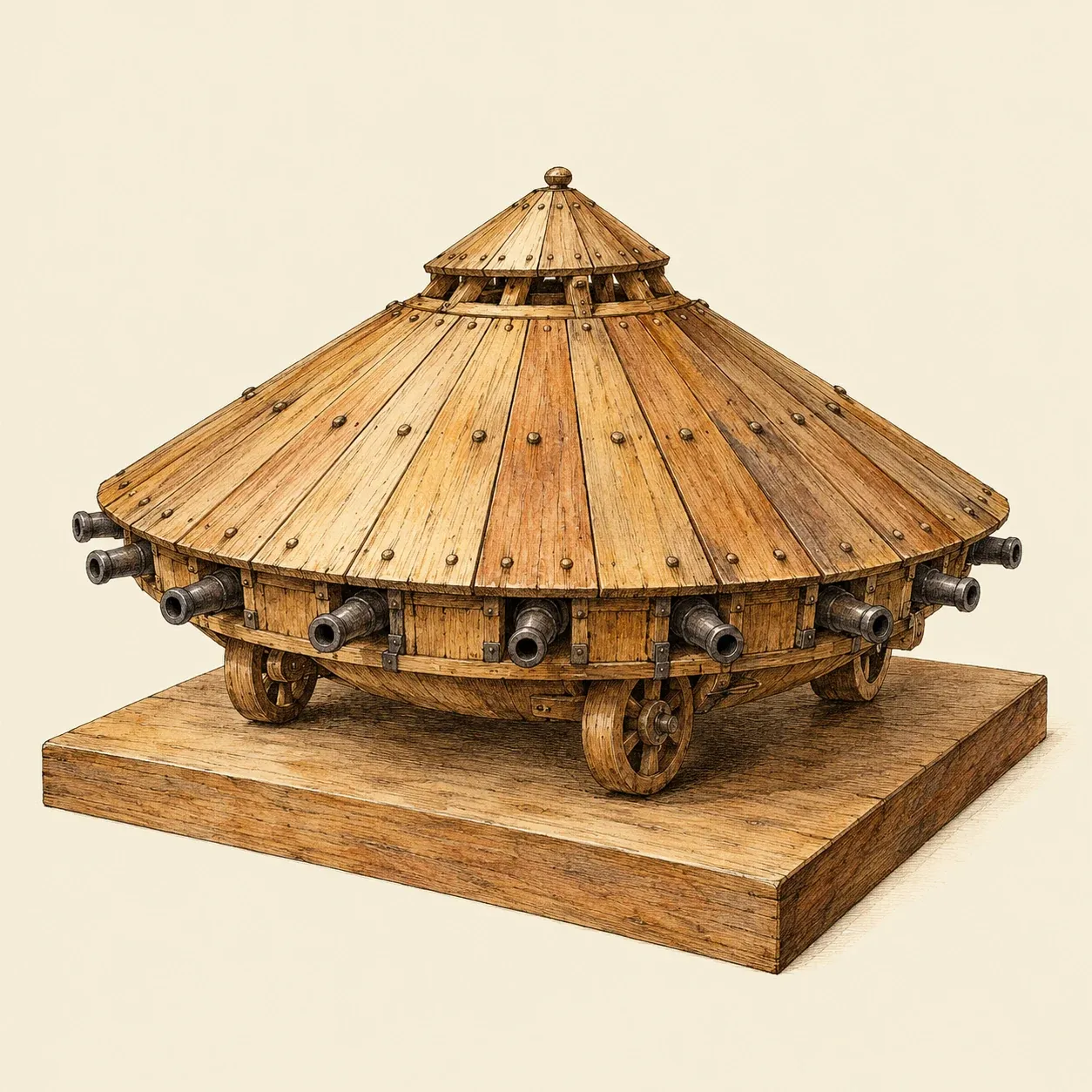 Leonardo da Vinci drew a covered fighting car in the 1480s; like many of his machines, it was never built.
The idea of a protected fighting vehicle is old. Siege towers and battering rams covered the men who worked them, and in the mid-1480s Leonardo da Vinci drew an armoured car to be moved and steered by eight men inside it. In 1900 the firm of John Fowler armoured steam traction engines to haul supplies in the South African War. Proposals for armoured vehicles on tracks were turned down before 1914, among them a design that the Australian L. E. de Mole sent to the British War Office in 1912.
The war made the need urgent. Early in 1915 Winston Churchill, then First Lord of the Admiralty, set up the Landships Committee, so that the navy rather than the army led the first work. The farm machinery firm of William Foster and Company, in Lincoln, built the prototype. Its first tracks, bought from an American tractor maker, did not suit a fighting vehicle, and William Tritton designed new ones that became the pattern for almost all British tanks of the war.
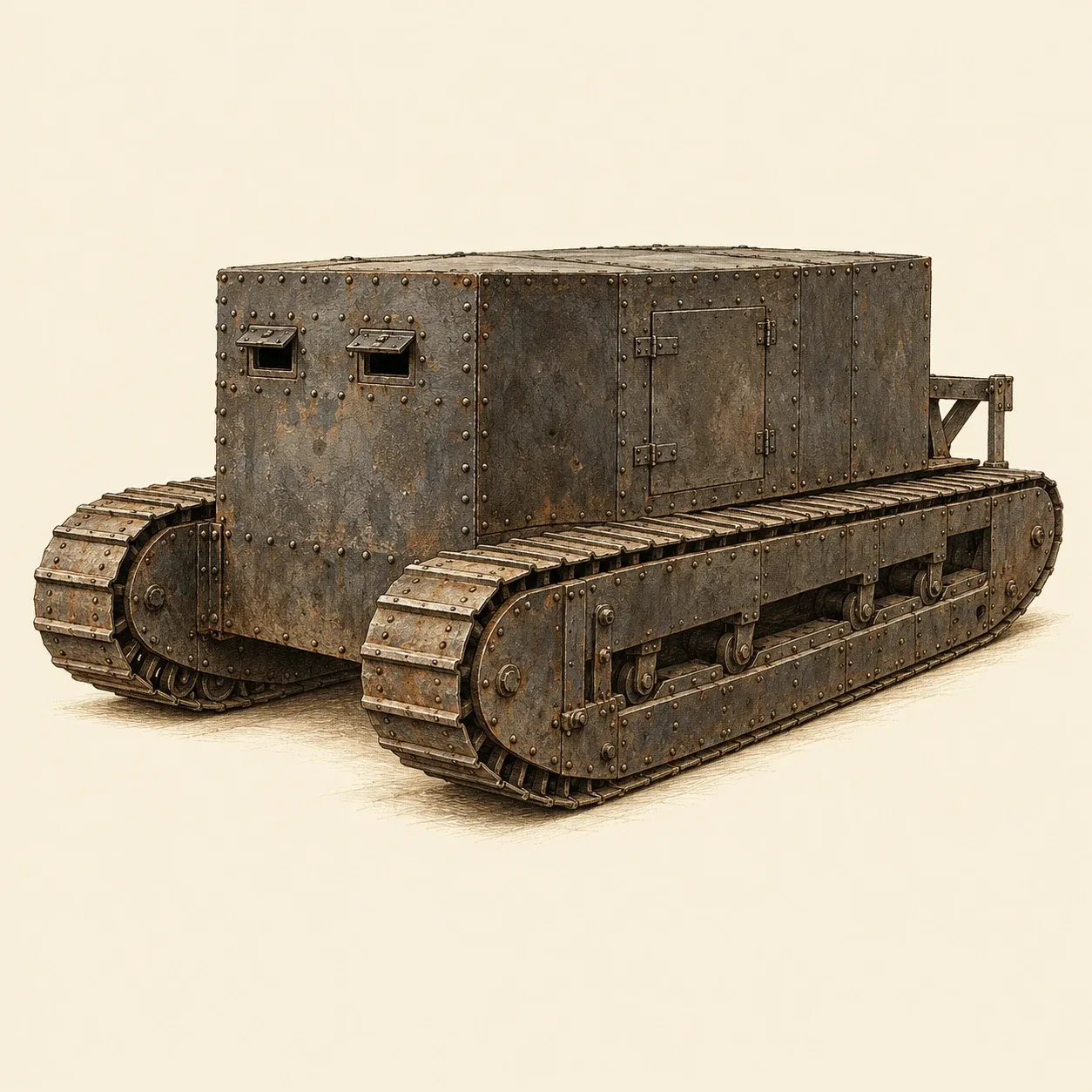 Little Willie, built in Lincoln in 1915, is the oldest tank in existence.
The prototype, completed in 1915 and known as Little Willie, never left Britain, and it is kept at the Tank Museum at Bovington as the oldest surviving tank.
Its successor, called Big Willie or Mother, had the rhomboid hull with the track running all the way round, designed by Walter Wilson and William Tritton. Built in Lincoln, it went through its official trial at Hatfield Park, north of London, on 2 February 1916, and an order for production tanks, the Mark I, followed. To keep the project secret, the machines under construction were described as water tanks, and the name stayed.
Tanks went into battle for the first time on 15 September 1916, at Flers-Courcelette during the Battle of the Somme. Forty-nine were available, and many of them broke down or became stuck before or during the attack. On 20 November 1917 the British used several hundred tanks together at Cambrai and broke deep into the German lines, but they were too slow to exploit the gap, and a German counter-attack ten days later took back much of the ground.
France developed its own tanks from late 1915. Its light Renault FT set the layout of most later tanks, and more were built than of any other tank of the war. Germany built only about twenty of its A7V. Between the wars, armies debated whether tanks should support the infantry or move fast on their own, as cavalry once had. In the Second World War they fought in large armoured formations, and the main battle tank of the following decades combined a large gun in a turret with heavy layered armour and a powerful engine.