Windsock
Showing where the wind comes from
Contents
- 1Throat hoop holding the mouth open
- 2Swivel at the top of the mast
- 3Fabric cone in five bands
- 4Narrow open tail
- 5Mast
A windsock is a tapered tube of fabric that turns on top of a mast so that its open mouth faces the wind. It shows at a glance where the wind comes from, and how far it stands out gives a rough idea of its strength. Aviation dictionaries printed in 1917 already list the wind cone among the words of the airfield, and airport rules now fix its size and colours.
What it is
A windsock, also called a wind cone or wind sleeve, is a cone of fabric open at both ends. A stiff hoop holds its wide mouth open and joins it to a pivot at the top of a mast, and the narrow tail hangs free. Air enters the mouth and leaves by the tail, and the sock streams away downwind, so the mouth always faces the side the wind blows from: a west wind sends the tail toward the east. In a light breeze the sock droops, and in a strong wind it stands out level.
Aircraft take off and land into the wind, so every aerodrome needs a way to show it. International standards ask for at least one wind indicator on each aerodrome: a fabric cone at least 3.6 m long and 0.9 m across the mouth, visible from a height of at least 300 m. It should be a single colour or, where more contrast with the background is needed, five alternating bands of two colours with the darker colour at each end. In the United States, certificated airports must also place a wind cone at each runway end used by airlines, or at least one that pilots can see on final approach and before take-off.
How it works
The sock behaves like a weathervane. Its pivot is at the mouth, the upwind end, while the drag of the air on the long fabric acts well behind the pivot. Any wind from the side therefore swings the cone round until it trails straight downwind. A good sock turns freely on its bearing: the American specification for airport wind cones requires it to line up with a wind of 3 knots, about 5.6 km/h, and to show the true direction within 5 degrees.
The taper keeps it full. The mouth is wider than the tail, so the wind pushing into the sock builds up a slight pressure inside that holds the fabric open as a cone. The taper is chosen so that the sock stands fully extended at a set speed, 15 knots or about 28 km/h in the American specification. Below that it hangs lower the weaker the wind, so its angle gives an estimate of strength, never a measurement, and in gusty air it swings and rises and falls with each gust. Airport socks are 2.5 or 3.75 m long, four to six times as long as the mouth is wide, and a rigid frame holds the front three-eighths of the sock open even in still air.
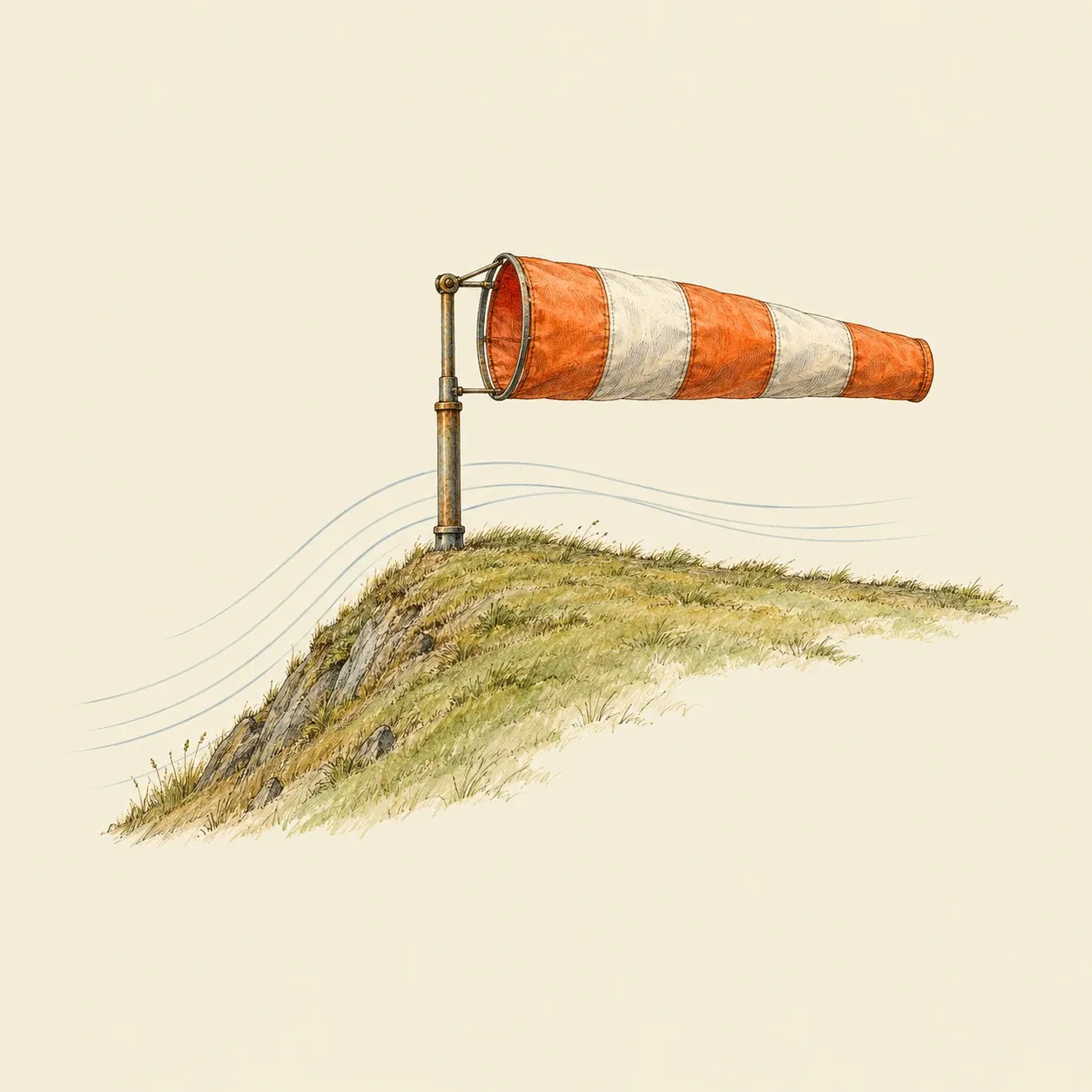 On a hill site the sock shows whether the wind is blowing onto the slope.
Where the sock stands matters as much as its shape. The international standard asks for a place free of the eddies thrown off by nearby objects, where pilots can see it both in the air and on the ground, and at night airport socks are lit from above or from inside. On hill sites, glider pilots read the windsock to see whether the wind is blowing onto a long ridge. Air pushed up the windward slope then gives slope lift that a glider can soar in, while beyond the crest the air sinks, at times with such strength and turbulence that a glider can no longer clear the terrain.
How to do it
A garden windsock shows the same principle on a small scale. You need a light, closely woven fabric such as cotton or ripstop nylon, strong thread, a ring of stiff wire or cane about 20 cm across, three pieces of cord, a small fishing swivel and a wooden post with a long arm at the top. Cut the fabric as a long trapezoid: the wide end as long as the ring’s circumference plus 2 cm for the seam, about 65 cm; the narrow end about half that; and a length of about 90 cm, four or five times the width of the mouth, in the proportions of airport socks.
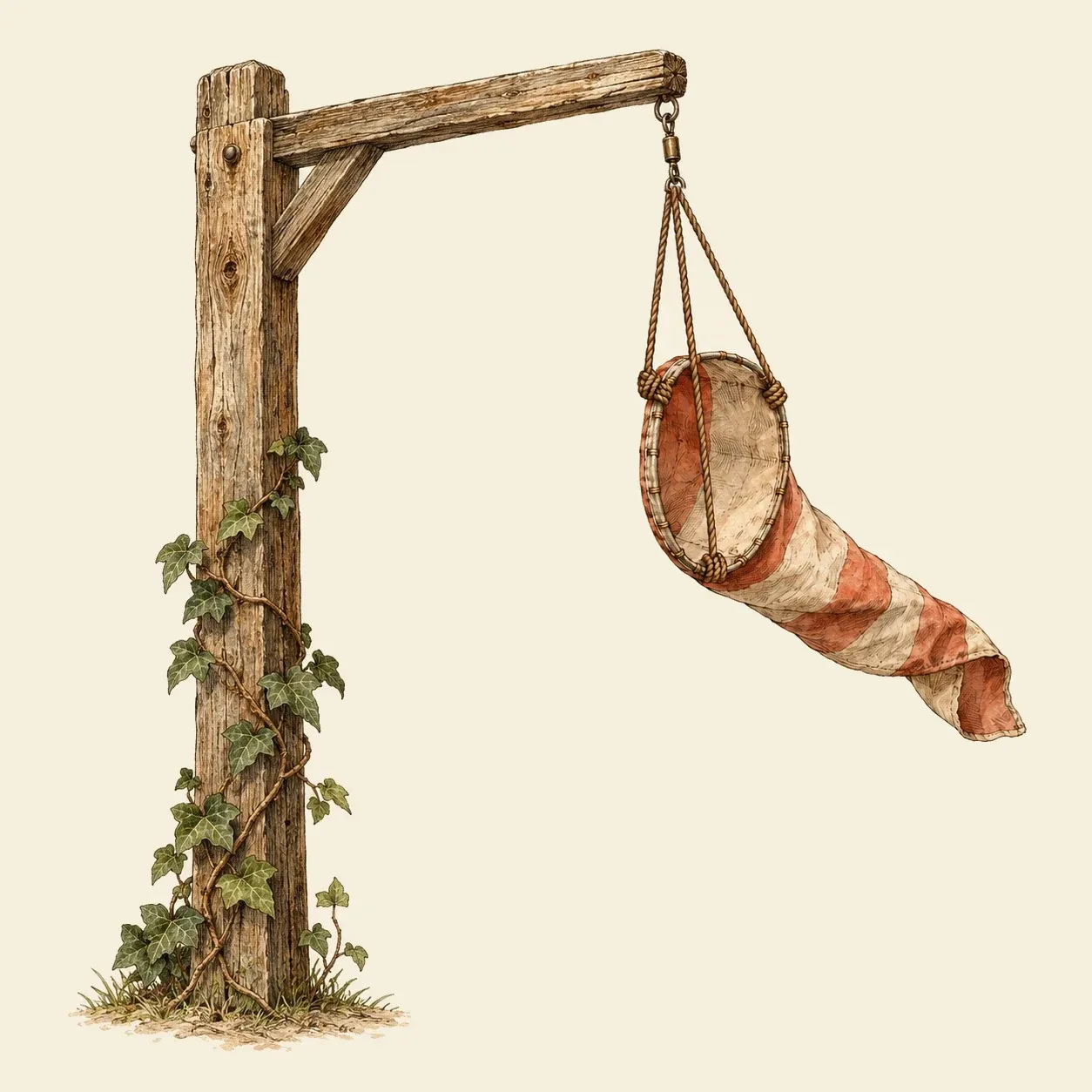 Three cords and a swivel let a garden windsock turn freely at the end of its arm.
Sew the two long edges together, right sides facing, to make a tapering tube, and hem the narrow end so that it does not fray. Turn the wide end over the ring and stitch it down all the way round. Tie the three cords to the ring at equal spacing and knot their other ends together on the swivel, so that the sock hangs level. Hook the swivel to the end of the arm. The arm must be longer than the sock and its cords together, so that the sock can swing all the way round without hitting the post.
Set the post in open ground, away from walls and trees that break up the wind, and mark north, south, east and west on the ground at its foot. The mouth then shows where the wind comes from, and the height to which the sock lifts tells a light breeze from a strong wind.
History and evolution
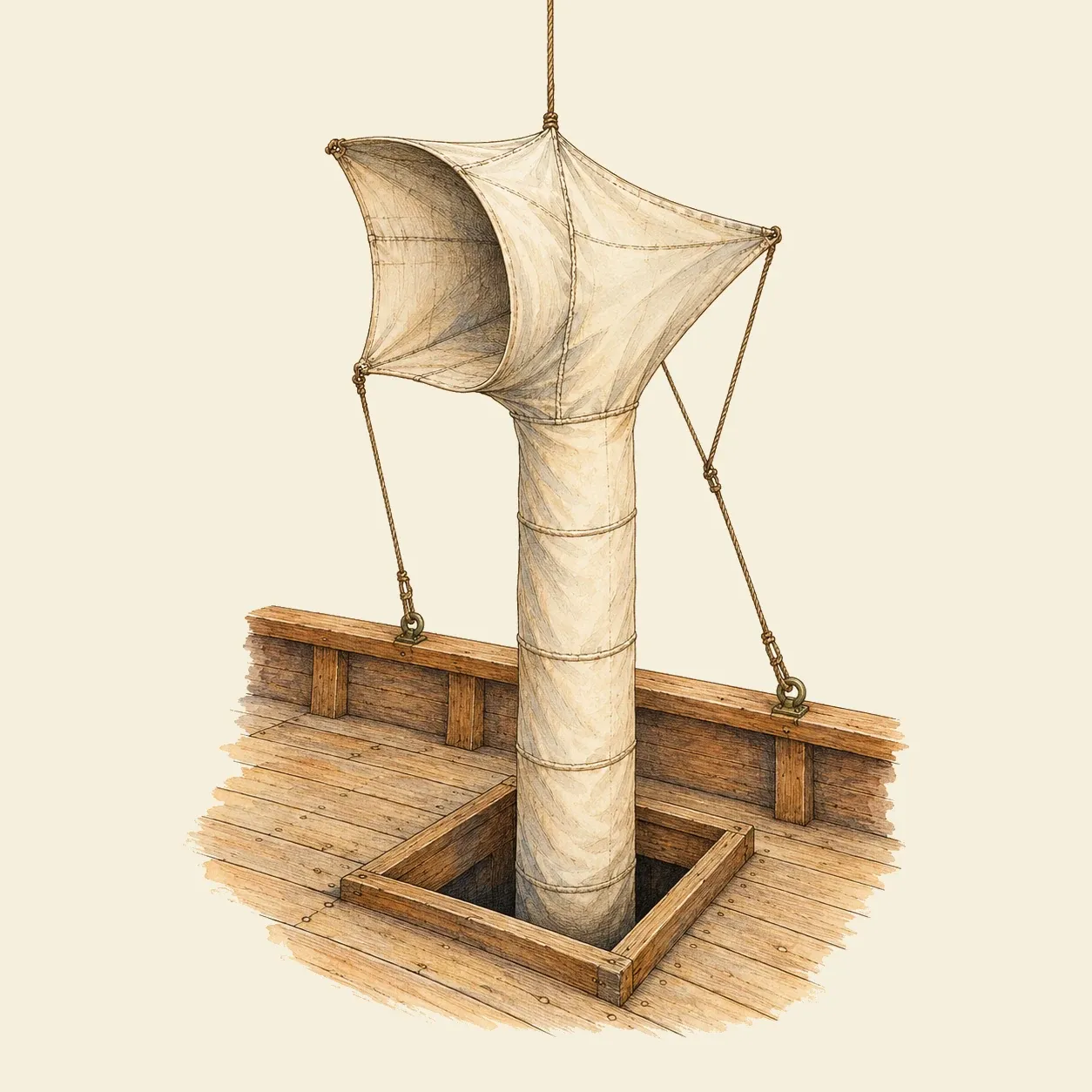 A wind-sail turned its mouth to the wind and sent fresh air down into the hold.
Long before aircraft, sailors rigged a wind-sail, a canvas tube with its mouth turned to the wind, to send fresh air down into a ship’s hold. French called it a manche à vent and German a Windsack. In 1917 a glossary of aviation terms already gave manche à vent as the French name for the wind cone of the aerodrome.
The oldest dated evidence of windsocks on airfields comes from 1917. Two dictionaries printed that year, a glossary of aviation terms published in New York and a military technical dictionary published in Washington, list the wind cone among the words of the airfield. In January 1919 the British weekly Flight recalled that before the war a pilot was content to read the weather report in the newspaper and glance at a wind cone on the aerodrome before taking off. English dictionaries record the term wind cone from the late 1910s and windsock from the 1920s.
In the 1920s the cone became a standard fitting of the flying field. The Aircraft Year Book for 1921 advised placing “the standard aviation wind cone” at one corner of the field, 30 feet above the ground. Some fields also laid out a large white cloth T to show the landing direction, and a photograph published around 1921 shows a T and a wind cone on the same field pointing different ways. Later rules fixed the size, colours, lighting and number of windsocks: the international standards for aerodromes and, in the United States, a specification for wind cone assemblies and a requirement for wind cones at certificated airports. Modern socks are made of cotton, synthetic fabric or a blend, often treated against water, and some are lit from inside.