Autogyro
A rotor turned by the wind of flight, and a propeller to pull it along
Contents
- 1Three-bladed rotor, free in flight
- 2Rotor head with its flapping hinges
- 3Hanging control column (direct control)
- 4Pylon carrying the rotor head
- 5Radial engine and tractor propeller
- 6Tailplane with upturned tips
An autogyro is an aircraft held up by a rotor that no engine turns in flight: the air flowing up through the rotor keeps it spinning, while an ordinary propeller pulls or pushes the machine forward. Juan de la Cierva's C.4 made the first autogyro flight at Getafe, near Madrid, in January 1923, thanks to blades hinged so that they could flap.
What it is
An autogyro, or gyroplane, is an aircraft that rides on a rotor turning freely above it. No engine drives the rotor once the aircraft is flying. The engine turns an ordinary propeller that pulls or pushes the machine forward, and the air that meets the rotor as it moves keeps the blades turning. The turning blades work as wings and carry the weight. Its Spanish inventor, Juan de la Cierva, called his machine the Autogiro.
An autogyro looks like a helicopter but behaves more like an aeroplane. It needs forward speed to stay up and cannot hover in still air. It can, however, fly very slowly without stalling, and if the engine stops, the rotor goes on turning and the machine comes down slowly under it. Most autogyros take off after a short run, but those built for the jump take-off can leave the ground straight up.
The Cierva C.30A is a two-seater of the 1930s, built under licence by the British firm Avro. Its fuselage carries a radial engine and a tractor propeller at the nose, two open cockpits and, above them, a pylon with a three-bladed rotor. It has no wings and no ailerons, and its fixed tailplane has no elevators. The pilot steers it by tilting the rotor head with a control column that hangs down from the head into the cockpit.
How it works
An aeroplane wing gives lift only when air flows over it, so the blades of a rotor must be kept moving through the air. In a helicopter the engine turns them. In an autogyro the rotor disc is tilted slightly back, so that as the machine moves forward, part of the oncoming air enters the disc from below and passes up through it. This upward flow is what drives the blades. A helicopter whose engine has failed uses the same effect to come down safely, which is called autorotation.
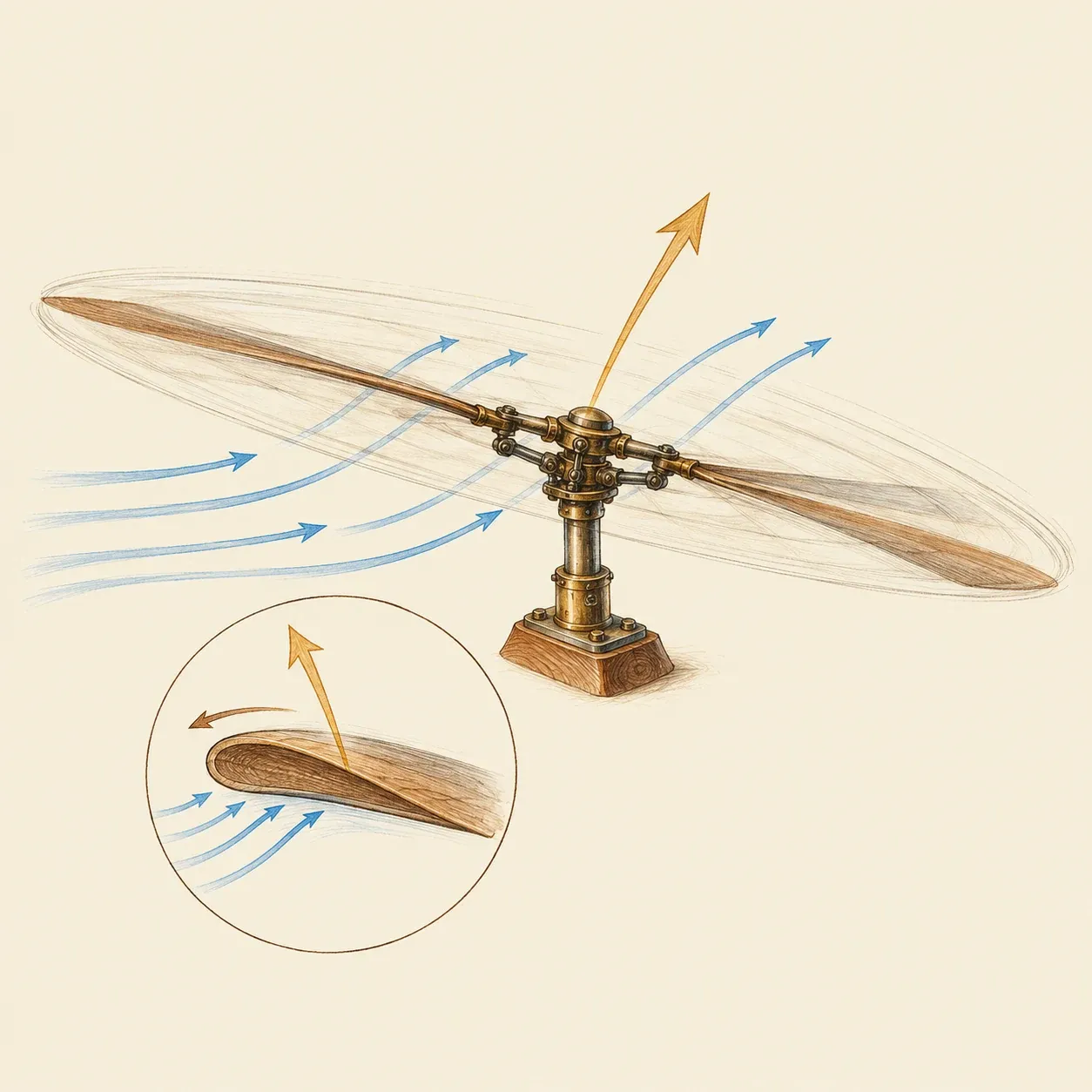 The air crosses the tilted rotor from below, and on part of each blade the force it makes leans forward and keeps the rotor turning.
Along each blade the air meets the blade section at an angle that changes from root to tip. On a middle part of the blade, the total aerodynamic force leans slightly forward of the axis of rotation and pulls the blade round. Near the tip and near the root it leans back and acts as drag. The rotor speeds up or slows down until the driving and braking parts balance, and it then turns at a steady speed while it lifts. The energy comes from the forward speed given by the propeller, or from height if the aircraft is gliding down.
A rotor moving forward has a second problem. The blade sweeping forward meets the air faster than the blade sweeping back, so it lifts more. With blades fixed rigidly to the hub, this unequal lift tips the machine over sideways. Cierva’s answer was a hinge at the root of each blade that lets it flap up and down. The advancing blade rises, which lowers its angle to the air and its lift; the retreating blade drops, which raises them. The lift evens out across the disc. A second hinge, added later, lets each blade lead and lag a little in its plane of rotation and relieves the stresses at its root.
The rotor must be turning before take-off. The first autogyros were taxied about until the airflow spun the rotor up, or a rope wound round the rotor shaft was pulled. Later machines deflected the propeller slipstream up through the rotor, and from the early 1930s an engine drive with a clutch spun the rotor on the ground and was disconnected for take-off. Early autogyros were steered like aeroplanes, with ailerons on small wings and elevators on the tailplane. From 1933 the C.30 did without these control surfaces and kept a fixed tailplane: the pilot tilted the whole rotor head, and the machine went where the rotor pulled it.
How to do it
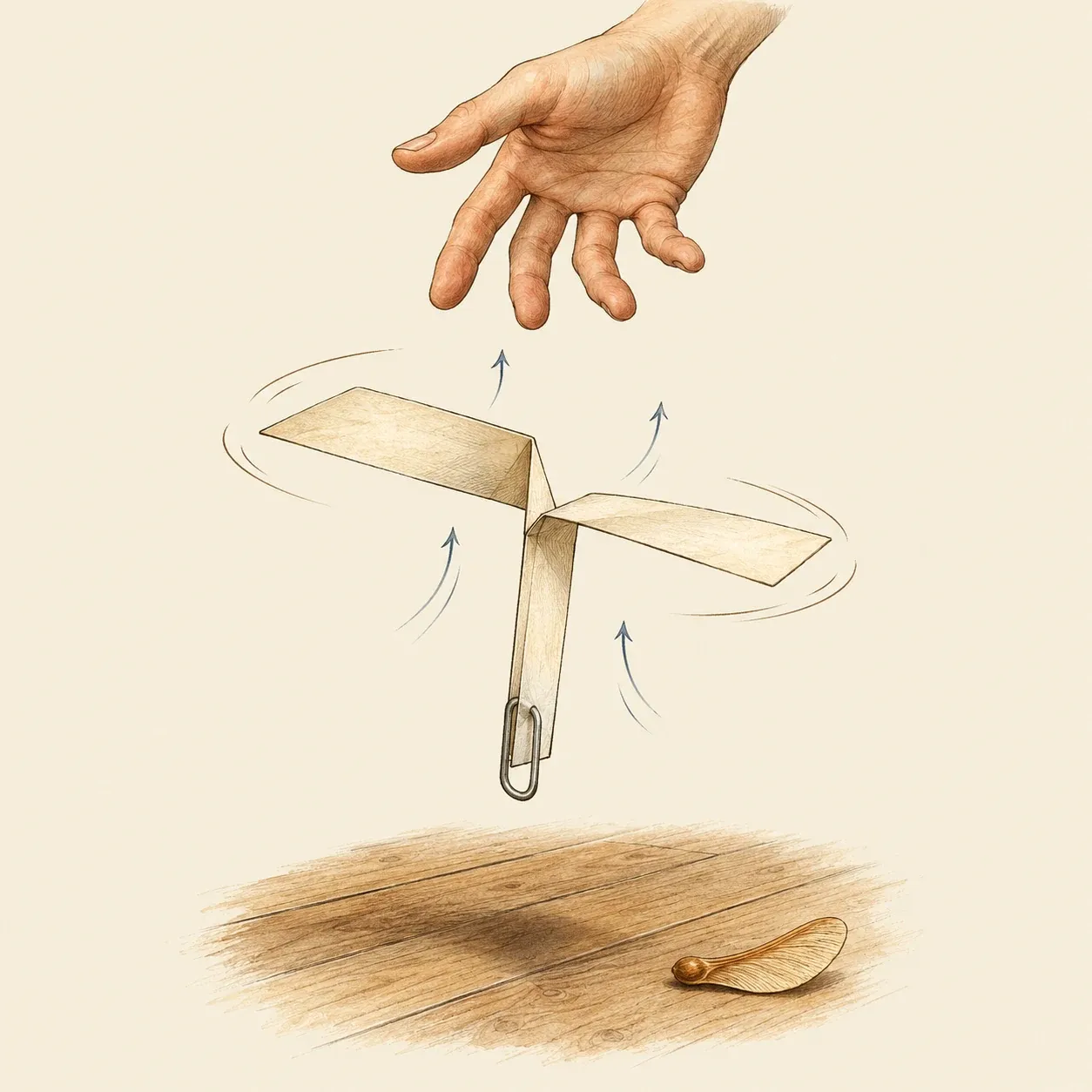 As the paper model falls, the air rising past its blades spins them, as it does a maple seed or an autogyro rotor.
A paper model shows autorotation in a few minutes. You need a sheet of paper, stiff if possible, scissors and a paper clip. Cut a strip from the sheet. Cut down the middle of the strip from the top to about halfway, to make two flaps. Fold one flap towards you and the other away from you: these are the blades. Fold the two sides of the lower half inwards to make a narrow body, fold its bottom end up and hold it with the paper clip, which gives the model its weight low down.
Stand up, hold the model by the body as high as your arm reaches and let it go. It starts to spin within a short drop and comes down much more slowly than a crumpled sheet of paper. As it falls, the air flows up past the blades, and the slant of the blades turns that flow into rotation, just as the upward flow through an autogyro rotor keeps it turning. Bend the blades the other way and the model spins the other way. Move the paper clip, add a second one or curl the blades slightly and compare the falls. A maple seed works the same way with a single blade.
Safety: take care with the scissors and keep the paper clip away from small children. Drop the model while standing on the floor: never climb on a chair or a table, or lean out of a window or over a balcony, to get more height. A real gyroplane is an aircraft: it must be airworthy and flown by a trained pilot holding the right licence, and a gyroplane assembled from a kit is only as sound as the work of the person who built and maintains it.
History and evolution
In the years around 1910 the Russian engineer Boris Yuriev found that a lifting rotor, under some conditions of descent, would turn by itself and allow a gliding landing. The Spanish engineer Juan de la Cierva came to the same effect from another direction. After a large biplane he had designed for a military competition crashed, he looked for an aircraft that could not lose control at low speed, and he imagined a freely turning rotor that would keep giving lift however slowly the machine flew. His first autogyro, the C.1 of 1920, had two rotors turning in opposite directions on one shaft, but they disturbed each other, turned at different speeds and tipped the machine to one side. The C.2 and C.3 that followed had a single rotor each, still without hinges. Both failed, the C.3 after a few short hops, because the advancing blade lifted more than the retreating one and the machine rolled over.
The fourth, the C.4, had flapping hinges. It flew a couple of hundred metres in a straight line at Getafe, near Madrid, on 9 January 1923, the date given by Guinness World Records and the FAA; the AIAA’s historic-site record dates the first official flight to 17 January. Cierva moved his work to Britain, where his designs were built mainly by Avro. He later added a second hinge so that each blade could lead and lag, and in 1928 a C.8 autogyro flew across the English Channel.
In the United States Harold Pitcairn built autogyros under Cierva’s licence, and his PCA-2 became the first rotary-wing aircraft certified there. Cierva’s C.30 of 1933 brought direct control by the tilting rotor head and did away with the wings. Avro built it under licence, and the Royal Air Force used it during the Second World War to calibrate radar, because it could fly slowly enough. Cierva then worked on the jump take-off: the rotor was spun on the ground faster than needed with its blades at no pitch, then given pitch all at once, so that the machine leapt into the air. He was killed on 9 December 1936, when the airliner in which he was a passenger crashed on take-off at Croydon. From 1939 onwards the helicopter, which could hover, drew interest and orders away from the autogyro.
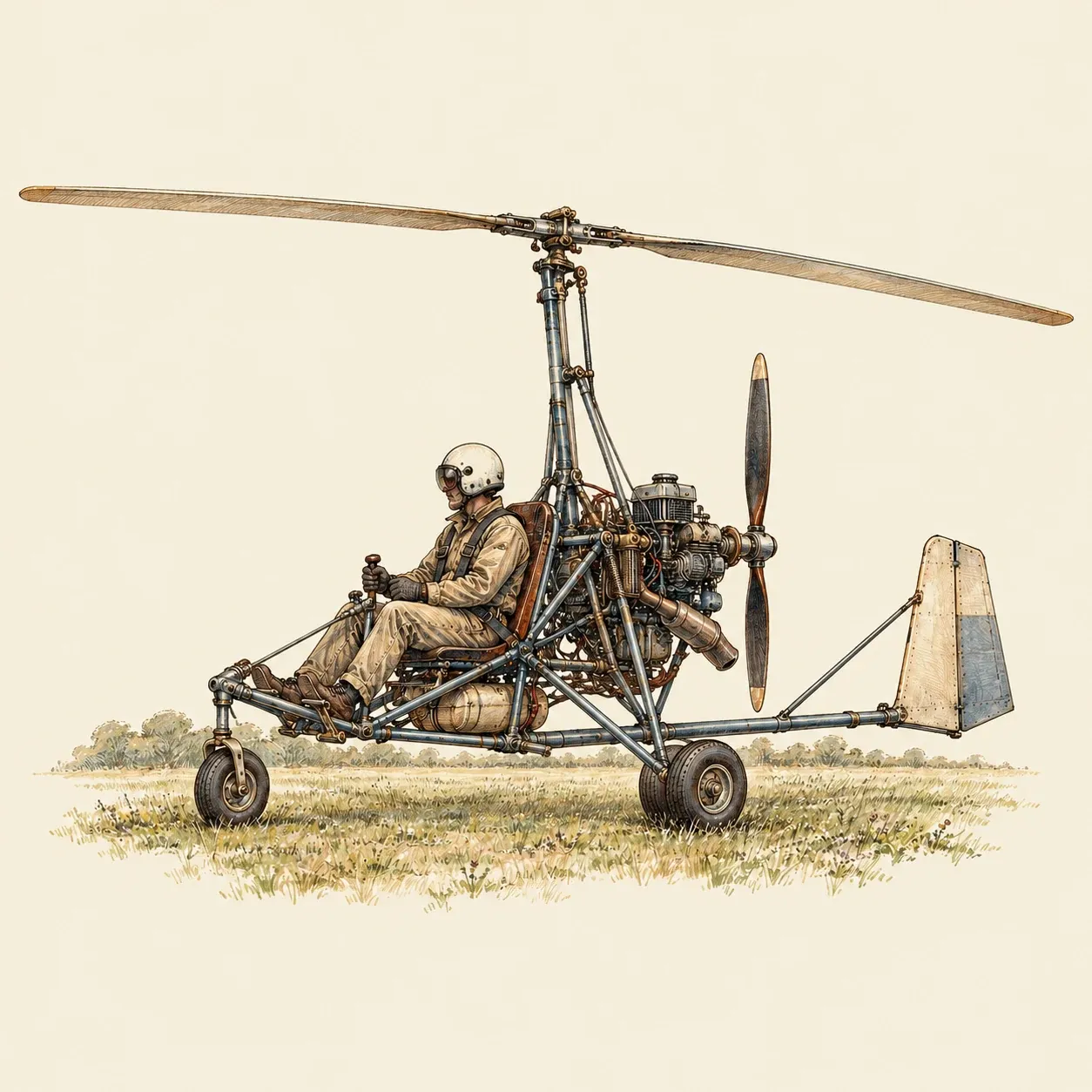 Light gyroplanes with a pusher propeller behind the pilot brought the autogyro back as a sport aircraft.
The autogyro came back in the 1950s and 1960s in a simpler form. The Russian-born American engineer Igor Bensen designed small open gyroplanes of steel or aluminium tube with the engine and propeller behind the pilot, and amateurs built many of them at home. Some gyroplanes were also produced in small series in the United States: the Umbaugh U-18, certified in 1961 and built as the Air & Space 18A until 1966, and the McCulloch J-2, which first flew in 1962 and was produced from 1971 to 1973. Gyroplanes are still built and flown today, some assembled from kits and others produced in factories, and each of them lets its rotor blades flap, as those of Cierva’s C.4 first did in 1923.