Phonograph
Writing sound into a groove and reading it back
Contents
- 1Mouthpiece and diaphragm
- 2Recording point
- 3Sheet of tinfoil
- 4Cylinder with a spiral groove
- 5Screw shaft in its threaded bearing
- 6Crank
A phonograph records sound as a groove and plays it back from the same groove. Speaking into a mouthpiece makes a thin diaphragm vibrate, and a point fixed to it presses a track of dents into tinfoil on a turning cylinder; running the point along that track again makes the diaphragm move as before and reproduces the sound. Charles Cros described the idea in a sealed note in April 1877, and Thomas Edison's workshop built its cylinder machine, the first shown outside the laboratory, at the end of that year.
What it is
The phonograph was the first machine that could keep a sound and give it back. In Edison’s first form, it was a metal cylinder with a fine spiral groove cut into its surface, covered with a sheet of tinfoil and turned by a crank. In front of it stood a mouthpiece closed by a thin diaphragm, with a small point fixed to the centre of the diaphragm resting on the foil just above the groove.
Edison’s patent of 1878 states the aim plainly: to record the human voice and other sounds in permanent marks, from which the sounds can be made audible again at a later time. The same principle, a point driven by sound that leaves a track and a point driven by the track that makes sound, was later applied to cylinders of wax and to flat discs.
How it works
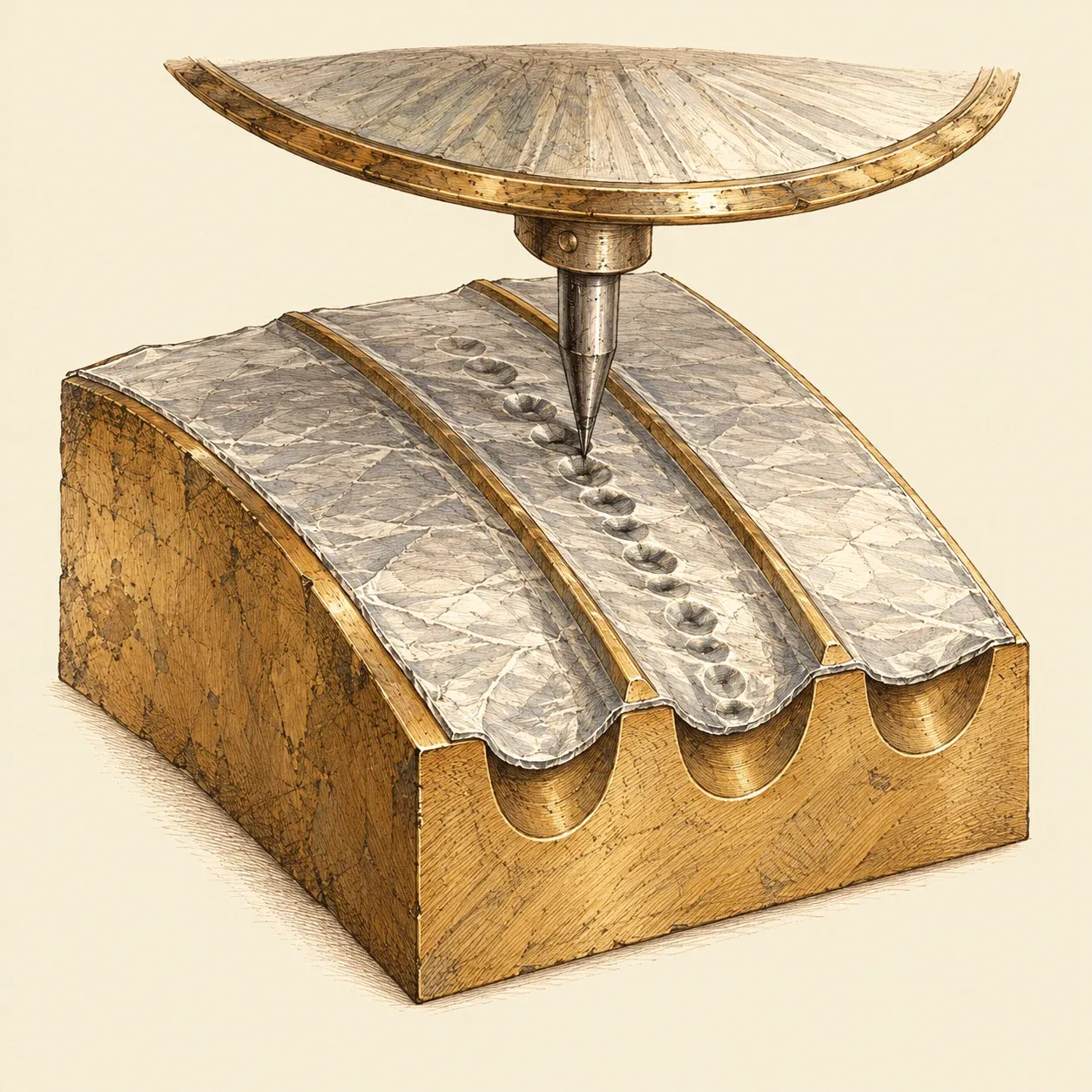 The point presses the foil into the groove: loud sounds make deep dents, quiet sounds shallow ones.
Sound is a rapid succession of small pressure changes in the air. Spoken into the mouthpiece, it makes the diaphragm bend in and out in step with those changes, and the point at its centre moves up and down with it. Under the point, the foil lies across an empty groove, so it can be pushed down into it. As the cylinder turns, the point presses into the foil a row of dents whose depth follows the movement of the diaphragm.
The groove must pass under the point all along the cylinder. Edison’s patent fixes the cylinder on a shaft cut with a screw thread of the same pitch as the groove, ten turns to the inch, running in a threaded bearing. Each turn of the crank therefore moves the cylinder sideways by exactly one turn of the groove, and the point traces a single long spiral.
To play the sound back, the cylinder is returned to the start and turned again with the point resting in the track. Each dent lifts and drops the point, the point moves the diaphragm, and the diaphragm pushes the air: the sound comes back, weaker than the voice that made it. Tinfoil recordings were fragile. In 1886 Chichester Bell and Sumner Tainter patented a different way of making the track: a stylus that cuts and removes material instead of pressing a dent.
How to do it
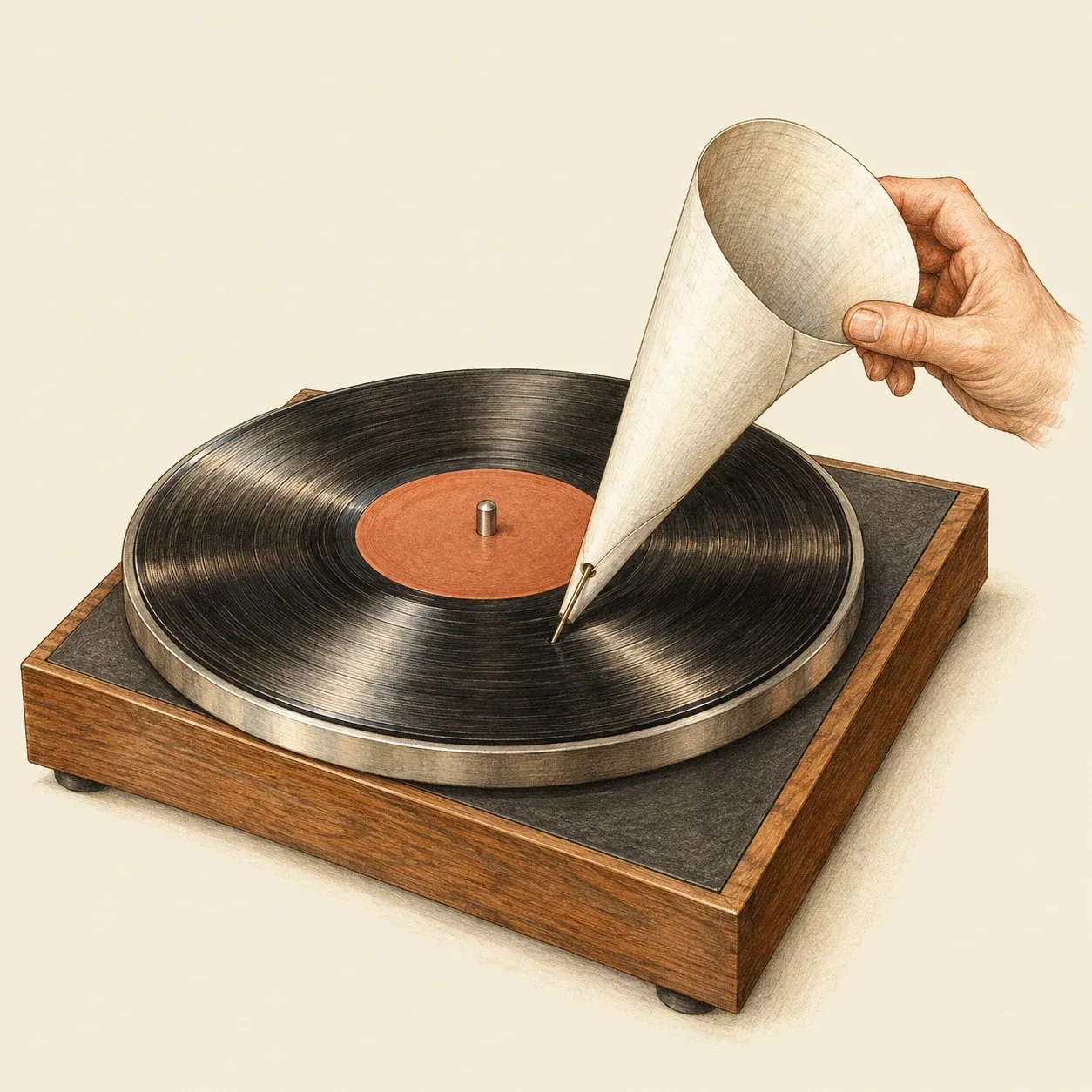 A needle and a paper cone are enough to hear a record without an amplifier.
A real tinfoil phonograph needs a lathe to cut its screw shaft and grooved cylinder, but the principle of playback can be heard with a paper cone. Use an old vinyl record that you do not mind damaging, never one of value. Roll a sheet of thin card into a cone about as long as your forearm and tape it. Push a sewing needle through the wall of the cone near the narrow end so that its point sticks out on the outside, slanting backwards, and fix it with tape.
Put the record on a turntable turning at its usual speed, with the arm of the turntable lifted away. If there is no turntable, push a pencil through the centre hole into a lump of modelling clay on a table and turn the record steadily by hand. Hold the cone by its wide end and let the point of the needle rest lightly in the groove, trailing behind the direction of rotation. Music comes out of the cone, faint but recognisable, with no amplifier: the groove moves the needle, the needle shakes the cone, and the cone moves the air, as the diaphragm of the phonograph did.
Safety: the needle is sharp; push it through the cone away from your fingers and cover the eye end with tape. The needle scratches the record, so use only a record you can spare. Keep fingers and hair away from a turning turntable, and do not leave young children alone with needles.
History and evolution
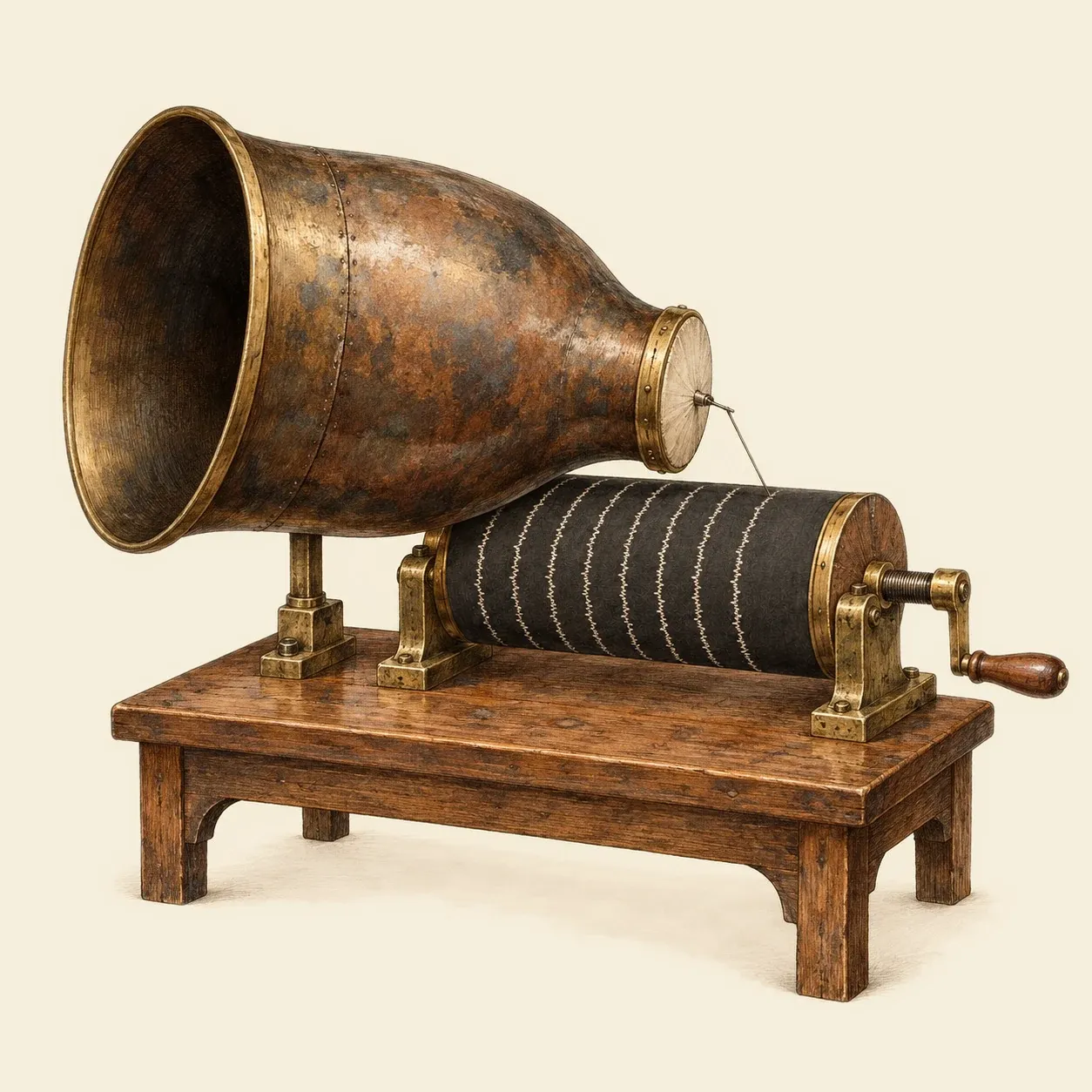 Scott’s phonautograph wrote sound as a wavy line but could not play it back.
Sound was written before it was played back. Édouard-Léon Scott de Martinville patented his phonautograph in 1857: a membrane at the end of a horn moved a stylus that scratched the vibrations onto paper blackened with soot, wrapped round a turning cylinder. He meant the traces to be studied, not heard. In 2008 a team led by David Giovannoni, with the Lawrence Berkeley National Laboratory, scanned one of them, made on 9 April 1860, and turned it into sound: a voice singing Au clair de la lune.
In April 1877 the French poet and inventor Charles Cros deposited a sealed note at the Academy of Sciences in Paris describing how a trace like Scott’s could drive a second membrane and reproduce the sound. He never built the machine. In the United States, Thomas Edison came to the idea in July 1877 while working on the telephone, and his team first tried a strip of paraffined paper. In late November Edison sketched a cylinder machine; his mechanic John Kruesi built it from 4 to 6 December, and it repeated the words spoken into it. Edison demonstrated it to the journal Scientific American on 7 December 1877 and filed his patent on 24 December; it was granted on 19 February 1878.
Edison later returned to the machine with improved wax cylinders. A tinfoil sheet recorded at a demonstration in St Louis on 22 June 1878, later kept folded in an envelope, was made audible again in 2012 by optical scanning at the Lawrence Berkeley National Laboratory. In 1887 Emile Berliner patented the gramophone, which cut a groove that wavered from side to side on a flat disc. In his patent he argued that a point pressing into tinfoil distorts the sound, because the foil resists more and more strongly the deeper it is pushed.