Bicycle bell
A struck dome that warns the way ahead
Contents
- 1Dome, or gong
- 2Thumb lever
- 3Toothed segment
- 4Large gear wheel and pinions
- 5Hammer carrier with two sliding hammers
- 6Return spring
A bicycle bell warns people ahead with a short, bright ring: a hammer strikes the rim of a thin metal dome and springs away from it so the dome can ring. The oldest dated evidence found is an English patent of 1879 for a gong rung by studs on the wheel, which says such gongs were already struck by the spokes; geared rotary bells with a thumb lever followed in the 1890s.
What it is
A bicycle bell is a small warning signal fixed to the handlebar, within reach of a thumb. It is used to tell walkers and other riders that a bicycle is coming up behind them. Its sound is short and high, and a rider can give it without letting go of the bars.
The bell itself is a thin dome of steel or brass, fixed at its centre to a post on a base, with its rim left free. A clamp holds the base on the handlebar. Under the dome sits the striking mechanism. The simplest kind has a single spring hammer that the thumb pulls back and lets go, giving one ring for each press. The rotary bell gives a quick run of strokes from each press of its lever.
Germany and France, among other countries, require a bell on every bicycle. German rules ask for at least one clear-sounding bell. French rules ask for a bell or a grelot, a small closed bell with a loose ball inside, that can be heard at 50 m at least.
How it works
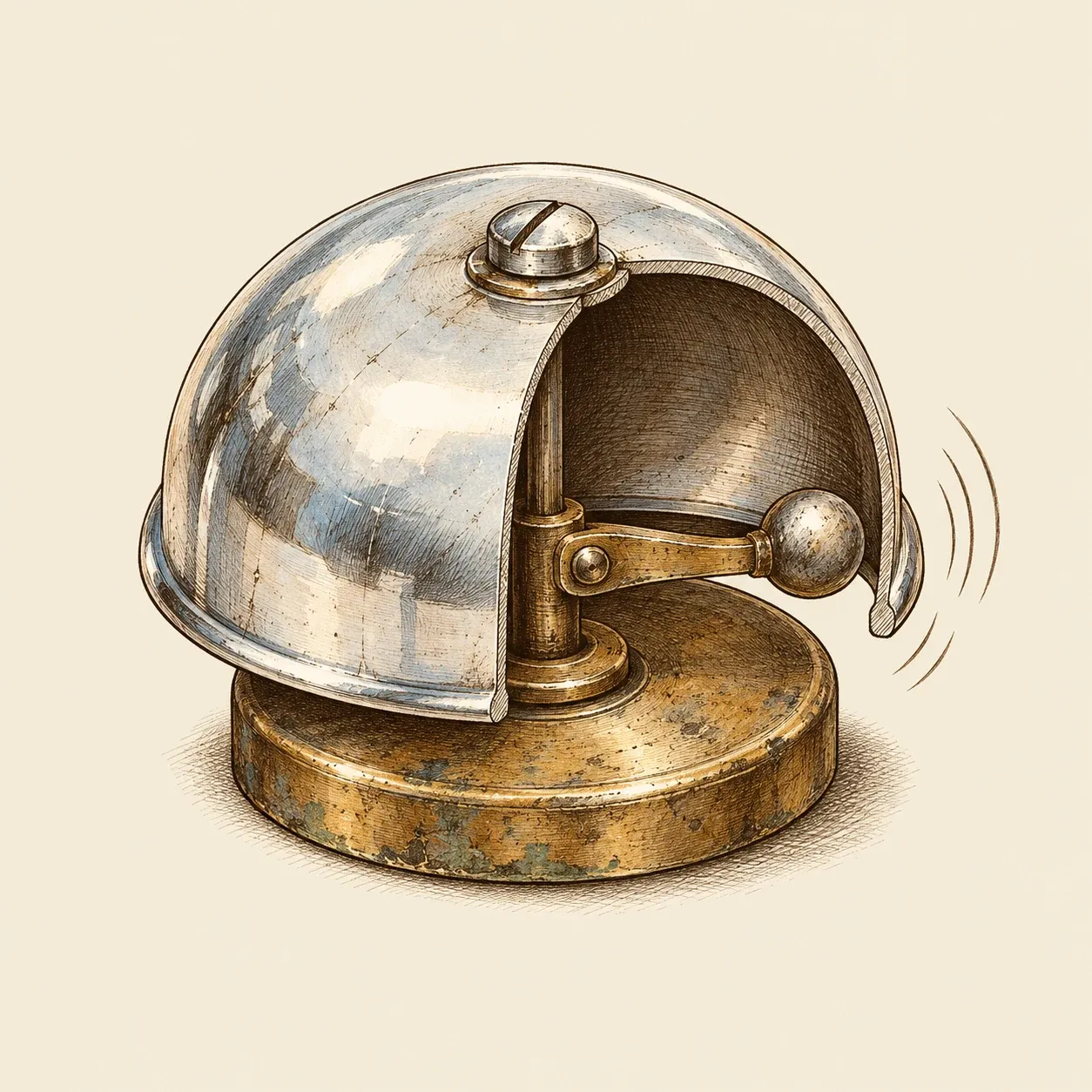 The hammer leaves the rim at once and lets the dome ring.
When a hammer hits the rim, the thin metal shell bends and springs back many times a second, and that vibration sets the air ringing. The dome is held only at its centre, so the rim is free to move. The hammer must leave the rim straight away: a hammer resting against the metal would deaden it, which is why bell makers arranged their hammers to strike and be thrown back.
In a rotary bell, the thumb lever pivots on a stud near the edge of the base. Its inner end is cut as a toothed segment that meshes with a pinion. That pinion is fixed to a larger gear wheel, which drives a small pinion on the central spindle. Each step of the train multiplies the speed, so a short push of the thumb spins the spindle several turns.
The spindle carries a carrier with two arms, and on each arm a hammer free to slide. As the carrier spins, the hammers fly outward, strike the inside of the rim and are thrown back towards the centre, then fly out again. The result is a rapid trill instead of a single ring. A coiled spring round the pivot of the lever pushes it back to its starting point when the thumb lets go.
How to do it
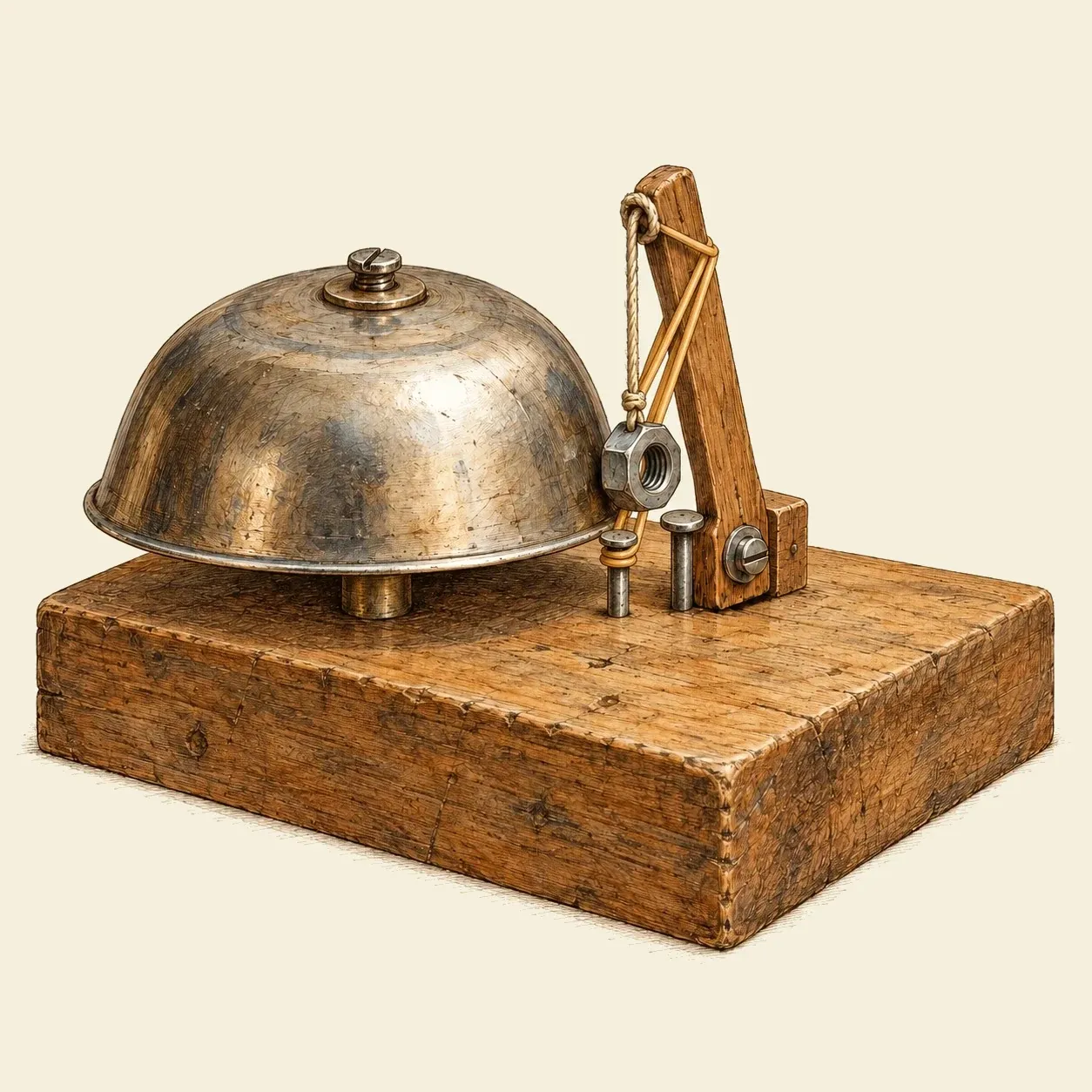 A single-stroke bell: the rubber band throws the nut against the rim, and it bounces off.
A single-stroke bell can be made on a wooden block. The dome can be a spare bell dome from a cycle shop or a small, thin metal bowl. Drill a hole in the centre of a bowl if it has none, and screw it upside down onto the block with a spacer, a stack of washers or a short tube, so that its rim stands clear of the wood all round.
Cut a small lever from a strip of wood about 10 cm long and pivot it on a screw beside the bowl. Tie a steel nut to the end of the lever on a loop of string about 2 cm long, so that it can swing a little beyond the lever. Stretch a rubber band from the lever to a nail so that it pulls the nut towards the rim, and set a second nail as a stop that halts the lever while the nut is still a few millimetres from the rim. Pull the lever back with a finger and let go: the band throws the lever onto the stop, the nut swings on across the last few millimetres, strikes the rim and drops back, and the bowl rings. Then hold the nut pressed against the rim and tap it, and compare the dull sound.
Clamp the bowl or the block when drilling and wear safety glasses, as metal swarf flies. Keep fingers clear of the lever path, and do not ring the bell right next to anyone’s ear.
History and evolution
The oldest dated record found for a bicycle bell is an English patent granted to John Harrington of Kensington, London, on 24 September 1879, no. 3,849, later taken out in the United States as well. It describes a gong fixed to the steering head of a bicycle, with a hammer on a lever. When the rider wanted to sound it, the lower end of the lever was let down into the path of studs fixed under the rim of the wheel, which struck it as the wheel turned; a key and a spring held it clear the rest of the time. The patent offers the studs in place of the existing arrangement, in which the gong was struck by every other spoke.
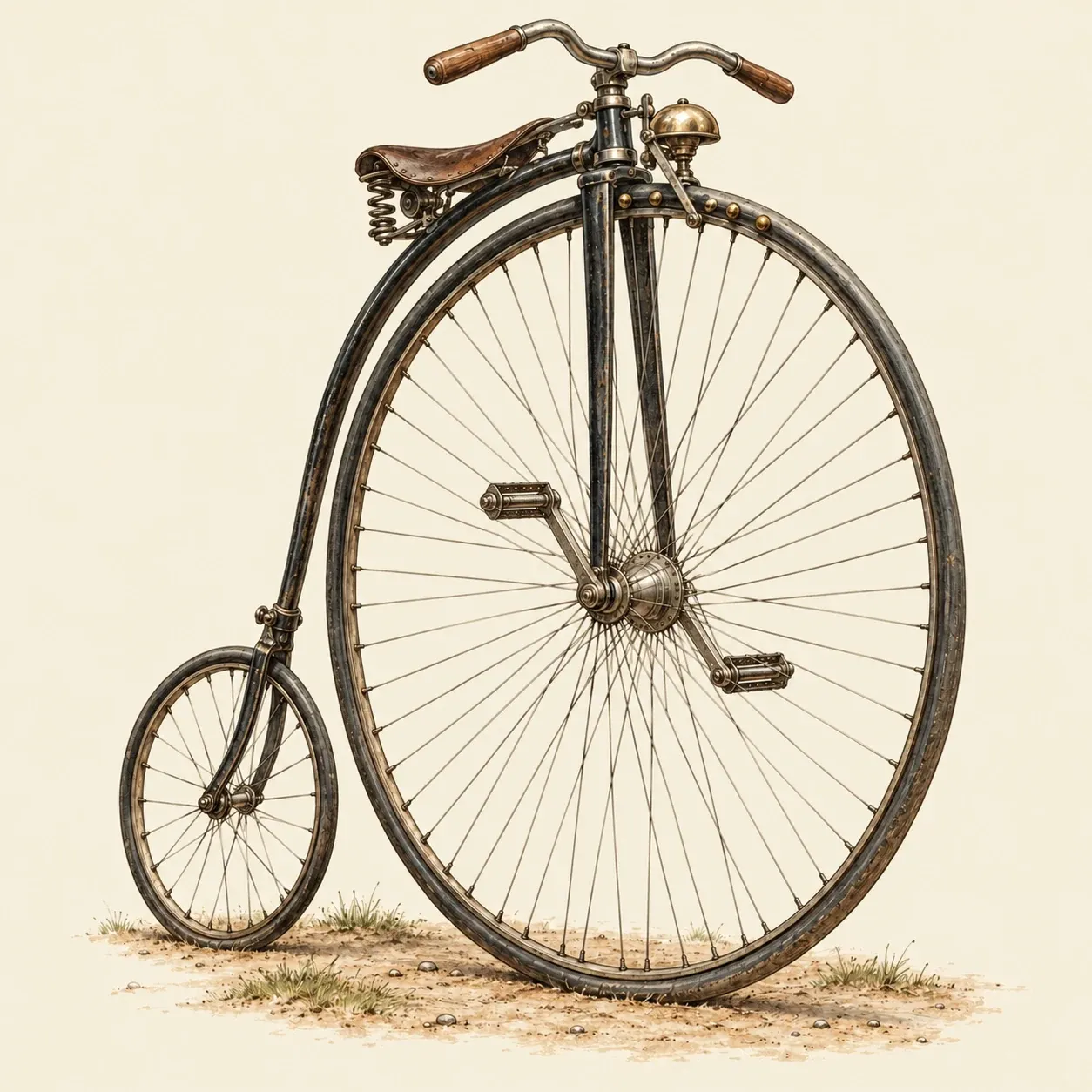 On early high-wheelers, the turning wheel itself could work the gong.
Bells worked by hand followed. In 1883 Harrie Hart of Philadelphia patented a bicycle bell whose clapper swung on a spring-loaded arm under a cast bowl fixed to a bracket. In 1892 Edward Rockwell of Bristol, Connecticut, patented a bell that gave two strokes for each press. In 1894 Albert Page patented, for Sargent & Co. of New Haven, a geared bell with a finger lever ending in a toothed segment and two hammers sliding on a spinning arbor. The same year Alfred Nicholas of Birmingham patented a geared repeating bell in England. By 1898 an American patent described rotary bells as the kind most widely used on bicycles.
German rules now forbid bells driven by the turning wheel, the kind described in the first patents, and both German and French rules exclude any other sound device on a bicycle.