Cable-stayed bridge
A deck hung from towers by straight stays
Contents
- 1Pylon
- 2Stays of the main span
- 3Back stays over the side span
- 4Steel deck girder
- 5Stay anchorage at the edge of the deck
- 6Abutment holding the deck down
A cable-stayed bridge hangs its deck from straight cables, the stays, that run from tall towers to points along the deck. Each stay lifts part of the deck and pulls it towards the tower, which is pressed straight down when the two sides balance. Carl Imanuel Löscher published a timber design of this kind in 1784, early stayed bridges collapsed at Dryburgh in 1818 and at Nienburg in 1825, and the type returned in steel with the Strömsund Bridge in Sweden in the mid-1950s.
What it is
A cable-stayed bridge carries its deck on straight cables, called stays, that run from one or more towers, the pylons, directly down to points spread along the deck. A suspension bridge works differently: there, the deck hangs from vertical hangers on two great main cables that pass over the towers and are anchored in the ground at each end. In a stayed bridge every stay is a separate straight line from the pylon to the deck, and the deck, the pylons and the stays together form one self-contained frame.
The type is used for footbridges a few tens of metres long and for road crossings with a main span of more than a kilometre. The pylons are built of steel or of reinforced concrete, the stays of bundles of high-strength steel wire or strand, and the deck is a steel or concrete girder.
How it works
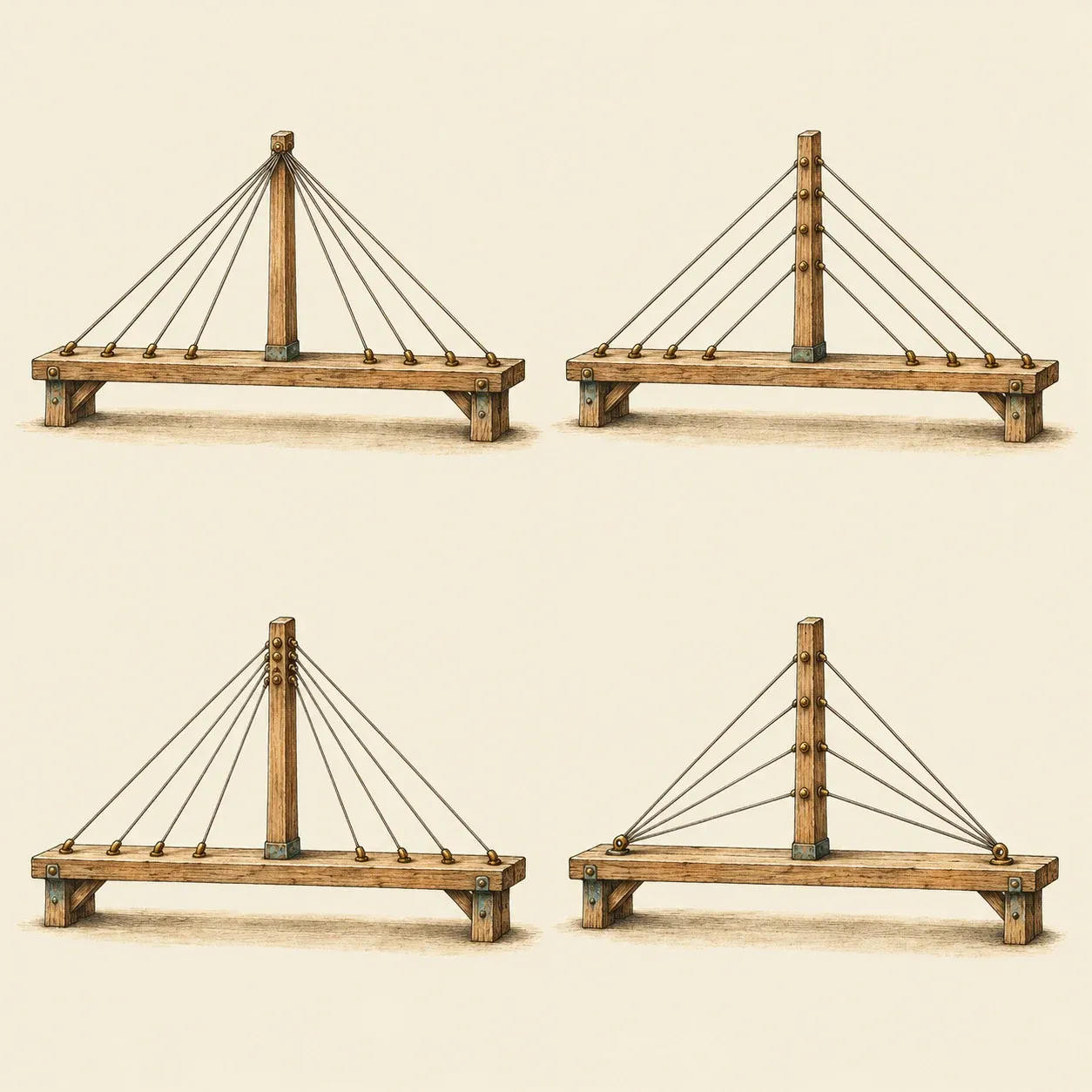 The four basic stay patterns: radiating, harp, fan and star.
The weight of the deck and of the traffic on it pulls on the stays and puts them in tension. Because each stay is inclined, its pull has two parts. The vertical part lifts the deck where the stay is anchored, so the deck behaves like a beam resting on many elastic supports instead of spanning the whole gap. The horizontal part pushes the deck lengthwise towards the pylon, so the deck is squeezed, most strongly near the pylon. At the top of the pylon, the stays on the river side and those on the side span pull in opposite directions; when they balance, the pylon is simply pressed down onto its foundation. The back stays, anchored near the end piers, stop the pylon from leaning into the main span when a heavy load crosses it, and the end piers hold the deck down against their upward pull.
The stays only work if they are taut. Walter Podolny, in his 1974 history of the type, notes that the early builders could not calculate the forces in the stays and used timber, round bars or chains that could not be tensioned fully; slack stays let the deck sag a long way before they began to carry any load. Modern stays are tensioned as they are fitted. In elevation they follow four basic patterns, radiating, harp, fan or star, and they hang in one plane along the middle of the deck or in two planes along its edges.
A modern stayed deck is usually built out from each pylon in a balanced way. A segment of deck is placed on one side and another on the other side, each is hung from its new stay, the stays are tensioned, and the cycle is repeated until the two arms from neighbouring pylons are joined in the middle. No temporary supports are needed in the water below.
How to do it
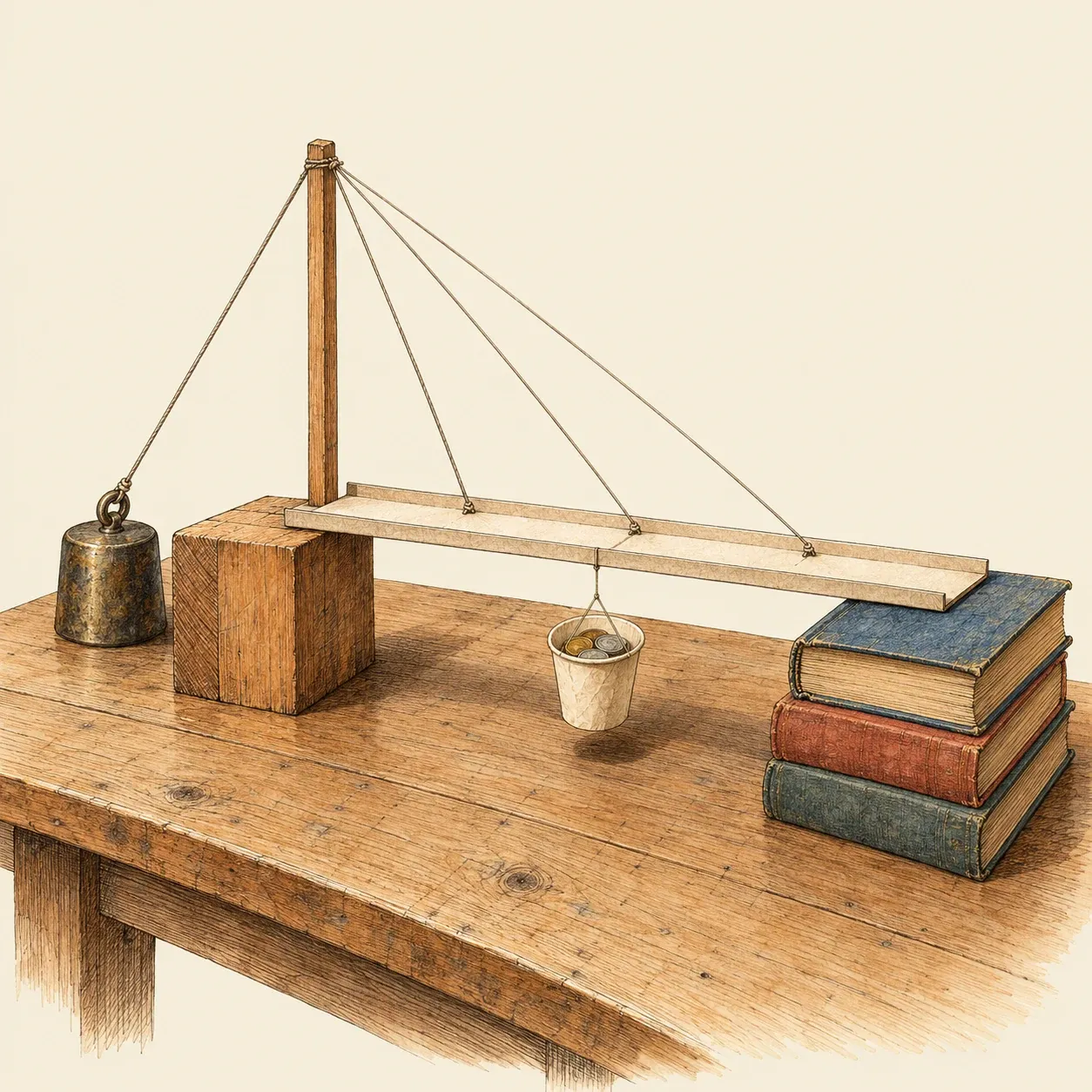 A one-pylon model: three stays carry the card deck, and a back stay keeps the pylon upright.
A tabletop model shows how stays carry a deck and why the pylon needs back stays. You need a square wooden strip about 30 centimetres long for the pylon, a heavy wooden block, a strip of thin card 50 centimetres long and 8 centimetres wide, strong thread or thin string, white wood glue, adhesive tape, a pile of books as high as the block, a small paper cup and a handful of coins.
Glue the strip upright against one face of the block and bind it with tape while the glue sets. Fold up 1 centimetre along each long edge of the card so it forms a shallow channel, and lay it from the top of the block to the pile of books 45 centimetres away. Hang the cup from the middle of the card with a loop of thread and add coins: the card sags and folds. Remove the cup. Pierce the folded edges at 15, 30 and 40 centimetres from the block and tie a thread from each pair of holes to the top of the pylon, pulling each one just taut. Tie one more thread from the top of the pylon back to a heavy object on the table behind the block. Hang the cup again and add coins one at a time: the card now stays nearly level. Untie the back stay and watch the pylon lean towards the span and the deck drop, then tie it again.
History and evolution
The idea of holding a deck up with inclined ties from a tower is old. In the Machinae novae of Faust Vrančić (Verantius), a book of machines printed in Venice and dated between 1595 and 1616 by different sources, an iron bridge hangs from chains. Podolny counts it among the first stayed bridges; other historians read the same drawing as a chain suspension bridge.
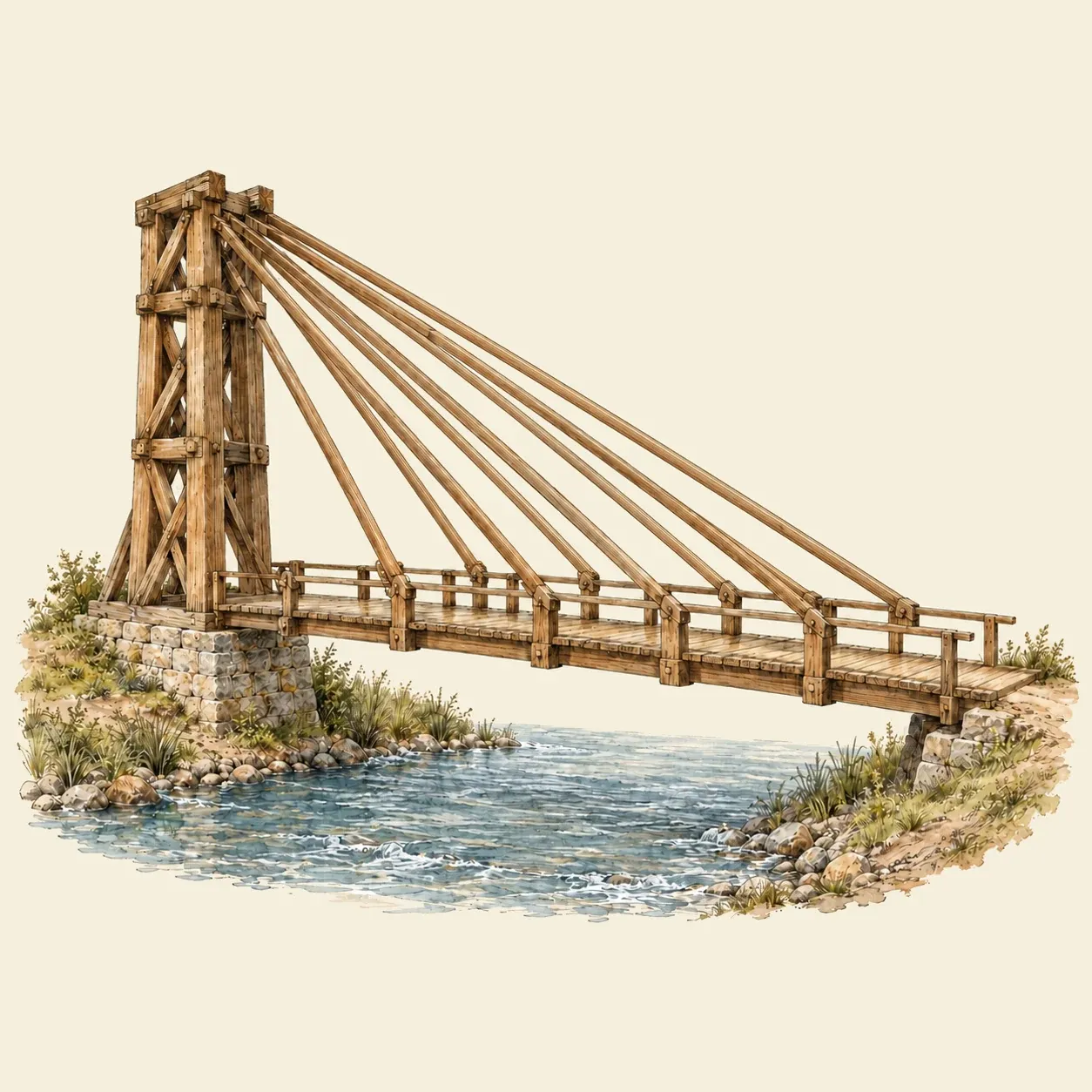 A timber stayed bridge of the kind Löscher proposed in 1784: straight timber stays from a timber tower carry the deck.
In 1784 Carl Imanuel Löscher, of Freiberg in Saxony, published a design for a bridge “from little and weak timber” that would cross a river over a long distance without an arch and carry heavy loads, worked out from load tests on wooden rods and from models. Podolny describes it as a timber bridge with timber stays fixed to a timber tower, the method of timber framing applied to a new layout. Another early proposal, by the French architect Poyet, used iron bars hung from tall towers; Löscher’s biographer dates it to 1787, Podolny to 1821.
Stayed footbridges appeared in Scotland in the 1810s. In 1816 Richard Lees, a woollen manufacturer of Galashiels, built a wire footbridge over the Gala to join his two mills, which the Historic American Engineering Record classes as a purely stayed form. In 1817 the King’s Meadow footbridge of the Edinburgh ironmongers John Redpath and John Stevenson Brown, with a span of about 110 feet (34 m), hung its deck from sloping wire stays fixed to a cast-iron tower. Over the Tweed near Dryburgh Abbey, John and William Smith built a footbridge of about 260 feet (79 m) whose deck was held by iron chain stays radiating from the towers; it opened in 1817 and the wind blew it down in January 1818, when the chains broke at their joints as the deck swung. After a stayed bridge over the Saale at Nienburg collapsed under a crowd in 1825, the French engineer Navier reported on these failures, and engineers turned to suspension bridges for more than a century.
The stays came back once steel wire could be made strong enough to be fully tensioned and engineers could calculate the forces. In 1938 the German engineer Franz Dischinger added inclined stays to a design for a railway suspension bridge over the Elbe to stiffen it. The Strömsund Bridge in Sweden, with a steel deck, is the first large modern cable-stayed bridge. Walter Podolny dates its completion to 1955, while Trafikverket, the Swedish transport administration, gives September 1956. Spans then grew quickly. The Tatara Bridge in Japan reached 890 metres in 1999, and the Russky Bridge in Vladivostok, completed in 2012, has a main span of 1,104 metres.