Jacquard loom
Punched cards choose the warp threads
Contents
- 1Chain of punched cards
- 2Square cylinder pressing each card against the needles
- 3Horizontal needles and their springs
- 4Hooks lifted by the griffe
- 5Harness cords and weighted heddles
- 6Treadle that raises the griffe
The Jacquard loom is a hand loom topped by a machine that chooses, for every pass of the weft, which warp threads rise. A chain of punched cards does the choosing: where a card has a hole, a hook catches on a rising bar and lifts its thread. Joseph-Marie Jacquard completed the machine in 1804, building on punched paper and cards tried there from 1725, and it let one weaver make figured silks that had needed a helper pulling cords.
What it is
In plain weaving, the same two sets of warp threads are raised in turn, and two heddle bars are enough. A figured silk with a flower or a portrait in it needs a different set of raised threads for almost every pass of the weft, sometimes hundreds of threads chosen one by one. Before Jacquard, these choices were set up in bundles of cords at the side of the loom, and a helper, the drawboy, pulled the right bundle for each pass.
A Jacquard machine does that work. It sits on top of the loom, and each warp thread, or each group of threads repeated across the width of the cloth, hangs from it by its own cord. A chain of punched cards, one card per pass of the weft, decides which cords are lifted. The weaver works the machine alone with a treadle, and the pattern can be changed by changing the cards.
How it works
Each warp thread passes through the eye of a heddle, a short cord with a small weight hanging below it. Above the heddle the harness cord runs up through a board drilled with many holes, which keeps the cords in order, to a vertical wire hook in the machine. The hook is bent over at the top. A frame of horizontal blades, the griffe, rises and falls with the treadle; a hook whose bent top sits over a blade is carried up with it and lifts its warp thread, while the weight pulls it down again when the griffe falls.
Whether a hook is caught depends on a horizontal needle. Each hook is held by one needle, whose point sticks out through a needle board at the front of the machine and whose tail is pushed forward by a small spring. Before each lift, a square wooden cylinder with a card on its face swings against the needle points. Where the card has a hole, the needle goes into it and into a matching hole in the cylinder, so it does not move, and its hook stays over its blade and rises. Where the card is solid, it pushes the needle back. The needle pushes its hook off the blade, and that thread stays down.
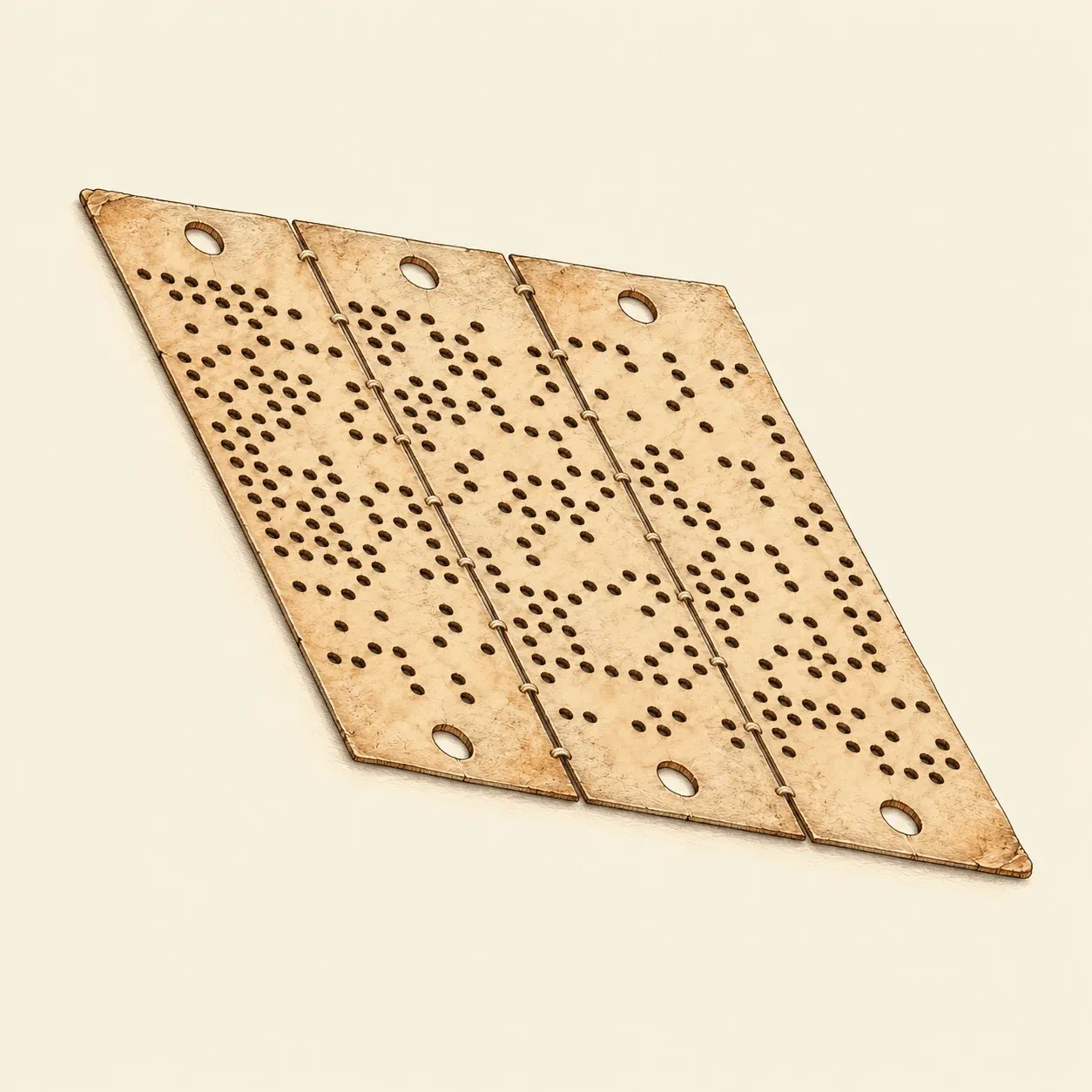 The cards follow the same layout as the hooks and the needle board, in rows of eight.
The weaver throws the shuttle through the opening between the raised and lowered threads and beats the weft in. The griffe comes down, the cylinder swings away, turns a quarter turn and brings the next card. In a 400-hook machine described in 1909, the hooks stand in rows of eight, and the needle board and the cards follow the same layout.
The cards are cut from the design. A draughtsman paints the pattern on squared paper, each small square standing for one warp thread in one pass of the weft, and a card cutter reads it row by row and punches a card for each row. A large shawl could need thousands of cards.
How to do it
A model with eight pins shows how a card chooses threads. You need two strips of plywood about 25 by 5 cm, a base board about 30 cm square, two uprights 25 cm tall and two 18 cm tall, two small wooden blocks 1 cm thick, eight wooden dowels 4 mm thick and 20 cm long (or kebab skewers with the points cut off), sixteen small rubber bands, thin card, an office hole punch, strong thread, two sticks about 25 cm long, a little glue and a strip of paper or a length of yarn for the weft.
Drill the boards. Clamp the two plywood strips together and drill a row of eight 5 mm holes through both, 2.5 cm apart. Then open the holes of one strip, the presser, to 8 mm; the other strip is the guide. Drilling both together keeps the holes in line.
Stretch the warp. Glue the two short uprights at the middle of the front and back edges of the base and fix a stick across the top of each. Tie eight threads from the back stick to the front one, 2.5 cm apart, and fasten each to the front stick through a rubber band, so that it stays taut but can be pulled down a little.
Set the pins. Glue the two tall uprights at the middle of the left and right edges and fix the guide across their tops, one hole above each warp thread. Wind a rubber band round each dowel 3 cm from its top and push the dowel up through a hole of the guide from below until the band stops against it. Tie each dowel to the thread beneath it, pulling the thread down about 2 cm, so that the thread holds the dowel up against its stop and all the tips stand 3 cm above the guide. Glue the two small blocks on top of the guide, one at each end.
Punch the cards. Cut strips of card the length of the presser. Mark the eight hole positions of the presser on each strip and punch a hole wherever a thread is to stay up. Number the cards and tie them into a chain with thread through two corner holes.
Weave. Hold the first card against the underside of the presser, holes under holes, and press both down on the pin tips until the presser rests on the blocks. A pin under a hole passes through the card and the presser and keeps its thread up. A pin under solid card is pushed down and pulls its thread down with it. Slide the weft between the raised and the lowered threads, lift the presser so that the pins spring back, and take the next card. After a few cards a pattern of floats appears.
Safety. An adult should drill the boards, with the work clamped and hands clear of the bit. Cut the points off skewers before use. Keep the pins, rubber bands and punched-out circles away from small children.
History and evolution
Looms that stored a pattern in their set-up are much older than punched cards. Four model looms from a tomb at Laoguanshan in Chengdu, China, of the second half of the second century BCE, represent looms with many shafts, worked by treadles and hook rods, for patterned silk. Their excavators see them as the oldest pattern looms known and suggest that this kind of loom led on to the draw loom.
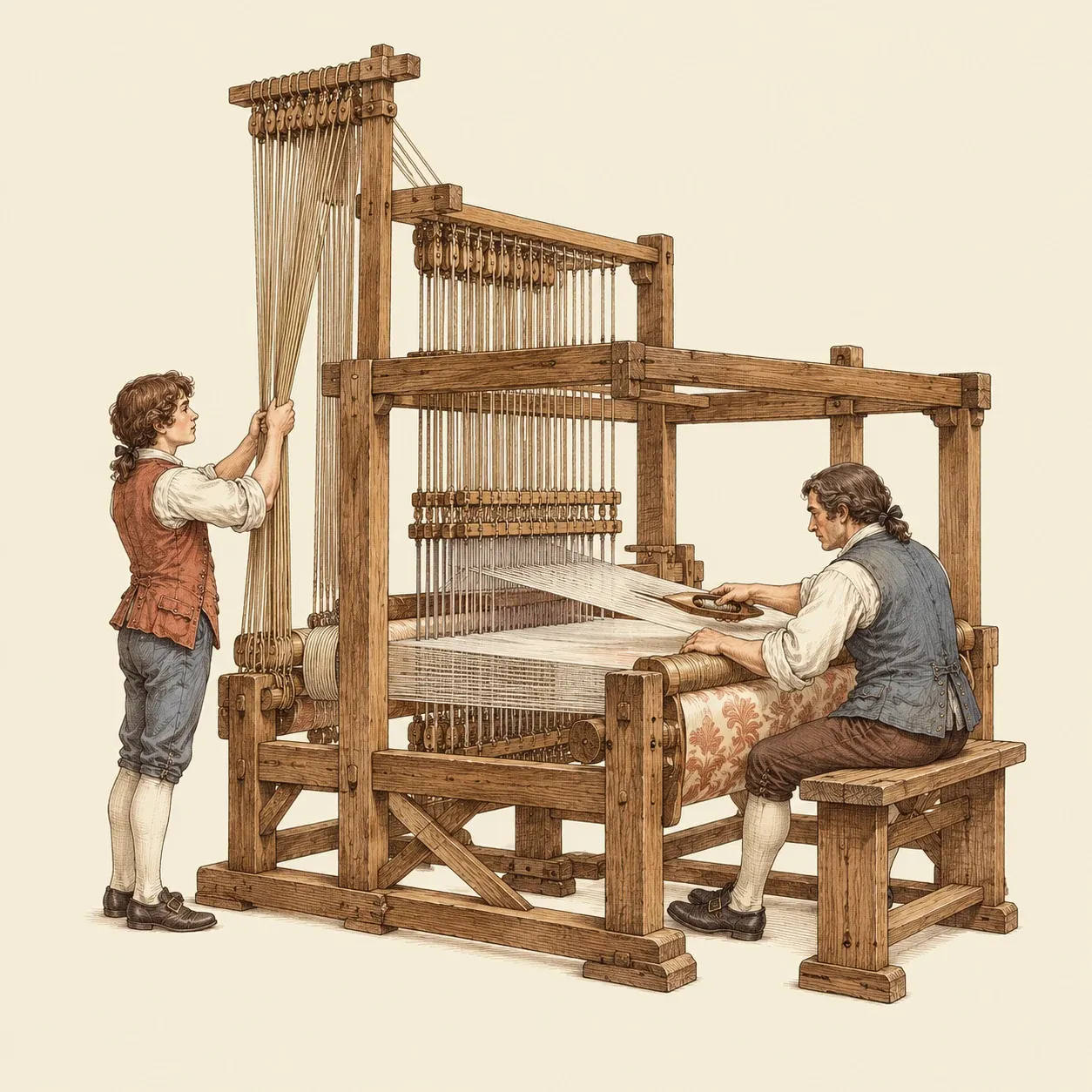 On the draw loom, a drawboy pulled the bundle of cords chosen for each pass while the weaver threw the shuttle.
In the draw loom, used for figured silks in China and later in Europe, each warp thread hung from a cord, and the cords for each pass of the weft were tied into bundles in advance. A drawboy stood or sat at the side of the loom and pulled the bundles in order while the weaver threw the shuttle. In Lyon, which became the centre of French silk weaving, Claude Dangon’s large draw loom of 1606 and a lever arrangement by Garon of 1717 eased the work, but the drawboy remained. The bundles could be so heavy that up to three people were needed to pull them.
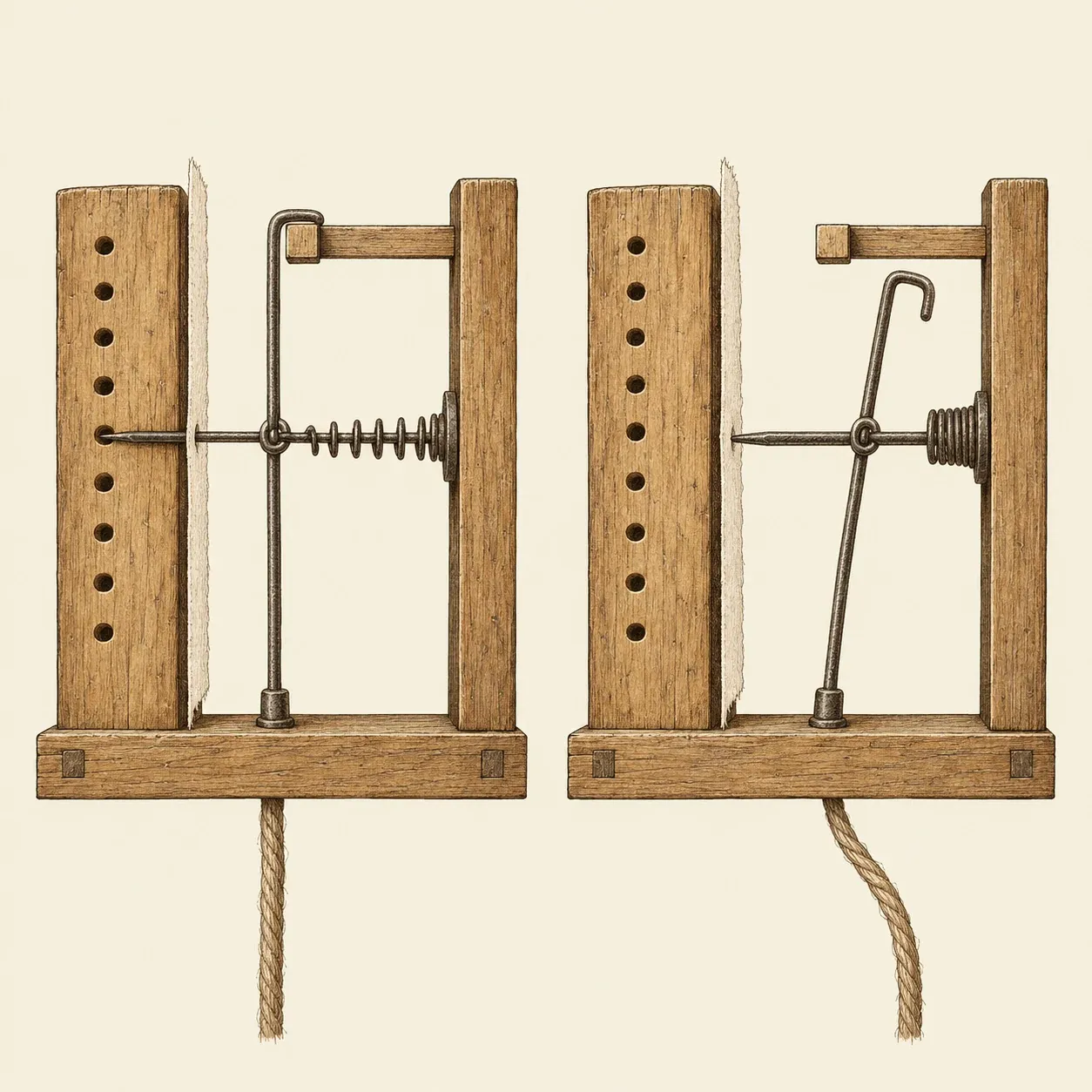 Bouchon’s needles read a band of punched paper; each needle governs one hook and one cord.
In 1725 Basile Bouchon, in Lyon, tied the cords of the loom to hooks controlled by needles that read a band of punched paper. In 1728 Falcon replaced the band with punched cards laced into a chain, which could be changed without rebuilding the loom, though a helper still had to present each card. Jacques Vaucanson, appointed inspector of silk manufacture in 1741, built in 1746 a loom worked entirely by a crank, with cams for the shuttle and the beater and a cylinder carrying the programme. It remained a prototype and is now in the Musée des arts et métiers in Paris.
Joseph-Marie Jacquard, born in Lyon in 1752, won a bronze medal at the Paris exhibition of 1801 and in December of that year a patent for a machine to replace the drawboy. In January 1803 he was sent to the Conservatoire, where he reassembled Vaucanson’s loom. His card machine was finished in 1804, and on 2 February of that year the Society for the Encouragement of National Industry gave him a gold medal. The Musée des arts et métiers dates his idea to 1801 and describes it as Vaucanson’s driven cylinder combined with Bouchon’s paper and Falcon’s cards. On 15 April 1805, at Lyon, Napoleon granted him a bonus of 50 francs for every loom delivered and set to work over six years, and in 1806 a decree confirmed a yearly pension of 3,000 francs voted by the city. According to the Fondation Napoléon, Lyon weavers who feared for their work attacked him.
Jean-Antoine Breton was the first to improve the machine, with a better transmission from the cards to the needles that reduced faulty cloth, and his nephew Berly built machines in 1818 to prepare the cards. New trades appeared, such as the reader who turned the painted design into a set of cards. The machine spread through Europe for silks and patterned shawls, and by 1909 an American textbook described machines with between 100 and 2,600 hooks.
Punched cards also found a use outside weaving. Charles Babbage, who conceived his Analytical Engine in 1834, planned to control it with punched cards on the Jacquard principle. In 1843 Ada Lovelace wrote that the engine “weaves algebraical patterns just as the Jacquard-loom weaves flowers and leaves”. Cards later carried data and programs for tabulators and early computers.