Paper guillotine
Cutting a whole stack of sheets in one stroke
Contents
- 1Straight steel knife in its beam
- 2Clamp pressing the stack
- 3Screw and hand wheel of the clamp
- 4Back gauge
- 5Cutting stick set in the table
- 6Lever that brings down the knife
A paper guillotine cuts through a whole stack of paper or card in one stroke. The stack is squared against a back gauge and squeezed by a clamp, and a long straight knife comes down between guides just in front of the clamp. The oldest surviving dated example is a crank-driven paper trimmer patented in the United States in 1834, the year of a New York binding on which the conservator Jeff Peachey has found guillotine marks; the American Bookbinders Museum places the introduction of the guillotine in the 1820s. Guillaume Massiquot, whose name the French massicot carries, patented his machines in 1844 and 1852.
What it is
A paper guillotine, or massicot, is a machine that cuts a pile of sheets in one stroke, cleanly and square. Printers use it to cut large sheets down to size and to trim printed work, and bookbinders use it to trim the edges of books so that all the leaves line up. It does not print: it works on paper that is already printed, or on blank stock before printing.
Its main parts are few. The stack lies on a flat table and is pushed against a movable back gauge, which sets the width of the cut. A heavy beam, the clamp, comes down on the front of the stack and holds it tight. A long straight knife of hardened steel, fixed in its own beam, then descends between vertical guides just in front of the clamp, cuts through the stack and stops in a cutting stick, a strip of hardwood set in a slot in the table. On hand machines a screw and a wheel bring down the clamp and a lever or a flywheel drives the knife; larger machines are driven by a motor.
How it works
Paper slides easily. If a knife were pushed into a loose stack, the top sheets would shift and the cut would come out ragged and slanting. The clamp prevents this by pressing the stack so hard that it behaves almost like a solid block, and the back gauge keeps the stack square to the knife, so that each sheet is cut along the same line.
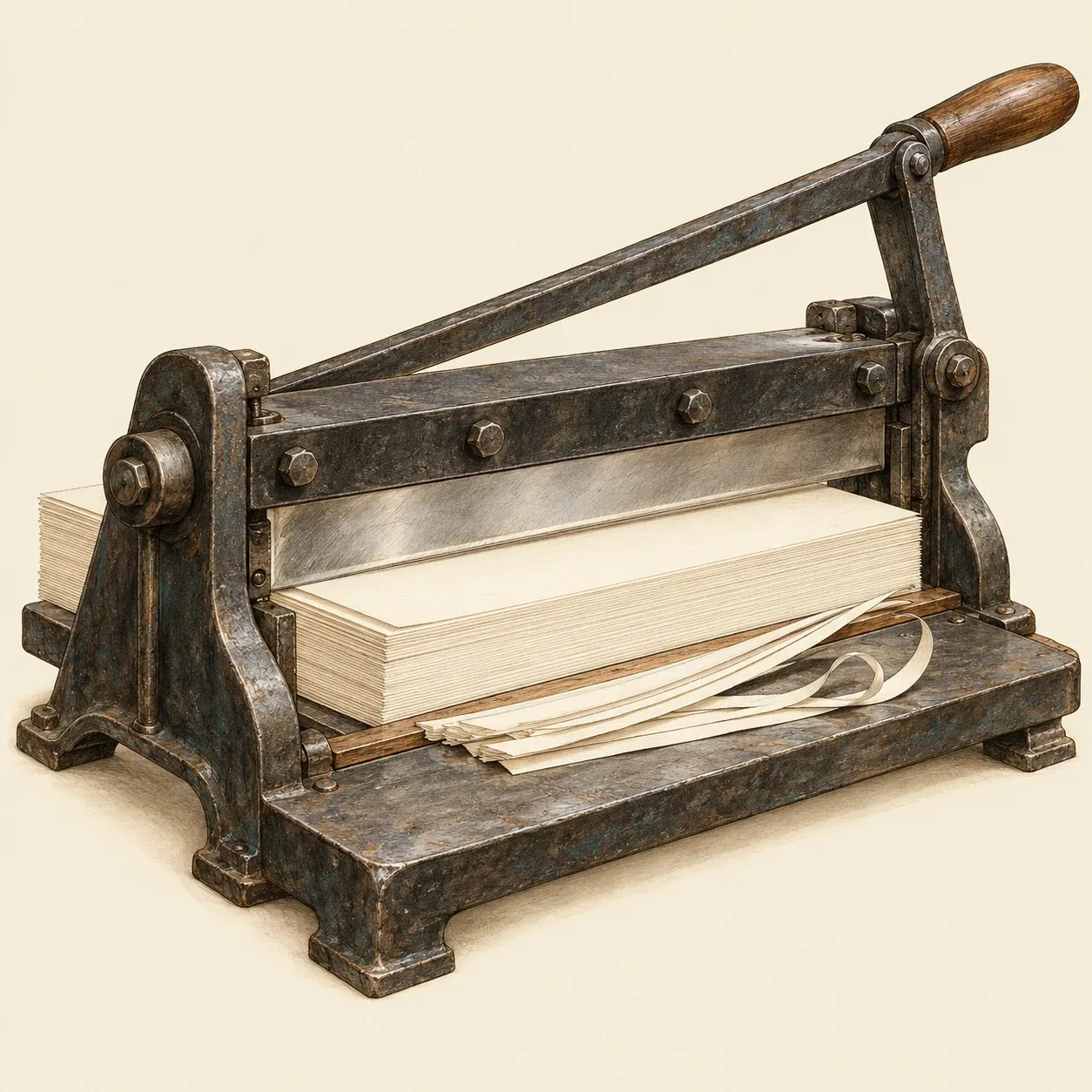 The knife cuts just in front of the clamp and ends its stroke in the cutting stick.
Many guillotines do not bring the knife straight down. Its beam is pulled down and sideways at the same time, so that the edge slices through the stack at a slant, as scissors do. At the end of each stroke the edge enters the cutting stick, which saves it from striking the table. A square stick can be turned so that each of its four faces is used in turn, and the knife is taken out from time to time to be ground. On some old books the guillotine has left faint curved marks on the cut edge of the leaves, because the clamp squeezed the book hard while the knife went through.
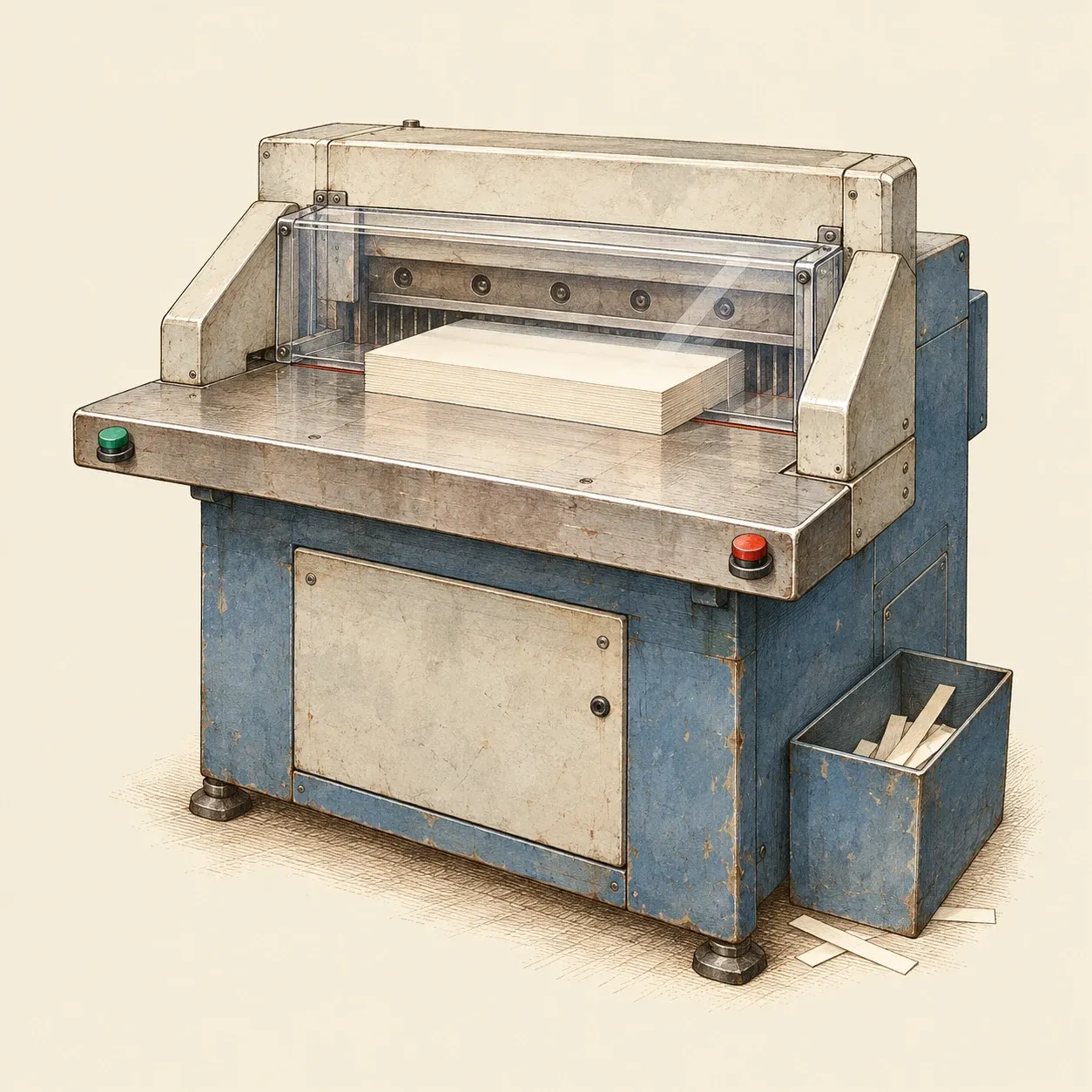 In single-stroke cutting, both hands must be on the controls before the knife can move.
Modern machines measure the cut electronically and can move the back gauge automatically between cuts; in fully automatic mode, a single press of the cut controls starts a programmed series of cuts. Their safety devices follow from the danger of the knife. In single-stroke cutting the operator must use both hands, on two controls set apart, to start each cut, and the knife comes to rest at the top of its stroke, so that it does not cut again by itself. A light curtain or a guard in front of the knife stops it if a hand comes near, and a single control is allowed only in exceptional cases, behind interlocked guards that enclose the knife.
The knife of a guillotine can cut through a hand as easily as through paper. It is to be used only by trained staff, on a certified machine with its guards and two-hand controls working. Never reach under the clamp or the knife, and never remove, adjust or sharpen the knife yourself: that is work for a specialist with the proper tools.
History and evolution
For centuries, stacks of paper were cut by hand. In a primer on paper-cutting machines published in 1918 by the United Typothetae of America, Niel Gray describes the operator laying a weight on a small pile and leaning on it with one hand while cutting with a knife in the other. A first improvement held the pile in a screw clamp on a table and guided the knife in a groove.
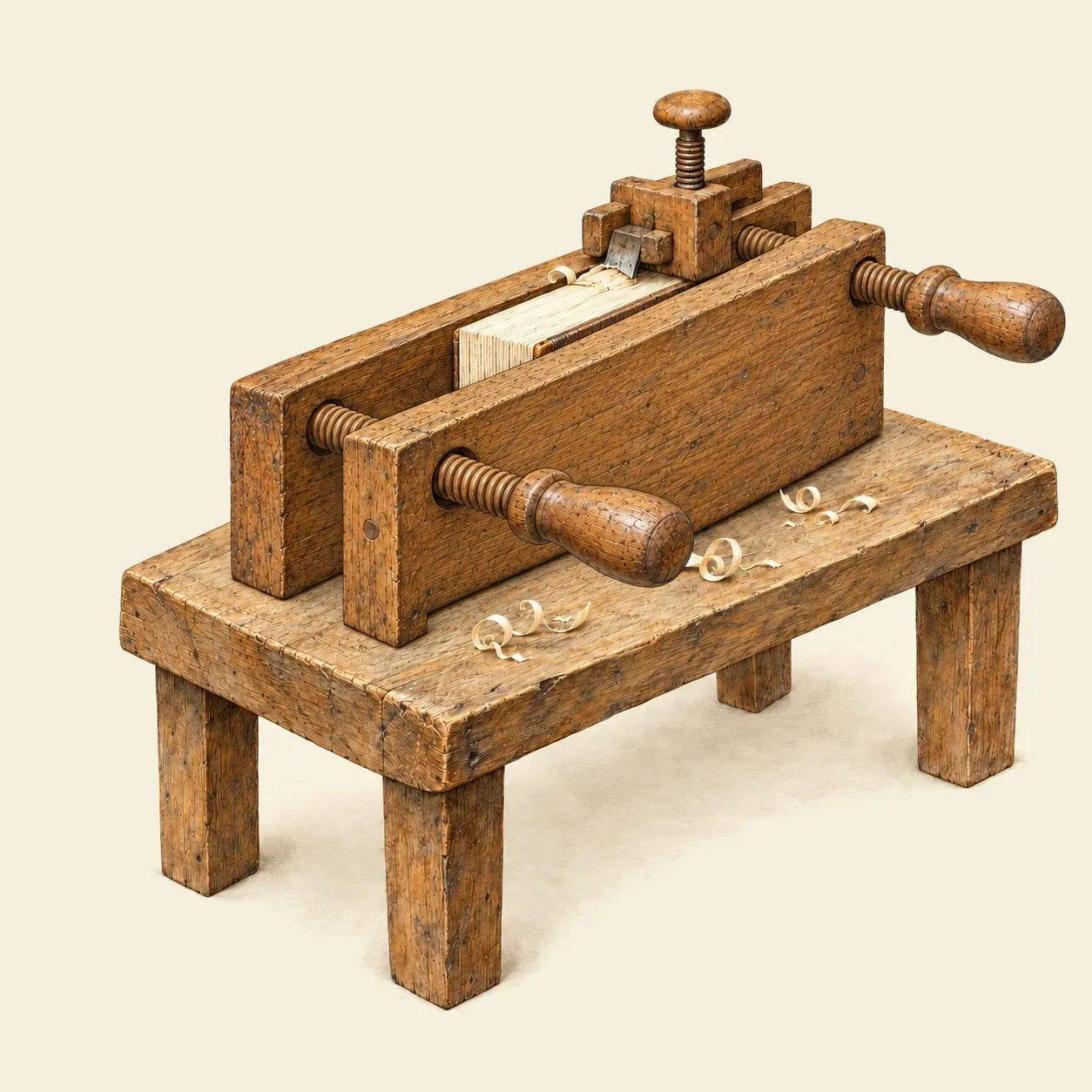 With the plough, the binder shaved the edge of the book a little deeper at each pass.
Bookbinders trimmed the edges of books with the plough and press. The book was clamped between the cheeks of a wooden press, and a blade held in a sliding frame, the plough, was pushed to and fro along the press, shaving the edges a little deeper at each pass until the leaves were even. Gray calls it probably the first successful machine for cutting many sheets at once.
The American Bookbinders Museum places the introduction of the guillotine, whose knife comes down through the whole stack, in the 1820s. In the dictionary of bookbinding terms by Matt Roberts and Don Etherington, guillotines came into use in the late 1830s, with a model by Thirault in 1837. The oldest surviving dated example is a patent model in the National Museum of American History: a paper-trimming machine patented by J. Ames on 28 February 1834, which the museum’s catalogue describes as a crank-driven guillotine paper cutter. The fire of 1836 at the United States Patent Office destroyed the records of that patent. The book conservator Jeff Peachey has found clear guillotine marks on a cloth binding published by Harper in New York in 1834. In France, Guillaume Massiquot patented cutting machines in 1844 and 1852; one of them was driven by a hand flywheel and gears, and the French name for the machine, massicot, comes from his.
In the second half of the nineteenth century, makers such as Fomm and Krause in Germany, Furnival in England and Seybold in the United States improved the machine. Gray notes that the oldest German cutter shown at the Leipzig graphic arts exhibition of 1914 dated from 1855, and that by 1876 a crank was pulling the knife sideways as it came down, giving it the slicing stroke. Power drives, and later electric motors, took over from the lever and the wheel, and machines gained powered clamps, automatic spacing of the back gauge and two-hand controls.