Hand mincer and grater
A crank-driven screw that cuts food at a perforated plate
Contents
- 1Hopper
- 2Feed screw
- 3Crank
- 4Cross-shaped knife
- 5Perforated plate
- 6Ring nut
A hand mincer turns pieces of meat or other food into a fine, even mince: a screw driven by a crank pushes them forward against a perforated plate, where a cross-shaped knife turning with the screw cuts off whatever comes through the holes. The oldest dated description found is an American patent of 1845 for a sausage-meat machine with spiral wings and a revolving cutting plate; the same drive can turn a grating drum.
What it is
A hand mincer, or meat grinder, cuts meat, fish, vegetables or nuts into small pieces of even size. It is a cast-iron or steel body clamped to the edge of a table, with a hopper on top, a horizontal barrel, a crank at the back and a plate pierced with round holes at the front. The cook drops pieces of food into the hopper, turns the crank, and minced food comes out through the holes of the plate.
The same machine does more than one job. Plates with larger or smaller holes give coarse or fine mince. Some makers sold a perforated drum that fits on the end of the screw instead of the plate and grates potatoes or other vegetables as the crank turns it.
How it works
Inside the barrel lies a feed screw, a shaft with a continuous spiral thread, turned by the crank. Pieces that fall from the hopper are caught between the turns of the thread and carried forward, the way a screw conveyor moves grain, so the food is pressed harder and harder against the front of the barrel.
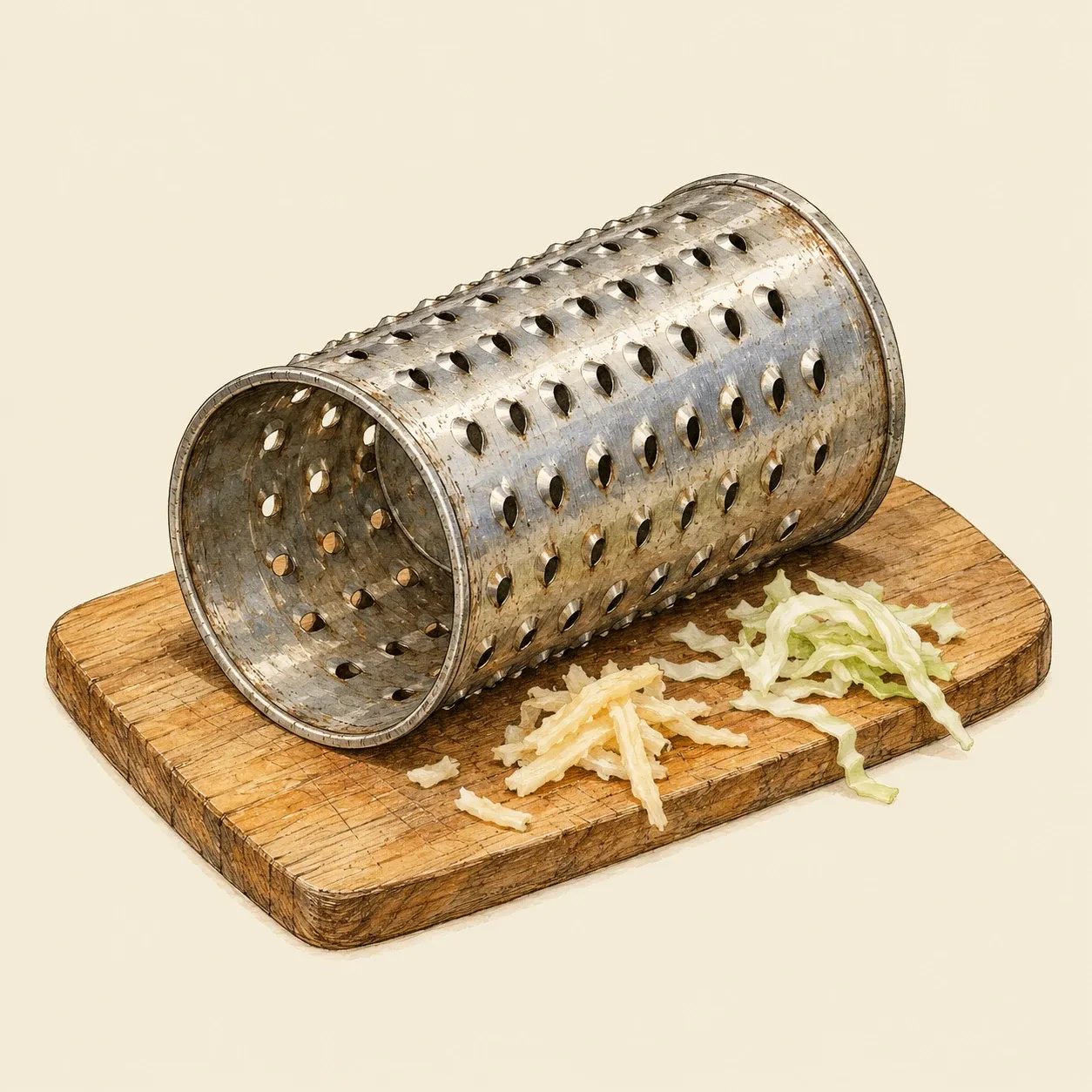 A grating drum takes the place of the plate on the same screw.
The square front end of the screw carries a knife with four blades in the shape of a cross. It turns with the screw and rubs against the back face of the perforated plate, which is held still by a lug in a notch of the barrel. A ring nut screwed onto the front of the barrel holds the plate tight against the knife. The food is forced into the holes, and each time a blade sweeps past a hole it shears off what has entered, like the two edges of a pair of scissors. The minced food is pushed out in strands by the food behind it.
The grating drum works on the same drive. It is a cylinder of thin sheet metal punched with sharp-edged holes and open at one end, turned by the screw. Food pressed against its surface is rubbed into shreds.
How to do it
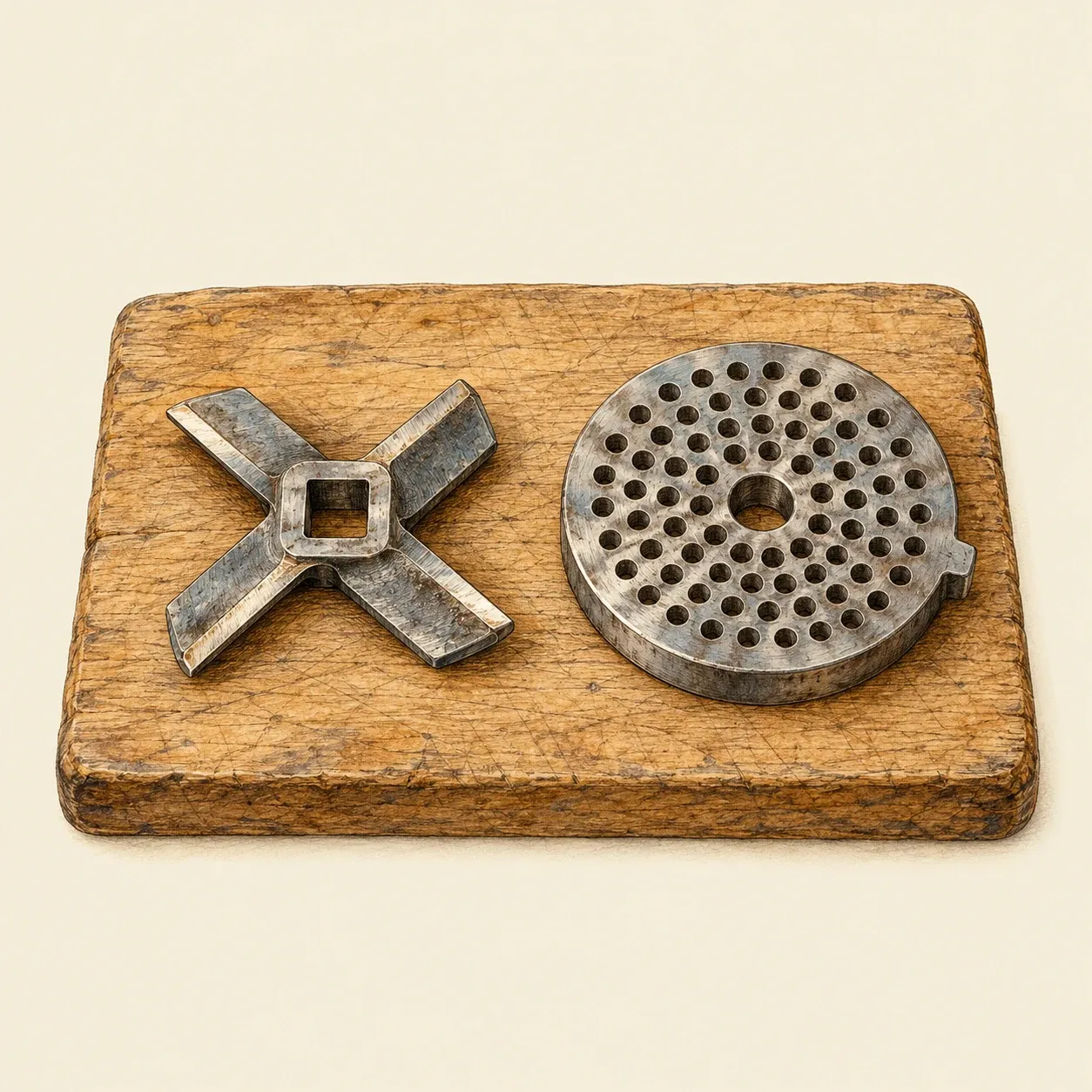 The knife fits on the square end of the screw and turns; the lug keeps the plate from turning.
A mincer is cast and machined in a factory, but putting one together, using it and cleaning it show how each part works. Clamp the body to a firm table edge. Slide the screw into the barrel, fit the knife on the square end with its flat cutting face against the plate, put the plate on with its lug in the notch and screw the ring nut on by hand until it is snug.
Cut the meat into strips small enough to drop into the hopper and remove large sinews. Keep the meat in the refrigerator until you mince it, and work quickly. Feed the hopper a little at a time and push the food down with a wooden pusher, never with the fingers, as the screw can draw them in. Stop turning before reaching into the hopper or opening the ring nut.
Mincing spreads any bacteria from the surface of the meat through the whole mince. Cook minced meat until it is steaming hot right through with no pink left, which the UK Food Standards Agency sets at 70 °C for two minutes or an equivalent. Take the mincer apart straight after use, wash every part in hot soapy water, brush out the holes of the plate, dry each part fully and oil the iron lightly with food-grade oil so it does not rust.
History and evolution
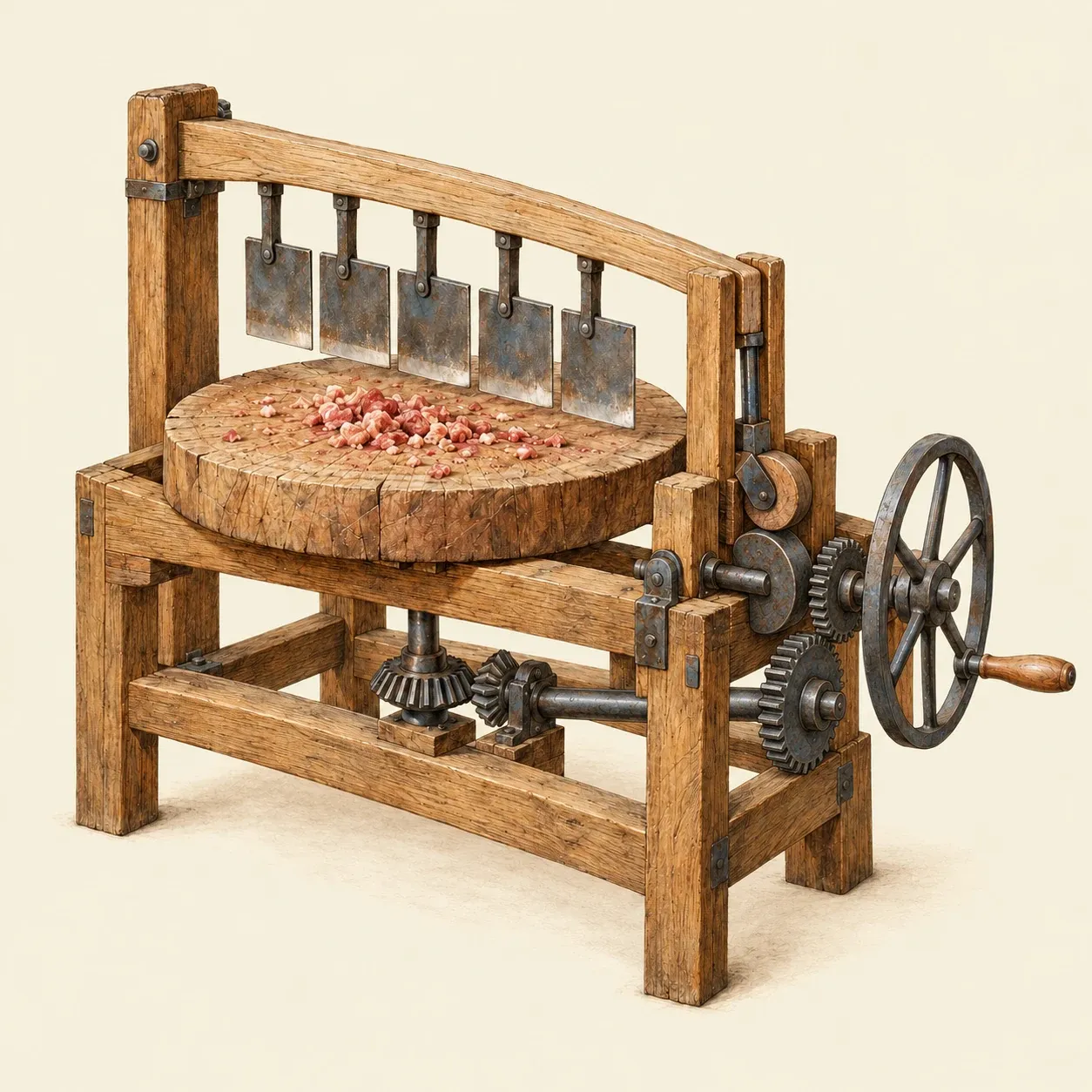 Before the screw mincer, some sausage machines chopped meat with knives that rose and fell over a turning block.
Several early mincing machines worked like a mechanical chopping knife. In 1849 Allen Burdick of Glens Falls, New York, patented a sausage machine in which a row of knives on a springy beam rose and fell over a turning block. The oldest dated description found of the principle used today is earlier: in February 1845, George Coffman of Middlebrook, Virginia, patented a machine for cutting sausage meat in which spiral wings at the end of a turning cylinder forced the meat out through a circle of openings, while a plate with bevelled cutting edges, turning with the cylinder, cut it finer as it passed.
Inventors also tried to drive several kitchen tools from one crank. In 1865 Henry Shepardson of Shelburne Falls, Massachusetts, patented a geared machine on a stand that took interchangeable fittings for cutting meat and for grating, slicing and mashing fruit, spices or vegetables. By the end of the century the table mincer with a feed screw, a perforated plate and a turning knife was a factory product: the Enterprise Manufacturing Company of Philadelphia patented improvements to it, and in Germany the Alexanderwerk of Remscheid, founded in 1885, built mincers under a licence its founder had obtained after seeing the machine in the United States. The Western Australian Museum holds a cast-iron mincer of this kind with a perforated potato-grating drum among its fittings, marked with a German patent. Electric mincers later kept the same screw, knife and plate.