Sundial
Telling time with a shadow
Plate
- 1Style (the shadow-casting edge)
- 2Dial plate
- 3Noon line
- 4Shadow
- 5Angle equal to the latitude
- 6Celestial pole
Anatomy
Loading the figure…
A sundial tells the time from the shadow that the Sun casts on a marked surface. The oldest surviving examples come from Egypt in the fifteenth century BCE, and until mechanical clocks spread in the late Middle Ages it was the main way to divide the day.
What it is
A sundial is an instrument that shows the time of day by the position of a shadow. A rod or blade, the gnomon, stands over a surface marked with lines, and its shadow sweeps across them as the Sun crosses the sky.
The plate shows a horizontal garden dial drawn for latitude 45°, seen from above, with its gnomon seen from the side. The sloping edge of the gnomon, the style, points at the celestial pole, which keeps the hours equal all year round.
How it works
The Earth turns once a day about an axis that points, in the northern hemisphere, close to the Pole Star. Seen from the ground, the Sun turns about that same axis at a steady 15° per hour. A style set parallel to the axis therefore sits at the centre of the Sun’s daily circle, and the plane through the style and the Sun turns at that same steady rate whatever the season. In practice the style is tilted toward the north (toward the south in the southern hemisphere) at an angle equal to the latitude: about 48.9° in Paris, 41.9° in Rome.
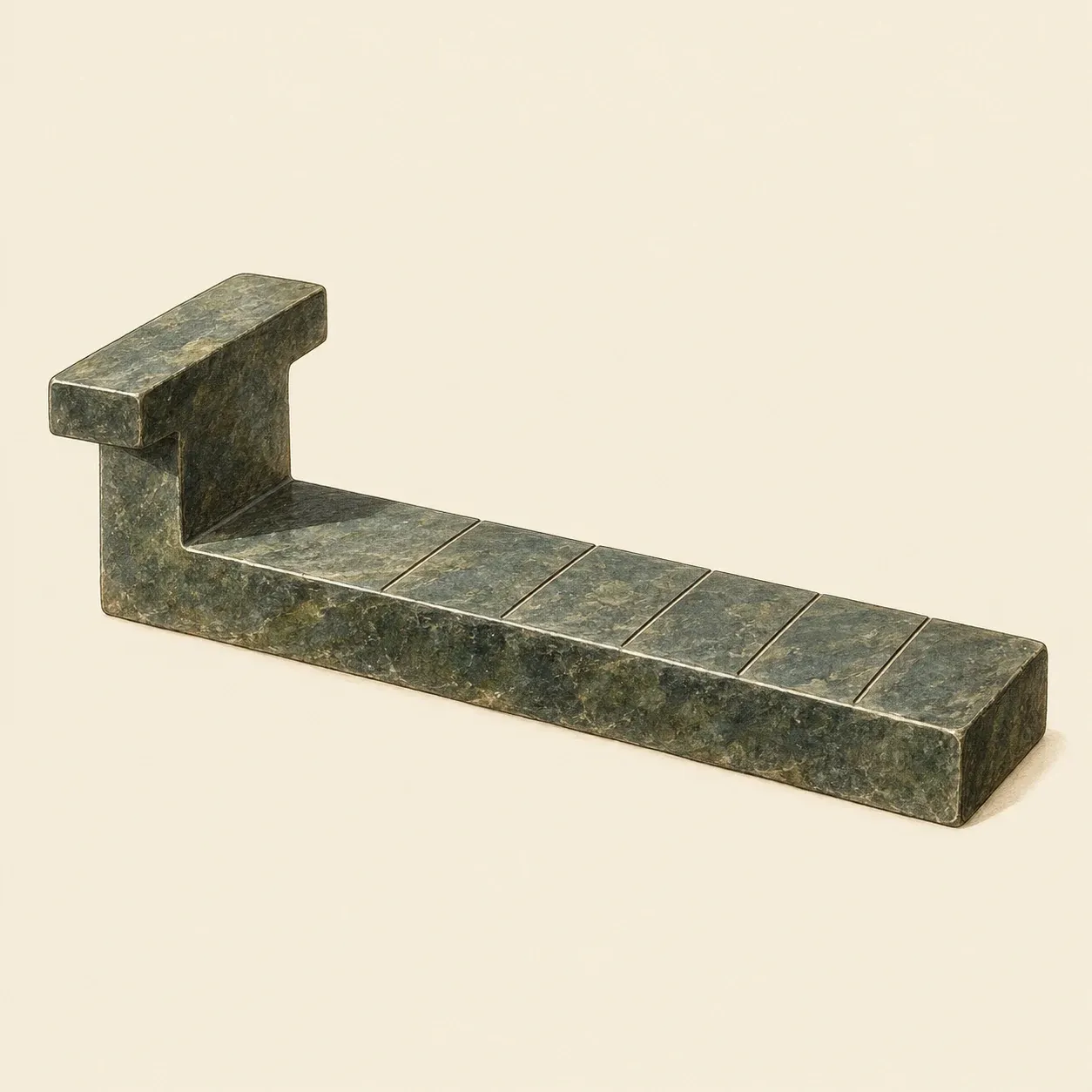 An Egyptian shadow clock: the crossbar faced east in the morning and was turned round at noon.
On a horizontal dial that turning plane meets a flat plate, so the shadow sweeps unevenly and the hour lines are not evenly spaced. The angle between the noon line and the line for each hour follows a simple rule: its tangent equals the sine of the latitude times the tangent of 15° per hour from noon. At 45°, the lines for one to six hours after noon lie at about 11°, 22°, 35°, 51°, 69° and 90°. They crowd together near noon and spread out toward six o’clock, which lies at right angles to the noon line.
A sundial shows local solar time, not the time on a watch. Clock time follows the central meridian of the time zone, so a dial reads 4 minutes slow for every degree of longitude west of it, and 4 minutes fast for every degree east. Because the Earth’s orbit is an ellipse and its axis is tilted, the Sun also runs up to about 16 minutes fast or slow over the year: this is the equation of time, often engraved in a small table beside the dial. Summer time adds one more hour.
How to build it
A horizontal dial needs a flat plate of slate, stone, hardwood or metal about 30 cm across, a thin triangle of brass or aluminium for the gnomon, a protractor, a ruler, a spirit level and a calculator. These steps are for the northern hemisphere. South of the equator, put the dial centre near the northern edge and make the style rise toward the south.
Draw the hour lines. Read your latitude from a map to the nearest tenth of a degree. Mark the dial centre near the southern edge of the plate and draw the noon line from it to the far edge. For each hour from noon, compute the angle from the rule above and draw the line on both sides of the noon line: the morning hours lie to the west, the afternoon hours to the east. Draw the six o’clock lines straight across at 90°, where the rule breaks down; this simple dial covers the hours from six to six.
Cut the gnomon. Make a right triangle whose sharp angle equals your latitude. Fix it upright along the noon line with the sharp corner on the dial centre, so the sloping edge rises toward the north. If the blade is thicker than a couple of millimetres, open the dial along the noon line by that thickness: the morning lines start from one face and the afternoon lines from the other.
Find true north. A compass points to magnetic north, which can be several degrees off. On a sunny day, plant a vertical stick on level ground, mark the tip of its shadow in mid-morning and draw a circle through that mark around the foot of the stick. In the afternoon, mark the point where the shadow tip touches the circle again. The line between the two marks runs east and west, the morning mark lying to the west. Standing on the morning mark and facing the afternoon one, north is on your left. The result is approximate, because the Sun’s path shifts a little during the day; it is best near the solstices.
Set it up. Place the dial on a level support, with the noon line on the north-south line and the gnomon rising toward the north.
Safety. Never look at the Sun directly, even for a moment, and never through binoculars or a lens: it damages the eyes without pain. File the edges of a metal gnomon smooth, and set the dial where nobody can fall onto its blade.
History and evolution
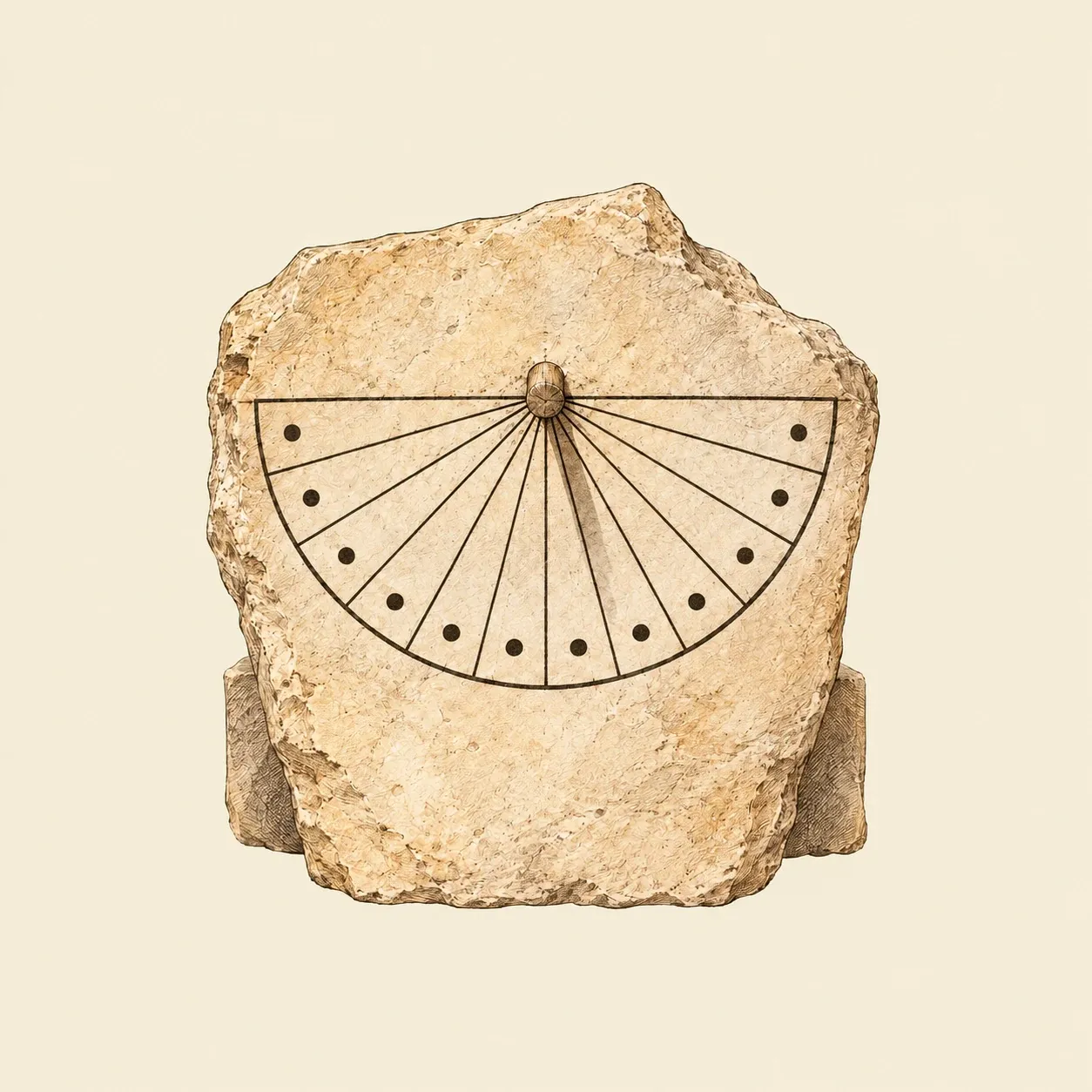 A dial painted on a limestone flake, found in 2013 in the Valley of the Kings and dated to the thirteenth century BCE.
The oldest surviving sundials are Egyptian shadow clocks from the reign of Thutmose III (about 1479 to 1425 BCE). They are L-shaped bars of stone: the raised crossbar at one end faced east in the morning, its shadow fell on marks along the bar, and at noon the instrument was turned to face west. In 2013 a team from the University of Basel found another kind of dial on the floor of a workman’s hut in the Valley of the Kings: a flat piece of limestone painted with a black half circle in twelve sectors, with a hole at the centre for a peg.
Greek tradition credits Anaximander of Miletus, around 560 BCE, with bringing the gnomon to Greece from Babylonian practice. Greek and Roman makers carved hemispherical dials, bowls of stone whose hour lines divided daylight into twelve parts. Those hours were unequal: a summer hour was longer than a winter one. Pliny the Elder reports two dates for the first public sundial in Rome, 293 BCE and 263 BCE. The second was taken from Catania in Sicily during the First Punic War. It had been laid out for Sicily, so it read slightly wrong in Rome, yet it served for 99 years, until a more accurate dial was set up beside it in 164 BCE.
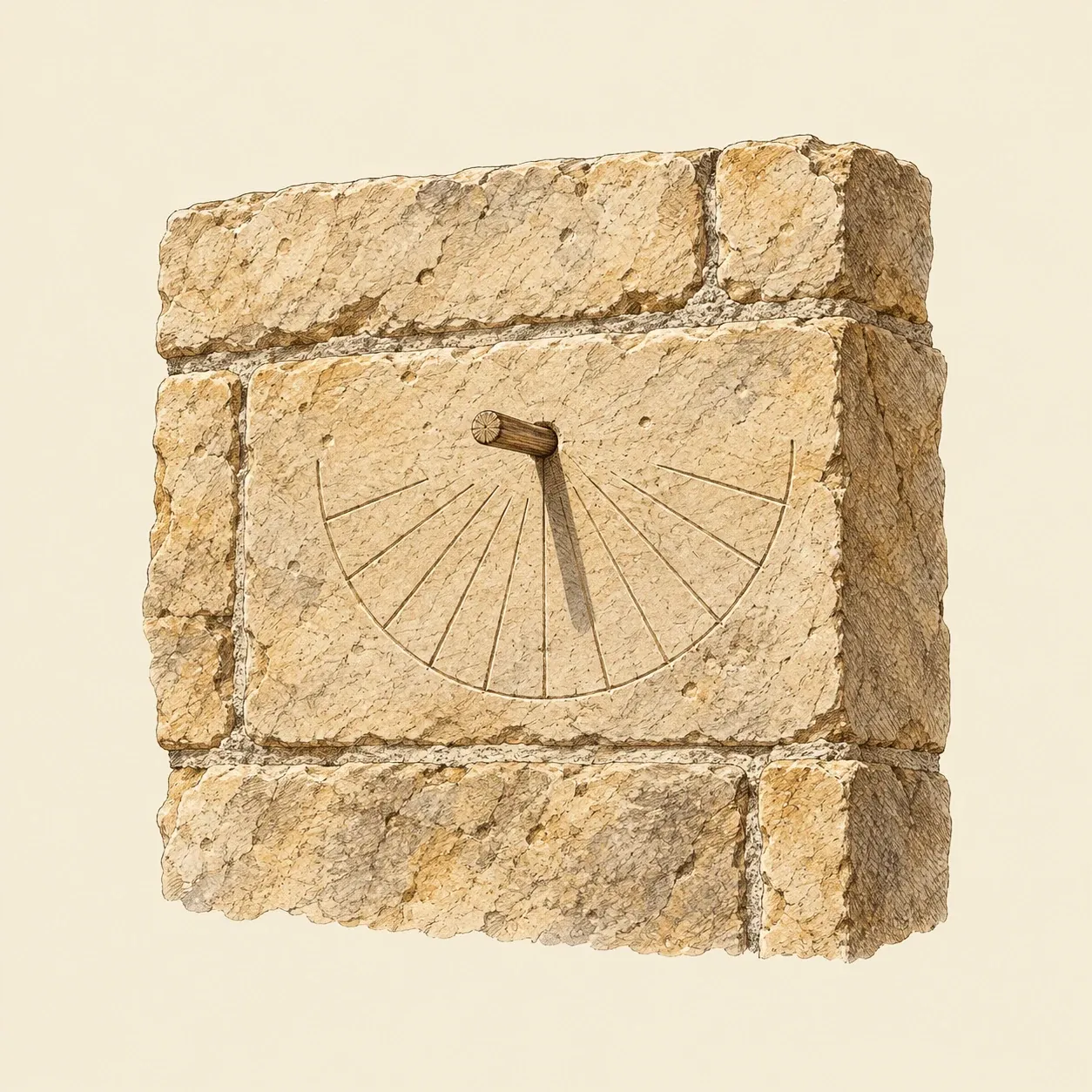 A scratch dial: a peg in the central hole cast its shadow on the lines below.
In the eighth century the English monk Bede encouraged dials that marked the hours of prayer, and many medieval churches had a simple scratch dial cut into a stone of their south wall. A style parallel to the Earth’s axis gives equal hours throughout the year. The astronomer Ibn al-Shatir built such a dial in 1371 for the Umayyad Mosque in Damascus, and European dials used the idea from at least 1446. Mechanical clocks spread across Europe from the fourteenth century, but for centuries they kept poor time and were checked and set against sundials.