Steam bath
Sweating in a room of hot stones and steam
Contents
- 1Heap of stones on the firebox
- 2Smoke vent high in the wall
- 3High bench near the ceiling
- 4Lower bench
- 5Wooden bucket and ladle
- 6Low door
A steam bath is a small closed room heated until the people inside sweat, usually by stones warmed in a fire, with water thrown on the stones to raise bursts of steam. The Finnish sauna, the Russian banya, the Mesoamerican temazcal and the sweat lodge of the Plains are all forms of it. One of the earliest known is at Puerto Escondido in Honduras, from about 1100–900 BCE; the earliest in the Maya lowlands is at Cuello in Belize.
What it is
A steam bath is a room built to be very hot. People sit inside until they sweat, then cool off outside or with cold water and go back in. The heat usually comes from stones heated by a fire, and water poured or thrown on the stones fills the room with steam for a moment. Some baths are mostly dry heat, others are kept wet.
Many peoples have built one. The Finnish sauna is a wooden room with benches set high near the ceiling, and its oldest form, the smoke sauna, has no chimney at all. The Russian banya is a wooden bathhouse of the same family. The Maya called their sweat bath pib na and the Aztecs temazcalli, which gave the word temazcal; these were small masonry chambers heated from a firebox. Peoples of the Great Plains build a sweat lodge, a low dome of bent saplings covered tightly, into which stones heated in an outside fire are carried. These baths served for washing, for care of the body, and for ceremony.
How it works
Stones are the store of heat. They take a long time to warm and give their heat back slowly, so a heap of stones heated for hours keeps a small room hot long after the fire has died. In a smoke sauna the fire burns under the stones through the day and is then put out. The smoke is let out through vents in the walls before anyone goes in, and the stones go on heating the room for hours while people bathe.
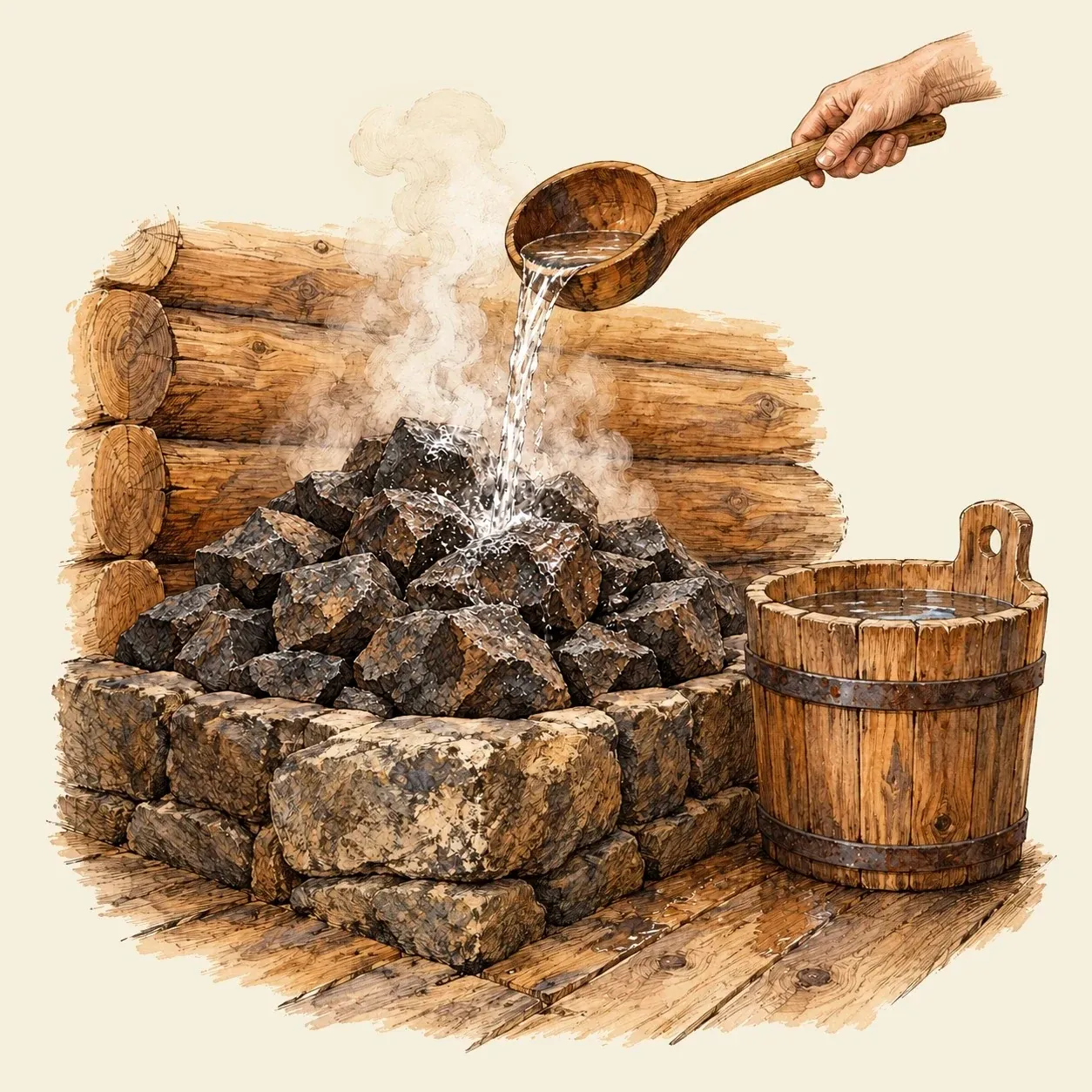 Water thrown on the hot stones turns at once to steam and sends a wave of heat through the room.
Hot air rises. A bench placed high near the ceiling is the hottest seat, the floor is cooler, and a lower bench lets a bather choose a gentler heat. In a Finnish sauna, Jari Laukkanen and his colleagues give 80 to 100 °C at the level of the bather’s head and a relative humidity of 10 to 20%. Bathers usually stay 5 to 20 minutes at a time, and the heart rate can rise to 120 to 150 beats a minute.
Throwing water on the stones raises the temperature and the humidity for a short time. The Finns call this burst of steam löyly. The body loses heat by sweating, but sweat cools the skin only as it evaporates, and in moist air it evaporates less, so a ladle of water makes the room feel much hotter at once. When Mark Child rebuilt the firebox of a royal sweat bath at Piedras Negras in Guatemala and poured water on hot stones, the heat became almost unbearable within minutes. A low door and a small chamber keep that heat in.
How to do it
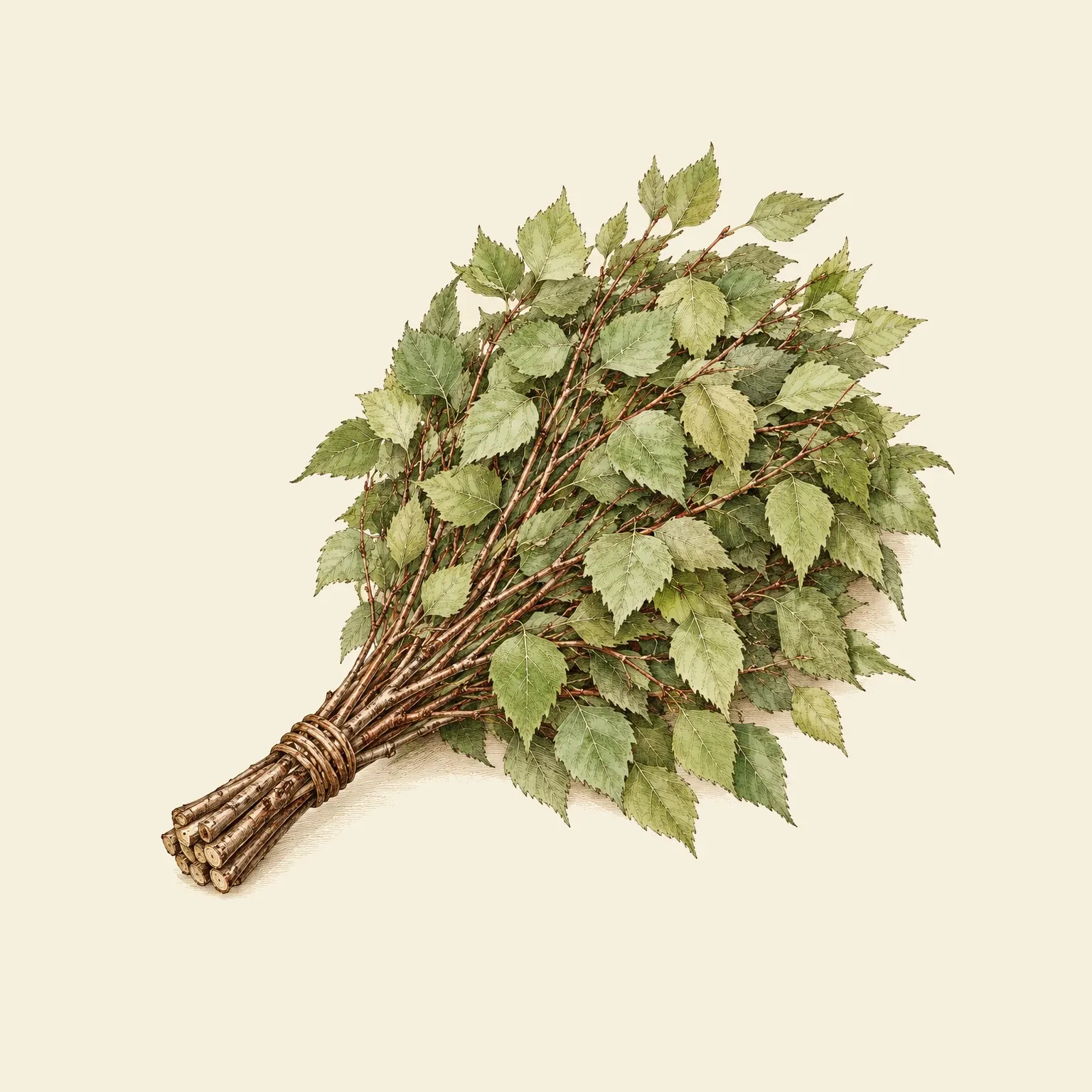 Bathers beat their skin with whisks of leafy birch twigs.
In the Finnish tradition a smoke sauna was a small log room with a low door. Inside, a large heap of rounded stones was built over a hearth of dry stone, and a wide plank platform was set high along the opposite wall, with a step or a lower bench in front of it. A fire burned in the hearth through the day until the stones were very hot. It was then put out, and the smoke was let out through vents in the walls before the bath began. The bathers sat on the platform until they sweated, threw ladles of water on the stones for steam, beat their skin with whisks of birch twigs, and went outside to cool off in the air, in cold water or in snow.
A sauna for regular use today is built around a stove designed for saunas, wood-fired with a chimney or electric, installed as its maker specifies and according to local building and fire regulations, with an electrician for an electric heater. A smoke sauna is a specialist building and is best left to builders who know the tradition.
Safety: the stones, the stove, the metal fittings and the steam all burn, so throw water gently, keep your face back from the rising steam and keep children away from the stove. Heat raises the heart rate and draws blood to the skin, which can cause fainting. Stay only a short time, leave at once if you feel dizzy or unwell, drink water between rounds and never bathe alone. Do not drink alcohol before or during a bath: in a study of sauna deaths in Finland from 1990 to 2002, half of those who died had been drinking, and the authors advise never to leave a drunk bather alone. People with unstable angina, a recent heart attack or severe narrowing of the aortic valve should not take a sauna, and anyone with a heart condition, pregnant women and parents of young children should ask a doctor first. A fire in a closed room produces carbon monoxide, a gas with no smell that can kill: never sit in a smoke sauna while the fire burns or while smoke remains, and fit a carbon monoxide alarm in any room with a wood stove.
History and evolution
Prehistoric heaps of fire-cracked stone, known as burnt mounds, are common in northern Europe, and many of them date from the Bronze Age. In 1987 Lawrence Barfield and Mike Hodder suggested that some were sweat baths, where stones heated in a fire made steam inside a tent or hut. Others read them as places for cooking or other work, and the question remains open. At the Links of Noltland on Westray, in Orkney, the team that excavated a Bronze Age building with a hearth, a water tank and a cluster of small cells proposed that it was a sweat house.
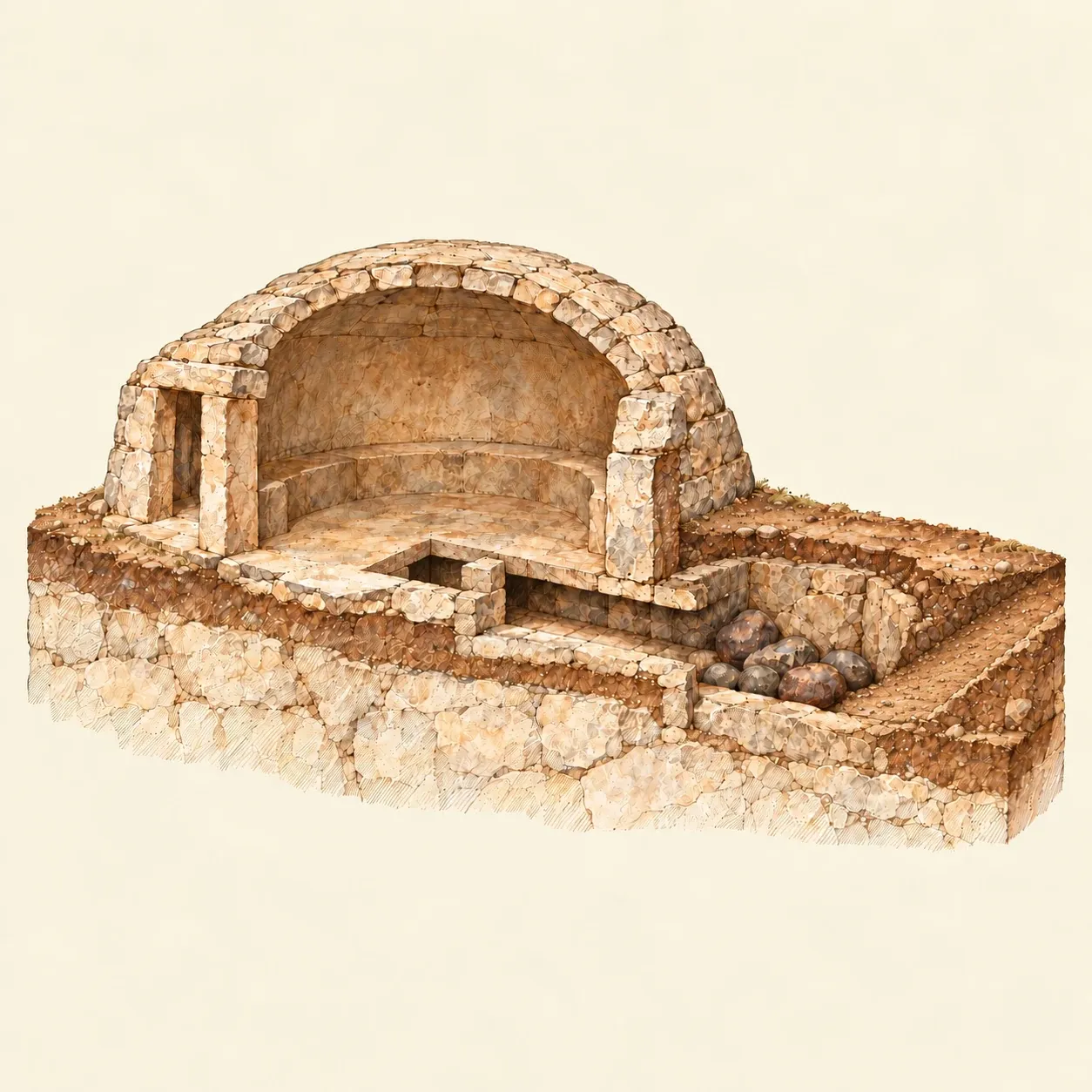 In a Maya sweat bath a firebox heated a small masonry chamber entered by a low door.
At Puerto Escondido, a village in Honduras, John Henderson and Kathryn Hudson describe a sweat bath of the Chotepe phase, about 1100–900 BCE, and Jarosław Źrałka and his colleagues, who excavated an early rock-cut sweat bath at Nakum in Guatemala, cite it with that date among the earliest in Mesoamerica. The earliest known sweat bath in the Maya lowlands is at Cuello, a village in northern Belize excavated by a team led by Norman Hammond. It was built among the houses of a domestic group. Hammond and Jeremy Bauer date it to about 900 BCE; Jessica MacLellan, comparing the first settled villages of the Maya lowlands, places its construction in the Bladen phase, about 800–600 BCE. Maya sweat baths of later centuries are known at other sites; at Piedras Negras, in the Classic period, one royal bath had a cistern above its steam room to collect rain for bathing.
In the fifth century BCE the Greek historian Herodotus described how the Scythians, after a funeral, set up three stakes leaning together, covered them with felt and threw red-hot stones into a basin inside. They then threw hemp seed on the stones, and the vapour, he wrote, was thicker than any steam bath in Greece; it took the place of washing for them. In the first century BCE the Roman architect Vitruvius described the laconicum, a domed sweating room next to the warm room of a bath, with a bronze disc hung on chains over an opening in the dome, raised or lowered to adjust the heat.
In northern Europe the Russian Primary Chronicle, compiled in the early twelfth century, tells a legend in which the apostle Andrew sees the Slavs heat wooden bathhouses until they are extremely hot, lash themselves with young branches and then drench themselves in cold water. Finnish emigrants took the smoke sauna to North America, where one built in 1868 at Cokato, Minnesota, still stands. Sauna culture in Finland was added to UNESCO’s list of intangible heritage in 2020, when the country had about 3.3 million saunas for 5.5 million people.