Submarine
A boat that sinks and rises at will
Contents
- 1Hull of riveted plates
- 2Hatch and small windows
- 3Treadwheels
- 4Propeller and rudder
- 5Ballast water in the bilge and hand pumps
- 6Sliding cast-iron trim weight
A submarine is a boat that can sink, travel under water and come back up when its crew chooses, by taking water into tanks to become heavier and driving it out to become lighter. Cornelis Drebbel tried the first one reported to have gone under water in the Thames from about 1620, a decked-over rowing boat made watertight with greased leather.
What it is
A submarine is a vessel that can dive below the surface, travel under water and return to the surface when its crew decides. A boat floats because it weighs less than the water it would displace if it were fully under. To dive, a submarine has to become as heavy as that water or slightly heavier, and to come up it has to become lighter again, without changing its shape. It does this by letting water into tanks and driving it out.
A submarine also needs a hull that stays watertight and does not collapse as the water around it presses harder with depth, a way to move and steer under water, and air for its crew. Early submarines were rowed or driven by hand and foot, carried only the air shut inside them and stayed down for a few hours at most. Later ones ran on engines and batteries, and a nuclear submarine makes its own air and can stay down far longer.
The Brandtaucher, built at Kiel in 1850 by Wilhelm Bauer with the engineering works of Schweffel & Howaldt, was an early submarine driven by people. Its hull of riveted plates, shaped like a fat seal, had small windows, a hatch on top and a propeller and rudder at the stern. Inside, two men walked in two treadwheels as tall as a man, which turned the propeller, while a third steered. To dive, water was let into the bottom of the hull, and hand pumps worked by levers emptied it again. A cast-iron weight that could slide fore and aft kept the boat level. Sources differ on the metal: sheet iron for most accounts, steel for the Deutsches Museum.
How it works
The weight of a submarine and the weight of the water it displaces decide whether it rises or sinks. On the surface, its ballast tanks are full of air. In many modern boats these tanks lie between the strong inner hull, which holds the crew, and a thinner outer hull. Each tank has vents at the top and openings at the bottom.
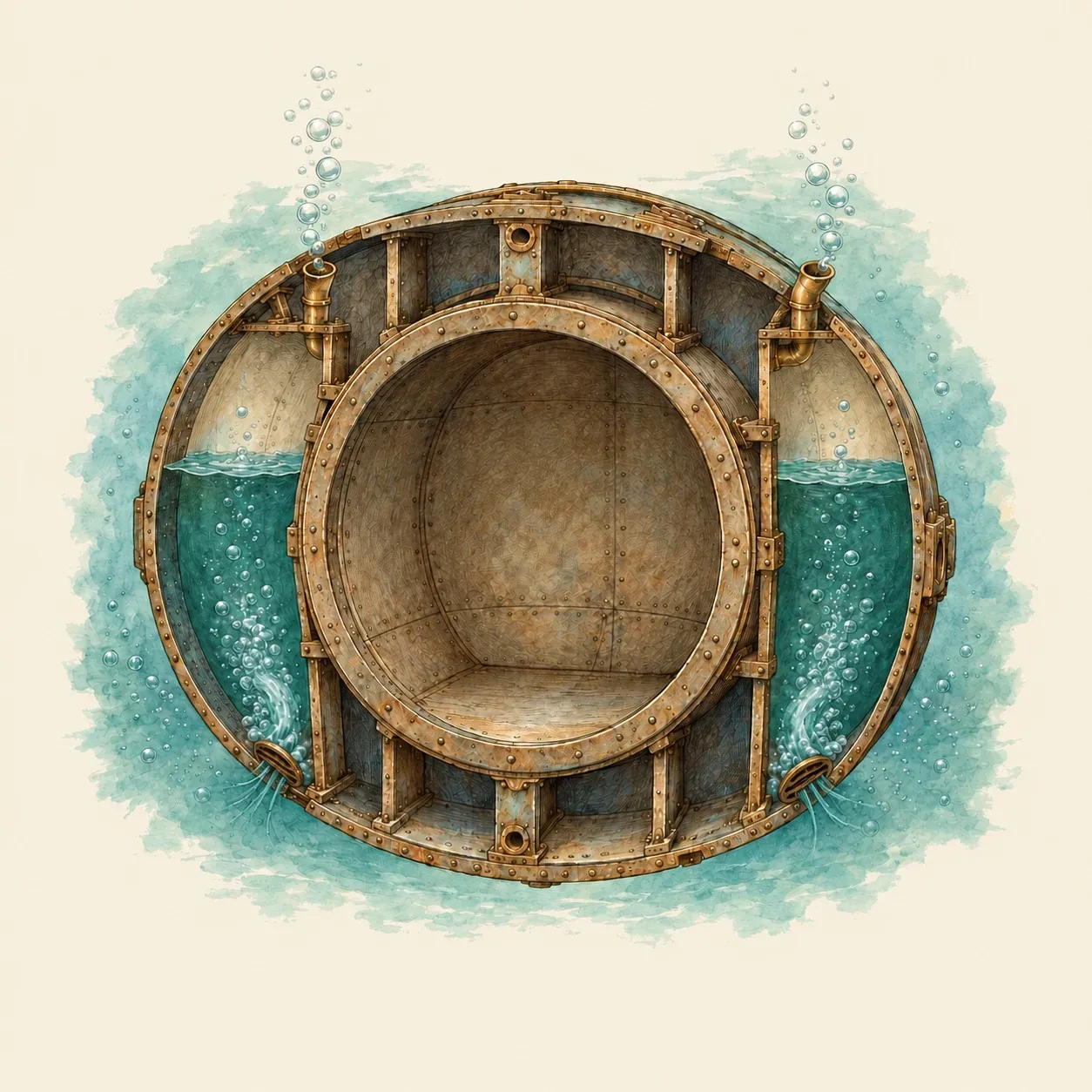 To dive, the vents at the top of the ballast tanks open: air escapes and the sea floods in from below.
To dive, the crew opens the vents. The air escapes upwards and water enters through the bottom openings, and the boat settles until it weighs about as much as the water it displaces. Smaller trim tanks at the bow and stern are then adjusted, by pumping water between them or overboard, to make it neither rise nor sink and to keep it level. The diving planes, short fins at the bow or on the conning tower and at the stern, tilt the boat up or down as it moves, a little as wings would. To surface, the vents are closed and compressed air, carried in strong bottles, is blown into the tanks. It drives the water out through the bottom openings and the boat rises.
The water presses harder the deeper the boat goes: about one more atmosphere for every 10 m of seawater. The inner hull has to resist that pressure on every square centimetre, and it is round in section because a cylinder or a sphere spreads the load evenly. Its thickness and material set the depth the boat can reach. Water left free to move inside a boat is a danger in its own right: it runs to the low end and makes the tilt worse. This is what happened on the Brandtaucher’s dive of 1 February 1851, when water came in, ran towards the stern and the trim weight slid with it.
An engine that draws its air from the atmosphere cannot run in a closed hull under water. Early boats used human muscle. From about 1900 most used a petrol engine, later a diesel, on the surface, which also charged batteries, and an electric motor under water. From the Second World War onward, a snorkel, an air intake and an exhaust tube raised above the waves, let a boat run its diesels while submerged at periscope depth. A nuclear reactor needs no air at all, and the crew’s air is then made on board.
How to do it
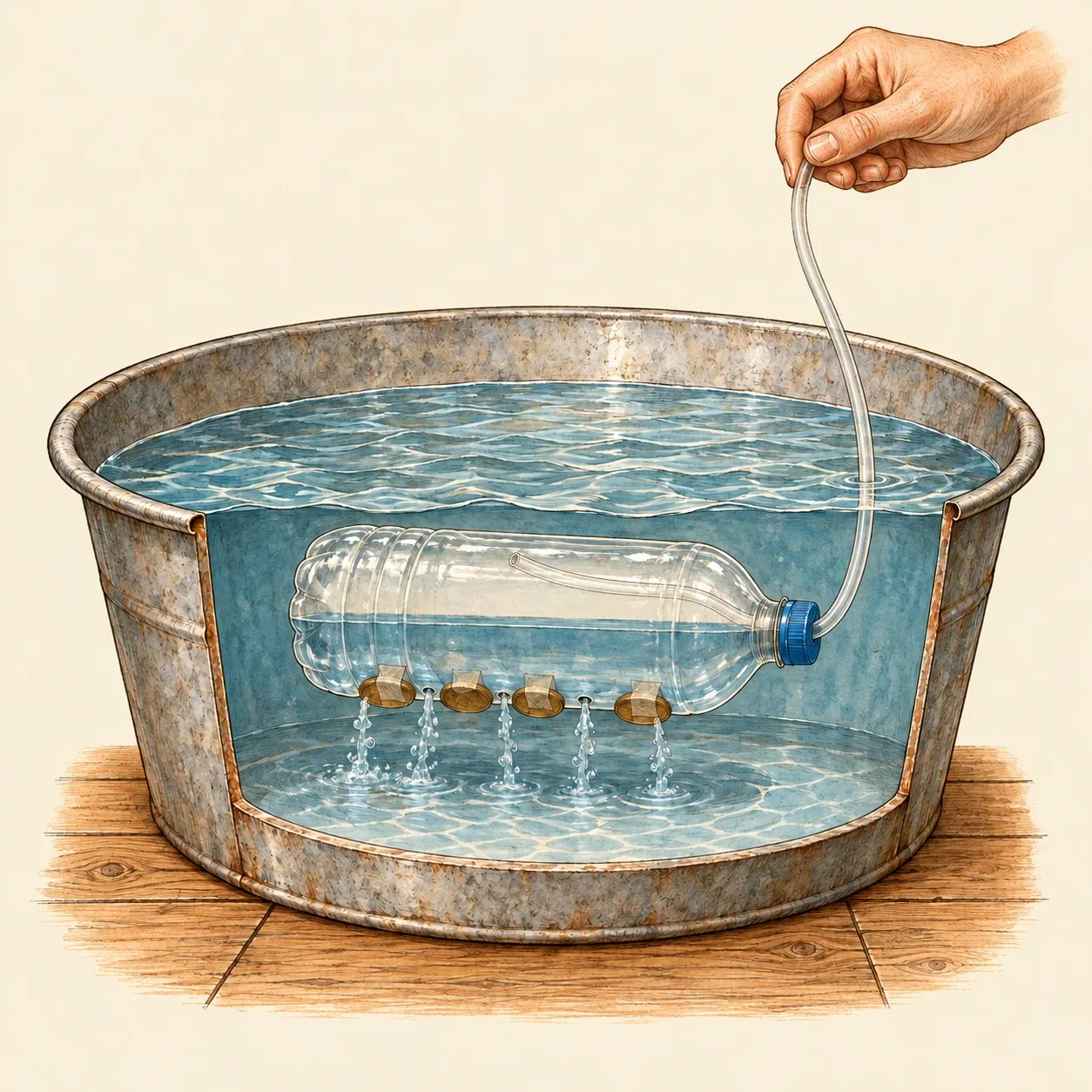 Blowing air into the tube pushes the water out through the holes underneath, and the model rises.
A plastic bottle makes a working model of a ballast tank. Take a clean plastic bottle with its cap, a few coins or flat washers, waterproof tape, modelling clay and a length of flexible plastic tube or a long drinking straw. Ask an adult to make a row of small holes along one side of the bottle with the point of a pair of scissors or a small hand drill. Tape the coins along the same side. That side becomes the underside: the weights keep it down and the holes let water in and out at the bottom.
Make a hole in the cap just large enough for the tube, push the tube through and seal round it with modelling clay. Push the tube in far enough that its inner end lies against the upper side of the bottle, where the air will collect. Screw the cap on.
Lay the bottle in a bathtub, a deep basin or a clear tank full of water with the holes down, and let water run in through the holes while air escapes through the tube. The bottle fills and sinks. Then blow gently into the tube. The air collects at the top, the water is pushed out through the holes below and the model rises. Let the air out of the tube again and it sinks. Add or remove coins until the empty bottle floats and the flooded one just sinks. Moving one coin towards the cap or the base makes the model tilt, as a trim weight does.
Safety: do this with water no deeper than a basin or bath, and keep young children supervised near any water. Leave the cutting of the plastic to an adult. Blow into the tube but never suck water through it. Keep electrical appliances away from the water. Never build anything to carry a person under water, and never shut anyone inside a closed container in or near water.
History and evolution
In 1578 the Englishman William Bourne described in a book of inventions a boat that would sink and rise by changing its own volume, with parts drawn in and out by screws and sealed with leather. He gave no drawing and it was never built. The Dutch inventor Cornelis Drebbel, who worked for James I in London, made the first boat reported to have gone under water. From about 1620 to 1624 he tried it in the Thames: a decked-over rowing boat made watertight with greased leather. Witnesses described it, but no drawing or note of Drebbel’s survives, and its exact construction is unknown.
In 1776, during the American War of Independence, Sergeant Ezra Lee took David Bushnell’s one-man Turtle into New York harbour. Its operator turned two propellers by hand or foot, let water into the bottom of the hull through a valve to dive and pumped it out to rise. His attempt on the British flagship HMS Eagle failed. On 1 February 1851, during a test dive in Kiel harbour, Wilhelm Bauer’s Brandtaucher sank stern first in 15 to 18 m of water, depending on the account. Bauer and his two companions, the carpenter Friedrich Witt and the smith Wilhelm Thomsen, waited for hours while water came in, until the pressure inside matched that outside and they could open the hatch and swim up. The hull was raised in 1887 and is kept at the Bundeswehr Military History Museum in Dresden.
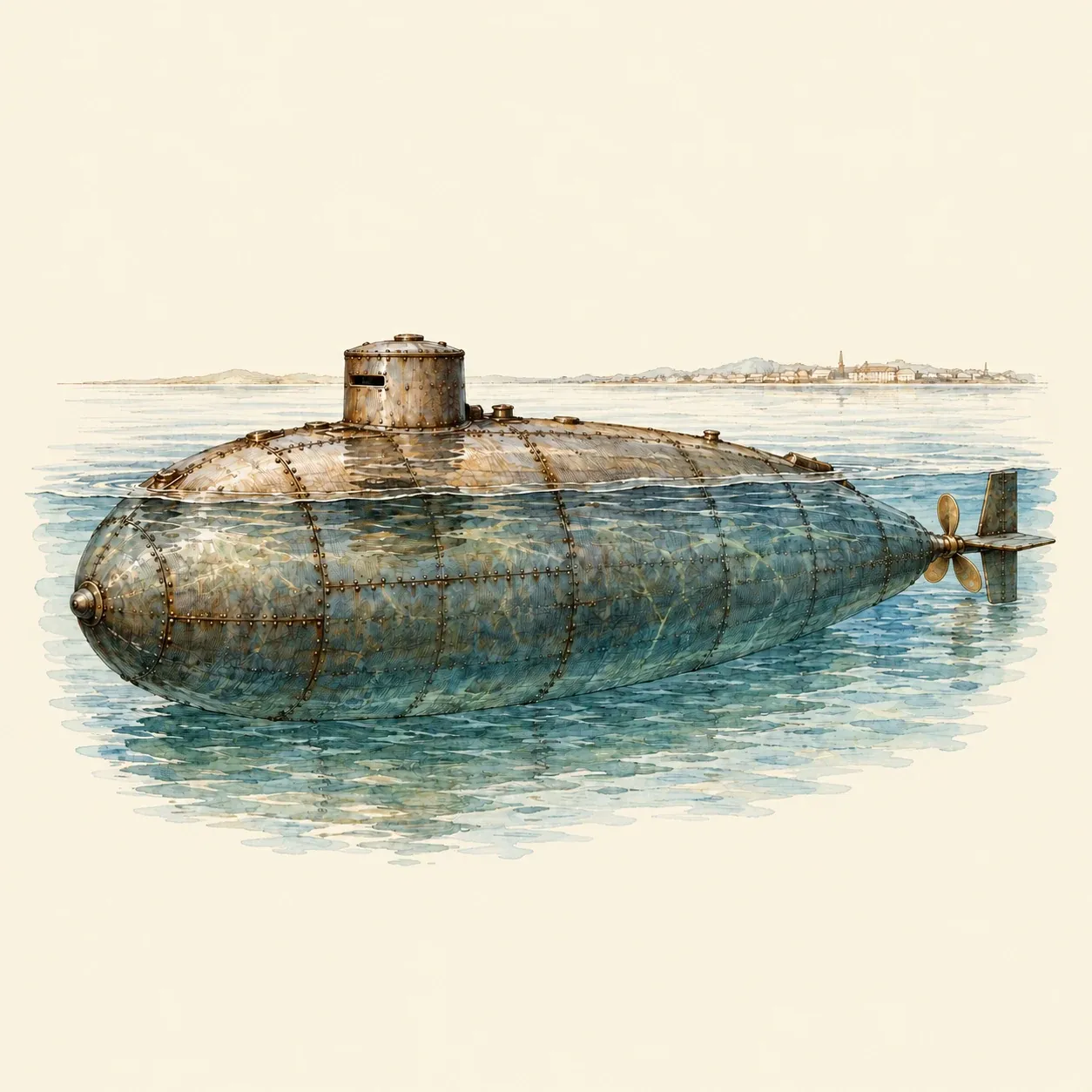 The Holland of 1900 ran on a petrol engine on the surface and an electric motor under water.
On 17 February 1864 the Confederate H. L. Hunley became the first submarine to sink an enemy warship, the USS Housatonic, and was lost with its crew soon after. John Holland’s Holland VI, launched in 1897, ran on a petrol engine on the surface, which also charged its batteries, and on an electric motor under water. The United States Navy bought it on 11 April 1900 and commissioned it in October as USS Holland. Diesel engines later replaced petrol engines in American submarines. On 17 January 1955 USS Nautilus, the first submarine powered by a nuclear reactor, signalled that it was underway on nuclear power.