Logarithms and the slide rule
Multiplying by adding two lengths
Plate
- 1Gunter's rule with its line of logarithms
- 2Dividers
- 3Stock (fixed body)
- 4Slide
- 5Cursor
- 6Hairline
Anatomy
Loading the figure…
A logarithm turns a multiplication into an addition: add the logarithms of two numbers and you get the logarithm of their product. The slide rule, made around 1622 from Napier's logarithms and Gunter's scale, does that addition with two sliding rulers, and engineers used it until pocket calculators replaced it in the 1970s.
What it is
Multiplying 4,738 by 2,916 by hand takes four rows of partial products and a long addition at the end. With logarithms the same job becomes three look-ups in a table and one addition.
In base 10, the logarithm of a number is the power to which 10 must be raised to give it. 100 is 10², so its logarithm is 2. Numbers between 1 and 10 have logarithms between 0 and 1: 2 is about 10 to the power 0.301, so log 2 = 0.301.
The slide rule carries these logarithms on two rulers. Each number sits at a distance from the start proportional to its logarithm, and sliding one ruler along the other adds two distances.
How it works
Powers of 10 multiply by adding their exponents: 10² × 10³ = 10⁵. This holds for fractional powers too, so log(a × b) = log a + log b. To multiply, look up both logarithms in a table, add them, and find the number whose logarithm is the sum. Division becomes subtraction, and a square root becomes half the logarithm. A table only needs the numbers from 1 to 10 in fine steps: 4,738 is 4.738 × 10³, so its logarithm is 3 plus that of 4.738. Printed tables reached astronomers, surveyors and navigators, and Johannes Kepler used them to reduce his planetary observations.
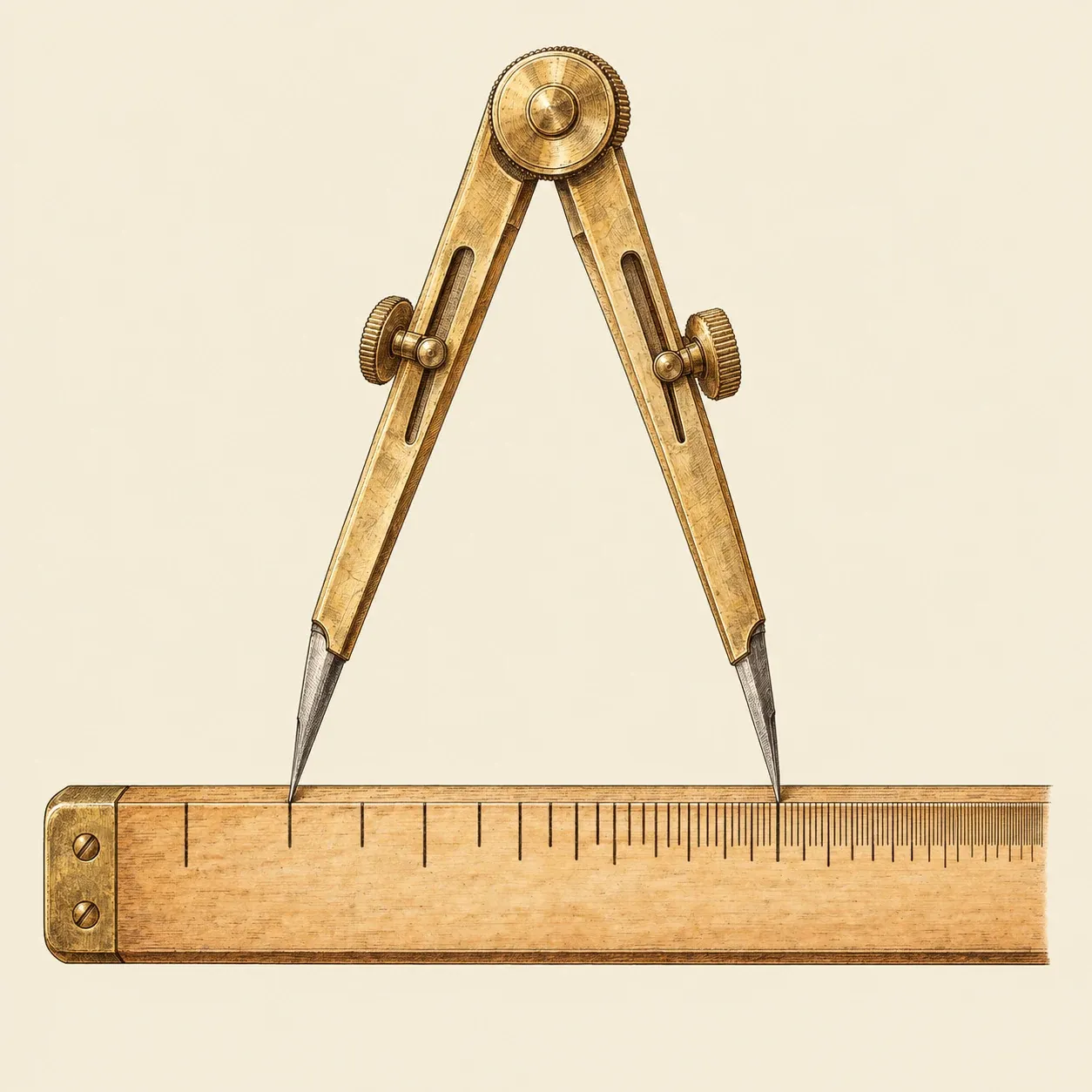 With dividers, Gunter’s line adds two logarithms as two lengths.
In 1620 Edmund Gunter engraved a line of logarithms along a two-foot rule. The 2 stands 30.1% of the way from 1 to 10, the 3 at 47.7%, and the marks crowd together toward the 10. To multiply 2 by 4, open the dividers from 1 to 2, then move them, keeping the opening, until one point rests on 4: the other lands on 8. Sailors carried such a rule and called it “a Gunter”.
The slide rule does without dividers. Two identical scales, D on the fixed stock and C on the slide, lie edge to edge. Set the 1 at the left end of C, the index, over the first number on D; under the second number on C, D shows the product. To divide, set the divisor on C over the dividend on D and read the result under the index. If the reading falls off the end of the stock, in either operation, use the 10 at the other end of C as the index.
The cursor is a window with a fine hairline that slides across all the scales. It holds a result while the slide moves, and it links scales that are not side by side. The A and B scales fit two cycles into the same length, 1 to 10 on the left half and 10 to 100 on the right, so the hairline on 3 on D crosses 9 on A. Read the other way they give square roots, provided you pick the right half: 25 on the right half stands above 5 on D, while 2.5 on the left half stands above 1.58.
The rule gives digits, not magnitudes: 2 × 3 and 20 × 0.3 use the same setting. The user places the decimal point by estimate: 37 × 21 is about 40 × 20 = 800, so a reading of 7.77 means 777. A 25 cm rule reads to about three significant figures, enough for most engineering, where loads and strengths are seldom known better.
How to build
You need thin card or two strips of planed wood, a millimetre ruler, a sharp pencil, a fine pen, a craft knife, a steel straightedge, glue and some clear plastic.
Get the logarithms. To three places: 1 → 0, 2 → 0.301, 3 → 0.477, 4 → 0.602, 5 → 0.699, 6 → 0.778, 7 → 0.845, 8 → 0.903, 9 → 0.954, 10 → 1. Any printed table of common logarithms gives them, and fuller tables list 1.1, 1.2 and so on. You can check a value by hand: 2¹⁰ = 1,024, just over 10³, so log 2 must be just over 0.3. Sums and differences give more marks: log 1.5 = log 3 − log 2 = 0.176.
Cut the strips. Two strips 30 cm long and 3 cm wide, one for the stock and one for the slide. Glue the stock onto a wider base card, then a thin guide strip parallel to it, leaving a channel where the slide runs straight and snug.
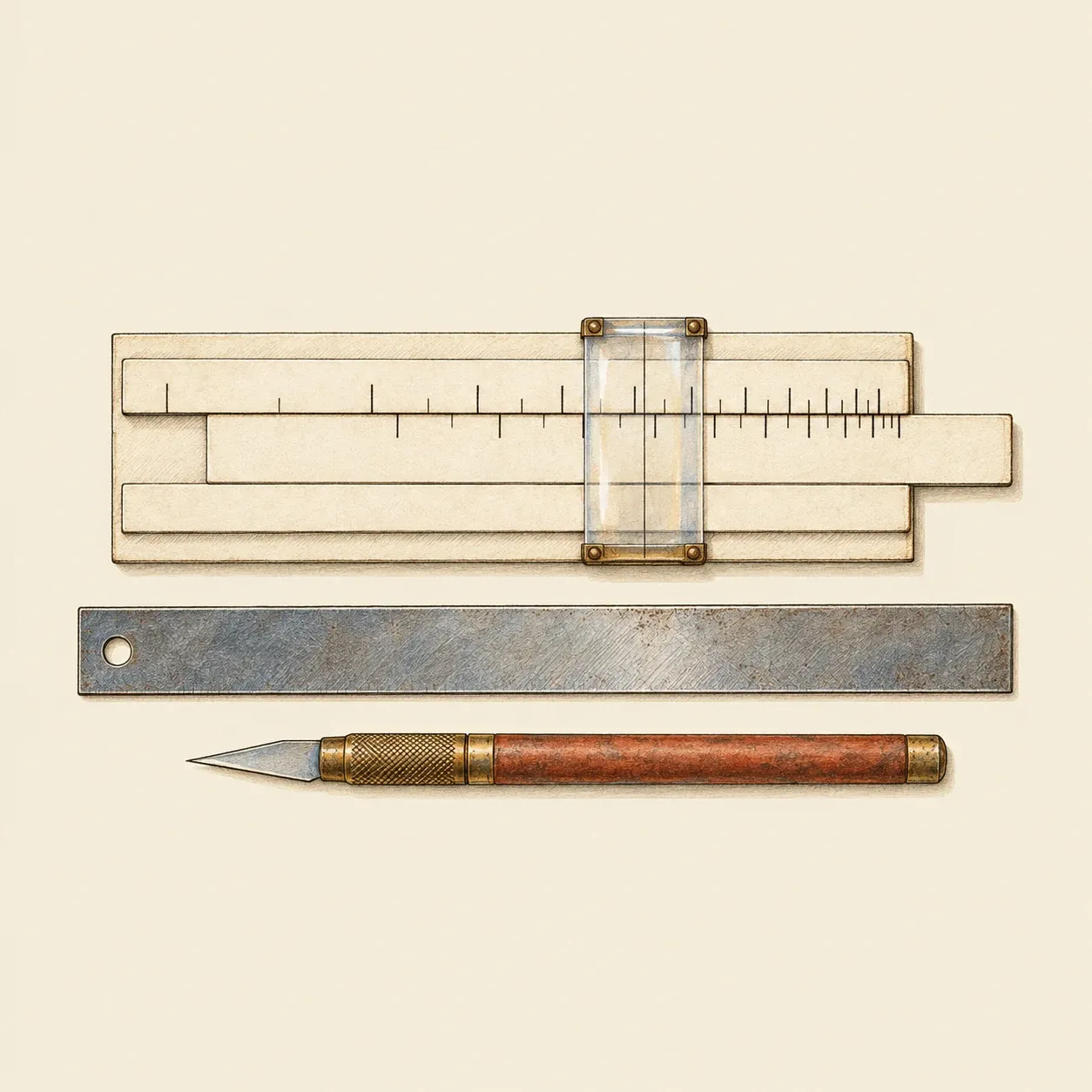 The card rule: the slide runs between two glued rails, and the cursor slides over both.
Mark both scales at once. Tape the slide against the stock with their left ends level. Take 25 cm from 1 to 10, multiply each logarithm by 250 mm and mark to the nearest half millimetre: 2 at 75.3 mm, 3 at 119.3, 4 at 150.5, 5 at 174.7, 6 at 194.5, 7 at 211.3, 8 at 225.8, 9 at 238.6, 10 at 250. Draw each tick across the joint so the scales match. For the test below, also mark 2.1 at 80.6 mm and 3.7 at 142.0 mm, then, on the stock only, 7.7 at 221.6 and 7.8 at 223.0.
Add a cursor. Wrap a sleeve of clear plastic around the whole base so it slides with light friction and crosses both scales, and rule one fine line on it, square to the scales.
Test it. Set the 1 of the slide over 2: under 3 you should read 6, under 4, 8. Then set the 1 over 3.7 and look under 2.1: the reading falls between 7.7 and 7.8, closer to 7.8. Long multiplication gives 37 × 20 = 740, plus 37 = 777. To divide back, put 2.1 over that reading: the index points to 3.7. A card rule gives two figures surely and the third by eye; if one reading keeps drifting, measure that mark again.
Safety. Cut on a mat against a steel ruler, keep the holding hand out of the blade’s path, and retract or cover the blade whenever you put the knife down.
History and evolution
John Napier, a Scottish landowner, published logarithms in Edinburgh in 1614, with tables for the sines used in astronomy. His logarithms had no base in the modern sense. Henry Briggs, of Gresham College in London, visited him in 1615 and 1616; they settled on base 10 with log 1 = 0. Briggs printed a first table in 1617, and his Arithmetica logarithmica of 1624 ran to 14 decimal places. In 1628 Adriaan Vlacq filled the gap between 20,000 and 90,000.
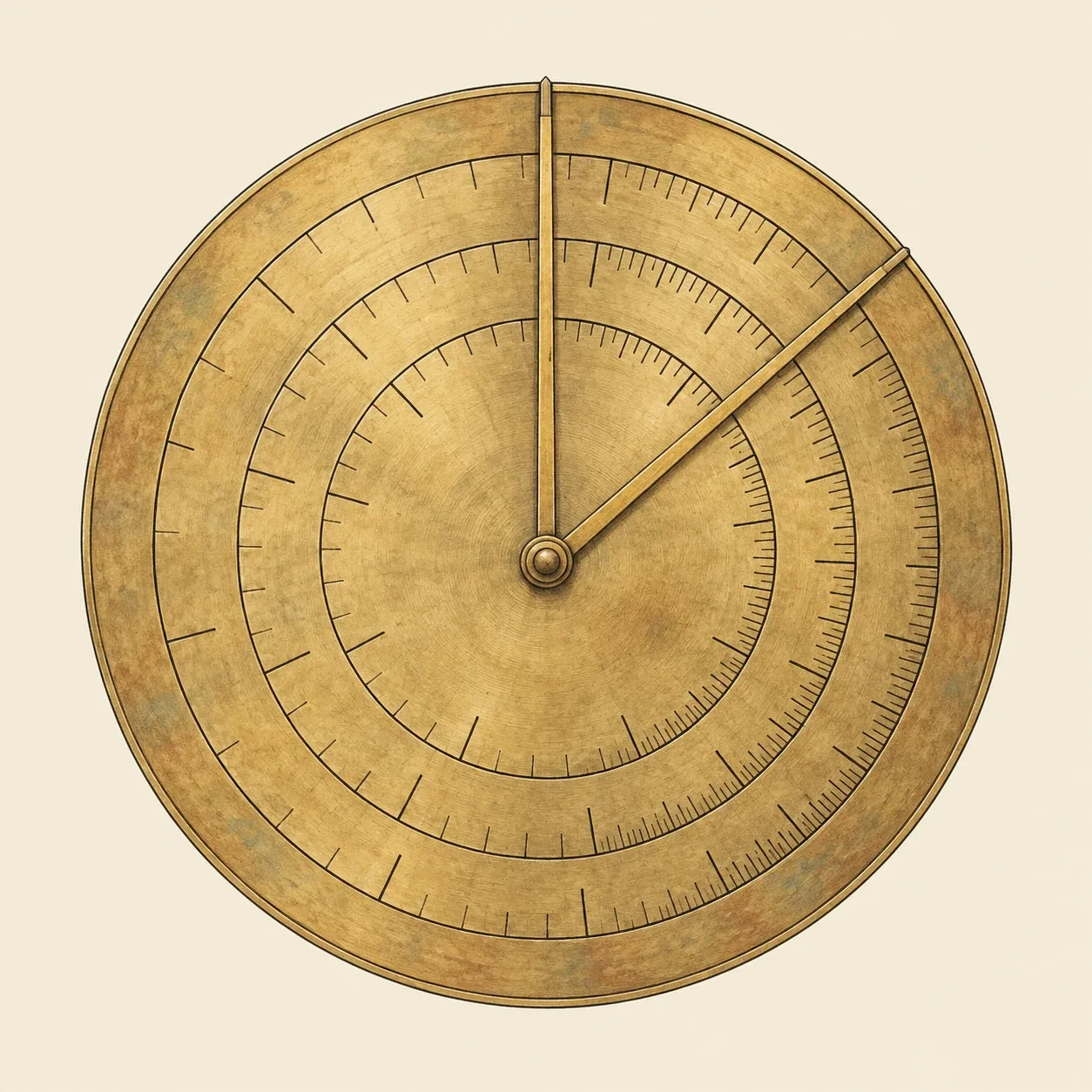 On circular rules, the scales run round concentric rings and two arms replace the dividers.
Around 1622 William Oughtred, a clergyman in Surrey, slid two Gunter lines against each other. He published only in 1631–1632, partly to answer a former student’s priority claim. His instrument maker, Elias Allen, also made a circular form. Straight rules with a slide in a stock spread later in the century, and in 1851 Amédée Mannheim, an officer cadet at Metz, fixed the A, B, C, D layout with a cursor that makers kept for about a hundred years.
Engineers sized bridges, aircraft and power stations with slide rules, and Apollo crews carried them. Hewlett-Packard’s HP-35 pocket calculator went on sale in 1972, and Keuffel & Esser, the largest American maker, produced its last slide rule on 11 July 1976.