Road construction
Carrying traffic on layers of stone
Contents
- 1Side ditch
- 2Foundation of large stones
- 3Layers of smaller stones and gravel
- 4Cambered paving of fitted stone slabs
- 5Kerbstone
A built road spreads the weight of traffic over the ground and keeps that ground dry. Builders lay coarse stone below and finer material above, raise the centre so rain runs off into side ditches, and finish the top with slabs, packed broken stone, timber or a coat bound with tar. Some of the oldest are timber trackways across bogs, such as one in Lower Saxony built in 4629 BCE.
What it is
A road is a strip of ground prepared to carry traffic in every season. Bare earth serves while it is dry and firm, but rain softens it, and wheels, hooves and feet cut ruts that then hold water. A built road deals with both problems. It lays a hard body of stone, gravel or timber over the soil to spread each load, and it is shaped and drained so that water leaves it quickly.
The parts change little from one period to another. Ditches on either side take the water away. A foundation of large stones, or a bank of earth and gravel rammed hard, lifts the road above the wet ground. Finer layers fill the spaces above it, and a wearing surface takes the wheels: fitted stone slabs, small broken stone packed tight, or stone bound with tar or bitumen. Kerbstones hold the edges so the layers cannot spread sideways. Where the ground is too soft for stone, as in a bog, builders used timber instead.
How it works
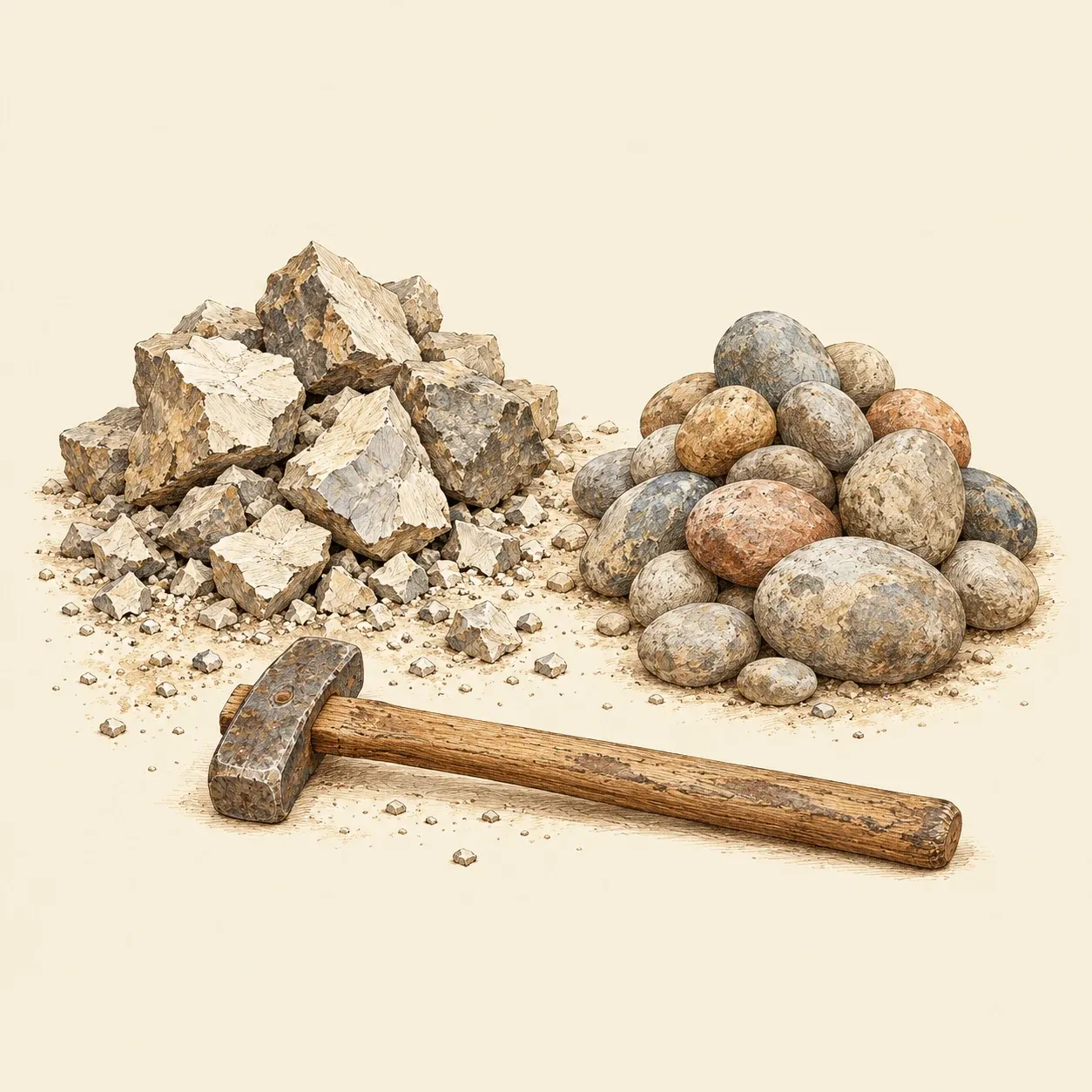 Broken stone with sharp faces locks together when it is rammed; rounded pebbles roll under a load.
Soil carries the weight of traffic as long as it stays dry. Wet clay or silt gives way under a wheel and squeezes out to the sides, which is how a rut begins. A road works in two ways. A stone pressed down at the surface pushes on several stones below it, and these on still more, so the load spreads over a wider and wider area with depth and the soil under a thick enough body of stone is pressed far less than the surface. The road also keeps water out of that soil, so it does not soften.
The stones must not slide past one another. Broken stone with sharp faces locks into a firm mass when it is rammed or rolled, while rounded river gravel rolls under the load. In the upper layers, smaller pieces and fine material fill the gaps and make the surface tight. Drainage does the rest. The surface rises slightly towards the centre, the camber, so that rain runs to the edges, and the ditches carry it away at a level below the base of the road.
John Loudon McAdam, a Scottish surveyor of turnpike roads, put the principle plainly in 1819: it is the native soil that carries the traffic, provided it is kept dry, and the road over it only needs to be a covering the rain cannot get through. His roads were a layer of clean broken stone, with no piece heavier than six ounces (about 170 g), laid over drained ground with a ditch on each side.
The wearing surface protects the body of the road. Stone slabs resist wheels well but are costly to quarry and fit. Loose broken stone is cheap, but it raises dust in dry weather and loosens in wet. Binding the top layer with tar, and later with bitumen, closes it against water and dust. A modern asphalt road still rests on layers of crushed stone laid on drained ground.
How to do it
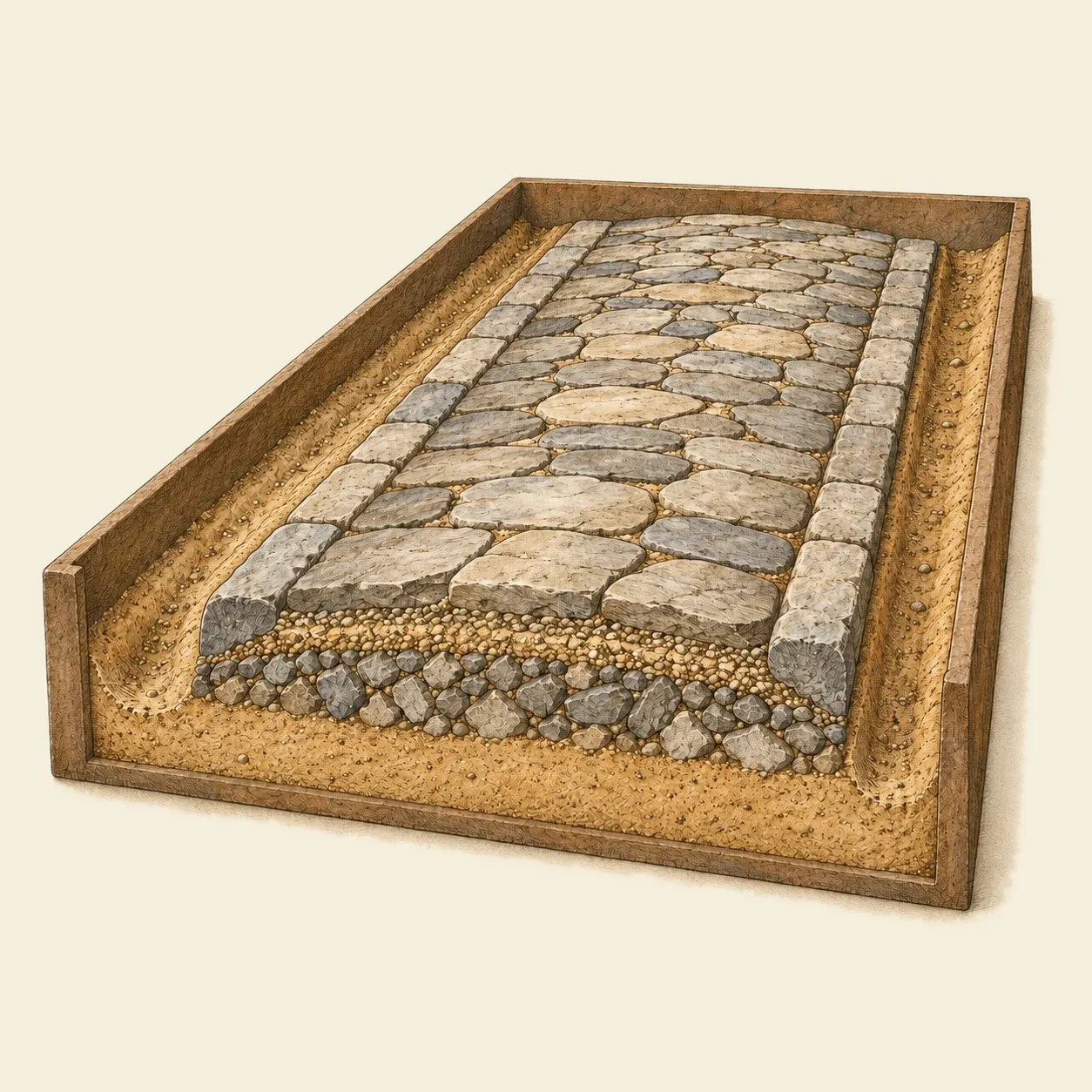 A model road follows the same order as a real one: coarse stone below, finer layers above, a cambered surface held by kerbs.
A model in a shallow tray shows each layer at work without any digging. You need a plastic tray, or a sturdy box lined with a plastic bag, about 40 centimetres long and at least 6 centimetres deep, damp sand, a few handfuls of coarse angular gravel, a handful of fine gravel, some small flat stones or pieces of broken tile, and a small block of wood. Spread two centimetres of damp sand over the bottom and press it flat with the block: this is the ground. Along each long side, scrape a groove about two centimetres wide in the sand for the ditches.
Down the middle, spread a strip of coarse angular gravel, not rounded pebbles, about a centimetre and a half deep, and press it firmly with the block. Cover it with a thin layer of fine gravel mixed with a little sand, shaped so that the centre stands a few millimetres higher than the edges. Set a row of larger stones along each edge of the strip as kerbs, their tops no higher than the edge of the finished surface so that water can run off over them, then fit the flat stones on top, tight against one another. Put a book under one end of the tray so that the ditches slope. Sprinkle water over the road from a cup or a watering can: it should run off the surface into the ditches and collect at the lower end. Then press with a thumb on the road and on the bare sand beside it, and compare.
History and evolution
Some of the oldest built ways are timber trackways laid across wet ground. In the Campemoor, a bog near Lake Dümmer in Lower Saxony, tree-ring dates show that trackway Pr 31 was built in 4629 BCE and repaired for decades afterwards. Its excavators attribute it to the early Swifterbant culture. A heritage report by Amandine Colson gives 4682 BCE for the same trackway.
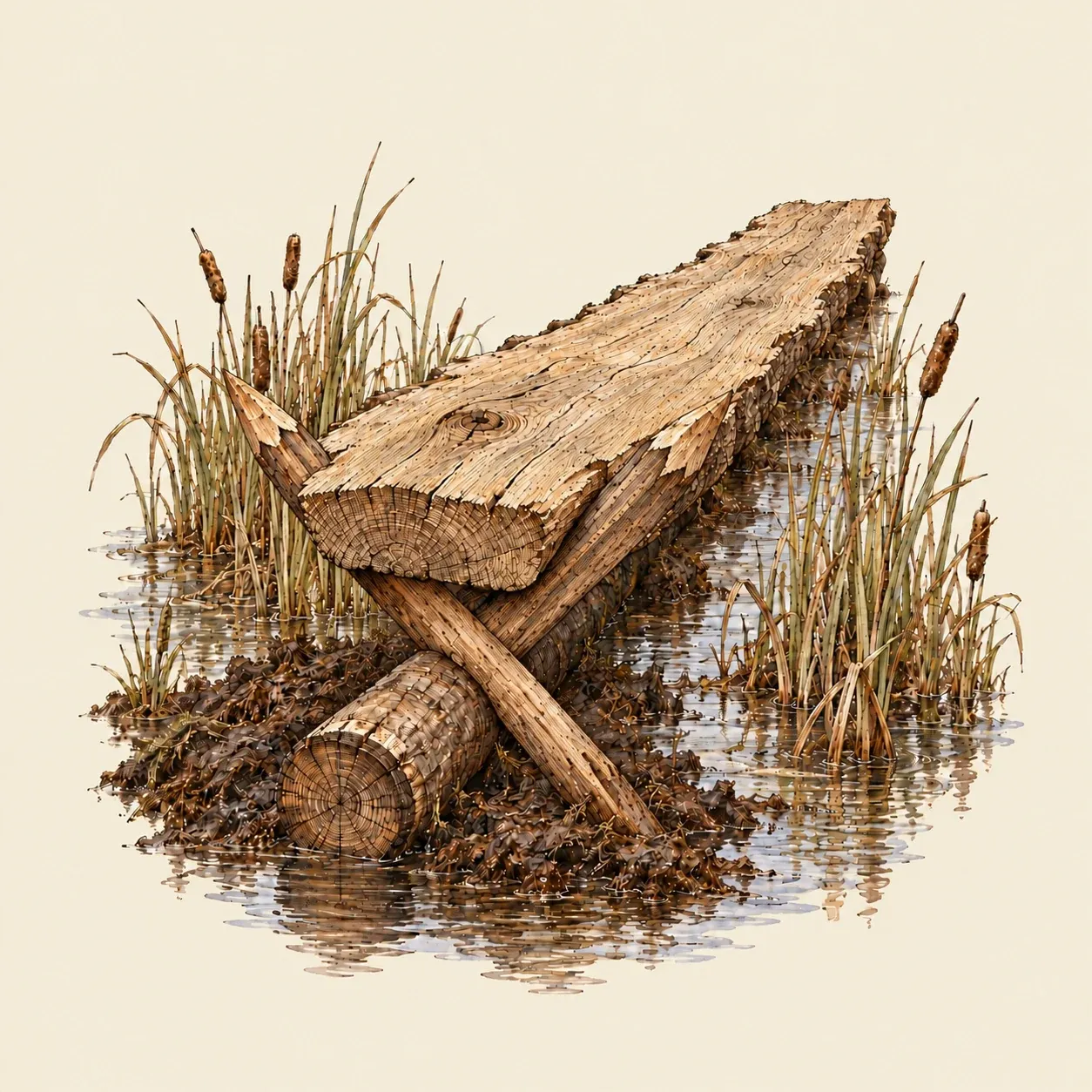 A timber trackway of the Sweet Track type: the plank lies in the V of a pair of crossed pegs, above a rail laid on the peat.
In Somerset, the Sweet Track was built in one campaign from timber felled in the winter or early spring of 3807/6 BCE, partly along the line of an older track. Its builders laid rails on the peat, drove pairs of crossed pegs on either side of them, and rested oak planks on the crossing points above the wet surface. In Egypt, a paved road of the Old Kingdom carried basalt from the quarries of Widan el-Faras, on the northern edge of the Faiyum, to a quay on ancient Lake Moeris. It was about 2 m wide. Per Storemyr and his colleagues give its length as 10.5 km, the American Society of Civil Engineers as 7.5 miles (about 12 km). It was paved with sandstone and limestone, and its basalt went to the pyramid temples at Giza.
Rome built engineered roads across its territory. The Via Appia, begun in 312 BCE by the censor Appius Claudius to link Rome with Capua, was later paved with tightly fitted blocks of basalt laid without mortar. In the provinces most Roman roads were simpler. In Britain, from 43 CE, the army raised them on a bank of rammed earth, sand and gravel dug from the side ditches, cambered and surfaced with small stones, and the best of them had kerbs.
The modern road began with the turnpike engineers of the 18th and 19th centuries. Thomas Telford set his roads on a foundation of stone. McAdam argued that the foundation was unnecessary if the soil was drained and covered with a tight layer of small broken stone, and roads built his way were called macadamised. In 1901 Edgar Purnell Hooley, county surveyor of Nottinghamshire, noticed a stretch of road near Denby, in Derbyshire, where spilt tar had been covered with slag from an ironworks: it stayed free of dust and ruts. In 1902 he patented a method of coating broken slag or stone with tar before laying it, and he then formed a company to sell it, the origin of the firm Tarmac.