Abrasive drilling and sawing
Cutting stone with sand
Contents
- 1Bow and its cord
- 2Hand stone
- 3Hollow tube of elder
- 4Wet sand at the cutting edge
- 5Axe blank wedged in a block
- 6Core left in the centre
Abrasive drilling and sawing cut a material harder than the tool by rubbing loose hard grains, usually wet quartz sand, against it with a moving tube, blade or cord. The tool only carries the grains, which scratch away tiny particles. The oldest known traces are on jade rings from Xiaonanshan in north-east China, cut with a cord and sand about 9,000 years ago. In central Europe, Early Neolithic farmers of the Linear Pottery culture, from about 5500 BCE, sawed slabs of greenstone into axe blanks and drilled their shaft holes with hollow tubes, fine sand and water. Egyptian masons later cut granite in the same way with copper, and diamond core drills apply the principle with grains fixed in the tool.
What it is
Abrasive drilling and sawing cut stone, glass or metal with loose grains that are harder than the material, pushed and dragged across it by a tool. The tool can be softer than the stone: a wooden or bone tube, a copper blade, a cord. It only holds the grains against the surface and moves them. Each grain scratches off a few particles, and many thousands of grains, renewed again and again, wear a hole or a groove.
The commonest grain was quartz sand, hard enough to scratch most building stones. Harder grains such as emery or corundum cut harder stones faster, and diamond, the hardest of all, cuts anything. The same principle runs from the hollow drills of Neolithic axe makers to the diamond-tipped core drills used on rock today. A drill for metal works differently: its hardened steel edges cut chips directly.
How it works
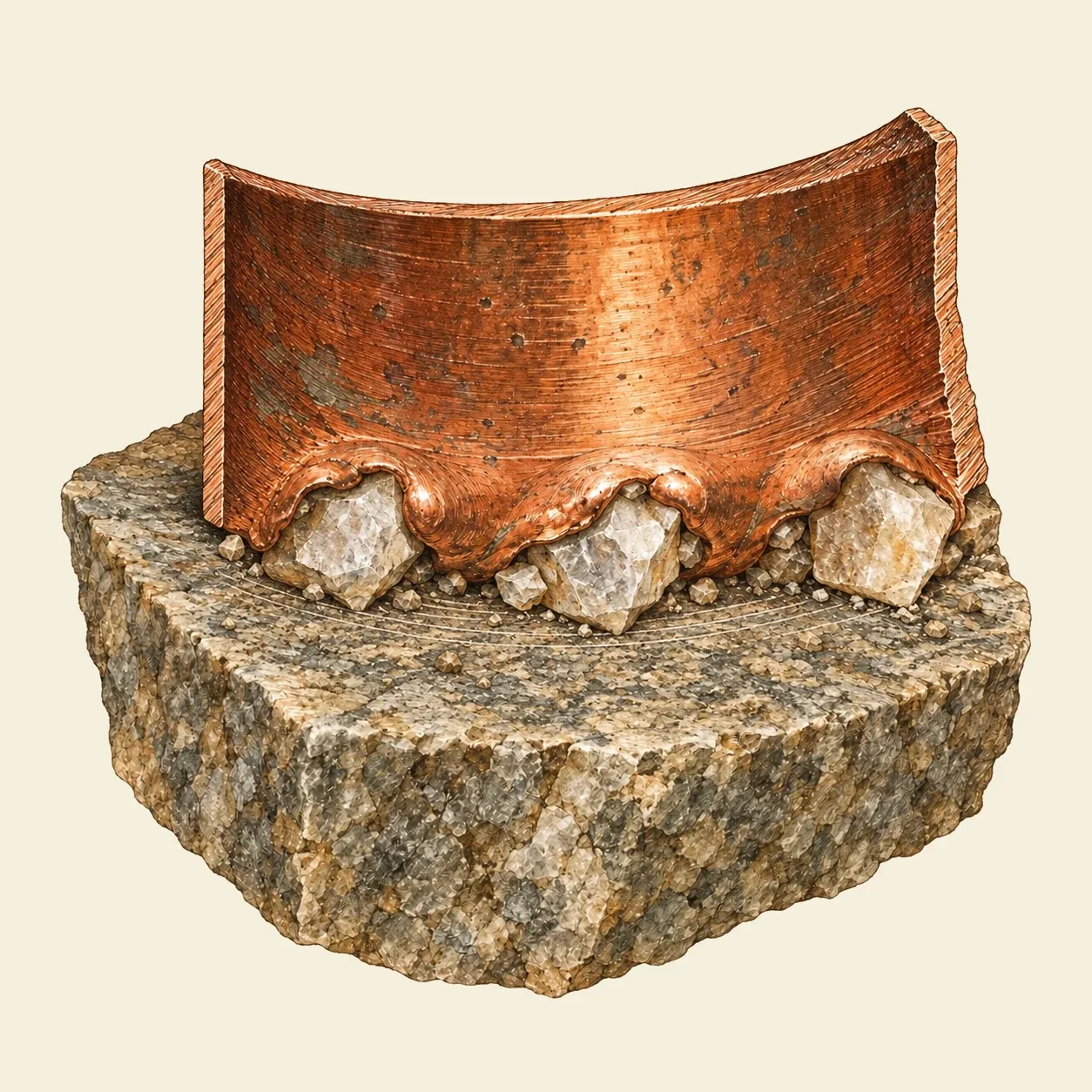 The grains, not the tube, do the cutting; some lodge in the soft copper, which then works like a file.
A hard grain pressed against a softer surface and dragged along it scratches it, as sand scratches glass. Under a moving tool, grains roll and slide, crush, and some lodge in the tool. Leonard Gorelick and John Gwinnett, who studied ancient drilling, point out that copper suited this work because it was soft enough for the abrasive to embed in it, so that the tube or saw became a kind of file. The tool wears down too, though more slowly than the stone.
Water is part of the method. It carries the grains under the tool, washes away the stone powder that would otherwise cushion the cut, and keeps the dust down. The worker feeds fresh wet sand into the hole or the groove as the old grains are worn round.
A tube drill cuts only a ring. The rest of the stone stands as a core inside the tube, so much less material has to be ground away, and the core can be snapped off when the ring is deep enough. The tube is turned back and forth with a bow whose cord is wrapped round its shaft, or simply between the palms, while a stone held on top presses it down. The hole is often drilled from both faces of the work until the two halves meet. Gwinnett and Gorelick note that the core left by a tube drill always tapers towards its top.
A saw with no teeth works the same way along a line. A blade of wood, copper or stone is drawn back and forth over a line of wet sand, and the groove deepens slowly. In Neolithic slabs from central Germany the saw groove has a rounded, U-shaped section for its first 8 to 10 mm and then narrows to a V.
How to do it
This exercise drills a hole through a terracotta tile with a copper pipe and sand, then saws a groove with a strip of wood. You need an unglazed terracotta floor tile about 1.5 cm thick, or a slab of soft limestone; a 10 cm length of 15 mm copper pipe; a carpenter’s brace whose chuck will grip the pipe, or a wooden dowel glued into the pipe and turned with a bow; fine dry sand; a lump of modelling clay; water; a strip of hardwood about 30 cm long; two clamps; safety glasses and gloves.
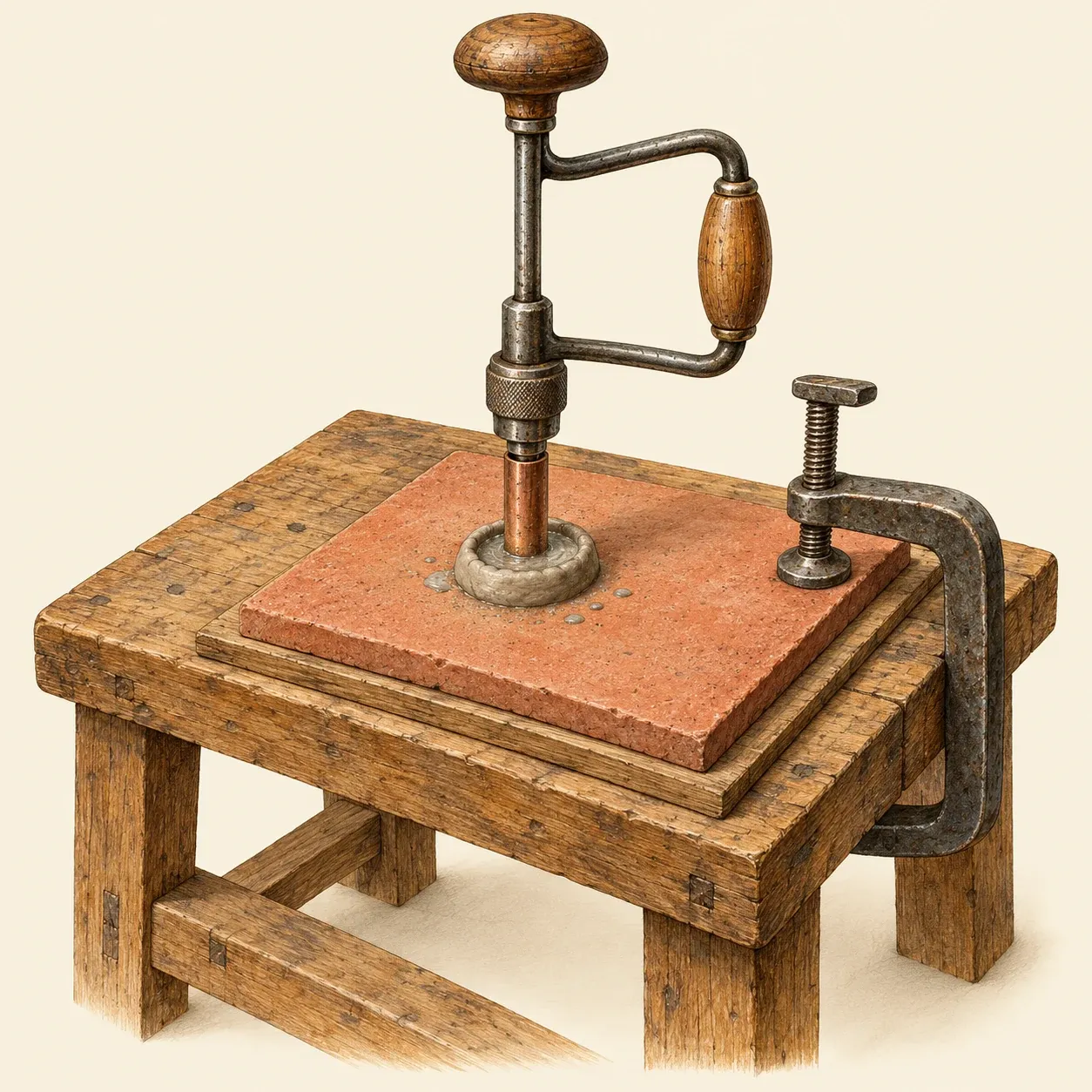 The copper pipe carries the wet sand round in a ring; the clay wall keeps the slurry in place.
Clamp the tile flat on a bench, over a scrap board. Make a ring of clay about 3 cm across round the place to drill and press it down so it seals on the tile. Put a teaspoon of sand inside it and add water until it is a thin slurry. Set the pipe upright in the slurry and turn the brace in steady strokes, pressing moderately. After a minute lift the pipe, stir the slurry and carry on. A ring-shaped groove appears; add sand when the slurry turns grey and smooth. When the groove is deep, turn the tile over and finish from the other side, or drill on until the core drops out.
To saw, clamp the tile again and draw a line across it. Spread a thin line of wet sand along the line and move the hardwood strip back and forth over it, held upright, adding wet sand as you go. A shallow groove forms within a few minutes. Look at its section: it is rounded at the bottom, like the grooves on Neolithic slabs.
Safety. Always work wet. Dry dust from sand, stone and terracotta contains fine silica, which harms the lungs if breathed in over time; never sweep or blow it, wipe up with a damp cloth. Use only a known material such as terracotta or limestone, and never work unknown green or fibrous stones, which can contain asbestos.
History and evolution
The oldest evidence found so far comes from north-east China. At Xiaonanshan, on the Ussuri River in Heilongjiang, burials dated to about 9,000 years ago held jades, among them slit rings worn as ear ornaments. The slits show the curved ridges left by a cord drawn back and forth while quartz sand was added. Tang Chung, who reproduced the method with hemp string and quartz sand, notes such traces of string sawing on the Xiaonanshan jades, and Ma Shuwen and his colleagues place the earliest string sawing in China at this site.
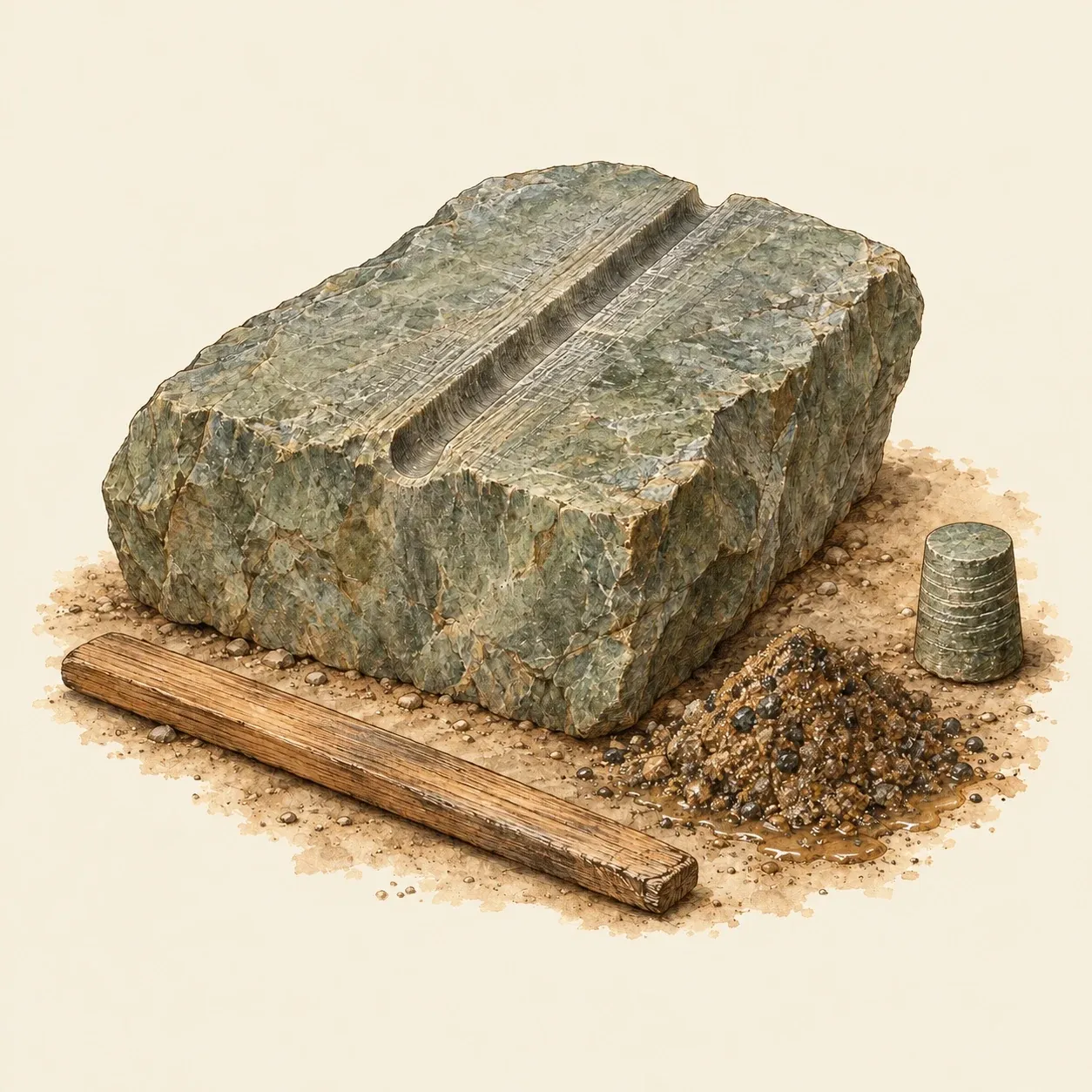 A partly sawn slab, the strip and the sand that cut it, and a core left by a tube drill.
Central Europe has a detailed record from the Early Neolithic. Simone Meinecke, Roberto Risch and their colleagues studied 357 axe blanks, drill cores and waste pieces from Saxony-Anhalt and Saxony. Blanks in the shape of the shoe-last adzes typical of the Linear Pottery culture, from about 5500 BCE, and of the following Stroke-ornamented Pottery and Rössen cultures, were sawn from slabs of a green schist on at least one side. The dominant view, they write, is that wooden saws were used with sharp quartz sand and water; saw blades of sandstone have also been found. Axe heads were hafted through round holes from the early Linear Pottery onwards, drilled with a hollow cylinder, probably of elder wood or bone, fine quartz sand and water. The cores left by these holes average 18 to 19 mm across. In experiments published in Hungary in 1997, a hollow elder stem and sand gave holes like the ancient ones, but smaller cores than those found on Lengyel sites.
In Mesopotamia, Gwinnett and Gorelick found concentric abrasion rings inside the holes of stone seals from about 3000 BCE onwards, the mark of drilling with sand. In Egypt, Flinders Petrie, who surveyed Giza in 1880–82, found holes and cores of tube drills in granite and the marks of a saw about 9 feet (2.7 m) long on the granite coffer of the Great Pyramid. He believed the bronze tools had been set with fixed points of hard stone.
In India, bead makers fixed hard grains in the tool itself. They drilled agate and carnelian with chips of diamond set in the tip of the drill: V. N. Prabhakar places the change from stone drill bits to diamond around 1000 BCE, and Mark Kenoyer and Massimo Vidale describe evidence from before 600 BCE. At Khambhat in Gujarat, bead drillers still fix two small diamond chips at the end of an iron shaft turned with a bow. In 1863 the engineer Rodolphe Leschot patented a hollow drill whose crown was set with diamonds and used it to bore blasting holes for the Mont Cenis railway tunnel through the Alps. His drill turned continuously and cut a ring, leaving a core, like the Neolithic tube drill. Mining engineers regard it as the ancestor of the diamond core drills still used to take samples of rock.