Enclosure traps
A way in with no way back
Contents
- 1Uphill edge, level with the ground
- 2High dry-stone wall on the downhill side
- 3Floor of the enclosure
- 4Broom planted inside the enclosure
An enclosure trap lets an animal in and stops it getting out again. The way in may be a drop it can jump down but not climb back, an entrance closed behind it, or an opening that can be pushed in one direction only. The oldest dated examples are the desert kites of eastern Jordan, stone walls that guided herds into enclosures in the Neolithic, in the 8th or 7th millennium BCE. In the mountains of northwestern Spain, villagers caught wolves in round stone corrals baited with a live goat or sheep.
What it is
An enclosure trap is a walled or fenced space that an animal can get into but cannot get out of. In its simplest form nothing strikes the animal or falls on it. The trap holds whatever has come in until people arrive, so it can take animals alive, from a single wolf to a whole herd.
Enclosure traps range from a stone pen built for one wolf to drive structures whose walls stretch across a desert. The small ones wait for an animal drawn in by bait, and the large ones rely on people who drive game towards them. The same idea of an entrance that works in one direction only is found in the basket traps of fishing, with their inward funnels, and in the glass fly trap.
How it works
There are three main ways to stop an animal from going back. The first uses a difference in height: the animal jumps down into the enclosure and cannot climb back out. The stone wolf corrals of northwestern Spain, called cortellos in Galician, worked on this principle, and the households of the village took turns to provide the live goat or sheep that drew the wolf in.
The second way closes the entrance behind the animal, as in the elephant hunts that Megasthenes described in India. Some modern live traps have a door that drops shut but can still be pushed inwards by the next animal.
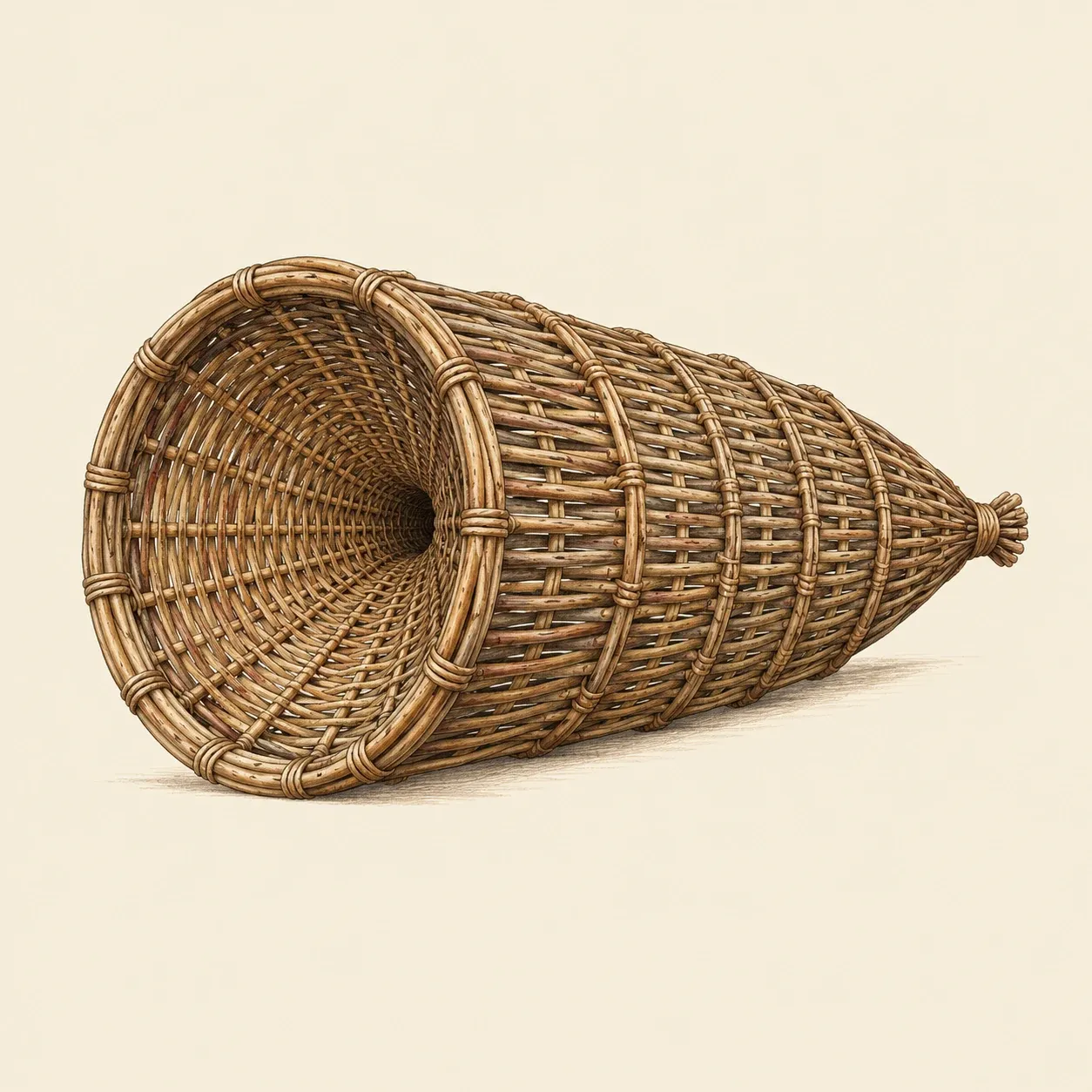 The funnel of a fish trap lets the catch in more easily than out.
The third is an entrance that opens one way only. Corral traps used in Texas to catch feral pigs alive can have an entrance that a pig pushes open from outside but cannot open again from inside. Funnel entrances in fish traps work in a similar way, although some animals find the narrow end again and escape.
Large drive enclosures add walls that steer animals. Converging walls lead a herd towards a narrowing opening and into an enclosure where the animals can no longer scatter. Archaeologists see the largest of them as tools for hunting whole herds at once. Trapping is regulated in many countries, and the rules depend on the place, the species and the method.
History and evolution
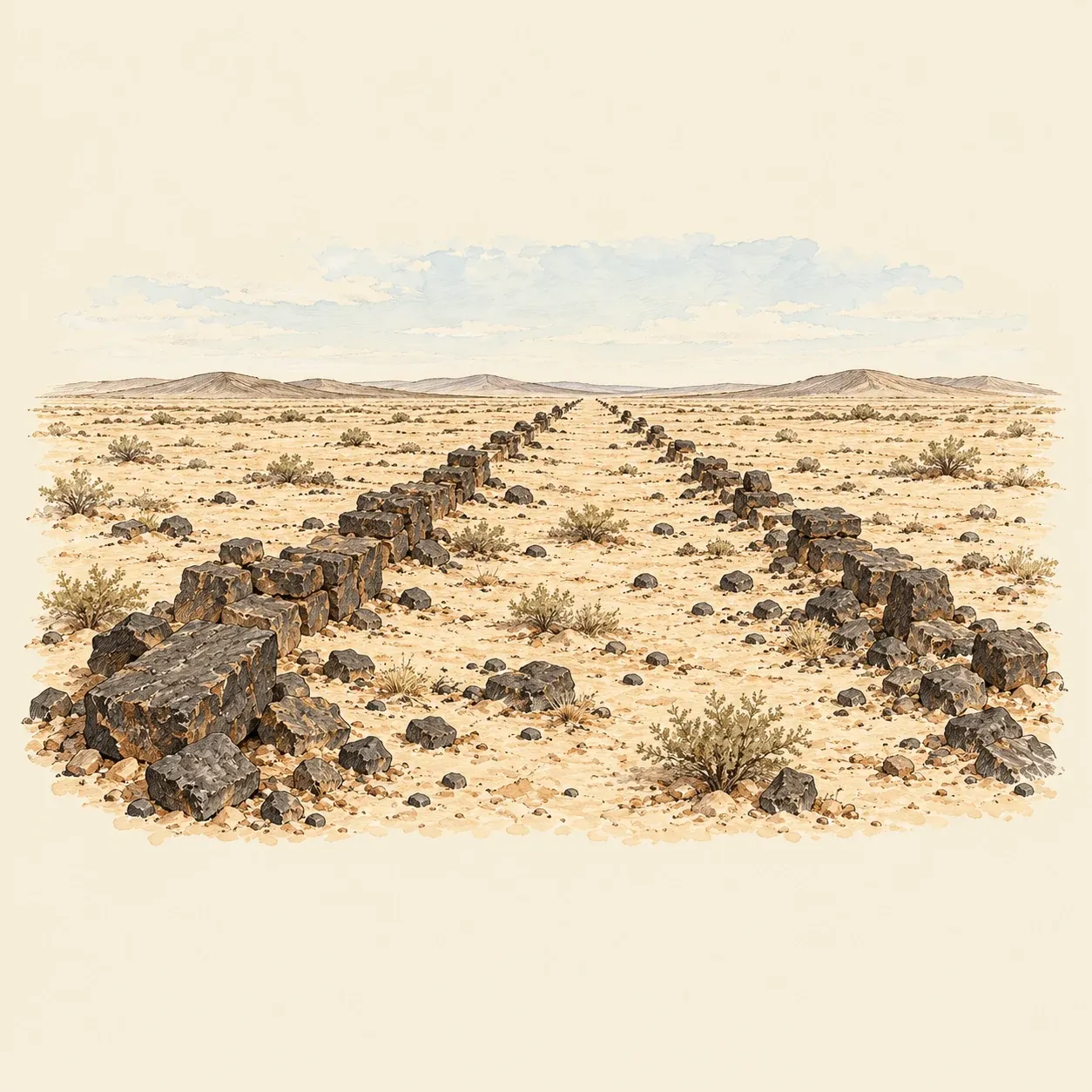 The low stone walls of desert kites still cross the deserts of the Near East.
Desert kites are the oldest dated drive enclosures. These stone structures of the deserts of the Near East and Arabia have long, low walls converging on an enclosure ringed by pits. A 2026 study that combined radiocarbon and luminescence dates from three kites of one chain at Jibal al-Khashabiyeh, in southeastern Jordan, places their construction in the second half of the 8th millennium BCE. In the 1980s, Svend Helms and Alison Betts had already placed the oldest kites of eastern Jordan in the Neolithic, in the 7th millennium BCE. Sahar al Khasawneh and colleagues, dating the buried surfaces of stones at another Jordanian kite, Jibal al-Gadiwiyt, obtained about 10,000 years. The authors of the 2026 study doubt this result, citing the method, the small number of samples and ages that do not agree. In Saudi Arabia, the fill of kite pits gave dates of about 6000 to 5500 BCE, so those kites were built before then. Rémy Crassard and his colleagues also describe two engravings, one in Jordan and one in Saudi Arabia, that show kites drawn to scale, and read them as the oldest known scale plans of structures made by people.
Similar structures were built in greener country. On the Karst plateau on the border between Slovenia and Italy, D. M. Vrhovnik and T. Fabec identified four funnels of long dry-stone walls that lead to enclosures or pits in sinkholes or below low cliffs. They read radiocarbon dates on charcoal from one of the sites as showing that it had been abandoned before the Late Bronze Age. In 2026 Anton Velušček, Matija Turk and Ivan Turk, of the ZRC SAZU Institute of Archaeology, argued that the dated wall may be later than the Roman period and that there is no direct evidence that the walls are prehistoric or were built for hunting. Vrhovnik and Fabec compare these structures to desert kites and think they were used to drive red deer and other hoofed animals.
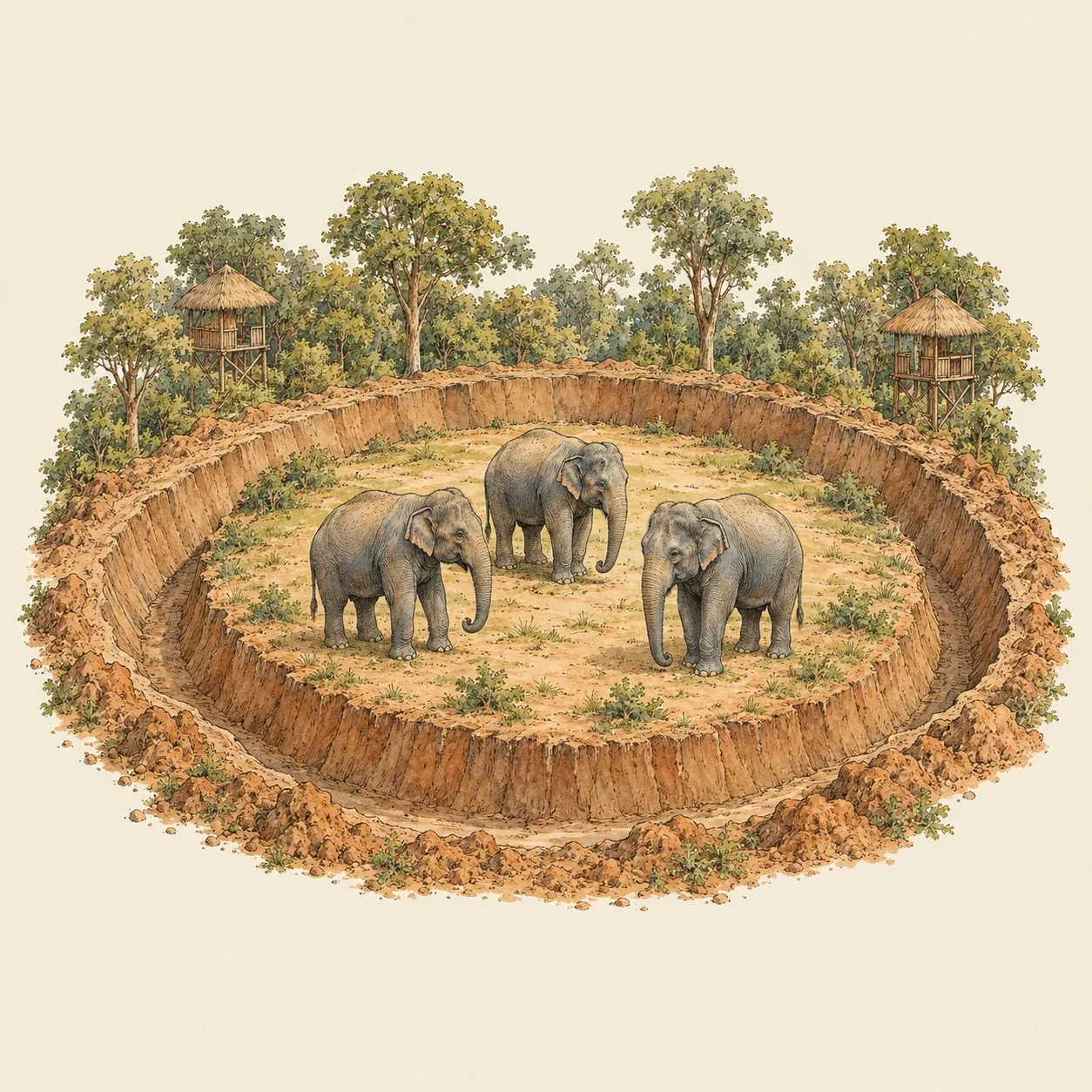 Megasthenes describes wild elephants lured into an enclosure ringed by a ditch.
Around 300 BCE, Megasthenes, a Greek envoy at the court of Chandragupta Maurya, described how wild elephants were caught in India: tame females drew them into an enclosure ringed by a ditch, whose only entrance was then closed. His book is lost, but Strabo and Arrian both retell this passage. According to Strabo, the elephants caught in this way were then tamed and taught to obey commands.
In Europe, according to the archaeologist Iris Nießen, wolf pits were in use from the early Middle Ages into the 19th century, and some were combined with fences. In 2013, a team from the University of Bamberg excavated a Wolfsgarten, a wolf-hunting ground documented in use in the 17th and 18th centuries, in the forest of Bischofsgrün in Upper Franconia. Two trenches that once held a fence ran at the same angle towards one of the pits, and iron nails in their fill probably came from it. Nießen concludes that the site served both to lure wolves with bait and for large drives that forced them into the pits. Written records link it to the margraves of Bayreuth.
In the mountains of northwestern Spain, villages built round stone corrals to catch wolves. The cortello of Lubián, in the Sanabria district of Zamora, is an enclosure of granite laid without mortar on a hillside, and the villagers planted broom inside so that it looked more natural to the wolf. Juan Carlos Cabrero mentions others in the same region, at Barjacoba and in the Ancares range, and the Corral de los Lobos near Sésamo in León follows the same plan. Wolves in these mountains were also driven between long converging walls into a pit, a method known as the chorco. Enclosures with one-way entrances are still used today to catch animals alive, as in the corral traps that Texas extension services describe for controlling feral pigs.