Automatic railway coupler
Cars that couple by bumping together
Contents
- 1Coupler head
- 2Knuckle
- 3Knuckle pin
- 4Lock
- 5Uncoupling lever
An automatic coupler joins two railway cars when they are pushed together, and parts them when a lever at the side of the car is pulled, so that nobody has to step between the cars. William C. Bussey of Illinois patented a coupling that locked itself when one car ran against another on 17 July 1847, and Ezra Miller's self-coupling hook of 1863 was fitted to passenger cars. Eli Janney's knuckle coupler of 1873, whose two curved jaws close on each other like hooked fingers, became the standard of North American railways, and a law of 1893 required automatic couplers on cars in interstate traffic in the United States.
What it is
A coupler is the joint that ties the cars of a train together and carries the pull of the locomotive from one car to the next. With the old link and pin, still common in the 1860s, a man had to stand between two moving cars, guide an iron link into a pocket on the other car and drop a pin through it. Many were maimed, losing fingers or whole hands.
An automatic coupler makes the connection by itself when one car is pushed against another, and it is opened from the side of the car, so that nobody has to go between the cars to couple or uncouple them. The knuckle coupler used on North American railways has a coupler head at the end of a shank fixed under each end of the car. On one side of the head is a curved jaw, the knuckle, which swings on a vertical knuckle pin. Inside the head, a lock holds the knuckle closed, and an uncoupling lever that reaches to the side of the car lifts the lock to free it.
How it works
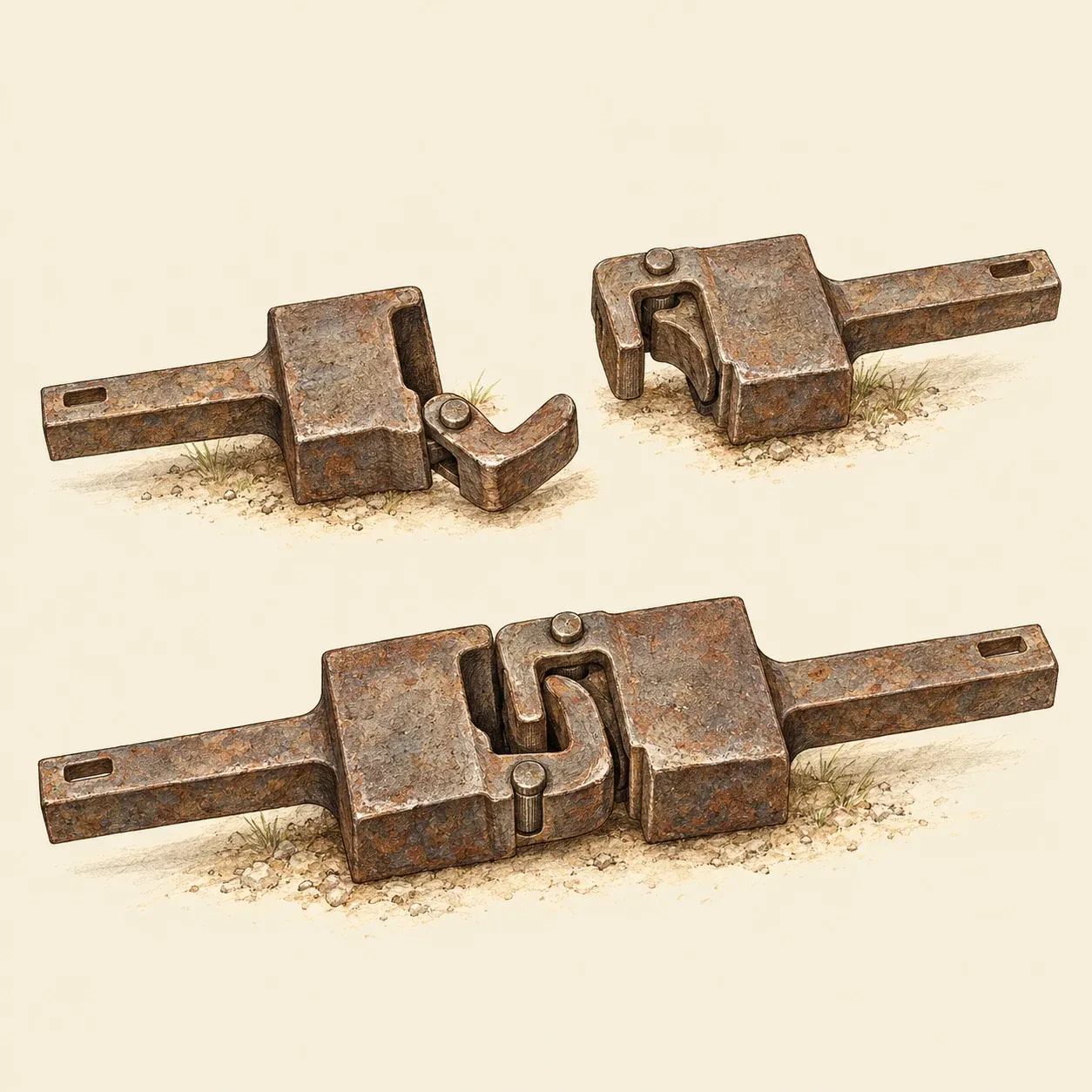 An open knuckle is pushed shut by the other coupler, and the two closed knuckles hold each other.
Before the cars meet, at least one of the two knuckles is swung open. As the couplers come together, the face of the other knuckle strikes the open one and pushes it round on its pin. The rear part of the knuckle, its tail, turns into the head, and when the knuckle is fully closed the tail clears the lock. On modern couplers the lock drops by its own weight into the space behind the tail; on Janney’s coupler of 1873 a catch lever pushed by a spring sprang into place. The knuckle can no longer swing open, and the two closed knuckles hook into each other.
When the locomotive pulls, the pull passes from the shank of one car to its head, through its knuckle into the knuckle of the next car, and back through that coupler’s head and shank. Each knuckle tends to swing open under the pull, and the lock behind its tail stops it. When the train is pushed, the heads and the knuckles press against each other.
To uncouple, a worker standing beside the train pulls the uncoupling lever, which lifts the lock out of the way. When the cars are drawn apart, the knuckle swings open and lets go of the other.
How to do it
A card model shows how a knuckle closes when two couplers meet and stays locked under pull. You need foam board or thick corrugated card, a craft knife, a ruler, two paper fasteners, two craft sticks, two rubber bands, a few pins, a length of string, glue and a smooth table.
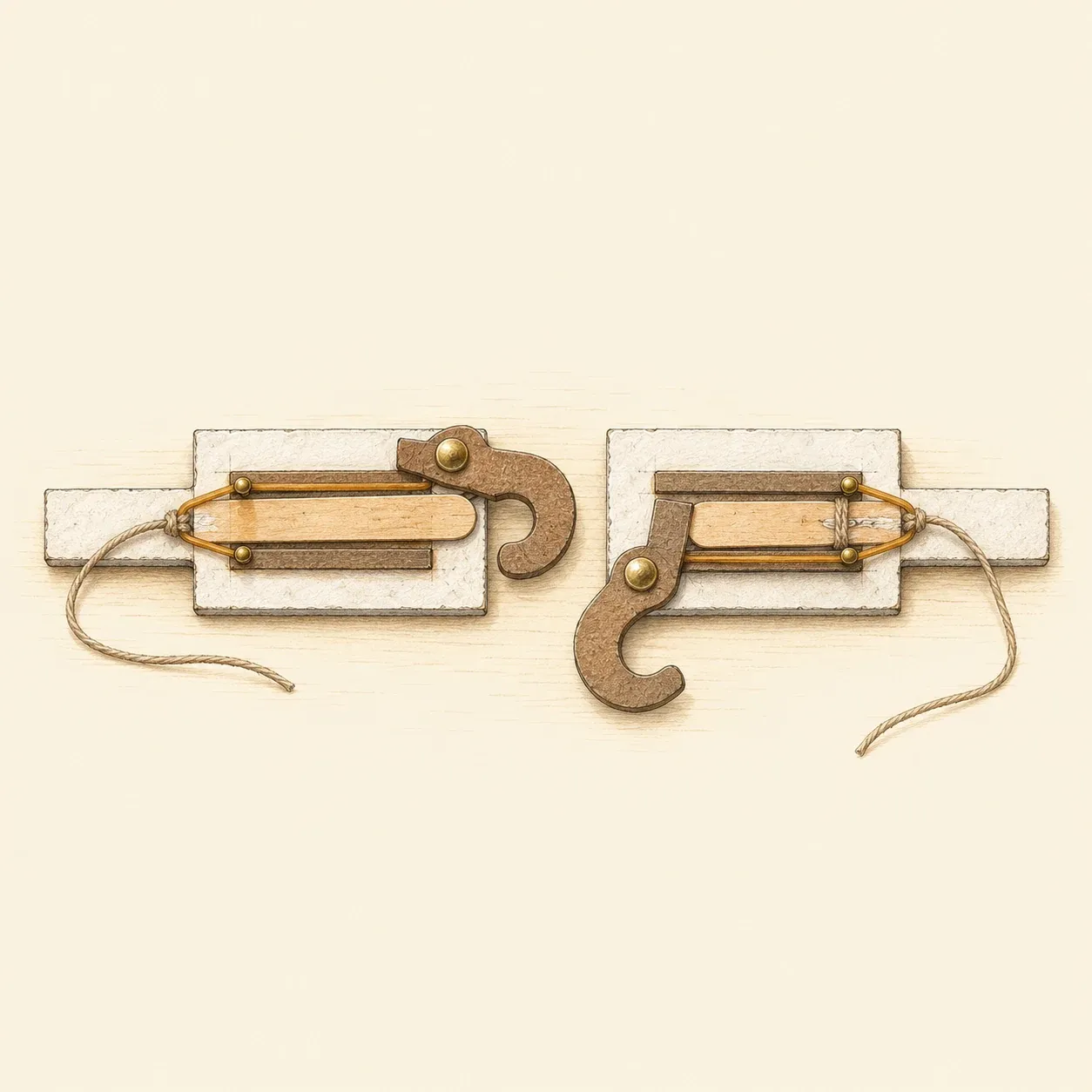 A craft stick pulled by a rubber band springs in behind the knuckle as it closes.
For each coupler, cut a head about 6 cm wide and 12 cm long, with a long shank at the back to hold it by. Cut a knuckle shaped like a thick letter C, with a short tail, and fix it to one front corner of the head with a paper fastener so that it can swing from wide open to closed across the front of the head. Glue two thin strips of card on the head to make a channel in which a craft stick can slide forward until its tip lies just behind the tail of the closed knuckle. Push two pins into the head on either side of the channel, near the front, and stretch a rubber band from them round the back of the stick, so that the band pulls the stick forward. Tie a string to the back of the stick as the uncoupling lever. Make a second, identical coupler. Laid face to face, the two heads meet with each knuckle opposite the other head.
Open one knuckle by pulling its string and swinging the knuckle out: its tail now holds the stick back. Lay both couplers on the table and push them together: the closed knuckle pushes the open one shut and its stick snaps in behind the tail. Pull the shanks apart: the couplers hold. Pull a string, and the knuckle is free to swing open as you draw the couplers apart.
History and evolution
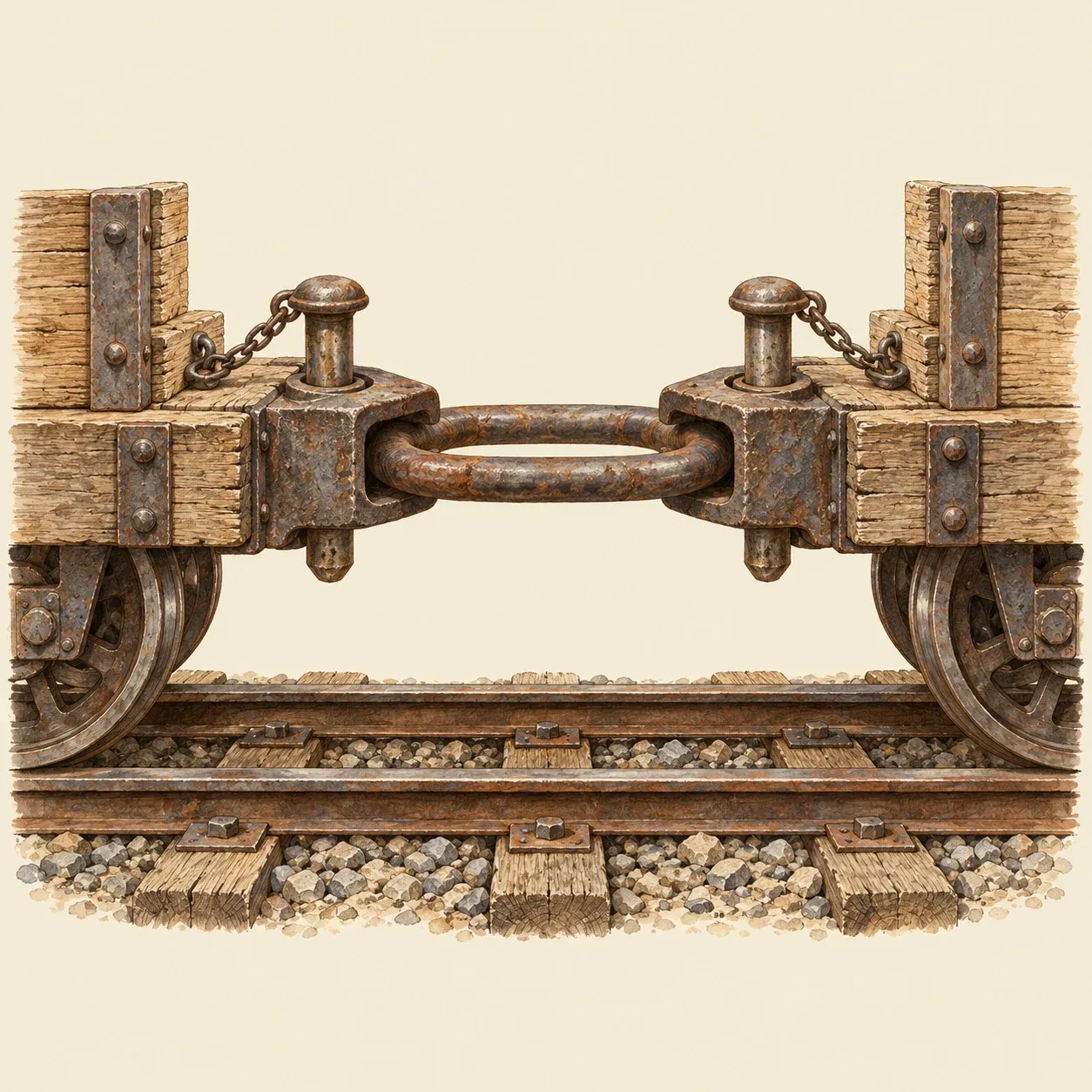 With link-and-pin couplers, a man had to stand between the cars to guide the link and drop the pin.
For decades nearly all American railways used link-and-pin couplers. They were cheap and simple, but they left slack between the cars and were dangerous for the men who coupled them. On 17 July 1847 William C. Bussey of Rock Grove, Illinois, patented a coupling that closed by itself: as one car ran against another, the head of a coupling bar entered the flared mouth of a cast-iron box, struck the tail of a notched tumbler and turned it against the neck of the bar, and a dog pushed by a spring or a weight dropped into the notch to hold it. Later, Daniel R. Pratt of Worcester, Massachusetts, patented a weighted hook that the link of the other car raised as it passed and then struck at its tail, turning it shut on the link; a cord from the platform or the roof of the car lifted it again. His patent names Bussey’s coupling as one of the best of the self-acting couplings invented before his own.
On 31 March 1863 Ezra Miller patented a coupling of two hooks that caught each other as the cars met and could be released from the platform of the car, so that nobody had to step between the cars. Several railways fitted Miller’s hook to their passenger cars, which seldom ran onto other companies’ lines, so that each railway could choose its own coupler for them.
Eli Janney, a Confederate veteran who worked as a store clerk near Alexandria, Virginia, received a first coupler patent in April 1868. His second, granted on 29 April 1873, described the knuckle: a rotating hook on the drawhead, struck by the hook of the other car and held closed by a spring catch until the lever was pulled. In the 1870s the Pennsylvania Railroad and its subsidiaries tested it and adopted it for their passenger cars. In 1888 the holders of Janney’s patents waived their rights to the contour of the knuckle, so that other makers could produce couplers that meshed with his, and the Master Car Builders’ Association recommended this type as the standard.
Freight cars changed more slowly, because they passed constantly from one railway to another, and the couplers of every railway had to fit those of the others. In the United States, the Safety Appliance Act of 1893 made couplers that couple automatically by impact, and can be uncoupled without men going between the ends of the cars, compulsory on cars in interstate traffic from 1 January 1898. That deadline was later extended by two years, to 1900. The same law also required power brakes on locomotives and on enough cars of each train. Couplers of the Janney type still join freight trains in North America.